 Skip to content

What Is Answer Engine Optimization (AEO)? A Complete Beginner’s Guide
What is answer engine optimization? A plain-English beginner's guide to AEO: what it means, how it differs from SEO, and how AI answer engines decide which brands to cite.
Quick Answer
Answer engine optimization (AEO) is the practice of optimising your content so AI answer engines cite, quote or recommend you. Unlike traditional SEO’s focus on ranked links, AEO targets inclusion in the generated answer itself, which depends on clarity, evidence and authority.
Answer engine optimization is the practice of preparing your content and brand so that AI answer engines, such as ChatGPT, Google AI Overviews, Perplexity, and Gemini, cite you inside the answers they generate. In plain terms, it is how you become one of the sources an AI names when someone asks it a question, rather than just one more blue link on a search results page. If you have heard the term AEO and wondered what it actually means for your business, this beginner’s guide explains it from the ground up, with no jargon assumed.
So what is answer engine optimization in practice? Understanding what is answer engine optimization starts with how AI answer engines choose who to cite.
Key Highlights
- AEO prepares your content and brand so AI engines cite you inside the answers they generate.
- It differs from SEO by targeting a citation in the answer, not a ranked link below it.
- It exists now because engines like ChatGPT, AI Overviews, Perplexity and Gemini answer directly.
- Engines cite sources they can retrieve, trust and extract a clean answer from.
- First steps: answer-first content, structured data, and consistent authority signals.
What is answer engine optimization, exactly?
Answer engine optimization is the work of making your content easy for an AI answer engine to find, trust, and quote. An answer engine is any tool that takes a question in normal language and replies with a single written answer instead of a list of links. When you ask ChatGPT to recommend software, or type a question into Google and see an AI Overview at the top, you are using an answer engine. Those systems pull information from across the web, decide which sources are reliable, and often name specific brands. AEO is how you influence whether your brand is one of them.
It helps to separate the term into its parts. An answer engine produces answers. Optimization means making yourself the preferred choice. Put together, AEO is the discipline of becoming the preferred source an answer engine reaches for. That is a different goal from ranking a page, and it needs its own approach.
People usually arrive at the question what is answer engine optimization after noticing that AI tools have started answering things they used to search for. The instinct is right: if an assistant is going to summarise your market and name a few providers, being one of those names is worth real money. AEO is simply the organised way to earn that spot, rather than hoping an engine stumbles onto you.
A quick example
Say you run a payroll software company. A prospect opens ChatGPT and asks, what is the best payroll tool for a 30-person company in India? The assistant replies with a short paragraph naming three products and a line on each. Notice what just happened. The prospect did not scroll a results page, compare ten links, or visit your competitors one by one. They read a single answer and formed a shortlist in seconds. If your product is named, you are in the running with almost no effort on the prospect’s part. If it is not, you were never considered, however good your website is. AEO is the work that decides which side of that line you land on.
How is AEO different from SEO?
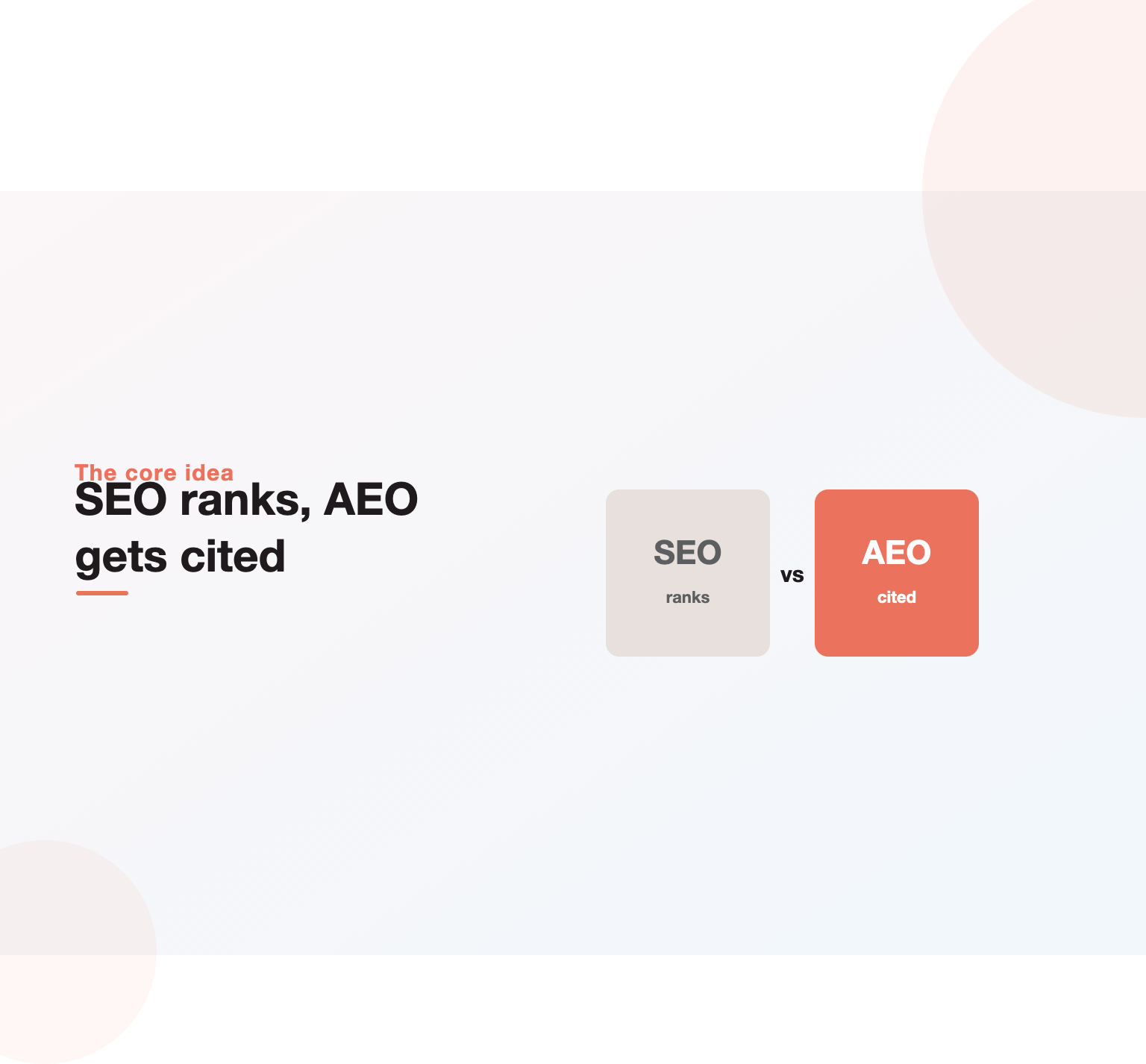
Search engine optimization aims to rank a page high enough that a person clicks it. AEO aims to be the source an AI quotes, whether or not anyone clicks. The two are related, because both reward clear, trustworthy content, but they measure success differently. In SEO you win when you hold position one and earn the visit. In AEO you win when the answer itself mentions you, which can happen even if your page sits lower in the classic results.
Here is a simple way to see the difference. Imagine a buyer asks an assistant, which project tools work well for a small team? A search engine would return ten links for the buyer to sift through. An answer engine returns a short paragraph that names three or four tools and briefly describes each. SEO fought to be one of those ten links. AEO fights to be one of the three or four names in the paragraph. The pillar guide on answer engine optimization covers the full picture, and how AEO works in 2026 explains the mechanics.
Why does AEO exist now?
AEO exists because the way people search has changed. For two decades the search results page was the front door to the web, and SEO was how you got noticed there. Now a growing share of questions are answered directly by AI, before anyone reaches a results page. That shift created a new place to be visible, the answer itself, and a new discipline to earn that visibility.
The change is not only about a new interface; it is about a new gatekeeper. On a results page the reader chose which links to trust. In an AI answer the engine has already made that judgement for them, deciding which sources are worth quoting before the reader sees anything. That moves the contest upstream. You are no longer only competing for a click; you are competing to be judged trustworthy enough to include. AEO is the response to that real change in behaviour, not a rebrand of SEO. Our explainer on why AEO matters for every business makes the business case in detail.
How do answer engines decide who to cite?
These engines look for sources they can trust and quote cleanly. Three things matter most. First, whether the engine recognises your brand as a real, credible entity, built from consistent information across the web. Second, whether your content is structured so a clear answer can be lifted from it without confusion. Third, whether other credible sources back up what you say, because engines are cautious about repeating a claim only one site makes. A page that answers the question in its first sentence, is written by a named expert, and agrees with other trusted sources is far more likely to be cited than a rambling, anonymous article.
- Authority: does the engine know and trust your brand?
- Structure: can it extract a clean answer from your page?
- Corroboration: do other credible sources agree with you?
It is worth understanding the mechanism a little more, because it explains why the three factors matter. Most answer engines do not simply recite what a model memorised during training. They search the live web for passages relevant to your question, feed the strongest passages to the model as context, and the model writes an answer grounded in that context, naming the sources it leaned on. This is called retrieval-augmented generation, and it means two separate gates sit between you and a citation. First your content has to be retrieved, which rewards clear relevance and clean structure. Then it has to be judged trustworthy enough to quote, which rewards authority and corroboration. A page can pass the first gate and fail the second, retrieved but skipped in favour of a source the engine trusts more, so both gates need attention.
Corroboration is the factor beginners underrate most. They are reluctant to state something that only one website claims, because a lone claim is a risk. When several independent, credible sources agree on a point, the point becomes safe to assert, and the site that states it most clearly tends to get named as the source. The practical lesson is counter-intuitive: being the clearest voice on a claim that others also support beats being the only voice on a claim nobody else makes.
What does AEO involve in practice?
For a beginner, AEO comes down to a handful of habits. Lead with the answer first, then explain, so the key point is easy to quote. Add structured data, or schema, which is code that labels what your content means so machines read it correctly. Put real, credentialed authors behind your content, since experience and expertise increasingly decide who gets trusted. Keep your brand information consistent everywhere it appears, so engines build an accurate picture of who you are. And keep content current, because answer engines favour fresh, maintained sources. None of these require a rebuild; most existing pages can be made citation-ready with focused edits.
Your first steps with AEO
If you want a concrete starting point rather than theory, work through a short loop you can repeat. It turns the whole idea into a manageable to-do list:
- List the ten questions your buyers most often ask before choosing, in their own words.
- For each, check the live answer in ChatGPT, Perplexity, and Google, and note who is cited today. Our AI citation readiness audit walks through this properly.
- Rewrite your matching page so it answers first, add the right schema, and attach a named author.
- Track whether citations appear over the following weeks, and move to the next question. The complete AEO checklist for 2026 and the framework in the ASE framework give you the fuller version.
This same discipline underpins the broader family of AI search work, from AI search optimization to generative engine optimization, so the habits you build here transfer directly.
Common misconceptions about AEO
Because the field is new, a few myths have taken hold. Clearing them up is part of answering what is answer engine optimization honestly:
- Adding an FAQ is not enough. Structured questions help, but without authority and corroboration an FAQ alone will not earn citations.
- Keyword stuffing backfires. Repeating a phrase works against you here, because the natural, confident language that engines quote is the opposite of repetition.
- Big brands hold no monopoly. Clarity and trust on a specific topic beat sheer size, which is good news for focused businesses.
- One-off effort fades. The engines re-evaluate constantly, so this is an ongoing practice rather than a project you finish.
Seen clearly, the discipline is less a trick and more a commitment to being genuinely useful, clearly structured, and demonstrably trustworthy, in a form machines can read.
How to know if your business needs AEO
Not every business needs to move at the same speed, so it helps to gauge your own exposure. Ask whether your buyers are the kind of people who now open an assistant to research options, which is increasingly true in software, professional services, finance, health, travel, and education. Ask whether your category involves comparison questions, best-of queries, or how-to research, because those are exactly the prompts answer engines love to summarise. And ask whether being left out of a recommendation would cost you real revenue.
If you answered yes to those, AEO is already relevant to you, not a future concern. A quick self-test is to open ChatGPT or Perplexity and ask the questions your best customers ask before they buy. If competitors are named and you are not, you have found both your gap and your opportunity. The good news is that the same questions reveal exactly which pages to improve first, which turns a vague worry into a concrete, short to-do list.
How AEO relates to GEO and AI Overviews
As you read about this field you will meet a few neighbouring terms, and it helps to place them. Generative engine optimization, or GEO, focuses specifically on generative AI surfaces and overlaps heavily with AEO; many practitioners treat them as two names for closely related work. AI Overviews are Google’s answer-engine feature, the summarised response that now sits above the traditional links for many searches. Voice search is the spoken version of the same behaviour, where a device reads a single answer aloud and there is no screen of links at all.
The useful takeaway is that these are surfaces and sub-disciplines within one broad shift: people want answers, and machines are increasingly the ones delivering them. AEO is the umbrella practice of earning your place in those answers wherever they appear. You do not need to master each surface separately on day one; the same foundations of authority, structure, and corroboration carry across all of them, which is why getting the fundamentals right pays off broadly rather than for one engine only.
What results can AEO realistically deliver?
It is fair to ask what you actually get for the effort. The honest answer is that AEO changes the kind of visibility you earn rather than simply adding traffic. When an answer engine names you, you receive a form of third-party endorsement at the moment a decision is forming, which tends to bring better-qualified enquiries because the person already arrived informed. You will often see branded searches rise, as people who saw you cited look you up by name afterwards.
What you should not expect is an overnight traffic spike or a single magic ranking. The gains compound: each question you win makes related questions easier to win, because citations cluster around sources an engine has already learned to trust. Set the expectation with your team accordingly. AEO is a durable position built over months, and once you hold it, a competitor has to displace an established default answer rather than simply outrank a page, which is a much harder thing to do. That durability, not a short-term bump, is the real return.
Does AEO replace SEO?
No. AEO sits alongside SEO and shares much of its foundation. The clean structure and genuine authority that earn AI citations also help you rank in classic search, and strong search visibility feeds the retrieval step that answer engines rely on. The practical approach is to keep doing solid SEO and add the AEO habits on top, weighting your effort toward how your particular buyers search. If most of your audience now starts with an AI assistant, AEO deserves more of your attention than it did a year ago, and the sooner you begin building citation history, the harder it becomes for a competitor to unseat you later.
We help businesses become the answer AI engines cite. If you want a clear read on your current AEO readiness and the gaps to close, our team can help.
What answer engine optimization does for a business in practice
It helps to ground the idea in outcomes, because understanding what is answer engine optimization is easier once you see what it changes. When an AI engine answers a buyer’s question and names your company as a source, three things happen at once: you earn visibility at the exact moment of need, you borrow the engine’s authority by being the one it chose to cite, and you often get a referral click from the small share of users who want to go deeper. Even when no click follows, the citation plants your brand in the answer the buyer trusts.
Consider a company that sells project-management software. A buyer asks an AI assistant which tool suits a small remote team, and the assistant recommends three options with reasons. Being one of those three, described accurately and favorably, is worth more than ranking tenth on a traditional results page that the buyer never scrolls to. That placement is what answer engine optimization is built to earn, and it is why brands are treating AI citations as a channel rather than a curiosity.
The compounding effect matters too. The engines lean on sources they have seen quoted and corroborated elsewhere, so early, consistent citations tend to beget more, and a brand that becomes a trusted source on a topic gets pulled into a widening set of related answers over time. That is the practical payoff behind the theory, and it is the reason the question is shifting from what is answer engine optimization to how quickly a business can start earning those mentions.
What answer engine optimization is built on
Underneath the concept sits a concrete set of techniques, and knowing them makes what is answer engine optimization far less abstract. The first is structure. These engines extract cleaner answers from content that leads with a direct response and then explains, uses clear headings, and keeps each section focused on one question, because well-structured pages are simply easier to quote without distortion.
The second is schema and machine-readability. Structured data tells an engine what a page is, who wrote it, and what entities it covers, which helps the model retrieve and trust the content. The third is authority and entities: engines are cautious about repeating a claim only one obscure site makes, so being recognized as a real entity, with a consistent presence across your site, reputable directories and third-party mentions, raises the odds of being cited. The fourth is freshness and accuracy, because engines re-evaluate constantly and quietly stop quoting sources that go stale or prove wrong.
None of these are exotic. They overlap heavily with good modern SEO and with plain clear writing, which is why teams with a strong content foundation adopt answer engine optimization faster than they expect. The shift is one of emphasis: writing and structuring so a machine can lift a trustworthy answer from your page, not just so a human can skim it, and pairing that with the entity and authority signals that make the machine comfortable naming you. Seen through those four levers, what is answer engine optimization becomes a checklist you can actually work rather than a buzzword.
How to tell whether your answer engine optimization is working
Because AI answers are harder to see than blue links, measuring answer engine optimization takes a slightly different toolkit. The most direct signal is citation tracking: monitoring whether ChatGPT, Google AI Overviews, Perplexity and Gemini mention your brand for the questions that matter to you, and how that share of voice moves over time. A growing citation rate on your priority questions is the clearest proof the work is landing.
Supporting signals help fill the picture. Referral traffic from AI engines, though small, shows up in analytics and tends to convert well because those visitors arrive already informed. Branded search often rises as AI mentions introduce your name to people who then look you up directly. And qualitative checks matter: periodically ask the engines your buyers’ questions yourself and read how, and whether, you are represented, because an inaccurate citation is a problem to fix, not a win. Track those together and you can judge answer engine optimization on evidence rather than faith, which is what turns it from an experiment into a managed channel with targets and accountability.
Which businesses gain most from answer engine optimization
Answer engine optimization is not equally valuable to everyone, and being honest about that is part of understanding what is answer engine optimization in the first place. The businesses that gain most are those whose buyers ask questions before they buy, because that is exactly where AI answers intercept the journey. Software and technology companies, professional and financial services, healthcare providers, education and any considered-purchase category all fit this pattern, since their customers research options, compare approaches and look for trustworthy guidance before committing.
Complex or high-value offerings benefit especially, because the more a buyer needs to understand before purchasing, the more AI assistants get used to shortcut that learning, and the more a well-placed citation shapes the shortlist. Business-to-business firms with long sales cycles see outsized value, since a single cited recommendation can influence a deal worth far more than any individual click. Local businesses have a version of this too, as people increasingly ask assistants for the best option near them, and being the cited answer to that question wins real customers.
The businesses that gain least are pure impulse-purchase or brand-loyalty plays where nobody asks an assistant for advice, and sites whose traffic depends on volume rather than trust. Even there, though, the direction of travel makes ignoring AI answers risky, because search behavior is shifting toward conversational queries across almost every category. For most companies selling something people research, the answer to who should invest is the same as the answer to what is answer engine optimization worth: if your buyers are already asking AI engines about your category, you cannot afford to be absent from the replies.
How answer engine optimization fits alongside your SEO
A common worry is that this is yet another discipline competing for budget, but answer engine optimization is better understood as an extension of good SEO than a replacement for it. The two share a foundation: quality content, clean structure, technical health and genuine authority all serve both a classic ranking and an AI citation. Work you do to become citable almost always strengthens your traditional rankings as well, so the effort compounds rather than splits.
The difference is emphasis and measurement. Classic SEO optimizes for a click from a results page; answer engine optimization optimizes for being quoted inside a generated answer, which means leaning harder on clear direct answers, entity signals and structured data, and tracking citations rather than only rankings. The practical move for most teams is not to build a separate program but to widen the existing one, adding the citation-focused techniques and metrics on top of the SEO they already run. Framed that way, the choice is not SEO versus AEO but SEO plus AEO, and the businesses that treat them as one connected effort are the ones showing up everywhere their buyers now look for answers.
If you take one idea away, let it be this: answer engine optimization is not a separate future to prepare for, it is the present shape of how a growing share of buyers already find and vet the companies they consider. The mechanics can be learned, the results can be measured, and the work overlaps with things a good marketing team already values. The businesses that start now, structuring content to be quoted, earning the entity signals engines trust, and tracking their citations the way they once tracked rankings, are quietly building a presence in the answers their competitors have not yet thought to claim. That head start compounds, because the sources engines cite today are the ones they lean on tomorrow. Getting into that set early, while the category is still forming, is the single highest-leverage move most brands can make in AI search right now, and the cost of waiting is watching a competitor become the cited answer instead.
Key Takeaways
- Understand AEO as optimising for citations, not just rankings.
- Start by making key pages answer-first and well-evidenced.
- Build genuine authority so engines trust your content.
- Measure whether engines cite you for priority questions.
Frequently asked questions
What is answer engine optimization in one sentence?
It is the practice of structuring your content and brand so AI answer engines cite you inside the answers they generate, rather than only listing your page in classic search results.
Is AEO the same as SEO?
No. SEO optimises to rank a page and earn a click; AEO optimises to be the source an AI answer quotes. They share a foundation but reward different outcomes, and most businesses now benefit from doing both.
Which tools count as answer engines?
Google AI Overviews, ChatGPT with search, Perplexity, Microsoft Copilot, and Gemini are the main ones today. Any tool that returns a written answer instead of a list of links is an answer engine.
Do I need technical skills to start with AEO?
Not to begin. Answering questions clearly and first, adding basic schema, and showing real authorship get you a long way. Deeper technical and entity work helps as you scale, and is where a specialist can add value.
How quickly does AEO work?
Structural improvements can influence citations within weeks, while the authority and entity signals that make you a default source build over months of consistent effort.
Can a small business get cited by AI engines?
Yes. Answer engines reward the clearest, best-supported answer on a specific topic, so a focused small business often gets cited ahead of a larger brand that covers the subject vaguely.
Ready to put this into practice?
Talk to the team that runs SEO, AI search and paid growth programs every day.
Book a Strategy Call →