 Skip to content

Google Ads Campaign Types: Which One to Use and When
Google Ads campaign types explained: Search, Performance Max, Shopping, Display, Video, Demand Gen and App, what each is for, when to use it, and how to combine them into a funnel.
Quick Answer
Google Ads campaign types are the different formats of advertising you can run across Google’s networks, each built for a different goal, audience and stage of the buying journey. The main campaign types are Search, text ads on the results page that capture active demand; Performance Max, an automated type spanning every Google surface; Shopping, product listings for retailers; Display, visual ads across millions of websites and apps; Video, ads on YouTube; Demand Gen, visual ads across YouTube, Discover and Gmail; and App, for driving app installs and engagement. Choosing the right campaign types matters because each behaves differently, costs differently and suits a different objective, so running the wrong type for your goal wastes budget while the right mix reaches the right people at the right moment. Search captures people already looking for what you sell, making it the most direct for demand capture, while Display and Video build awareness earlier in the journey. This guide explains each of the main formats, what each is for, when to use it, and how to combine them into a strategy that fits your goals and budget.
Key Highlights
- Google Ads campaign types are distinct ad formats, Search, Performance Max, Shopping, Display, Video, Demand Gen and App, each built for a different goal.
- By capturing active demand from people already looking, Search is the most direct type for driving conversions.
- Awareness types like Display and Video reach people earlier in the journey and convert at lower rates, serving upper-funnel goals.
- Shopping and Performance Max suit retailers, using a product feed to sell across Google’s surfaces with heavy automation.
- The right choice depends on your goal, audience and budget, since running the wrong campaign type for the objective wastes spend.
- Most mature accounts combine several campaign types into a funnel rather than relying on a single one.
Search: capturing active demand
Search sits at the foundation of most accounts as the type that captures existing demand most directly. They show text ads to people actively searching for keywords you target, which means they reach buyers at the exact moment of intent, when someone types a query looking for a product, service or solution. Because that intent is so strong, it is usually the most efficient type for driving conversions and the first campaign most advertisers should run, since it puts your ad in front of people already trying to find what you offer rather than interrupting them.
The strength of Search is also its limit: it can only reach people who are already searching, so it captures demand rather than creating it. That makes it essential but not sufficient for businesses that also need to build awareness among people not yet looking. Of all the Google Ads campaign types, Search is where nearly every account should start, because it delivers the clearest, most measurable return, and mastering it, tight keywords, strong ads, disciplined negatives, well managed bidding, is the groundwork for everything else, the core of what a serious Google Ads management engagement builds first.
Performance Max campaigns
Performance Max is the automated, cross-channel type that runs across every Google surface, Search, Shopping, Display, YouTube, Gmail, Maps and Discover, from a single campaign. Instead of choosing placements yourself, you supply assets and a conversion goal, and the automation decides where and when to show ads to hit that goal. This makes it powerful for reach and for retailers with a product feed, but it trades manual control and placement visibility for that automated reach, so it rewards strong assets and clean conversion data while frustrating advertisers who expect the granular control of a Search campaign.
Within the automated Google Ads campaign types, Performance Max suits advertisers with clear goals and enough conversion volume to feed the automation, and it works best run alongside Search rather than as a replacement for it. Used carelessly it can absorb branded traffic and low-value placements, so it needs guardrails like brand exclusions and parallel Search campaigns for important keywords. For advertisers who set it up well, it can drive incremental conversions across channels a single-network campaign would miss, which is why it has become a central part of many accounts, and why our dedicated Performance Max campaigns guide covers keeping control of it in depth.
Shopping campaigns
Shopping campaigns are built for retailers and show product listings, with an image, price and store name, directly in search results when people look for products. Rather than targeting keywords, they draw on a product feed that describes your inventory, and Google matches those products to relevant searches, so the quality of the feed largely determines performance. For an ecommerce business, Shopping is often one of the most efficient formats available, and for many retailers it quietly becomes the single largest source of profitable sales in the account, because it puts the actual product, priced and pictured, in front of someone searching for exactly that kind of item.
Success with Shopping rests on the feed and the structure around it. A complete, accurate, well-optimized feed, good titles, correct attributes, clear images, competitive pricing, is what lets the campaign match to the right searches and compete, whereas a neglected feed caps performance no matter how the campaign is managed. Many retailers now run Shopping inventory through Performance Max as well, blurring the line between the two formats, but the underlying discipline is the same: a strong feed is the foundation. Getting Shopping right is central to ecommerce PPC management, where product-level economics decide whether the spend pays.
The Display network
The Display network shows visual ads, images and banners, across the vast set of websites, apps and videos that partner with Google, reaching people as they browse rather than as they search. Because these people are not actively looking for your product at that moment, it is an awareness and consideration type more than a direct-response one, and it typically converts at lower rates than Search, so judging it by the same cost-per-conversion target sets it up to look like a failure. Its value is in reach, building familiarity, and staying visible to audiences earlier in their journey. A person who has seen your brand across the sites they browse is more likely to click your Search ad and more likely to trust you when they finally compare options, so the payoff shows up in other campaigns rather than in the Display numbers themselves, which is exactly why it must be judged on its own terms.
This format earns its place when used for the right goals and audiences. It is particularly effective for remarketing, showing ads to people who already visited your site, keeping your brand in front of them as they continue browsing and gently pulling them back, which tends to be far more efficient than untargeted display. As a format, Display works best as part of a funnel, building awareness and re-engaging visitors, rather than as a standalone demand-capture channel, and setting realistic expectations for it, upper-funnel metrics, not immediate conversions, is what keeps it from being wrongly judged a waste.
Video on YouTube
Video campaigns place ads on YouTube and across Google’s video partners, letting you reach people with the engagement and storytelling that only video allows. Like Display, Video sits mostly in the awareness and consideration stages, since viewers are usually watching content rather than shopping, so it builds brand, tells a story and reaches audiences earlier in their journey rather than capturing immediate demand. For businesses that benefit from demonstration, emotion or explanation, video’s richer format can do things text and static images cannot, which is why a product that benefits from being shown in motion often finds Video its most persuasive channel.
The keys to Video are targeting and creative. Reaching the right audience, by interest, demographics, or as remarketing to past visitors, an approach that pays off across verticals from retail to Google Ads for contractors, and pairing that with a compelling video suited to the format keeps spend efficient, whereas broad, untargeted video with a weak creative burns budget for little return. As a format, Video is a powerful upper-funnel tool when a business has the creative to use it well and judges it by awareness and engagement rather than last-click conversions, and it increasingly overlaps with Demand Gen, which packages YouTube alongside other visual surfaces for a similar purpose.
Demand Gen and App campaigns
Demand Gen campaigns run visual, social-style ads across YouTube, Discover and Gmail, designed to create demand among audiences in a browsing, discovery mindset rather than an active-search one. They blend the reach of Display and Video with formats suited to visual, feed-based surfaces, and they suit brands that want to generate interest and consideration with strong imagery and audience targeting. Of the awareness-oriented formats, Demand Gen has become the way many advertisers reach Google’s most engaging visual placements in a single, goal-driven campaign.
App campaigns serve a narrower, specific purpose: promoting a mobile app to drive installs and in-app actions. They automate placement across Search, Play, YouTube, Display and Discover, using your assets and a goal like installs or in-app conversions, so the system finds the users most likely to install and engage. For any business whose product is an app, whether a consumer utility or a niche tool like those behind SaaS paid search, this type is the dedicated tool for growth, and while most advertisers will never need it, those who do find it the most efficient way to acquire users. Knowing which of these specialized campaign types applies to your situation prevents both wasted effort and missed opportunity, a judgment that experienced management makes routinely across verticals like Google Ads for SaaS.
Matching campaign types to your goal
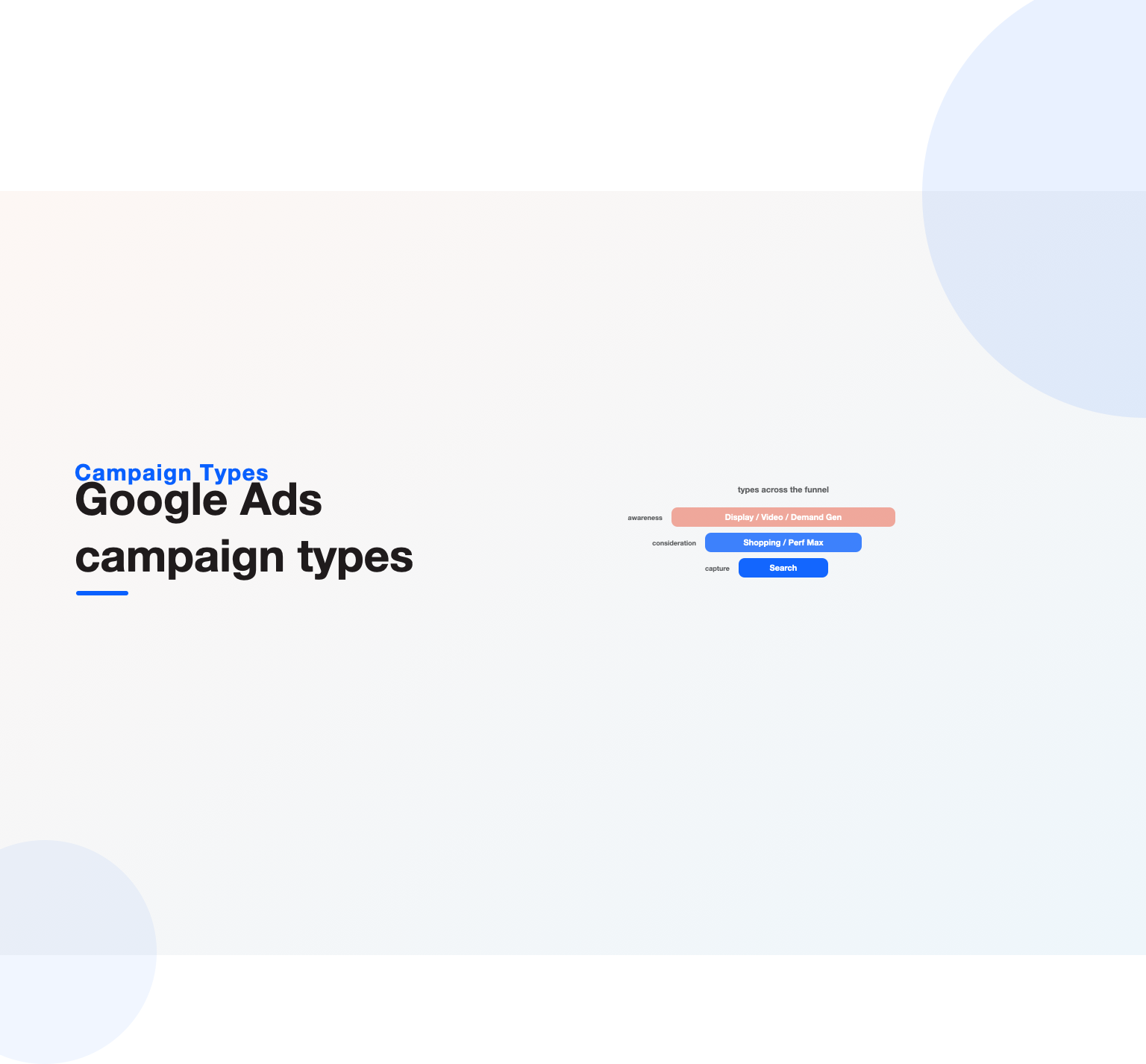
With the options understood, choosing among Google Ads campaign types comes down to your goal, audience and stage in the funnel. If you want to capture existing demand and drive conversions directly, Search is the starting point; if you sell products online, Shopping and Performance Max put your inventory in front of buyers; if you want to build awareness among people not yet searching, Display, Video and Demand Gen reach them earlier; and if your product is an app, App campaigns are the dedicated tool. The type should follow the objective, not the other way around.
Budget shapes the choice too. With a limited budget, concentrating on the type that captures the most valuable demand, usually Search for direct response, before expanding into upper-funnel types is the disciplined path, since spreading a small budget thinly across many campaign types starves each of the data and reach it needs. As budget and maturity grow, adding types to build a fuller funnel makes sense, but the sequence matters, and planning it against a realistic Google Ads budget keeps the expansion grounded rather than scattering spend across formats that cannot yet be funded properly.
Combining campaign types into a funnel
Mature accounts rarely rely on a single type; they combine several Google Ads campaign types into a funnel that reaches people at each stage of their journey. Upper-funnel types, Display, Video and Demand Gen, build awareness and reach new audiences; Search captures the demand that awareness helps create, along with existing demand; and remarketing through Display or other types re-engages people who showed interest but did not convert. Orchestrated well, these types reinforce one another, with awareness campaigns feeding demand that Search and remarketing then capture.
The art is in coordination and measurement. Because upper-funnel types rarely earn last-click credit, judging them by the same metric as Search undervalues their contribution, so understanding how the types work together, and measuring their combined effect through sound marketing attribution, is what makes a multi-type strategy pay off. Building this funnel is a progression, not a starting point: most accounts begin with Search, prove it, then layer in other campaign types as budget and understanding grow. Combining types thoughtfully, each doing the job it is built for, is how larger accounts build durable, compounding performance rather than depending on a single channel.
Targeting differs across campaign types
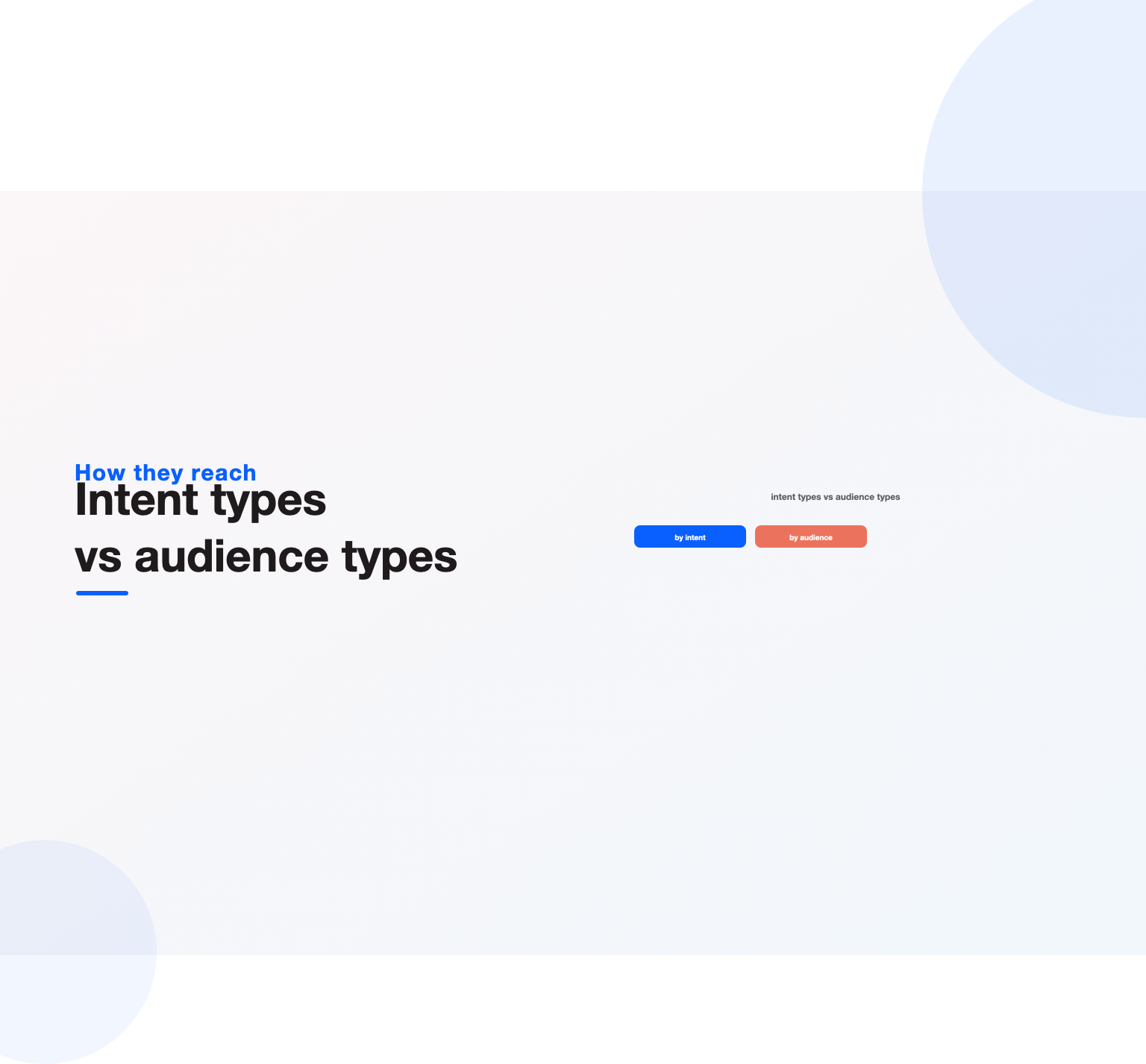
One reason the types are not interchangeable is that they reach people in fundamentally different ways, and understanding that shapes how you use each. Demand-capture types work from intent: a Search campaign targets the keywords people type, and a Shopping campaign matches products to those queries, so both reach people who are actively looking. The awareness types work from audiences instead: Display, Video and Demand Gen target people by their interests, demographics, behaviors or their past interaction with your site, reaching them while they browse rather than while they search.
This distinction matters because it changes what good targeting looks like. On the intent-driven types, precision comes from keywords, match types and negatives that control which searches trigger your ads; on the audience-driven types, precision comes from choosing the right segments and, often, from remarketing to people who already showed interest. Trying to run an audience type with a search mindset, or the reverse, leads to poor targeting and wasted spend, so respecting how each type finds people is part of using it well. The most reliable audience across the visual types is usually your own past visitors, which is why remarketing tends to be the most efficient use of Display and Video, a pattern that holds across verticals from retail to Google Ads for real estate agents.
Measuring each type by the right metric
Because the types serve different stages, judging them all by the same number is one of the most expensive mistakes an advertiser can make. Demand-capture types like Search and Shopping can fairly be judged on cost per conversion and return, since they are meant to drive action directly and usually earn last-click credit. Awareness types like Display and Video rarely earn that last click, because their job is to build familiarity and interest that pays off later, so holding them to a Search campaign’s cost per conversion makes them look like failures and tempts advertisers to cut the very campaigns feeding their funnel.
The fix is to measure each type against the goal it was chosen for. Awareness campaigns should be judged on reach, engagement, assisted conversions and their effect on overall demand, while direct-response campaigns are judged on immediate return, and the whole account is judged on blended results rather than any single campaign’s last-click number. Setting these expectations before launch, and reading performance through that lens with sound Google Ads conversion tracking behind it, keeps a multi-type strategy honest and prevents the false conclusion that upper-funnel spend is wasted when it is actually doing its job.
Budgeting across the types
Once you run more than one type, the budget question becomes how to split spend among them, and it does not follow a fixed formula so much as a priority order. The demand-capture types usually earn the first and largest share, because they convert most directly and give the clearest return, so a Search campaign, and Shopping for retailers, typically anchors the budget. Awareness types are funded from what remains once the direct-response work is properly resourced, since starving Search to fund Display rarely pays, whereas building awareness on top of a solid capture layer compounds.
The split also shifts as an account matures. Early on, almost all budget belongs on the highest-intent type until it is proven and scaled; later, as the capture layer saturates and further spend there yields less, moving budget into upper-funnel types to grow demand becomes the better return. Reading where additional spend earns the most, and moving budget toward it, is a continuous exercise rather than a one-time allocation, and doing it well ties directly to the discipline in our Google Ads budget guide and the ongoing Google Ads optimization that keeps every type earning its share, whether for a lead-generation account or a retailer running Google Ads for B2B companies.
Common mistakes with campaign types
Several recurring errors keep advertisers from getting the best from the different types. The most common is judging every campaign type by the same last-click conversion metric, which makes upper-funnel Display and Video look like failures and leads advertisers to cut the awareness that feeds their whole funnel. Close behind is spreading a limited budget across too many campaign types at once, starving each of the data and reach it needs, when concentrating on the highest-value type first would serve them better. Choosing a type that does not match the goal, running Display for direct response, say, wastes spend on a mismatch.
Other frequent mistakes include neglecting the product feed on Shopping and Performance Max, letting Performance Max run without guardrails so it absorbs branded traffic, using Video without the creative to make it work, and treating the formats as interchangeable rather than distinct tools with distinct purposes. The thread through these errors is failing to respect that each type is built for a specific job and stage. Advertisers who match types to goals, sequence them sensibly as budget allows, and judge each by the right metric get a coordinated strategy that performs, while those who run the wrong types for the wrong goals waste budget, a pattern our Google Ads audit reliably surfaces.
When to get help with campaign strategy
A capable marketer can run the core Google Ads campaign types, especially Search, by following the principles here, matching type to goal, sequencing by budget, and judging each by the right metric. For a smaller account focused on capturing demand, starting with Search and managing it well is entirely realistic and builds a strong foundation of understanding. The essential judgment, which type for which goal, is more about clear thinking than technical difficulty, and a diligent owner can make it well.
Expert help pays off as accounts add types and complexity, when coordinating a full funnel across several campaign types requires balancing goals, budgets and measurement that a generalist finds hard to manage, or when specialized types like Performance Max and Shopping demand feed and automation expertise. An experienced practitioner selects and sequences types with a feel for how they behave together, sets realistic expectations for each, and measures their combined effect, so folding campaign strategy into ongoing Google Ads services often lifts results across the whole account. Whichever route you take, the essentials stay the same: start with the type that captures your most valuable demand, add others to build a funnel as budget allows, match each type to its goal, and judge each by the metric that fits it.
A final point ties the whole picture together: the types are means to an end, not a checklist to complete. Success does not come from running every type Google offers, but from choosing the ones that serve your goals and running each well, which for many businesses means a strong Search foundation plus one or two others rather than the full set. Resisting the pull to be everywhere before the fundamentals are solid, and adding types deliberately as goals and budget justify them, is what turns a collection of campaigns into a coherent strategy, and it is the judgment that separates accounts that spend efficiently from those that spread themselves thin, the same judgment a careful Google Ads audit is built to apply.
Key Takeaways
- Google Ads campaign types, Search, Performance Max, Shopping, Display, Video, Demand Gen and App, are distinct tools built for distinct goals.
- Search captures active demand most directly, making it the starting point for nearly every account.
- Shopping and Performance Max suit retailers with a product feed, while Display, Video and Demand Gen build upper-funnel awareness.
- Match the campaign type to your goal, audience and stage, since running the wrong type for the objective wastes budget.
- Judge upper-funnel types by awareness and assisted conversions, not last-click, or you will wrongly cut what feeds the funnel.
- Start with the highest-value type and combine others into a funnel as budget grows, applying the discipline a Google Ads optimization routine demands.
Frequently asked questions
What are the different Google Ads campaign types?
The main Google Ads campaign types are Search, text ads on the results page that capture active demand; Performance Max, an automated type spanning every Google surface; Shopping, product listings for retailers driven by a feed; Display, visual ads across millions of websites and apps; Video, ads on YouTube and video partners; Demand Gen, visual ads across YouTube, Discover and Gmail; and App, for driving app installs and engagement. Each is built for a different goal, audience and stage of the buying journey, from capturing existing demand with Search to building awareness with Display and Video. Choosing the right type, or mix of types, for your objective is what makes an account efficient.
Which Google Ads campaign type is best?
There is no single best type; the right one depends on your goal. For capturing existing demand and driving conversions directly, Search is usually best, because it reaches people actively looking for what you sell, which is why most accounts start there. For retailers, Shopping and Performance Max put products in front of buyers efficiently. For building awareness among people not yet searching, Display, Video and Demand Gen reach them earlier in the journey. For promoting a mobile app, App campaigns are the dedicated tool. Rather than seeking a single best type, match the type to your objective, and as you grow, combine several into a funnel.
What is the difference between Search and Display campaigns?
These campaigns show text ads to people actively searching for keywords you target, reaching them at the moment of intent, which makes Search a direct-response type that typically drives conversions efficiently. A Display campaign shows visual ads across websites, apps and videos to people as they browse, not as they search, so Display reaches audiences earlier in their journey and builds awareness rather than capturing immediate demand. Because Display viewers are not actively looking, it converts at lower rates and should be judged by awareness and assisted conversions, not the same last-click cost per conversion as Search. Display is especially effective for remarketing to people who already visited your site.
Should I use Performance Max or Search campaigns?
For most advertisers the answer is both, not one or the other. A Search campaign gives you direct control over your most valuable high-intent keywords and clear visibility into what is working, so it remains the foundation. Performance Max adds automated reach across every Google surface and is especially strong for retailers with a product feed, capturing incremental conversions a single-network campaign would miss. The effective pattern is to run Search for your important keywords and Performance Max for broad automated reach, with brand exclusions so Performance Max does not simply absorb your branded searches. Running them together, with guardrails, gives you both control where it matters and automated reach where it helps.
How many campaign types should I run?
Start with one, usually Search, and add more only as budget and maturity allow. Spreading a limited budget across many campaign types at once starves each of the data and reach it needs to perform, so concentrating on the type that captures your most valuable demand first is the disciplined path. As budget grows and you have proven your foundation, layering in additional types, Shopping for products, Display and Video for awareness, remarketing to re-engage visitors, builds a fuller funnel. The number of types you run should match the budget available to fund each properly, not an ambition to be everywhere before you can afford it.
Do I need Display and Video campaigns?
Not necessarily, and not at first. These are upper-funnel types that build awareness and consideration among people not yet searching, so they serve businesses that need to create demand or stay visible to audiences earlier in their journey. If your priority is capturing existing demand efficiently, Search and, for retailers, Shopping deliver that more directly, and many smaller accounts run those alone quite successfully. Display and Video become valuable as you grow and want to build awareness, re-engage past visitors through remarketing, or use video’s richer format to demonstrate and explain. Add them when you have the budget and the goal that fits, not before.
Ready to put this into practice?
Talk to the team that runs SEO, AI search and paid growth programs every day.
Book a Strategy Call →