 Skip to content

Google Ads Bidding Strategies: Which One to Choose
Google Ads bidding strategies explained: manual vs smart bidding, target CPA, target ROAS, maximize conversions and value, plus how to match a strategy to your goal and data.
Quick Answer
Google Ads bidding strategies are the methods you choose for how much to bid in the ad auction, and picking the right one is one of the biggest levers over what your campaigns cost and how many conversions they produce. They fall into two broad families: manual approaches, where you set bids yourself and keep full control, and automated or smart bidding, where Google sets bids in real time using signals about each auction to hit a goal you define, such as a target cost per acquisition, a target return on ad spend, maximizing conversions, or maximizing conversion value. The right choice depends on your goal, how much conversion data you have, and how much control you want to keep. Automated bidding strategies can outperform manual management when they have clean, plentiful conversion data to learn from, because they adjust to signals no human could process in real time, but they optimize toward whatever you feed them, so accurate conversion tracking is a prerequisite. This guide explains the main bidding strategies, how each works, when to use them, and how to choose and manage the one that fits your campaign.
Key Highlights
- Google Ads bidding strategies fall into manual, where you control bids, and automated smart bidding, where Google sets them toward a goal.
- Smart bidding uses real-time auction signals to optimize toward a target, and can beat manual management when it has enough clean conversion data.
- Every automated strategy optimizes toward whatever conversions you feed it, so accurate conversion tracking is a prerequisite, not an option.
- Target cost per acquisition and target return on ad spend suit accounts with clear efficiency goals and solid conversion volume.
- Maximize conversions or conversion value suit growth within a fixed budget, while manual bidding suits thin data or tight control.
- Choosing a strategy is not permanent, and matching it to your goal, data and stage is an ongoing decision, not a one-time setting.
Manual versus automated bidding
The first and biggest choice among bidding strategies is whether to set bids yourself or hand the job to Google’s automation, and understanding the trade-off is the foundation for everything else. The manual approach gives you complete control over how much you pay for each keyword, which is valuable when you have specific knowledge the automation lacks, or when an account has too little conversion data for automation to learn from, but it demands constant attention and cannot adjust bids for the individual signals of each auction. Automation gives up that granular control in exchange for real-time optimization the automation performs at a scale and speed no person can match.
The reason automation has become dominant is the signals it can act on. Google sets bids using a vast range of real-time information about each auction, the searcher’s device, location, time, context and much more, adjusting the bid up or down for the specific likelihood of conversion in that exact moment, which manual bidding simply cannot do. When an account has enough clean conversion data for the system to learn from, this real-time responsiveness usually produces better results than manual management, which is why automated bidding strategies are the default for most mature accounts and a core focus of professional Google Ads management. The catch, always, is that the automation is only as good as the conversion data feeding it, which is why the data comes before the strategy every time.
Why conversion data comes first
Before any automated strategy can work, the account needs accurate conversion tracking, because smart bidding optimizes relentlessly toward the conversions you define and nothing else. Point it at broken, double-counted or misattributed conversions and it will confidently bid toward the wrong outcome, spending efficiently in pursuit of a goal that does not reflect real business value. This is why the very first step before choosing among automated bidding strategies is verifying that conversion tracking fires correctly and measures genuine value, work that a thorough Google Ads conversion tracking setup exists to guarantee.
Volume matters as much as accuracy. Smart bidding learns from conversion data, and a strategy starved of conversions, only a handful a month, never gathers enough signal to optimize well, so it stays stuck spending inefficiently in a prolonged learning state. This is why thin-data accounts often do better on manual or simpler bidding until conversion volume builds, and why concentrating budget to generate enough conversions matters so much. Choosing bidding strategies without first ensuring the conversion data is both accurate and plentiful is the most common way advertisers set automation up to fail, and it is the check any capable practitioner makes before touching bids, the same discipline a rigorous Google Ads audit enforces first.
How target CPA bidding works
The target cost per acquisition method is one of the most widely used automated bidding strategies, and it aims to get as many conversions as possible at a cost per conversion you specify. You tell Google the average amount you are willing to pay for a conversion, and the system bids on each auction to hit that target across the campaign, bidding higher when conversion looks likely and lower when it does not, so some conversions cost more and some less while the average lands near your target. This suits advertisers who know what a conversion is worth and want to control efficiency directly, and it pairs naturally with the disciplined creative testing of strong responsive search ads.
The strategy works best with steady conversion volume and a realistic target. Set the target far below what the market and your conversion rate allow, and the system cannot find enough conversions at that price, so volume collapses; set it sensibly, informed by your actual cost per acquisition and what a conversion is truly worth, and it can hold efficiency while the automation handles the auction-by-auction bidding. Among bidding strategies, target cost per acquisition is a strong default for lead-generation and other conversion-focused accounts with enough data, and getting the target right, neither too greedy nor too loose, is the main skill in running it, a balance that matters in considered-purchase accounts like Google Ads for B2B companies.
Bidding to a target return (tROAS)
The target return on ad spend method is the value-focused counterpart, designed for advertisers who track revenue per conversion and want to hit a specific return rather than a flat cost per conversion. Instead of treating every conversion as equal, it uses the values you feed it to bid more for conversions likely to be worth more, chasing a target ratio of revenue to spend, so a strategy set to a given return aims to generate that many dollars of value for every dollar spent. This makes it powerful for ecommerce and any account where conversion values vary meaningfully, because it lets the system concentrate spend on the orders and customers that actually move the bottom line rather than treating a small sale and a large one as the same win, which is a distinction flat cost-per-conversion bidding can never make and one that matters enormously wherever margins differ from product to product.
The prerequisite is accurate conversion values, not just conversion counts, because the strategy optimizes toward value it can only see if you provide it. An ecommerce account passing real revenue with each purchase gives the system what it needs to chase profit rather than volume, concentrating spend on the high-value conversions, whereas an account tracking only conversion counts cannot use this strategy meaningfully. Among bidding strategies, target return on ad spend is the natural choice for value-driven accounts with reliable value tracking, and it is one of the clearest examples of why conversion values, not just counts, are worth setting up, especially in ecommerce PPC management where margins hinge on it.
Maximize conversions and maximize conversion value
When the goal is to get the most out of a fixed budget rather than hit a specific efficiency target, the maximize strategies fit. Maximize conversions tells the system to get as many conversions as possible within your budget, spending the full budget to find the greatest number of conversions without regard to a specific cost per conversion, which suits advertisers who have a set budget and simply want the most conversions it can buy. Maximize conversion value does the same for value, spending the budget to generate the greatest total conversion value, which suits value-focused accounts with a fixed budget.
These strategies are straightforward but demand attention to the budget, because they will spend all of it. Since they optimize for volume or value within the budget rather than for a cost target, they can raise the average cost per conversion if the budget is generous relative to available demand, so they pair best with a budget sized deliberately, as our Google Ads budget guide describes. Both can also take an optional target, a cost per acquisition or return on ad spend, which effectively blends them toward the target strategies. Among bidding strategies, the maximize approaches are a sensible starting point when you have a fixed budget and clear conversion tracking but not yet a firm efficiency target to hold.
Manual and enhanced bidding
Despite the rise of automation, manual bidding and its lightly assisted variants still have a place, particularly for accounts that lack the conversion volume automation needs or that require tight control. With manual cost-per-click bidding you set and adjust bids at the keyword level yourself, which gives complete control and is sometimes the only workable option for a new account with no conversion history, though it demands ongoing attention and cannot respond to individual auction signals. For advertisers who want to keep manual control but gain a little automation, an enhanced option can adjust manual bids up or down based on the likelihood of conversion, a middle ground between full manual and full automation.
The honest view is that manual bidding is usually a stage rather than a destination. It makes sense while an account gathers the conversion data that automated bidding strategies need, or in the hands of an expert managing an unusual situation, but for most accounts the goal is to build enough clean conversion data to move to automation that outperforms manual management. Treating manual bidding as the on-ramp, used deliberately while volume builds and then handed off to automation once the data supports it, is how many successful accounts progress, and knowing when to make that transition is part of the judgment that experienced management brings, even in niche accounts such as Google Ads for SaaS.
Matching a strategy to your goal
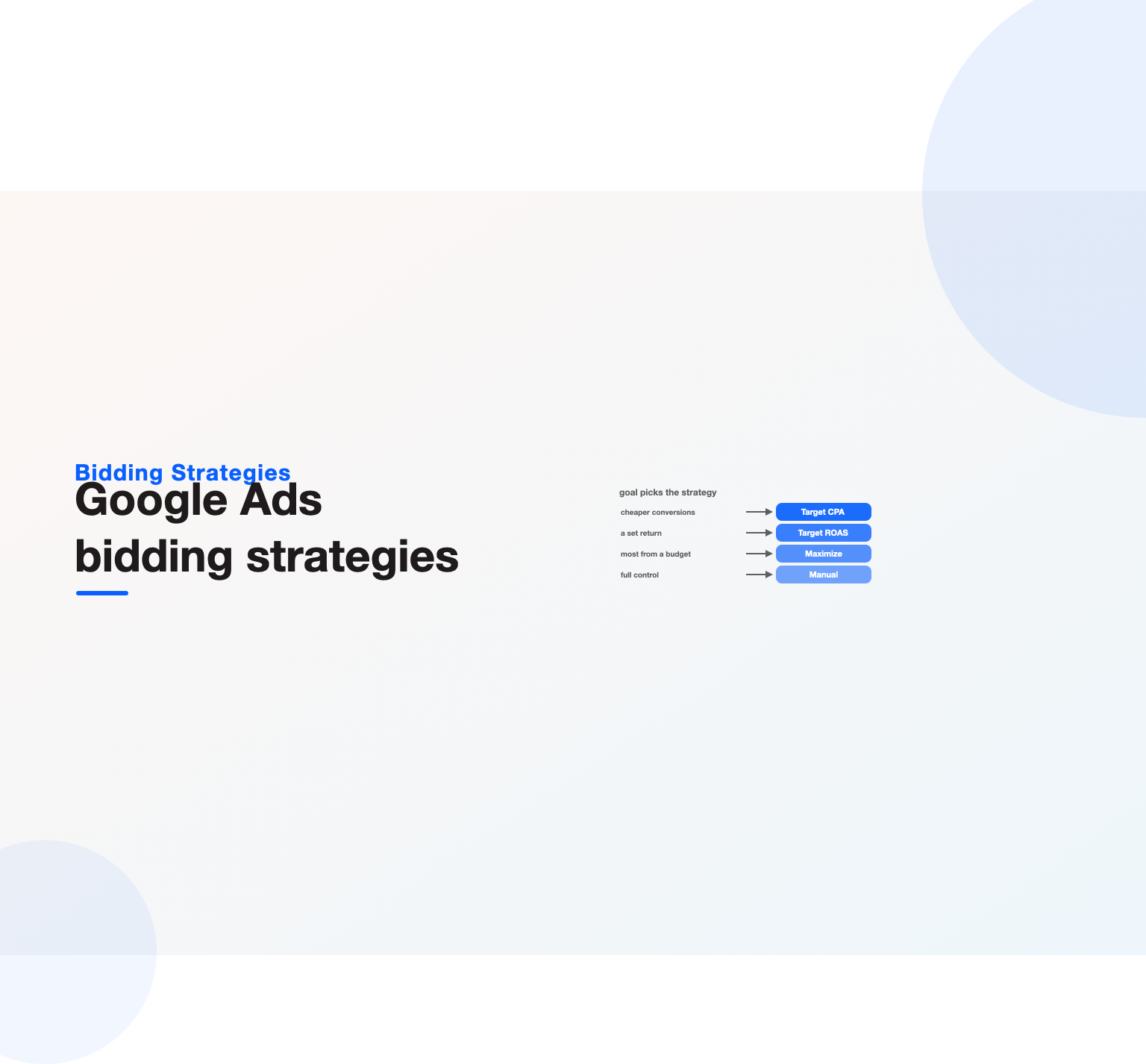
With the options understood, choosing among bidding strategies comes down to aligning the strategy with your goal, your data and your stage. If your aim is a specific cost per conversion and you have steady conversion volume, target cost per acquisition fits; if you track revenue values and want a specific return, target return on ad spend fits; if you have a fixed budget and want maximum volume or value, the maximize strategies fit; and if you lack conversion data or need tight control, manual bidding is the sensible starting point until volume builds. The strategy should follow the goal, not the other way around.
Getting this alignment right prevents most bidding disappointments. Advertisers who apply an advanced automated strategy to an account with too little data, or who chase an efficiency target on a strategy built for volume, end up frustrated by results that the mismatch, not the automation, caused. Thinking clearly about what you actually want, more conversions, cheaper conversions, more value, or a specific return, and choosing the strategy designed for it, is the single most important decision in bidding, and it reflects the same goal-first discipline that guides sound marketing attribution across the account.
Managing the learning period
Whenever you set or significantly change an automated strategy, it enters a learning period while the system gathers data and calibrates, and handling that period well matters as much as the choice of strategy. During learning, performance is often volatile and not yet representative, so the worst thing to do is panic at early swings and change the strategy again, which only resets the learning and prolongs the instability. Giving the strategy time and enough conversions to exit learning before judging it is a discipline that many advertisers lack, to their cost.
Stability during learning comes from restraint and adequate data. Avoiding frequent large changes, letting the campaign accumulate the conversions the system needs, and resisting the urge to intervene at every wobble all help the strategy settle into effective performance. Once it has learned, ongoing management is lighter but not absent, monitoring that it continues to hit the goal, adjusting targets as the market shifts, and stepping in when performance genuinely drifts rather than at every fluctuation. Handling the learning period with patience is what lets automated bidding strategies deliver the results they are capable of, and it is a core part of the steady Google Ads optimization that keeps an account improving.
Bidding across multiple campaigns
Once an account runs several campaigns, the question is not only which strategy each uses but how they work together, because bidding strategies chosen in isolation can pull against one another. Portfolio approaches let you apply a single automated strategy across a group of campaigns, so the system optimizes toward a shared target across the whole group rather than each campaign separately, which can improve efficiency when campaigns share a goal and pool their conversion data. For accounts where individual campaigns are too thin to feed automation well, grouping them this way can give the system the combined volume it needs to learn.
The trade-off is control versus pooling. A shared strategy across campaigns smooths performance and helps low-volume campaigns, but it also means the system balances spend across them toward the shared goal, which may not match how you want budget distributed. Deciding whether to run bidding strategies per campaign or as a portfolio depends on whether your campaigns genuinely share a goal and whether pooling their data helps more than separate control would, a judgment that grows more important as an account scales into many campaigns, and one that skilled management weighs alongside the broader Google Ads budget plan, whether for a retailer running ecommerce PPC management or a service business.
Seasonality, adjustments and staying in control
Automated bidding does not mean hands-off, and one place active input still matters is around predictable swings in demand. When a known event, a sale, a peak season, a surge in buying, will briefly change conversion rates in a way the automation has not seen, a seasonality adjustment lets you tell the system to expect it, so it does not lag behind the change or overreact after it. Used sparingly for genuine, short, significant shifts, this keeps automated bidding strategies aligned with reality during the moments that matter most.
Beyond special events, staying in control means monitoring that a strategy continues to hit its goal and adjusting targets as the market moves. Costs rise, competition intensifies, and a target that was realistic six months ago may be choking volume now or leaving efficiency on the table, so revisiting targets periodically keeps the strategy honest. The point is that choosing an automated strategy hands over the auction-by-auction bidding, not the responsibility for the account, and the advertisers who get the most from automation are the ones who set it up well and then steer it, a stance that runs through disciplined Google Ads optimization in every vertical, including hands-on accounts like Google Ads for real estate agents.
Common bidding mistakes
Several recurring errors keep advertisers from getting the best from their bidding. The most damaging is running automated bidding on inaccurate or thin conversion data, which points the automation at the wrong goal or starves it of the signal it needs, guaranteeing poor results no matter which strategy is chosen. Close behind is setting unrealistic targets, a cost per acquisition far below what the market allows, or a return far above it, which chokes off volume as the system cannot find conversions at that price. Impatience during the learning period, changing strategies before they have settled, is another frequent and costly mistake.
Other common missteps include choosing a strategy that does not match the goal, using a volume strategy when efficiency is the aim or the reverse, neglecting the budget on a maximize strategy that will spend all of it, and treating the choice as permanent rather than revisiting it as the account matures. The thread through these errors is a failure to align strategy, data and goal, or to give automation the accurate data and patience it needs. Advertisers who ensure clean conversion data, choose the strategy that fits their goal, set realistic targets, and manage the learning period patiently get the results automated bidding strategies promise, while those who neglect these fundamentals blame the automation for problems of their own making, a diagnosis our Google Ads audit makes plain.
When to get help with bidding
Choosing and managing bidding strategies is within reach of a capable marketer who understands the options and their prerequisites, and for a smaller account, selecting a sensible strategy and managing it through the learning period is a realistic task that builds valuable understanding of how the auction works. The core decisions, match the strategy to the goal, ensure clean conversion data, set realistic targets, be patient during learning, are more about judgment than technical complexity, and a diligent owner can run them well.
Expert help pays off as accounts grow in size and complexity, when large budgets make small efficiency differences worth real money, when multiple campaigns each need the right strategy, or when the nuances of targets and learning periods start to matter more than a generalist can manage. An experienced practitioner, the kind running managed SaaS paid search daily, chooses strategies with a feel for how they behave, sets targets informed by real data, and manages the learning and ongoing adjustment as routine, so folding bidding management into ongoing Google Ads services often lifts results by more than the cost. Whichever route you take, the essentials of bidding strategies stay the same: ensure accurate, plentiful conversion data first, choose the strategy that matches your goal, set realistic targets, and manage the learning period with patience.
It is worth remembering that no bidding strategy compensates for weaknesses elsewhere in the account. The most sophisticated automation still bids into whatever ads, keywords and landing pages you have built, so a strong bidding choice sits on top of clean structure, sharp creative and relevant pages rather than replacing the need for them. Advertisers sometimes reach for a new strategy hoping it will rescue a struggling campaign, when the real problem is a weak landing page or an untargeted keyword set that no bid can fix. Treating bidding as one lever among several, chosen to fit a goal and managed with patience, rather than a magic switch, is the mindset that gets the most from it, and it keeps attention on the fundamentals that ultimately decide whether the spend pays off. Before raising bids, use Google Ads auction insights to confirm whether you are losing share to rank or to budget.
Key Takeaways
- Google Ads bidding strategies split into manual control and automated smart bidding, which optimizes toward a goal using real-time auction signals.
- Automated bidding needs accurate, plentiful conversion data first, because it optimizes relentlessly toward whatever conversions you feed it.
- Use target cost per acquisition for a specific cost goal and target return on ad spend when you track conversion values.
- Use maximize conversions or conversion value to get the most from a fixed budget, and manual bidding for thin data or tight control.
- Match the strategy to your goal, data and stage, and set realistic targets, since a mismatch, not the automation, causes most disappointments.
- Manage the learning period with patience, applying the ongoing discipline a Google Ads optimization routine demands.
Frequently asked questions
What are Google Ads bidding strategies?
Google Ads bidding strategies are the methods you choose for how much to bid in the ad auction. They fall into two families: manual bidding, where you set and adjust bids yourself for full control, and automated or smart bidding, where Google sets bids in real time using auction signals to hit a goal you define. The automated options include target cost per acquisition, target return on ad spend, maximize conversions and maximize conversion value, each suited to a different objective. The right choice depends on your goal, how much conversion data you have, and how much control you want. Because automation optimizes toward the conversions you define, accurate conversion tracking is a prerequisite for any smart bidding strategy.
Which Google Ads bidding strategy is best?
There is no single best strategy; the right one depends on your goal, data and stage. If you want a specific cost per conversion and have steady conversion volume, target cost per acquisition fits. If you track revenue values and want a specific return, target return on ad spend fits. If you have a fixed budget and want maximum volume or value, the maximize strategies fit. If you lack conversion data or need tight control, manual bidding is a sensible starting point until volume builds. The key is to match the strategy to what you actually want rather than adopting the most advanced option, since a mismatch causes most bidding disappointments.
Is automated bidding better than manual bidding?
Usually, when the conditions are right. Automated bidding sets bids using real-time signals about each auction, the searcher’s device, location, time and context, adjusting for the likelihood of conversion in ways no human can match, so with enough clean conversion data it typically outperforms manual management. However, it depends entirely on accurate, plentiful conversion data, and an account with too few conversions or broken tracking is often better on manual or simpler bidding until volume and data quality improve. Manual bidding is best seen as a stage used while an account gathers the conversion history that automation needs, then handed off once the data supports it.
What is target CPA bidding?
Target cost per acquisition is an automated strategy that aims to get as many conversions as possible at an average cost per conversion you specify. You tell Google what you are willing to pay for a conversion, and it bids on each auction to hold that average across the campaign, bidding higher where conversion looks likely and lower where it does not. It suits advertisers who know what a conversion is worth and want to control efficiency directly, and it works best with steady conversion volume and a realistic target. Set the target too low and volume collapses because the system cannot find conversions at that price; set it sensibly and it holds efficiency automatically.
What is target ROAS bidding?
Target return on ad spend is a value-focused automated strategy for advertisers who track revenue per conversion and want to hit a specific ratio of revenue to spend. Rather than treating conversions equally, it uses the values you provide to bid more for conversions likely to be worth more, aiming to generate a target amount of value for every dollar spent. It is powerful for ecommerce and any account where conversion values vary, but it requires accurate conversion values, not just counts, because it can only optimize toward value it can see. An account passing real revenue with each conversion can use it to chase profit; one tracking only counts cannot.
How long does the bidding learning period take?
It varies with how quickly a campaign accumulates conversions, but typically a strategy takes about one to two weeks to exit the learning period, sometimes longer for lower-volume accounts. During this time performance is often volatile and not yet representative, so the important discipline is patience: avoid changing the strategy or making large adjustments, which resets the learning and prolongs the instability. Let the campaign gather enough conversions for the system to calibrate before judging results. Accounts with higher conversion volume stabilize faster because the system gets the data it needs sooner, while thin-volume accounts take longer and may struggle to exit learning, a sign they may need more data or a simpler strategy.
Ready to put this into practice?
Talk to the team that runs SEO, AI search and paid growth programs every day.
Book a Strategy Call →