 Skip to content


AI Voice Agents: How They Work, What They Cost, and Published Prices Compared (2026)
AI voice agents explained: how they work, use cases and compliance, plus a comparison of published per-minute prices from Bolna, Retell, Bland, Aircall and more.
Quick Answer
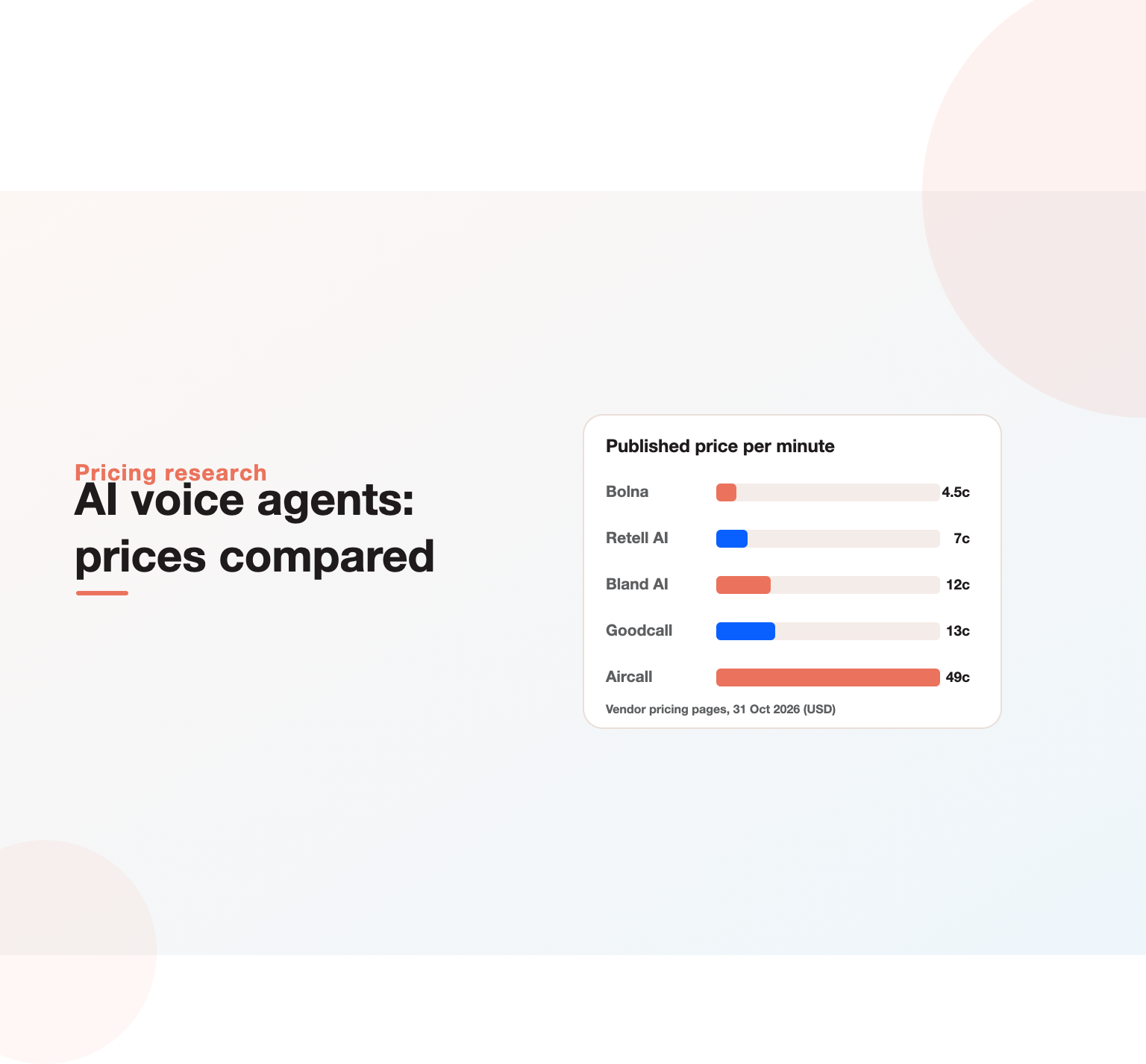
AI voice agents are software that answer and make phone calls using speech recognition, a large language model and a synthetic voice, so a caller can hold a natural conversation with no human on the line. Businesses use them for customer support, appointment booking, lead qualification and outbound follow-up. Pricing is now public for most platforms, and our comparison of published rates found a tenfold spread: from about 4.5 US cents a minute (Bolna, at volume) to 49 cents a minute (Aircall, pay as you go), with most developer platforms between 7 and 21 cents. That is roughly a tenth of what a live answering service costs per minute.
Key Highlights
- We compared the published per-minute prices of AI voice agent platforms on their own pricing pages on 31 October 2026.
- Prices range from about 0.045 to 0.49 US dollars a minute, a tenfold spread for broadly similar call minutes.
- India’s Bolna is the cheapest published rate at 6 US cents (INR 5.52) a minute, falling to 4.51 cents at volume.
- Mid-priced developer platforms such as Retell AI (0.07 to 0.31 dollars a minute) and Bland AI (0.12 to 0.14 dollars) sit in the middle.
- Business phone systems with built-in agents cost more: Aircall charges 0.49 dollars a minute pay as you go.
- Several enterprise vendors, including PolyAI and Sierra, publish no prices at all.
What are AI voice agents?
An AI voice agent is a phone-capable assistant that listens to a caller, understands what they want, decides what to do and replies out loud, in real time. Unlike the old phone menus that ask callers to press one or say “billing”, modern AI voice agents handle open-ended conversation: a caller can explain a problem in their own words, change their mind halfway through, or ask a follow-up question.
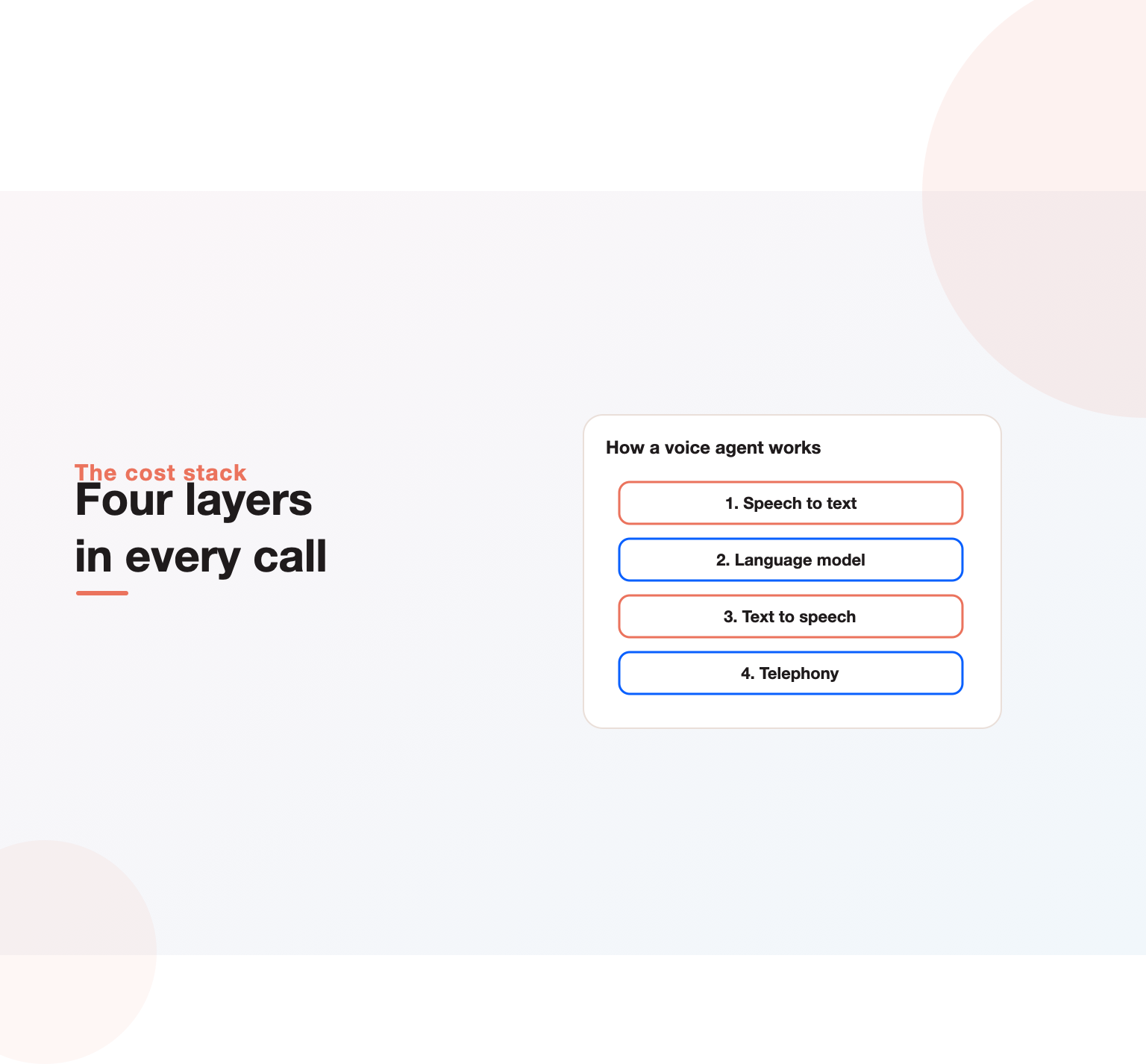
Under the hood, most AI voice agents chain four components together:
- Speech to text turns the caller’s voice into text, in a few hundred milliseconds.
- A large language model reads the conversation, follows the business’s instructions and decides the reply or action.
- Text to speech turns the reply into a natural-sounding voice.
- Telephony connects the agent to phone numbers, so it can take and place real calls.
Newer systems sometimes replace the first three steps with a single speech-to-speech model, which can cut response delay. Either way, the agent also connects to business systems such as a CRM, a calendar or a ticketing tool, so it can book an appointment or log a lead while the caller is still on the line.
Why AI voice agents are suddenly everywhere
Three things changed in the last two years. Language models became fast enough to reply in under a second, which is the threshold where a phone conversation stops feeling robotic. Synthetic voices became hard to tell apart from people. And the cost per minute fell to a level where an AI call costs a fraction of a staffed one. Search interest reflects the shift: “ai voice agents” draws around 3,000 searches a month in the US alone, and related searches such as “ai voice agent platform” and “ai phone agent” add thousands more.
For marketers and revenue teams, the attraction is coverage. A voice agent answers every call at any hour, follows up every web lead within seconds and never forgets to log the result. For businesses that miss calls after hours or let inbound leads wait a day for a callback, that is revenue recovered rather than a cost cut.
Adoption is also being pushed by the tools businesses already use. Phone systems such as Aircall and Dialpad, communications platforms such as Twilio and Vonage, and speech providers such as ElevenLabs and Deepgram now offer agent features or the building blocks for them. That means teams can often add a voice agent to an existing phone number and CRM rather than replacing their stack, which lowers the barrier to a first test considerably. It also means the market is crowded and pricing varies widely, which is why a side-by-side comparison of published rates is useful before any vendor conversation.
AI voice agent pricing: our comparison of published rates
Most buyers start with one question: what does a minute cost? Vendors publish prices in different shapes, some all-in, some per component, some with platform fees, so we read each vendor’s own pricing page on 31 October 2026 and recorded the published per-minute rate. Prices are in US dollars unless stated, exclude taxes and change often, so check the vendor’s page before you buy.
| Platform | Type | Published price per minute | Notes from the pricing page |
|---|---|---|---|
| Bolna | Developer platform (India) | 0.060, down to 0.045 at volume | Standard rate 6.00 cents (INR 5.52); volume plans reduce it |
| Smallest.ai | Developer platform | 0.09 to 0.21, as low as 0.05 | Depends on models; hosting 0.01 a minute flat |
| Retell AI | Developer platform | 0.07 to 0.31 | Example build shown at 0.11 a minute |
| Twilio ConversationRelay | Voice AI infrastructure | from 0.07 | Plus Twilio voice: 0.0085 to receive, 0.014 to make a call |
| Bland AI | Developer platform | 0.12 to 0.14 | 0.14 with no platform fee; 0.12 with a 299 dollar monthly fee |
| Goodcall | Small business answering | about 0.13 | Vendor’s own estimate for its Starter plan at four-minute calls |
| Phonely | Business answering | 0.25 to 0.30 overage; enterprise from 0.05 | Plans include a minute allowance |
| Aircall AI Voice Agent | Business phone system | 0.49 pay as you go | 725 dollars a month for a 2,500-minute bundle, about 0.29 a minute |
| Vapi | Developer platform (component pricing) | Sum of components | Speech to text from 0.0095, model from 0.0077, voice from 0.0146, telephony from 0.008 a minute |
| PolyAI, Sierra | Enterprise | Not published | Custom contracts through sales |
Sources: the pricing pages of Bolna, Retell AI, Bland AI, Twilio, Aircall, Smallest.ai, Goodcall, Phonely and Vapi, read on 31 October 2026.
What the price comparison shows
- A tenfold spread for similar minutes. The cheapest published rate is about a tenth of the most expensive. The difference reflects who does the setup work, not only the technology.
- Build-it-yourself platforms are cheapest. Bolna, Retell, Bland, Smallest and Vapi price low because your team, or an agency, designs the conversation, connects the systems and maintains it.
- Bundled business tools cost more but ship faster. Aircall, Phonely and Goodcall charge more per minute in exchange for a ready-made product inside tools teams already use.
- India is the price floor. The cheapest published rate in our comparison comes from an Indian platform, priced in rupees, which matters for Indian businesses with high call volumes.
- Enterprise vendors hide pricing. PolyAI and Sierra sell through sales teams with custom contracts, typical for large contact-centre deployments.
How to price AI voice agents: the cost stack
If a vendor quotes a single per-minute figure, it bundles several costs. If it prices by component, as Vapi does, you add them yourself. Either way, the same layers sit underneath, and knowing them helps you compare quotes.
| Layer | What it does | Example published rate |
|---|---|---|
| Speech to text | Transcribes the caller | Deepgram Flux English 0.0077 a minute pay as you go |
| Language model | Understands and decides | OpenAI models 0.0077 to 0.0452 a minute on Vapi |
| Text to speech | Speaks the reply | ElevenLabs 0.0146 to 0.0238 a minute on Vapi |
| Telephony | Connects the phone call | Twilio 0.0085 to receive, 0.014 to make a call |
| Platform or hosting | Orchestration, tools, analytics | Smallest.ai hosting 0.01 a minute; others bundle it |
Retell AI’s pricing page shows a worked example: about 0.04 a minute for the language model, 0.055 for voice infrastructure and 0.015 for text to speech, plus telephony, totalling around 0.11 a minute. Real costs vary with the model chosen, the voice quality and how long calls run, so the honest comparison is cost per resolved call or per qualified lead, not cost per minute alone. The Deepgram pricing page is a useful reference for the speech layer.
Not sure which marketing channels are worth your budget?
Our team reviews your current setup and shows you where the opportunities are. See how our digital marketing consulting work.
AI voice agents vs human answering services
The comparison most businesses make is with people. Goodcall’s pricing page puts a live answering service at about 1.50 to 1.90 US dollars a minute, against its own estimate of about 13 cents for an AI agent. On those figures, an AI voice agent costs roughly a tenth to a fifteenth of a staffed answering service per minute.
Price is not the whole story. People still handle complex complaints, emotional situations and high-value negotiations better. The strongest deployments use AI voice agents for the high-volume, repeatable work, such as answering common questions, booking appointments, qualifying leads and confirming orders, and hand off to a person when the conversation needs judgement. A clean handoff, where the human sees the transcript and does not ask the caller to repeat themselves, matters more than any single feature.
What AI voice agents can do for marketing and sales
- Speed to lead. Call every new web lead within a minute of the form submission, while interest is highest. Most teams take hours or days.
- After-hours coverage. Answer and qualify calls from ads and search at night and on weekends, when many businesses send callers to voicemail.
- Appointment booking. Check calendar availability and book demos, consultations or service visits during the call.
- Lead qualification. Ask the same qualifying questions every time and write the answers straight into the CRM.
- Reactivation. Call lapsed leads or past customers with a specific offer, at a scale no team could staff.
- Event and webinar follow-up. Confirm attendance and capture next steps after events.
Each of these depends on clean data flowing into your systems. Our CRM vs marketing automation guide and CRM migration services cover how to get that foundation right, and our AI lead generation guide covers the wider set of AI tools for pipeline.
Inbound vs outbound AI voice agents
Voice agents do two quite different jobs, and the right setup depends on which one you need.
- Inbound agents answer calls customers make to you: support lines, booking lines, sales enquiries from ads and after-hours calls. The caller has chosen to call, so consent is simple and expectations are clear. Inbound is the easiest place to start and usually pays back fastest, because every missed call is a lost opportunity.
- Outbound agents place calls: following up new leads, confirming appointments, reminding customers about renewals or reactivating old leads. Outbound brings more legal obligations and needs careful scripting, because the person did not expect the call. Done well, with consent and a relevant reason to call, it can lift contact rates on leads that would otherwise go cold.
Many businesses run both on the same platform, with inbound handling enquiries and outbound handling speed-to-lead follow-up for web forms. The same phone numbers, scripts and CRM connections can serve both.
Use cases by industry
| Industry | Typical voice agent jobs |
|---|---|
| Healthcare and clinics | Appointment booking, rescheduling, reminders and basic enquiries, with handoff for clinical questions |
| Real estate | Answering property enquiries, qualifying buyers by budget and location, booking site visits |
| Education | Course enquiries, counselling call booking, application follow-up and fee reminders |
| Financial services and insurance | Lead qualification, document reminders and renewal calls, within regulatory limits |
| Home services | Answering calls while technicians are on jobs, quoting standard services, booking visits |
| B2B software | Calling inbound demo requests within a minute, qualifying them and booking meetings with sales |
| Ecommerce and retail | Order status, returns, delivery questions and abandoned-order follow-up |
The common thread is volume and repetition: the same questions asked hundreds of times a day, where a consistent answer and fast response matter more than a personal touch.
How to write a voice agent script that works
A voice AI agent follows instructions rather than a rigid script, but the instructions still decide whether calls go well. These principles come up again and again in successful deployments.
- Open with who and why. Name the business and the reason for the call in the first sentence. Callers who do not know who is speaking hang up.
- Keep turns short. Speech is slower to absorb than text. One or two sentences per turn, then let the caller respond.
- Ask one question at a time. Stacked questions confuse callers and the agent alike.
- Write the qualification criteria explicitly. List exactly what makes a lead qualified, so the agent asks the right questions in a natural order.
- Define the exits. Spell out when to transfer to a person, when to book a callback and when to end the call politely.
- Plan for interruptions. Callers talk over agents. Good platforms handle barge-in, but your instructions should allow the conversation to change direction.
- Review real calls weekly. Read transcripts, find where callers got stuck and refine the instructions. The first version is never the final one.
Measuring voice agent performance
Track outcomes, not activity. The metrics that matter:
- Answer rate: share of inbound calls answered, compared with your previous rate.
- Containment rate: share of calls resolved without a human, for tasks the agent is meant to handle.
- Handoff quality: share of transfers where the person had the context needed to continue.
- Booked meetings or appointments per hundred calls or leads.
- Cost per outcome: total cost divided by resolved calls, bookings or qualified leads.
- Customer satisfaction: a short post-call rating or a sample review of transcripts.
Compare each metric against the process the agent replaced, over the same period and lead sources, so the result reflects the agent rather than a change in demand.
How to choose an AI voice agent platform
Choosing an AI voice agent platform comes down to who will build and run it, and what it must connect to.
- Decide build or buy. If you have developers or an agency, a developer platform such as Retell, Bland, Vapi, Smallest.ai or Bolna offers the lowest cost and the most control. If you want something running this week inside your phone system, a bundled product such as Aircall, Phonely or Goodcall is faster.
- Test latency on real calls. Call the demo agent from a mobile network, not office Wi-Fi. A delay of more than about a second between turns feels unnatural.
- Check languages and accents. For Indian businesses especially, test Hindi, regional languages and code-mixed speech, not only English.
- Confirm integrations. The agent must read and write to your CRM, calendar and helpdesk, or it creates more manual work than it saves.
- Read the full price. Add telephony, platform fees, number rental and the model you will actually use. Compare the cost of a completed task, not a minute.
- Check compliance features. Recording consent, opt-out handling, data retention and where data is stored.
The best AI voice agents by use case
Rather than one ranking, the best AI voice agents depend on the job. Based on how each vendor positions and prices its product:
- Lowest cost at volume, including India: Bolna, with the lowest published per-minute rate in our comparison and rupee pricing.
- Maximum flexibility for builders: Vapi, with component-level pricing and a wide choice of speech, model and voice providers, and Retell AI, with a clear all-in price range.
- Simple, predictable pricing: Bland AI, with a flat per-minute rate and an option with no platform fee.
- Inside an existing business phone system: Aircall’s AI Voice Agent, for teams already on Aircall.
- Small business call answering: Goodcall and Phonely, which package minutes into plans aimed at local businesses.
- Infrastructure for custom builds: Twilio ConversationRelay, for teams building their own agent on Twilio.
- Large contact centres: PolyAI and Sierra, which sell enterprise deployments with custom pricing.
We have no commercial relationship with any of these vendors. Run your own test calls before committing.
AI phone agent rules: consent and compliance
Outbound calling with AI voices carries legal obligations that inbound answering does not. In the United States, the Federal Communications Commission ruled in 2024 that AI-generated voices count as artificial voices under the Telephone Consumer Protection Act, so the consent rules for robocalls apply to an AI phone agent making outbound calls. In India, commercial calls fall under TRAI’s rules on unsolicited commercial communication and customer preferences.
The practical rules are the same everywhere: call people who have given consent, identify the business at the start of the call, offer a clear way to stop further calls, record consent where required and keep good records. Inbound answering, where the customer calls you, is far simpler, which is why many businesses start there. This is general information, not legal advice, so check with counsel for your market.
How to launch an AI call agent: a 30-day plan
- Week 1: pick one job. Choose a single, high-volume task such as after-hours inbound answering or calling new web leads. Write the script, the qualifying questions and the handoff rules.
- Week 2: build and connect. Configure the agent on your chosen platform, connect the CRM and calendar, and run at least 50 internal test calls with different accents and edge cases.
- Week 3: go live on part of the traffic. Route a share of calls or leads to the AI call agent and the rest to your current process, so you can compare.
- Week 4: measure outcomes. Compare answer rate, booked meetings, qualified leads, handoff rate and cost per outcome against the current process. Listen to a sample of calls every week.
Write the success rule before launch, for example “book more qualified meetings per hundred leads than the current process at a lower cost per meeting”, so the decision is based on outcomes rather than enthusiasm.
Want a marketing plan built around your numbers?
Book a free 30-minute strategy call and leave with a clear next step for your business.
Data privacy and security
Every call an agent handles produces a recording, a transcript and often personal details such as names, phone numbers, addresses or account information. Treat that data with the same care as any customer record.
- Know where data is stored. Ask which countries recordings and transcripts are processed and stored in, and whether that meets your obligations, including India’s Digital Personal Data Protection Act for Indian customers.
- Control retention. Set how long recordings and transcripts are kept, and delete what you do not need.
- Remove sensitive details. Some platforms can redact card numbers and other sensitive fields from transcripts automatically. Use that where available.
- Limit access. Restrict who in your team can listen to calls or export transcripts.
- Tell callers. State that the call is handled by an automated assistant and may be recorded, in line with local rules.
Questions to ask vendors before you buy
- What is the all-in cost per minute for our expected model, voice and telephony, including platform fees and phone numbers?
- What response delay should we expect on mobile networks in our markets?
- Which languages and accents are supported, and can we test with our own call recordings?
- Which CRMs, calendars and helpdesks connect natively, and what needs custom work?
- How does handoff to a human work, and does the person receive the transcript?
- How are consent, opt-outs and call recording handled for outbound calls?
- Where is call data stored, for how long, and can we delete it on request?
- What reporting is included, and can we export call-level data to our own analytics?
- What happens to our agent, numbers and data if we leave?
Vendors that answer these clearly and in writing are easier to work with later. Vague answers on pricing or data handling are a warning sign.
Common mistakes with voice AI agents
- Automating everything at once. Start with one task, prove it, then expand.
- No clean handoff. If a caller asks for a person and cannot reach one, trust drops quickly.
- Judging on cost per minute. A cheap agent that fails to resolve calls costs more in lost customers.
- Skipping the CRM. Calls that are not logged create blind spots for sales and marketing. Our revenue operations consulting team often finds this gap first.
- Ignoring local language. In India in particular, English-only agents miss a large share of callers.
- Cold calling without consent. It creates legal risk and damages the brand.
AI voice agents in India
India is one of the fastest-moving markets for voice AI. Phone calls remain central to how Indian customers buy, especially in financial services, education, real estate, automobiles and healthcare, and businesses handle very large call volumes. Indian platforms such as Bolna price in rupees and publish some of the lowest per-minute rates in our comparison, which makes high-volume use cases affordable.
The main challenge is language. Customers switch between English, Hindi and regional languages within a single call, and agents must handle that mix naturally. Test with real customer recordings before scaling. Voice agents also work well alongside WhatsApp, which many Indian customers prefer for follow-up. Our WhatsApp ads guide and WhatsApp marketing services cover that side of the conversation.
Where AI voice agents fit in your stack
Voice agents sit between your ads, your website and your sales team. Leads from search, social and ChatGPT Ads arrive on a landing page; the agent calls or answers them within a minute; qualified conversations land in the CRM with a transcript; and sales picks up from there. Measuring that chain end to end is what proves the value, so set up attribution before launch. Our marketing attribution guide and B2B marketing automation guide explain how.
For teams planning a build, our AI application development team designs and integrates custom agents, and our lead generation services cover the follow-up that turns answered calls into pipeline. If you are mapping where voice AI fits alongside other tools, our SaaS tech stack study shows what leading companies already run.
Methodology
On 31 October 2026 we read the public pricing pages of 30 AI voice agent and voice AI infrastructure vendors and recorded the published per-minute rates shown on each page. Vendors whose pages did not load, did not show per-minute pricing, or sell only through custom contracts are listed as not published or left out. Rates are taken as published, in US dollars unless stated, without taxes, discounts or negotiated terms. Where a vendor publishes a range, we show the range. Goodcall’s comparison with a live answering service is the vendor’s own estimate. Prices change frequently, so treat the table as a snapshot and confirm current pricing with each vendor.
Voice is one of several agent types; see our broader guide to AI marketing agents, including how vendors charge for them.
Planning outbound calls with AI? Read our guide to AI cold calling, including TCPA rules and what 20 vendors disclose.
Key Takeaways
- AI voice agents combine speech to text, a language model, text to speech and telephony to hold real phone conversations.
- Published prices range from about 0.045 to 0.49 US dollars a minute, a tenfold spread.
- India’s Bolna has the lowest published rate in our comparison; Aircall’s pay-as-you-go rate is the highest.
- Compare cost per resolved call or qualified lead, not cost per minute.
- Start with one high-volume job, connect the CRM, build a clean human handoff and get consent for outbound calls.
Frequently asked questions
What are AI voice agents?
AI voice agents are software that hold real-time phone conversations using speech recognition, a large language model and synthetic speech. They answer and make calls for tasks such as customer support, appointment booking and lead qualification, and can connect to CRMs and calendars.
How much do AI voice agents cost?
Published prices in our comparison range from about 0.045 US dollars a minute (Bolna, at volume) to 0.49 dollars a minute (Aircall, pay as you go). Platforms such as Retell AI and Bland AI cost roughly 0.07 to 0.31 dollars a minute, before any setup work.
What is the best AI voice agent platform?
It depends on the use case. Build-it-yourself platforms such as Vapi, Retell AI, Bland AI and Bolna suit custom builds at low cost; Aircall, Phonely and Goodcall suit teams that want a ready-made product; PolyAI and Sierra target large contact centres.
Are AI phone agents legal for outbound calls?
In the US, the FCC ruled in 2024 that AI-generated voices are artificial voices under the TCPA, so robocall consent rules apply to outbound AI calls. In India, TRAI’s commercial communication rules apply. Get consent and offer an easy opt-out.
Can AI voice agents replace call centre staff?
They can handle high-volume, repeatable calls such as common questions, bookings and lead qualification, at a fraction of the cost per minute. Complex or sensitive conversations still need people, so the best setups hand off cleanly to a human.
Do AI voice agents work in Indian languages?
Many platforms support Hindi and some regional languages, and Indian vendors focus on code-mixed speech. Test with real customer recordings in your target languages before scaling.
Ready to put this into practice?
Talk to the team that runs SEO, AI search and paid growth programs every day.
Book a Strategy Call →