 Skip to content

ChatGPT Ads: How They Work, Costs, and the 59 Brands Already Using Them (2026)
ChatGPT Ads explained: formats, CPC and CPM bidding, setup and measurement. Plus our research: 59 brands, from Zoom to Lenskart, already have the pixel.
Quick Answer
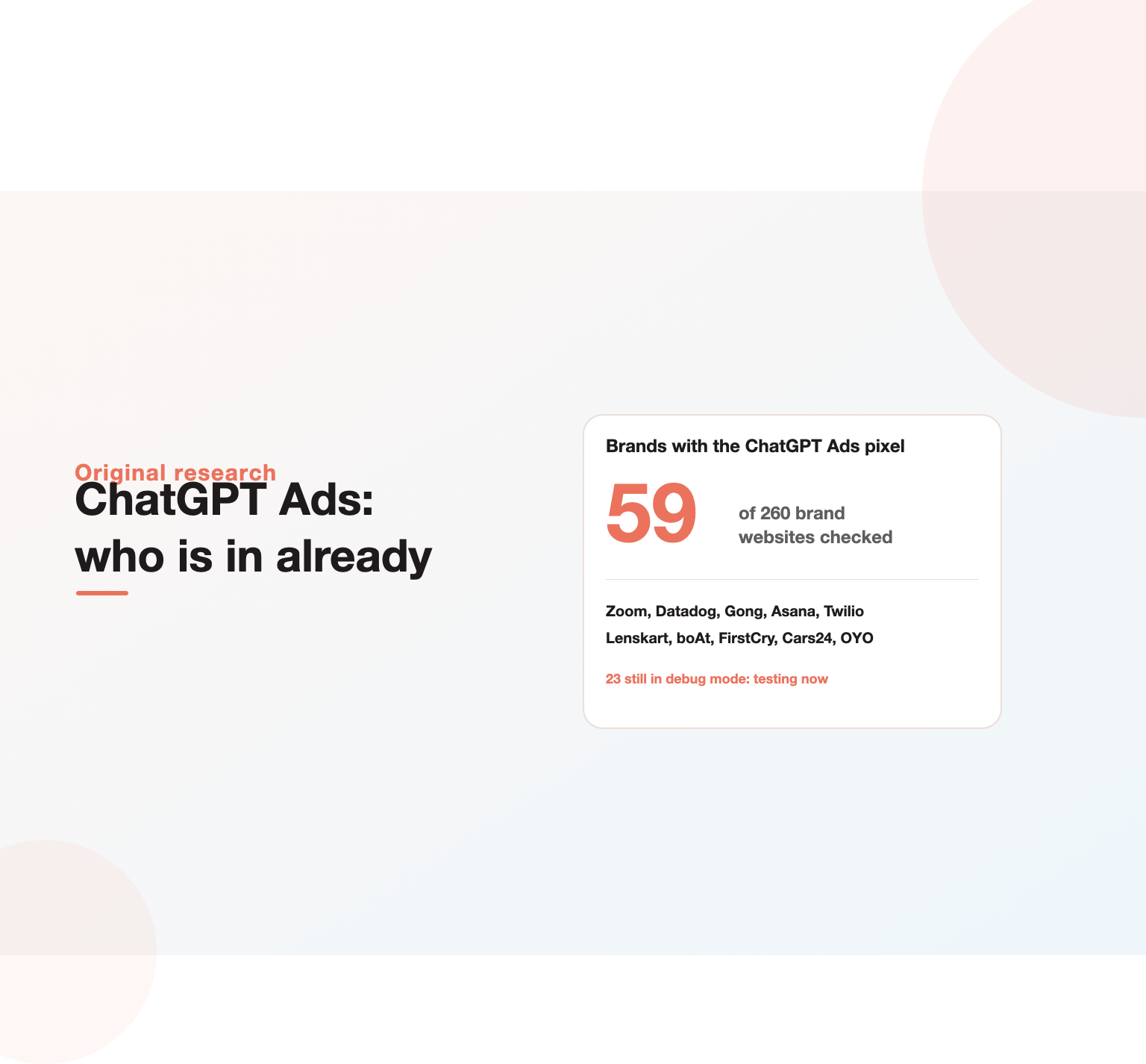
The ads are paid ads that appear below ChatGPT’s answers, bought through OpenAI Ads Manager at ads.openai.com. They launched as a test in February 2026, expanded across Europe in August and Southeast Asia in September, and are now open for self-service in many countries, including India. Advertisers pay per impression or per click, with OpenAI recommending a starting bid of 3 to 5 US dollars per click, and target by conversation context rather than exact keywords. Adoption is moving fast: in our check of 260 brand websites, 59 already have OpenAI’s ads pixel installed, including one in four B2B SaaS companies and one in four leading Indian consumer brands such as Lenskart, boAt, FirstCry, Cars24 and OYO.
Key Highlights
- 59 of 260 brands we checked (23%) already run the OpenAI ads measurement pixel on their websites.
- 46 of 181 B2B SaaS companies (25%) have it installed, including Zoom, Datadog, Gong, Asana, Monday.com, Miro, Twilio and Semrush.
- 9 of 36 top Indian consumer brands (25%) have it, including Lenskart, boAt, FirstCry, Cars24, Spinny, OYO, ixigo and SUGAR Cosmetics.
- 23 of the 59 pixels are still in debug mode, which means those brands are setting up and testing right now.
- The most tracked conversion is lead_created (25 brands), so B2B lead generation is an early use case, not only ecommerce.
- WeightWatchers’ cost per acquisition on the platform came in 15.3% below its paid search benchmark, measured by DV Rockerbox and reported by OpenAI.
What are ChatGPT Ads?
ChatGPT Ads are sponsored placements shown inside ChatGPT, OpenAI’s assistant used by 1.2 billion people each week according to OpenAI. Instead of appearing next to a list of search results, ChatGPT Ads appear below the answer ChatGPT gives to a user’s question. The company describes the goal as reaching people “as they explore, compare, and decide” within a single conversation.
According to OpenAI’s advertiser documentation, each ad includes the advertiser name, a logo, a headline, a short description, a landing page and an image. Ads are labelled, kept separate from ChatGPT’s answer, and are not shown to users on Plus, Pro or Business plans, or to accounts identified as belonging to people under 18. That means these ads reach users on the free and lower-priced tiers, which is the largest part of ChatGPT’s audience.
For marketers, the important shift is intent. People bring ChatGPT their real problems in full sentences: which laptop to buy for video editing, which CRM suits a ten-person sales team, which travel insurance covers a specific trip. The ads let a brand appear at that moment, with far more context about what the person wants than a short search query provides.
How ChatGPT Ads launched: the timeline
OpenAI has rolled out ChatGPT Ads in stages over 2026, documented on its ChatGPT Ads blog:
| Date | Milestone |
|---|---|
| 16 January 2026 | OpenAI publishes its approach to advertising and expanding access to ChatGPT |
| 9 February 2026 | Testing of ads in ChatGPT begins |
| 5 May 2026 | New ways to buy ChatGPT Ads |
| 18 August 2026 | These ads expands across Europe |
| 23 September 2026 | Expansion to Southeast Asia and Taiwan |
| 5 October 2026 | Measurement partnerships and new conversion tools announced |
Self-service access through Ads Manager depends on the country where the advertising company is legally based. In some newer European markets, advertisers currently start through OpenAI’s sales team or agency partners. In India, OpenAI is actively recruiting advertisers with an introductory credit of INR 5,000 when a new advertiser spends INR 5,000, an offer that runs until 31 December.
Our research: who is already preparing to advertise on ChatGPT
OpenAI does not publish a list of advertisers, and there is no public library of ChatGPT advertisers. So we looked for the clearest public signal that a brand is advertising or preparing to: the OpenAI ads measurement pixel. OpenAI’s developer documentation describes this pixel as a browser script that lets advertisers measure website actions attributed to ads in ChatGPT. A brand installs it only if it intends to run, or is already running, ads in ChatGPT.
On 31 October 2026 we checked the homepages of 310 brands for the pixel, both in the page code and inside each site’s public Google Tag Manager container, where most companies now install tracking tags. The sample combined the 183 B2B SaaS companies from our SaaS tech stack study, 77 large US consumer brands and 50 leading Indian consumer brands. 260 sites could be checked; the rest blocked automated requests.
| Group | Sites checked | Pixel found | Share |
|---|---|---|---|
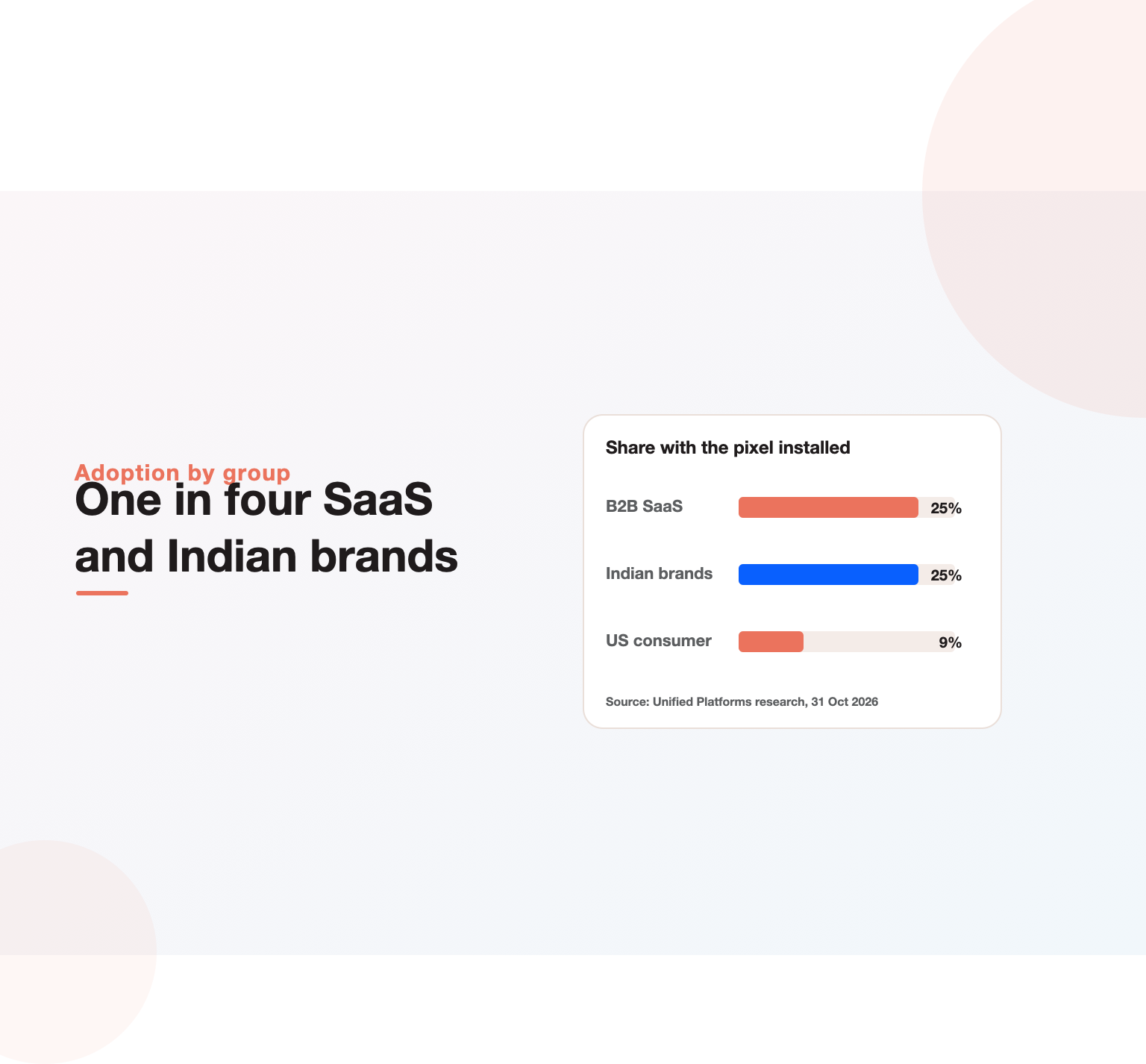
| B2B SaaS companies | 181 | 46 | 25% |
| Indian consumer brands | 36 | 9 | 25% |
| US consumer brands | 43 | 4 | 9% |
| Total | 260 | 59 | 23% |
These figures are a lower bound. Our check read page code and tag containers without running every script or accepting cookie banners, and many large US retailers block automated checks entirely, so the true adoption rate is likely higher, especially among US consumer brands.
B2B SaaS companies with the OpenAI ads pixel
Abnormal Security, ActiveCampaign, Amplitude, Apollo, Arctic Wolf, Asana, Avoma, Bill.com, CircleCI, ClickHouse, Close, CockroachDB, Contentsquare, Datadog, Deel, ElevenLabs, Fivetran, Front, Gainsight, dbt Labs, Glean, Gong, Hightouch, Jasper, Klaviyo, Lattice, Miro, Monday.com, Netskope, NinjaOne, Optimizely, Outreach, Pendo, Samsara, Sanity, Seamless.AI, Semrush, SentinelOne, Sumo Logic, SurveyMonkey, Twilio, Typeform, UiPath, Yotpo, Zoom and ZoomInfo.
Indian brands with the OpenAI ads pixel
boAt, Cars24, FirstCry, ixigo, Lenskart, OYO, Simplilearn, Spinny and SUGAR Cosmetics. These span direct-to-consumer retail, used cars, travel, hospitality and education, the categories where people already ask ChatGPT for buying advice.
US consumer brands with the OpenAI ads pixel
ExpressVPN, Hostinger, PetSmart and Quince. The company also names Newegg, Best Buy, Lowe’s and VistaPrint as early advertisers on its own site.
What the pixel data tells us
- Many brands are mid-setup. 23 of the 59 pixels are still configured in debug mode, the testing setting OpenAI provides before a pixel goes fully live. A large share of adopters started in the last few weeks.
- B2B is not waiting. The most common event tracked is lead_created, configured by 25 brands, followed by page views, registrations, trial starts and orders. Advertisers are using the channel for B2B lead generation from the start. Many pair it with AI voice agents that call new leads within a minute of the form fill.
- It follows the Reddit and LinkedIn pattern. Of the 46 SaaS companies with the pixel, 28 also run the Reddit Pixel and 29 run the LinkedIn Insight Tag. The same mature demand generation teams that added Reddit, covered in our reddit ads examples analysis, are first to test advertising in ChatGPT.
- India is moving as fast as US SaaS. One in four leading Indian consumer brands we could check already has the pixel, the same rate as B2B SaaS, helped by OpenAI’s introductory credit for Indian advertisers.
How ChatGPT Ads work
Where ads appear
The ads appear below ChatGPT’s response, not inside it. According to OpenAI, ads remain distinct from answers and are clearly labelled, so the answer itself is not changed by advertising. This is the most important difference from AI visibility, where a brand earns a mention inside the answer. Paid placement and organic citation are separate, and serious brands will need both.
How ads are matched to conversations
OpenAI’s ad system selects ads using the context and intent of the current conversation, the ad’s landing page, headline and copy, and context hints supplied by the advertiser. When a user has ad personalisation enabled, select signals from their wider ChatGPT use can also be considered. Context hints describe the topics or situations where a product is relevant. They are not exact-match keywords and do not guarantee delivery in a given conversation.
The auction
The auction is relevance-weighted and second-price. In practice, a more relevant ad can win against a higher bid, which rewards clear landing pages and specific copy over raw budget.
Not sure which marketing channels are worth your budget?
Our team reviews your current setup and shows you where the opportunities are. See how our digital marketing consulting work.
What ChatGPT ads cost: pricing and bidding
These ads support three ways to buy, set at the ad group level:
- Views: impression-based buying with a maximum CPM bid, used for reach.
- Clicks: traffic buying with a maximum CPC bid.
- Conversions: optimised toward a standard conversion event. Conversion-optimised campaigns with click billing still charge for valid clicks, not conversions.
For click campaigns, OpenAI recommends starting with a maximum bid of 3 to 5 US dollars per click. Ads Manager also shows bid-strength guidance indicating whether a bid is likely to be competitive. Actual costs depend on how many advertisers compete for similar conversations, so the reliable way to judge ChatGPT ads cost is cost per qualified lead or sale, not cost per click.
For comparison, OpenAI’s measurement announcement cites WeightWatchers’ attributed cost per acquisition on ChatGPT Ads at 15.3% below its blended paid search benchmark, as measured by DV Rockerbox. One advertiser’s result is not a forecast for yours, but it shows the platform can compete with search on efficiency.
How to advertise on ChatGPT: step by step
Here is how to advertise on ChatGPT based on OpenAI’s own setup guides.
- Create an Ads Manager account. Go to ads.openai.com and sign in with an OpenAI account tied to your work email. You can start from your website URL, and Ads Manager will draft a first ad from it.
- Complete the account. Add your logo, set up billing, complete verification and invite your team.
- Install measurement. Create a web data source, add the pixel to your site directly or through Google Tag Manager, and send key events such as leads, sign-ups or purchases. Server-side events can be added through the Conversions API.
- Build the campaign. Choose Views, Clicks or Conversions, set a budget and a maximum bid, write context hints that describe the situations where your product helps, and create ads with a clear headline, description and image.
- Add tracking parameters. Static UTM parameters on landing page URLs let you see this traffic in Google Analytics or any other analytics tool.
- Launch and review. Campaigns go live after review. Impressions, clicks and CTR refresh roughly every 15 minutes, while spend data can lag by 7 to 8 hours.
Bulk upload is also supported for larger accounts and product-feed campaigns for retailers, although bulk upload does not currently create product-feed campaigns.
Measuring ChatGPT Ads
Measurement is where these ads differ most from search ads. People often use ChatGPT to work through a decision, so the click is not always the next step. In an early OpenAI analysis of campaigns optimised for deeper outcomes, 52.7% of eligible one-day view-through conversions happened within an hour of the matched impression, and a WorkMagic geo-lift study estimated 2.3 times more incremental orders for the brand Dose than last-click attribution captured.
That has two consequences for marketers:
- Last-click reporting will undercount this channel. Teams that judge the channel on clicks alone will cut it too early. Our marketing attribution guide covers how to set up view-through and incrementality measurement.
- Your existing tools mostly connect. According to OpenAI’s measurement announcement, data integrations include Hightouch, Tealium and LiveRamp; attribution partners include AppsFlyer, Triple Whale, Adjust, DV Rockerbox, Northbeam, Branch, Singular, Kochava, Airbridge and Tenjin; and incrementality testing is available with Haus, Measured and WorkMagic.
Comparing ChatGPT Ads with Google Ads
| ChatGPT Ads | Google Ads (search) | |
|---|---|---|
| Where it appears | Below an AI answer in a conversation | Above and below search results |
| Targeting | Conversation context plus advertiser context hints | Keywords, audiences and match types |
| Buying | CPM, CPC or conversion-optimised, second-price auction | CPC and many automated bid strategies |
| Maturity | Beta, launched 2026 | Mature, two decades of tools and data |
| User mindset | Exploring and comparing in detail | Searching for a specific answer or site |
| Measurement | Pixel, Conversions API, partner attribution | Full Google measurement ecosystem |
The platform will not replace Google Ads for most businesses in the near term. Search still captures demand at enormous scale, and our Google Ads management team still sees it as the core of most paid programs. What this channel adds is a way to reach people earlier, while they are still deciding what kind of solution they need, which is exactly where search has been losing clicks to AI answers.
Who should test ChatGPT Ads now
- Brands whose buyers research in ChatGPT. Software, consumer electronics, travel, education, finance and health products all see heavy research use.
- Teams with working measurement. The pixel, conversion events and a way to read view-through results are prerequisites for a fair test.
- Advertisers in launch markets. India’s introductory credit lowers the cost of a first test for Indian brands.
- Companies already strong on paid search and social. The early adopters in our data are the same mature teams running LinkedIn and Reddit.
If measurement is not in place yet, fix that first. A rushed test without conversion tracking will produce numbers nobody trusts.
Why paid ads and AI visibility both matter
The ads buy a placement below the answer. They do not change what ChatGPT says in the answer itself. If ChatGPT recommends three competitors in its response and your ad appears underneath, the user still reads the recommendation first. Paid ads and organic AI visibility work together:
- Organic visibility decides whether ChatGPT names you when people ask about your category. Our guide to ranking in ChatGPT and AEO services cover how to earn that.
- Paid ads in ChatGPT guarantee a presence in conversations where you are not yet recommended, and let you test messages fast.
A quick way to see where you stand is our free AI visibility score, which checks the signals that decide whether AI engines cite your brand.
Writing ChatGPT Ads that work
- Match the question, not the keyword. Write context hints and headlines around the problem people describe, such as choosing a CRM for a small sales team, rather than a product name.
- Be specific. People in ChatGPT are comparing options. A concrete claim, a price point where appropriate, or a clear differentiator beats a slogan.
- Send people to a page that continues the conversation. A comparison page, calculator or guide converts better than a generic homepage. Our B2B conversion rate optimization guide explains how to build these pages.
- Use relevance, not budget, to win. In a relevance-weighted auction, a tightly matched ad and landing page can beat a bigger bidder.
- Respect the environment. Sensitive contexts are excluded from ads, and qualifying advertisers can add negative phrases. Brands that feel intrusive will lose trust quickly in a conversational product.
Which industries benefit most from ChatGPT advertising
The pixel data gives an early read on where advertisers see the clearest opportunity. Adoption clusters in categories where people ask ChatGPT long, specific questions before they buy.
- Software and SaaS. Buyers ask ChatGPT to compare tools, check integrations and shortlist vendors. 46 of the 59 brands with the pixel in our research are software companies, from security (SentinelOne, Abnormal Security, Arctic Wolf, Netskope) to sales tools (Gong, Outreach, Apollo, ZoomInfo) and data platforms (Fivetran, dbt Labs, ClickHouse, Hightouch).
- Considered consumer purchases. Eyewear, electronics, used cars and baby products all involve research and comparison, which explains Lenskart, boAt, Cars24, Spinny and FirstCry in the Indian group.
- Travel and hospitality. Trip planning is one of the most common ChatGPT tasks, and ixigo and OYO are already preparing.
- Education and careers. Course and certification choices are researched heavily, which fits Simplilearn’s adoption.
- Subscriptions and online services. VPNs and web hosting, represented by ExpressVPN and Hostinger, are classic comparison categories.
Impulse purchases and categories where people rarely research before buying are likely to see less benefit, because the ad’s value comes from appearing in the middle of a considered decision.
How to check if a competitor runs ChatGPT Ads
Because there is no public library of ChatGPT advertising, the pixel is the most reliable signal you can check yourself. It takes a few minutes and uses only your browser.
- Open the competitor’s website in Chrome and open developer tools (right-click, then Inspect).
- Go to the Network tab and reload the page.
- Filter for “openai”. A request to bzrcdn.openai.com or bzr.openai.com means the OpenAI ads pixel is loading.
- Accept the cookie banner and reload if nothing appears, because many sites load marketing tags only after consent.
- Check their checkout or demo page too. Some brands load the pixel only where conversions happen.
This is the same signal we used for the research in this article. A pixel tells you a competitor is investing in the channel; it does not tell you their budget or which conversations they target. Pair it with your own test results before drawing conclusions.
Using ChatGPT Ads for B2B lead generation
The data surprised us here. We expected ecommerce to dominate early adoption, but lead_created was the most common conversion event configured, set up by 25 of the 59 brands, and B2B SaaS companies made up most of the adopters. Software buyers already use ChatGPT to shortlist tools, compare pricing models and check whether a product fits their stack, so the intent is there.
A B2B lead generation approach to OpenAI ads looks different from a retail one:
- Offer a reason to click before a demo. A comparison page, an ROI calculator or a short buyer’s guide fits a person mid-research far better than a “book a demo” button.
- Write context hints around jobs to be done. Describe the situations buyers bring to ChatGPT, such as consolidating tools after a merger or replacing spreadsheets for sales forecasting.
- Send leads into nurture, not straight to sales. Early-stage conversation leads need follow-up content. Our B2B marketing automation guide covers how to route them.
- Judge on pipeline, not form fills. Track how many ChatGPT leads become qualified opportunities within 60 to 90 days.
For teams building this alongside other channels, our B2B demand generation guide explains how paid channels feed a single pipeline.
Want a marketing plan built around your numbers?
Book a free 30-minute strategy call and leave with a clear next step for your business.
India and ChatGPT Ads: what Indian brands should know
India is one of the most active early markets for ChatGPT advertising. Indian businesses can sign up for self-service Ads Manager, and OpenAI’s introductory offer gives new advertisers INR 5,000 in credit once they spend INR 5,000, until 31 December.
Our research shows Indian brands are not waiting. Nine of the 36 leading Indian consumer brands we could check already have the pixel installed, a 25% adoption rate that matches B2B SaaS. They cover eyewear (Lenskart), consumer electronics (boAt), baby and kids retail (FirstCry), used cars (Cars24 and Spinny), travel (ixigo), hotels (OYO), beauty (SUGAR Cosmetics) and education (Simplilearn). These are categories where people ask detailed buying questions before they decide.
Three points matter for Indian advertisers. First, the introductory credit makes a small first test almost free, so the cost of learning is low. Second, ChatGPT use in India is huge and growing, which means conversation volume in many categories is already large. Third, landing pages built for mobile and for Indian payment and delivery expectations will decide whether those clicks convert.
A 30-day ChatGPT ads test plan
- Week 1: measurement first. Create the account, install the pixel (in debug mode while you test), confirm your key conversion fires and add UTM parameters to landing pages.
- Week 2: launch two campaigns. One click campaign with a 3 to 5 US dollar maximum bid, as OpenAI recommends, and one conversion-optimised campaign on your main lead or purchase event. Use two or three distinct context hints per ad group.
- Week 3: read beyond the click. Compare click-through conversions with view-through conversions, and check which context hints drive qualified leads rather than cheap clicks.
- Week 4: decide. Compare cost per qualified lead or sale against paid search and paid social. Scale, adjust the context hints, or pause.
Write the decision rule down before launch. It stops a promising but unproven channel from running for months on hope.
Common mistakes with ChatGPT advertising
- Treating context hints like keyword lists. They describe situations, not exact phrases, and pasting a keyword list wastes the system’s understanding of conversations.
- Skipping the pixel. Without conversion data, conversion-optimised campaigns cannot learn and you cannot compare channels fairly.
- Judging on last click only. The platform’s own data shows many conversions happen after an impression without a click.
- Sending traffic to a homepage. People arrive mid-decision and want the next piece of the answer, not a generic brand page.
- Ignoring organic visibility. If ChatGPT’s answer recommends competitors, the ad below it has to work much harder. Our AI search optimization work addresses the answer itself.
What this means for marketers in 2027
ChatGPT Ads went from announcement to multi-region self-service in under a year, and our data shows a quarter of the B2B SaaS and leading Indian consumer brands we could check have already installed the pixel. That pace is faster than LinkedIn or Reddit advertising reached comparable adoption among the same companies.
Three practical steps follow. First, install the pixel and measurement now, even before spending, so you have baseline data when you test. Second, run a small, time-boxed test against a clear cost per lead or cost per sale target, read alongside view-through results. Third, keep building organic AI visibility, because ads sit below the answer and the answer still matters most.
If you want help planning a first test inside a wider paid program, our digital marketing consulting and lead generation teams work with B2B and consumer brands across India and the US. For paid social programs that run alongside it, see our LinkedIn ads and Meta ads services.
Methodology
On 31 October 2026 we requested the homepages of 310 brands: 183 B2B SaaS companies from the Unified Platforms SaaS Tech Stack Study, 77 large US consumer brands and 50 leading Indian consumer brands. A brand was recorded as having the pixel when its page code, or a public Google Tag Manager container referenced on its homepage, contained the OpenAI measurement pixel script (bzrcdn.openai.com) or its initialisation call. Every match was reviewed and contained a brand-specific pixel ID. Debug mode and tracked events were read from the same configuration. 260 sites returned a readable page; 50 blocked automated requests and were excluded. Results are a lower bound, because scripts loaded only after cookie consent or by other tag managers would not be detected. A pixel indicates a brand is advertising or preparing to advertise on ChatGPT; it does not confirm an active campaign on a given day. Product facts are taken from OpenAI’s advertiser help centre, developer documentation and ChatGPT Ads blog, accessed 31 October 2026.
For comparison with an established B2B channel, see our LinkedIn ads library research, which estimates how many ads 70 leading software brands ran on LinkedIn in a single month.
Using ChatGPT inside your team rather than advertising on it? See our guide to ChatGPT for marketing, with copy-ready prompts.
Key Takeaways
- These ads appear below ChatGPT’s answers, bought through OpenAI Ads Manager on a CPM, CPC or conversion-optimised basis.
- The recommended starting click bid is 3 to 5 US dollars, in a relevance-weighted second-price auction.
- 59 of 260 brands we checked already have OpenAI’s ads pixel, including one in four B2B SaaS companies and one in four leading Indian consumer brands.
- 23 of those pixels are still in debug mode, and lead_created is the most tracked event, so B2B lead generation is an early use case.
- Last-click reporting undercounts ads in ChatGPT; plan for view-through and incrementality measurement.
- Paid placements sit below the answer, so organic AI visibility remains essential alongside paid placement.
Frequently asked questions
What are ChatGPT Ads?
ChatGPT Ads are sponsored placements that appear below ChatGPT’s responses. Each ad shows an advertiser name, logo, headline, description, image and landing page. They are bought through OpenAI Ads Manager and are not shown to users on Plus, Pro or Business plans or to users identified as under 18.
How much do ChatGPT Ads cost?
The platform cost depends on the auction. Advertisers set a maximum CPM for reach or a maximum CPC for clicks, and OpenAI recommends starting click bids at 3 to 5 US dollars. Indian advertisers can currently claim an introductory credit of INR 5,000 after spending INR 5,000.
How do you advertise on ChatGPT?
Create an account at ads.openai.com, complete billing and verification, install the measurement pixel, build a campaign with a budget, bid and context hints, add UTM parameters, and launch once your ads pass review.
Are ChatGPT Ads available in India?
Yes. Self-service availability depends on the country where the advertiser is legally based, and OpenAI is offering Indian advertisers an introductory ad credit. In our research, nine leading Indian brands, including Lenskart, boAt and Cars24, already have the OpenAI ads pixel installed.
Which brands advertise on ChatGPT?
The company names Newegg, Best Buy, Lowe’s and VistaPrint as early advertisers. In our check of 260 brand websites, 59 had the OpenAI ads pixel installed, including Zoom, Datadog, Gong, Asana, Twilio, Semrush, PetSmart, Lenskart and OYO.
Do ChatGPT Ads change ChatGPT’s answers?
No. According to OpenAI, ads are clearly labelled and remain separate from ChatGPT’s responses. To appear inside answers, brands need organic AI visibility built through answer engine optimization.
Ready to put this into practice?
Talk to the team that runs SEO, AI search and paid growth programs every day.
Book a Strategy Call →