 Skip to content

AI Marketing Agency: Which Agencies AI Actually Recommends (We Asked 16 Times)
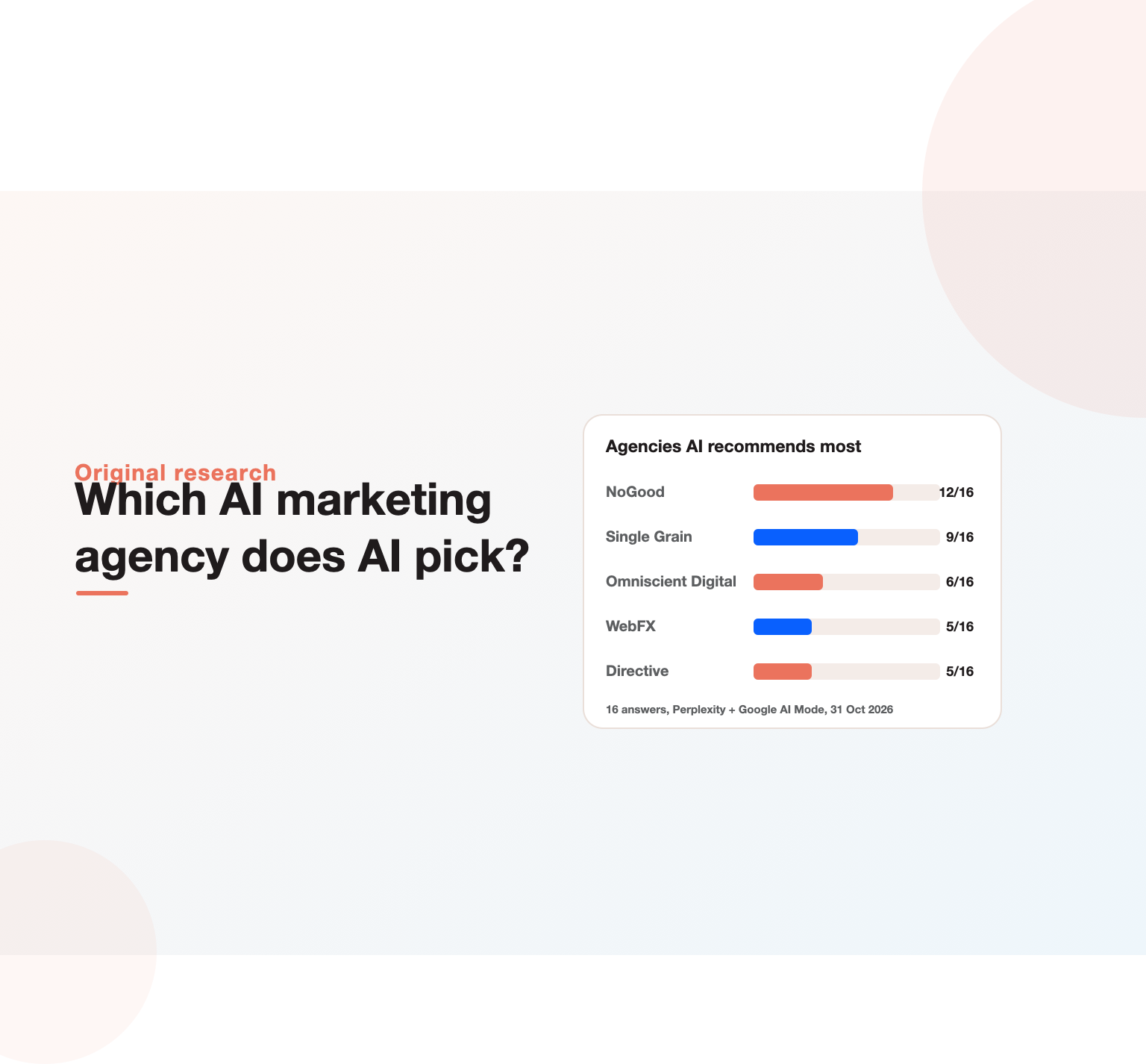
Which AI marketing agency do ChatGPT-style engines recommend? We asked Perplexity and Google AI Mode 8 buyer questions: 87 agencies named, NoGood in 12 of 16.
Quick Answer
An AI marketing agency is a marketing firm that uses artificial intelligence across strategy, content, paid media, search and analytics, and that increasingly helps brands get recommended inside AI answers. To see which agencies AI itself recommends, we asked Perplexity and Google AI Mode eight buyer questions, from “best AI marketing agency” to “best AI marketing agency in India”. Across 16 answers they named 87 different agencies. NoGood appeared in 12 of the 16 answers, followed by Single Grain (9), Omniscient Digital (6), WebFX (5) and Directive Consulting (5). But the two engines agreed on only 3.6 of their top 10 agencies on average, so the agency you are shown depends heavily on where you ask.
Key Highlights
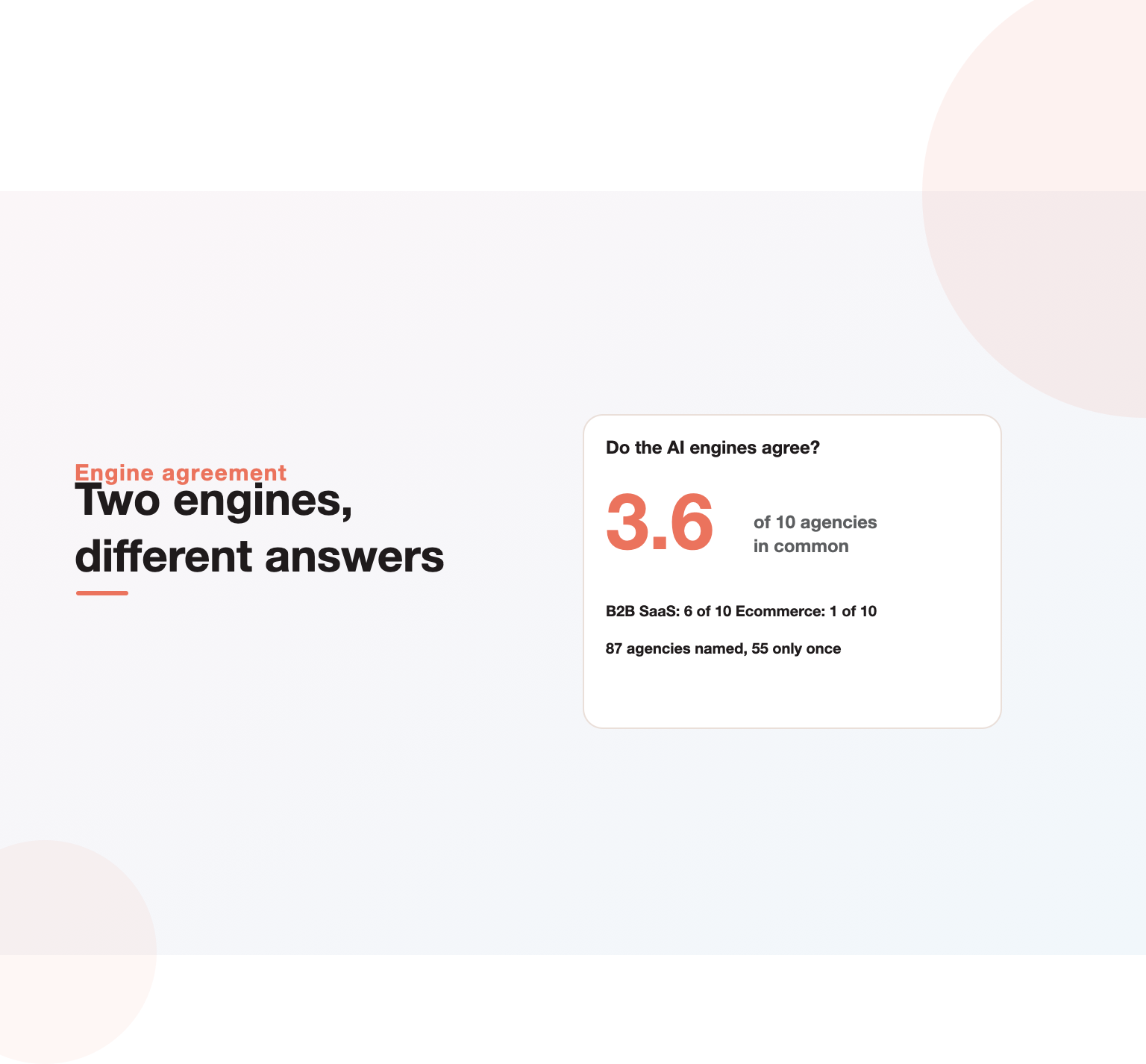
- 16 AI answers to 8 buyer questions named 87 different agencies; 55 of them appeared only once.
- NoGood was the most recommended agency, named in 12 of 16 answers (75%) across both engines.
- Single Grain (9 answers), Omniscient Digital (6), WebFX (5) and Directive Consulting (5) complete the top five.
- The two engines agreed on only 3.6 of 10 agencies per question on average, and on just 1 of 10 for ecommerce.
- For India, both engines named WATConsult, Kinnect, Growth Hackers Digital and AdGlobal360.
- In one answer, two agencies were recommended on the strength of “best agency” lists they had published themselves.
What is an AI marketing agency?
An AI marketing agency is a marketing services firm that builds artificial intelligence into how it plans, produces and optimises campaigns. The term covers a wide range of businesses. At one end are established agencies that have added AI tools to their existing services, such as using machine learning for bid management or generative tools for ad creative. At the other end are newer AI-native firms that position AI as the core of what they do, from automated content production to AI search visibility.
In practice, most agencies that describe themselves this way offer some mix of the following:
- AI search optimization (often called AEO or GEO): getting a brand cited and recommended inside ChatGPT, Perplexity, Gemini and Google’s AI answers.
- AI-assisted content at scale, with human editing and fact-checking.
- Paid media run with machine-learning bidding, automated creative testing and audience modelling.
- Analytics and attribution that use modelling to estimate the impact of each channel.
- Marketing automation and AI agents for lead qualification, follow-up and reporting.
- AI training and workflow design to help in-house teams adopt the tools themselves.
Because the label is so broad, two firms that both call themselves an AI marketing agency may offer very different services. That is the first thing to clarify before comparing them.
Our research: which agencies does AI recommend?
When buyers look for an agency today, many start by asking an AI assistant rather than scrolling search results. So we asked the AI assistants directly. On 31 October 2026 we put the same eight questions to Perplexity and to Google AI Mode, asking each to name ten agencies:
- What are the best AI marketing agencies?
- Which is the best AI marketing agency in the United States?
- Which is the best AI marketing agency in India?
- Which is the best AI marketing agency for a B2B SaaS company?
- Which is the best AI digital marketing agency for ecommerce brands?
- Which marketing agencies are best at AI search optimization?
- Which AI-powered digital marketing agencies are best for enterprise brands?
- Which is the best AI marketing agency for startups?
We recorded every agency named in each answer, producing 16 answers in total, and counted how often each agency appeared. The full method is at the end of this article.
The most recommended AI marketing agencies
| Agency | Answers naming it (of 16) | Engines | Questions it appeared in |
|---|---|---|---|
| NoGood | 12 | Both | 7 of 8 |
| Single Grain | 9 | Both | 7 of 8 |
| Omniscient Digital | 6 | Both | 4 of 8 |
| WebFX | 5 | Both | 3 of 8 |
| Directive Consulting | 5 | Both | 3 of 8 |
| Monks | 4 | Both | 2 of 8 |
| Tinuiti | 4 | Both | 3 of 8 |
| Thrive Internet Marketing | 4 | Both | 3 of 8 |
| iPullRank | 4 | Both | 3 of 8 |
| Fractl | 4 | Perplexity only | 4 of 8 |
| Power Digital | 3 | Both | 3 of 8 |
| Kalungi | 3 | Both | 2 of 8 |
| Jellyfish | 3 | Perplexity only | 3 of 8 |
| Superside | 3 | Perplexity only | 3 of 8 |
NoGood is the clear outlier. It was named for almost every question type, from startups to enterprise and from ecommerce to AI search, and by both engines. Single Grain shows the same breadth. Every other agency was recommended for a narrower set of questions, which suggests the AI engines associate them with a specific niche rather than with AI marketing in general.
The two engines rarely agree
The most striking result is how differently the two engines answered the same question. For each prompt we compared the ten agencies named by Perplexity with the ten named by Google AI Mode.
| Question | Agencies both engines named | Agreement |
|---|---|---|
| B2B SaaS | Directive Consulting, Kalungi, NoGood, Omniscient Digital, Refine Labs, Single Grain | 6 of 10 |
| AI search optimization | First Page Sage, iPullRank, NoGood, Siege Media, Thrive Internet Marketing, WebFX | 6 of 10 |
| India | AdGlobal360, Growth Hackers Digital, Kinnect, WATConsult | 4 of 10 |
| Enterprise | Accenture Song, Deloitte Digital, Monks, Tinuiti | 4 of 10 |
| Best overall | Monks, NoGood, Single Grain | 3 of 10 |
| Startups | Directive Consulting, NoGood, Omniscient Digital | 3 of 10 |
| United States | NoGood, WebFX | 2 of 10 |
| Ecommerce | Darkroom | 1 of 10 |
On average the engines agreed on 3.6 of 10 agencies. Agreement was highest for well-defined niches with an established set of specialists, such as B2B SaaS and AI search, and lowest for broad questions such as the best agency in the United States or for ecommerce. For a buyer, the lesson is simple: one AI answer is a starting list, not a verdict. For an agency, it means visibility in one engine says little about visibility in another.
Recommended agencies by use case
B2B SaaS
The strongest agreement in our data: Directive Consulting, Kalungi, NoGood, Omniscient Digital, Refine Labs and Single Grain were named by both engines. In addition, Perplexity added TripleDart, Hop AI, RevvGrowth and Mighty and True; Google AI Mode added Optimist, RZLT, GrowthSpree and Graphite. For more depth on this segment, see our guides to the best SaaS SEO agencies and best B2B SEO agencies.
AI search optimization
Both engines named First Page Sage, iPullRank, NoGood, Siege Media, Thrive Internet Marketing and WebFX. The Perplexity answer also listed Omniscient Digital, Seer Interactive, Minuttia and Brainlabs; Google AI Mode listed Evolve, Victorious, Single Grain and Go Fish Digital. Our AEO agency comparison covers this specialism in more detail.
Enterprise
Large consultancies and holding-company networks dominate: Accenture Song, Deloitte Digital, Monks and Tinuiti appeared in both. Beyond those, Perplexity added Publicis Sapient, WPP and VML, Merkle, Jellyfish and Superside; Google AI Mode added Power Digital, Single Grain, Tribe AI, NoGood, Brave Bison and IBM iX.
Ecommerce
The engines disagreed almost completely. Only Darkroom appeared in both. One engine, Perplexity, favoured large performance agencies such as Tinuiti, Power Digital and Wpromote, while Google AI Mode named ecommerce development and specialist firms such as Digital Commerce Partners, Magebit and Absolute Web.
Startups
Directive Consulting, NoGood and Omniscient Digital appeared in both answers. On the Perplexity side, developer-marketing specialists appeared too: Infrasity, Draft.dev and Hackmamba, while Google AI Mode named growth firms such as Genesys Growth, GrowthSpree and RevvGrowth.
United States
Only NoGood and WebFX appeared in both answers. The Perplexity list leaned toward content and growth agencies such as Fractl and Xponent21; Google AI Mode named larger US agencies such as NP Digital, Ignite Visibility, Amsive and iPullRank.
Not sure which marketing channels are worth your budget?
Our team reviews your current setup and shows you where the opportunities are. See how our digital marketing consulting work.
Which AI marketing agency does AI recommend in India?
For Indian buyers, the two engines named four agencies in common: WATConsult, Kinnect, Growth Hackers Digital and AdGlobal360. On Perplexity, the list leaned toward large, established networks and specialists, including iProspect India, Schbang, Techmagnate and AdLift. Google AI Mode’s list included more independent and performance-focused firms, such as Ministry of Marketing, Moris Media, OneMetrik, Social Beat and EZ Rankings.
India is notable for having the highest agreement of any geographic question in our test. That likely reflects a smaller set of agencies that appear consistently in Indian industry rankings and press coverage, which the AI engines draw on.
What gets an agency recommended by AI
Looking at which agencies appeared, and at the sources Google AI Mode cited, a few patterns stand out. These are observations from our data, not rules published by the engines.
- A clear niche wins specific questions. Agencies associated with one specialism, such as Kalungi for B2B SaaS or iPullRank for AI search, appeared reliably for that question and rarely elsewhere.
- Breadth plus content wins general questions. NoGood and Single Grain publish extensively about AI marketing and were named across almost every question type.
- Third-party lists shape answers. The engines draw heavily on published “best agency” roundups. In Google AI Mode’s answer to the general question, two of the ten agencies recommended, LymLyt and Right Side Up, were the publishers of the roundup articles the answer cited, each of which listed its own agency first.
- Directories and community threads matter. Google AI Mode also cited a Reddit thread listing AI marketing agencies as a source.
The third point is the one buyers should notice. A recommendation from an AI engine can trace back to an agency’s own marketing. Check the sources an AI answer cites before relying on it. For a deeper explanation of how the engines select brands, see our guide on how AI search engines choose which brands to cite.
How to choose an AI marketing agency
AI recommendations are a useful starting list, but the choice should rest on evidence you can check.
- Define the job first. AI search visibility, paid media, content at scale and marketing automation need different skills. Decide which outcome you need before you compare agencies.
- Ask for results with numbers. Request case studies showing the before and after, the time frame and the metric that changed, ideally in your industry.
- Ask how they use AI, specifically. Which tools, for which tasks, and where humans review the output. “We use AI” is not an answer.
- Check their own AI visibility. Any agency selling AI search optimization should be visible in AI answers for its own category. Ask the engines yourself.
- Look at measurement. Ask how they will report results and connect them to pipeline or revenue, not only traffic. Our marketing attribution guide explains what to expect.
- Meet the team who will do the work. Senior people often sell the account and junior people run it.
- Start with a defined pilot. A fixed-scope, time-boxed project with agreed success measures lowers the risk on both sides.
Services a good AI marketing agency should offer
The label covers so much that it helps to know what each service involves and what good looks like.
AI search optimization
The work of getting a brand named in AI answers. It includes making the brand clearly identifiable to the engines through consistent entity information and structured data, publishing content that answers buyer questions directly, earning mentions in the third-party sources the engines draw on, and measuring citations across each engine. Expect a baseline audit of where you appear today and a monthly view of how that changes.
AI-assisted content
Using AI to research, outline and draft at speed, with subject experts and editors checking every claim. Good agencies are open about where AI is used and can show their review process. Google’s guidance on AI-generated content is clear that content made mainly to manipulate rankings at scale risks being treated as spam, so the human layer is not optional. Our content writing services follow this model.
AI in paid media
Platform automation such as Google’s Performance Max and Meta’s Advantage+ now does much of the bidding and targeting. The agency’s value shifts to feeding those systems good conversion data, producing and testing many creative variations, and judging results on profit rather than platform-reported numbers.
Automation and AI agents
Automating lead scoring, routing, follow-up and reporting, and increasingly deploying AI agents that qualify leads or answer enquiries. See our marketing automation services and marketing automation strategy guide.
Measurement
Connecting marketing activity to pipeline and revenue, using attribution modelling and, where budgets allow, incrementality tests. As AI answers reduce clicks, measurement that looks beyond the last click becomes more important.
What working with an AI marketing agency looks like
A well-run engagement usually follows a similar shape in its first three months.
- Weeks 1 to 2: audit and baseline. The agency reviews your current channels, data and content, and records where you appear in AI answers and search results today.
- Weeks 3 to 4: plan and priorities. A short list of initiatives ranked by expected impact and effort, with agreed measures of success.
- Months 2 to 3: execution and first results. Content, technical fixes, campaign changes or automation go live, with weekly or fortnightly reporting.
- End of month 3: review. Compare results with the baseline and decide what to scale, change or stop.
Some results, such as paid media efficiency, can move within weeks. Others, such as AI search visibility and organic rankings, typically take several months to show. Promises of instant AI visibility are a sign of overpromising.
AI marketing agencies for small businesses
Most agencies named in our test serve funded startups, mid-market and enterprise brands. Smaller businesses have different needs: a tighter budget, fewer channels and less internal capacity to manage an agency. For them, the right partner often focuses on a few high-impact jobs, such as local and AI search visibility, a simple lead capture and follow-up system, and one or two paid channels, rather than a full-service programme.
When comparing options as a small business, ask for examples from businesses of a similar size, insist on simple reporting you can understand, and avoid long contracts before a pilot proves value. Our growth marketing services are structured around that kind of staged approach.
How AI marketing agencies use AI day to day
Asking for concrete examples is the quickest way to separate real capability from marketing language. Strong answers sound like these:
- “We use an AI tool to cluster thousands of keywords and buyer questions into topics, then a strategist decides which to prioritise.”
- “We generate twenty ad variations per concept with AI, then a creative lead picks the five worth testing.”
- “We track how often your brand is cited across ChatGPT, Perplexity and Google AI answers every month for a fixed set of buyer questions.”
- “An AI agent qualifies inbound leads against your criteria and books meetings, with every conversation logged in the CRM.”
Weak answers stay abstract: “we leverage AI to drive growth” tells you nothing about what actually happens to your account.
Questions to ask before hiring an AI digital marketing agency
- Which parts of your work use AI, and which are done by people?
- How do you check AI-generated content for accuracy and originality?
- Can you show us where your clients appear in ChatGPT, Perplexity or Google’s AI answers, before and after your work?
- Which of our competitors do you also work with?
- What will we own at the end of the engagement: content, data, accounts and workflows?
- How do you measure success in the first 90 days?
- Who on your team will run our account day to day?
A simple scorecard for your shortlist
Once you have three to five candidates, score each one from 1 to 5 on the same criteria so the decision rests on evidence rather than the best pitch.
| Criterion | What a 5 looks like |
|---|---|
| Relevant results | Case studies in your industry with numbers, time frames and named metrics |
| AI process | Specific tools and tasks, with clear human review at each step |
| Own AI visibility | The agency appears in AI answers for its own specialism |
| Measurement | Reporting tied to leads, pipeline or revenue, not only activity |
| Team | You have met the people who will run your account |
| Commercial terms | Clear scope, a pilot option and a reasonable notice period |
| Independent proof | Reviews, references and coverage from sources the agency does not control |
Keep the scores and the evidence behind them in one shared document, so everyone involved in the decision sees the same facts. It also gives you a baseline to hold the winning agency to after the pilot, because the promises made during the pitch are written down next to the evidence offered for them.
Weight the criteria to match your priorities. A company that mainly needs AI search visibility might double the weight on own AI visibility and relevant results, while a company buying paid media might weight measurement most heavily.
Red flags
- Guaranteed AI rankings or citations. No one controls what ChatGPT or Google’s AI says. Promises of guaranteed placement are a warning sign.
- Volume over quality. Publishing hundreds of thin AI-written pages can trigger search penalties for scaled low-value content.
- No human review. AI output needs editing and fact-checking before it carries your brand.
- Vague reporting. Dashboards full of activity metrics with no link to leads or revenue.
- Self-ranked lists as proof. Topping your own “best agencies” article is marketing, not evidence.
Want a marketing plan built around your numbers?
Book a free 30-minute strategy call and leave with a clear next step for your business.
AI marketing agency vs traditional agency vs in-house
| AI marketing agency | Traditional agency | In-house team | |
|---|---|---|---|
| Speed of output | High, with AI-assisted production | Moderate | Depends on team size |
| AI search visibility | Often a core service | Varies widely | Usually a skills gap |
| Brand knowledge | Builds over time | Builds over time | Deepest |
| Best for | Scaling content, AI search and testing fast | Established channels and creative | Ongoing core marketing |
Many companies combine them: an in-house team owns strategy and brand, while an AI marketing company handles specialist work such as AI search optimization or high-volume content. Our digital marketing consulting work often starts by deciding that split.
How agencies can get recommended by AI
The data also offers lessons for agencies themselves, and for any business that wants to be named when buyers ask an AI assistant.
- Own a clear category. Engines recommended niche specialists consistently for their niche. Be specific about who you serve.
- Get listed by independent sources. Roundups, directories, reviews and press coverage feed the answers. Your own website alone is not enough.
- Publish evidence. Case studies with real numbers and original research give engines something to cite.
- Measure your visibility in each engine separately. With only 3.6 of 10 agencies in common between engines, visibility in one says little about another. Our free AI visibility score and guide to tracking AI citations show how.
This is the work our AEO services and generative engine optimization teams do for clients, alongside AI search optimization more broadly.
How AI marketing agencies charge
Pricing models vary more than headline rates, and the model shapes the agency’s incentives.
- Monthly retainer. A fixed fee for an agreed scope of ongoing work. Predictable, but check exactly what is included each month.
- Project fee. A fixed price for a defined piece of work, such as an AI visibility audit or a content programme. Good for pilots.
- Percentage of ad spend. Common in paid media. Simple, but it can reward spending more rather than spending well.
- Performance-based. Fees tied to leads, sales or revenue. Attractive in theory, but only works when tracking is reliable and both sides agree on what counts.
- Hybrid. A smaller retainer plus a performance component, increasingly common for AI search and growth work.
Whatever the model, ask what happens if results fall short, how scope changes are handled and what notice period applies.
The limits of asking AI for an agency
Our results show both the value and the weakness of using AI assistants to find a partner. They are fast at producing a shortlist and often surface specialists a search engine would not show on page one. But the same question produced substantially different lists from two engines, some recommendations were traceable to self-published rankings, and well-known agencies were missing from many answers entirely. AI engines also rarely know about smaller or newer agencies with little written about them online, which may include excellent local specialists.
The practical approach is to use AI answers as one input among several: ask more than one engine, follow the cited sources, check independent review sites and directories, ask peers for referrals, and judge each candidate on evidence you can verify yourself. For a structured comparison process, see our guide to choosing an agency for AI visibility.
Where AI marketing is heading
Two shifts are reshaping what an AI marketing agency does. First, paid placements are arriving inside AI assistants themselves: our research on ChatGPT Ads found a quarter of B2B SaaS companies already have OpenAI’s ad pixel installed. Second, AI agents are taking over operational work, from AI voice agents that call new leads to automated reporting. The agencies that stay relevant will be those that combine organic AI visibility, paid AI placements and automation into one plan, and can prove the result in pipeline.
Disclosure
Unified Platforms is a marketing agency that offers AI search optimization and related services. We were not named in any of the 16 AI answers in this study, and we have not added ourselves to any ranking. The results reflect only what the AI engines returned.
Methodology
On 31 October 2026 we asked eight questions, listed above, to Perplexity (logged out, default model) and Google AI Mode (in a signed-in Chrome browser set to US English). Each question asked for ten agencies. We recorded every agency named in each answer, merged obvious name variants (for example “Directive” and “Directive Consulting”), and counted appearances across the 16 answers. Agreement between engines is the number of agencies named by both for the same question. AI answers change between sessions, locations and accounts, and Google AI Mode answers may reflect personalisation, so results are a snapshot rather than a stable ranking. We did not verify the claims the engines made about each agency. The raw answers are available on request.
Key Takeaways
- An AI marketing agency uses AI across strategy, content, paid media, search and analytics, and increasingly helps brands get recommended by AI.
- Across 16 answers from Perplexity and Google AI Mode, NoGood was the most recommended agency (12 of 16), followed by Single Grain (9).
- The engines agreed on only 3.6 of 10 agencies per question on average, so one AI answer is not a verdict.
- Some recommendations traced back to agencies’ own self-published rankings; check an answer’s sources.
- Choose on evidence: defined scope, case studies with numbers, a clear AI process with human review, and a pilot with agreed measures.
Frequently asked questions
What is an AI marketing agency?
An AI marketing agency is a marketing firm that uses artificial intelligence across planning, content, paid media, search and analytics. Many also offer AI search optimization to help brands get cited by ChatGPT, Perplexity and Google’s AI answers.
What are the best AI marketing agencies?
In our test of 16 answers from Perplexity and Google AI Mode, the most recommended agencies were NoGood (12 answers), Single Grain (9), Omniscient Digital (6), WebFX (5) and Directive Consulting (5). The best choice depends on your industry and the work you need.
Which is the best AI marketing agency in India?
Both engines named WATConsult, Kinnect, Growth Hackers Digital and AdGlobal360 for India. Perplexity also listed iProspect India, Schbang, Techmagnate and AdLift; Google AI Mode listed Ministry of Marketing, Moris Media, OneMetrik, Social Beat and EZ Rankings.
Do ChatGPT and other AI tools agree on the best agencies?
Often not. In our test, Perplexity and Google AI Mode agreed on only 3.6 of 10 agencies per question on average, and on just one agency for ecommerce.
How do I choose an AI digital marketing agency?
Define the outcome you need, ask for case studies with numbers, ask exactly how AI is used and reviewed, check the agency’s own AI visibility, confirm how results will be measured, and start with a time-boxed pilot.
How do agencies get recommended by AI?
From our data, agencies with a clear niche, strong independent coverage in roundups, directories and reviews, and published evidence such as case studies and research were recommended most consistently.
Ready to put this into practice?
Talk to the team that runs SEO, AI search and paid growth programs every day.
Book a Strategy Call →