 Skip to content

Healthcare SEO: Win Patients With Trust
Healthcare SEO explained: how medical practices win patients with credentialed expertise, strong local presence, reviews and accurate condition content that clears search's strictest trust bar.
Quick Answer
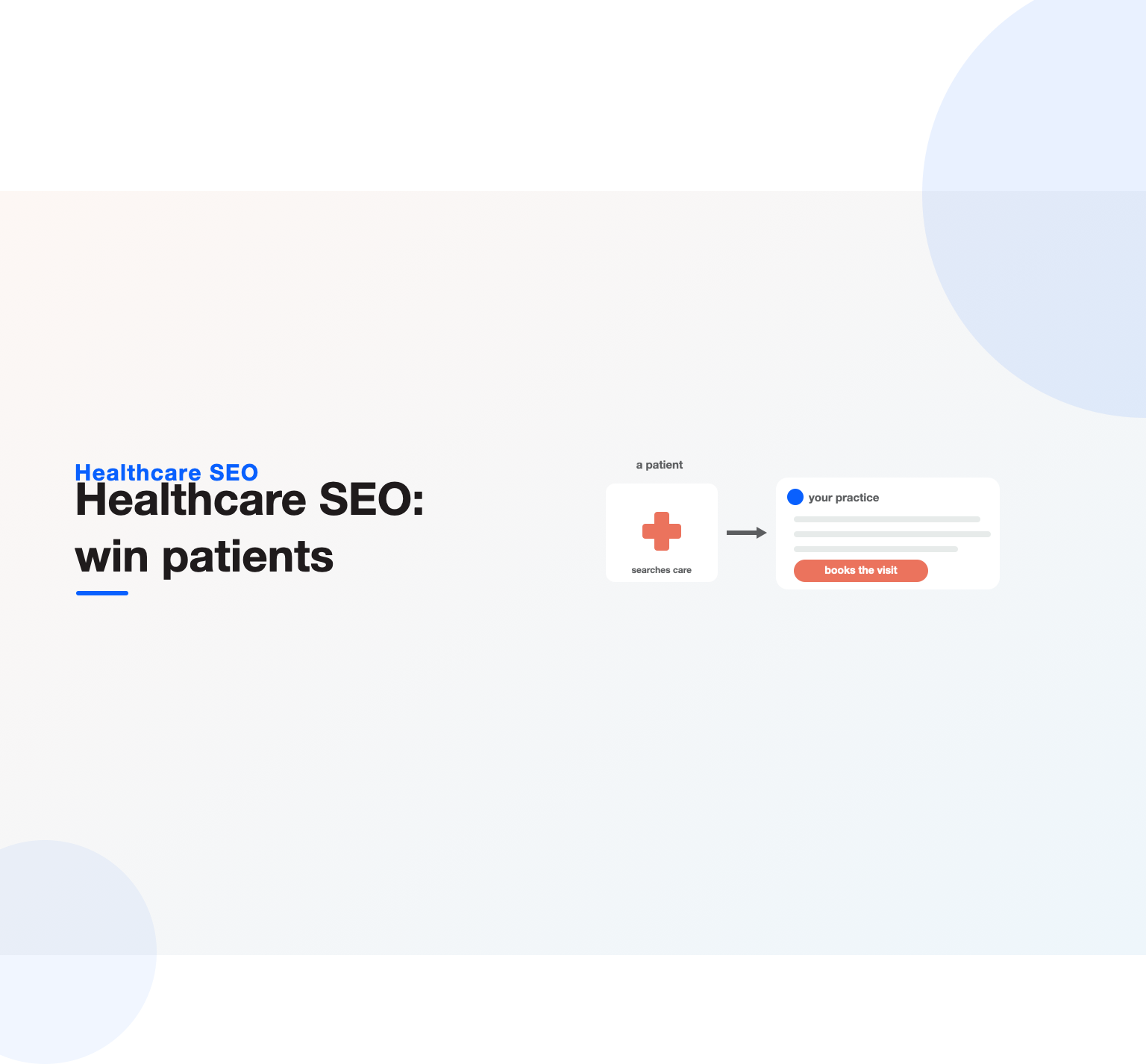
Healthcare SEO is the practice of helping medical practices, clinics, hospitals and health providers appear when patients search for care, symptoms, conditions and providers. It carries an unusually high bar because health sits in the category search engines treat most strictly, where accuracy, credentials and trust are scrutinized closely before a page is shown to someone making a decision about their wellbeing. Winning it means demonstrating genuine medical expertise and authorship, building a strong local presence so nearby patients find you, earning credible reviews, and publishing accurate, helpful content about the conditions and treatments you handle. Done well, healthcare SEO turns the moment a patient searches for a symptom or a provider into an appointment with your practice rather than a competitor.
Key Highlights
- Healthcare SEO faces the strictest trust bar, since health is the category engines scrutinize most.
- Demonstrating real medical expertise, credentials and authorship is essential, not optional.
- Most patient searches are local, so a strong local presence and reviews drive appointments.
- Accurate, helpful content about conditions and treatments builds authority and reaches patients early.
- The same trust signals increasingly decide whether AI answers recommend your practice.
Why healthcare SEO is different
Search engines do not treat all topics equally, and health sits squarely in the category they handle most cautiously, the subjects that can affect a person’s wellbeing, safety or finances. For these queries, engines apply a far higher standard of scrutiny, weighing the expertise, authoritativeness and trustworthiness of a source before surfacing it, because a wrong or misleading answer about a symptom or treatment carries real consequences. That elevated bar is the defining feature of healthcare SEO and the reason it cannot be approached like ordinary marketing content.
The practical upshot is that a healthcare provider must prove its credibility to rank, not merely assert it. Content about medical topics is expected to be written or reviewed by qualified professionals, attributed to named authors with real credentials, and grounded in accurate, current medical understanding. A generic article on a health condition, however well optimized in the traditional sense, struggles against content that clearly comes from a credentialed source, because the engine is actively looking for signals of genuine medical authority. This makes expertise and transparent authorship central pillars rather than nice-to-haves.
This higher standard also shapes how a practice should think about the whole effort. Rather than chasing keywords in isolation, a provider builds a credible, trustworthy presence, accurate content, clear credentials, a strong reputation, that satisfies both the engine’s scrutiny and the patient’s understandable caution about who to trust with their health. That alignment between what earns rankings and what earns patient trust is, in a sense, the good news of healthcare SEO: doing right by patients and doing well in search point in the same direction, a principle our overview of SEO services applies across every regulated field.
Demonstrating medical expertise and trust
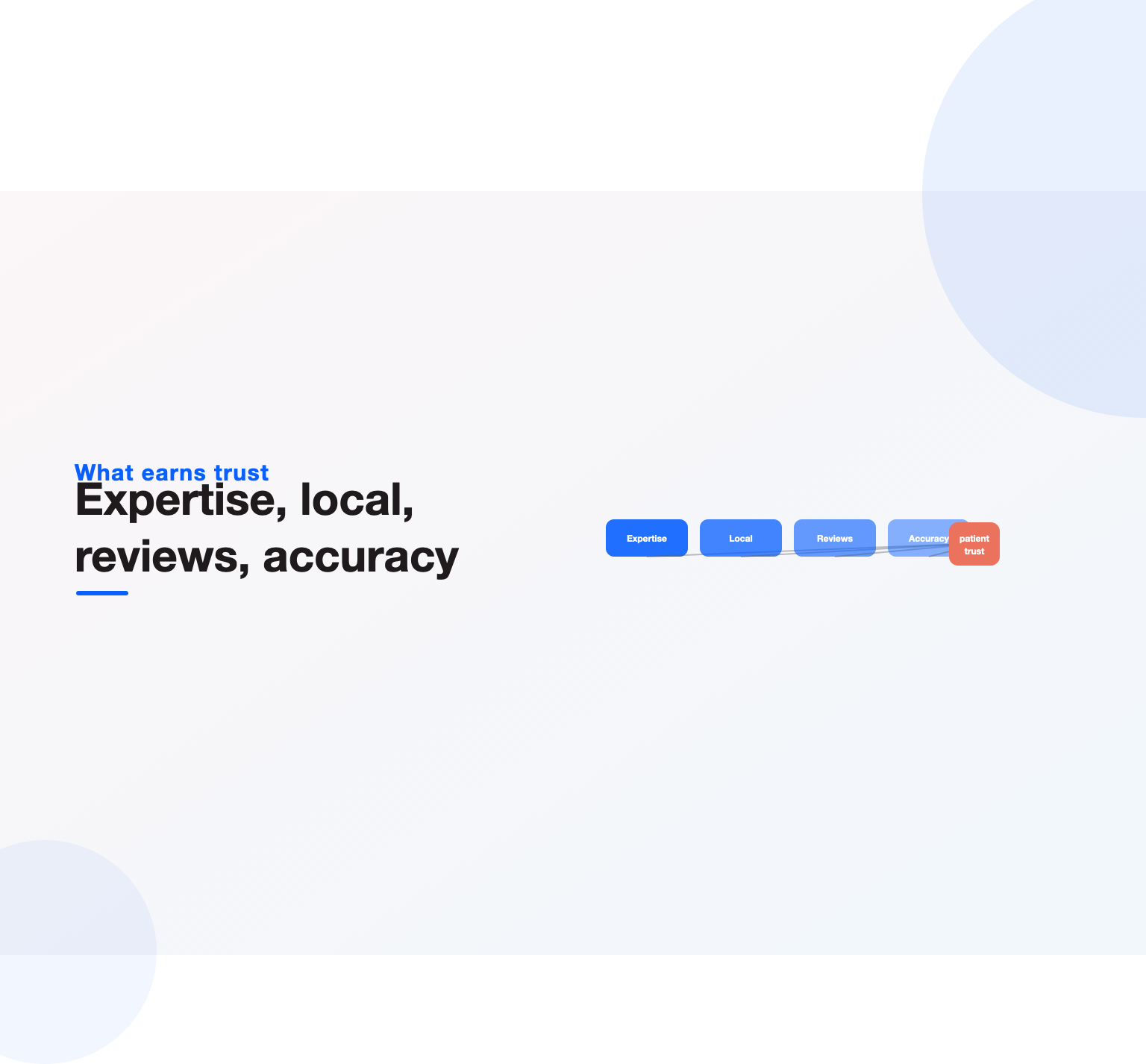
Since the trust bar is so high, demonstrating genuine expertise is the foundation of healthcare SEO. The most direct way is authorship: medical content should be written or reviewed by qualified professionals and clearly attributed to them, with real names, credentials and relevant experience shown, so both the engine and the patient can see who stands behind the information. A page on a condition that carries a named physician’s review signals a level of authority that anonymous content simply cannot match, and it is exactly what engines look for on health topics.
Beyond individual articles, a practice builds trust through the credibility of the whole organization. Clear information about your providers, their qualifications, their specialties and their affiliations establishes the practice as a legitimate, expert source, and consistency of that information across the web reinforces it. Professional recognition, memberships and genuine credentials all contribute to the picture an engine assembles of whether you are a source worth trusting with a patient’s health question, which is why presenting them clearly matters as much as the content itself.
Accuracy underpins all of it. Medical information must be correct and current, since outdated or mistaken content actively undermines the trust a provider is trying to build, and engines are increasingly capable of favoring sources that align with established medical understanding. Keeping content reviewed and up to date, and correcting it as guidance evolves, is therefore part of the ongoing work rather than a one-time task. This discipline, expert authorship, clear credentials, and rigorous accuracy, is what allows a healthcare provider to clear the bar that lower-stakes topics never face.
Local search and the patient journey
For most healthcare providers, the majority of valuable searches are local, because patients want care they can actually reach. Someone searching for a provider, a specialty or an urgent need is usually looking for options nearby, so appearing prominently in the local results and the map is often the single biggest driver of new patients. That makes a strong local presence, a complete and accurate provider profile, correct location and hours, clear service information, central to healthcare SEO for any practice with a physical location.
Reviews carry particular weight in healthcare because choosing a provider is a high-trust decision, and patients lean heavily on the experiences of others. Genuine, positive reviews across trusted platforms both improve local visibility and strongly influence whether a patient comparing options chooses your practice, so a thoughtful, compliant approach to earning and responding to reviews is a core part of the work. Handled well, and always within the privacy rules that govern healthcare, reviews become one of the most persuasive assets a practice has, tying directly into the broader local SEO foundations that win nearby patients.
Understanding the patient journey sharpens the whole effort. Patients often begin not by searching for a provider but by searching for a symptom, a condition or a treatment, gathering understanding before they ever look for care. A practice that meets them at that earlier, informational stage with accurate, helpful content builds awareness and trust well before the moment of choosing a provider, so that when the patient is ready to book, your practice is already familiar and credible. Mapping content to the stages of that journey, from early symptom research to provider selection, is what turns healthcare SEO from a collection of tactics into a coherent strategy for patient acquisition.
Content that reaches and reassures patients
Content is where a practice meets patients early and demonstrates its expertise, and in healthcare it must do both jobs at once. Accurate, clearly written material about the conditions you treat, the procedures you perform and the questions patients commonly ask serves the person seeking understanding and signals genuine authority to the engine. The aim is content that a patient finds genuinely helpful and reassuring, written in plain language but grounded in real medical knowledge, since that combination is what earns both trust and rankings on health topics.
The most valuable content often answers the specific questions patients actually ask, about symptoms, what to expect from a treatment, how to prepare for a procedure, when to seek care. Addressing these directly and accurately meets patients at their moment of need and positions the practice as a knowledgeable, trustworthy guide. Since health decisions are anxious ones, content that is clear, honest and reassuring, neither alarmist nor dismissive, serves the patient’s emotional as well as informational needs, which deepens trust in a way that dry, generic articles do not.
Depth and breadth matter too, since engines favor sources that comprehensively and credibly cover their area. A practice that thoroughly addresses the conditions and treatments within its specialties builds the topical authority that lifts all of its content, rather than relying on a few thin pages. This comprehensive, patient-centered content also feeds the wider goal of being found across every surface, since accurate, well-structured medical information is exactly what modern answer systems draw on, planning it against genuine patient demand much as our guide on SEO cost advises for any content investment.
Technical and privacy-aware foundations
Underneath the trust and content work sits a technical foundation that healthcare sites cannot neglect, because patients increasingly search on phones and expect a fast, secure, easy experience. A quick, mobile-friendly site with clear navigation to appointment booking, service pages and provider information is essential, since a slow or confusing site loses anxious patients at the moment they are ready to act. Secure browsing, sensible structure and clean, crawlable pages let engines understand the site and let patients move smoothly from a search to a booking, so the technical base directly supports the acquisition goal.
Privacy adds a dimension general businesses rarely face. Healthcare providers operate under strict rules about patient information, so the marketing effort must be designed to respect them at every turn, from how reviews are solicited to how forms collect data to what any tracking captures. A responsible approach never trades compliance for a marketing gain, and it treats patient privacy as a constraint that shapes the whole program rather than an afterthought. Getting this right protects both patients and the practice, and it is one reason healthcare providers often prefer a partner experienced in the field over a generalist unfamiliar with the obligations, a consideration our overview of SEO services takes seriously for regulated industries.
Structured, well-organized information also helps engines present a practice accurately, from its locations and hours to its services and providers. Clear, consistent details about the organization across the site and the web reduce the ambiguity that holds back visibility, and they make it easier for both search engines and, increasingly, AI systems to describe the practice correctly. This technical and organizational clarity is unglamorous but foundational, since even excellent content and reviews underperform on a site engines struggle to read, and planning the work against real demand, as our guide on SEO cost advises, keeps the investment proportionate.
Common healthcare SEO mistakes
Several avoidable errors hold healthcare providers back. The most damaging is publishing medical content without credible authorship or review, since anonymous or unqualified content struggles to rank on scrutinized health topics and can erode the very trust a practice needs. A related mistake is letting content go stale, leaving outdated medical information on the site, which both misleads patients and signals unreliability to engines that increasingly favor current, accurate sources. Both stem from treating medical content like ordinary marketing copy rather than the high-stakes information it is.
Another cluster of mistakes involves the local foundation. Some practices leave their provider profiles incomplete or inconsistent, with wrong hours, missing locations or conflicting details, which quietly caps their visibility for the nearby searches that drive most patients. Others neglect reviews entirely, missing the single most persuasive signal in a high-trust decision, or handle them in ways that risk the privacy rules. A further error is ignoring the earlier stages of the patient journey, focusing only on provider-selection queries while competitors capture patients earlier with helpful condition content. Avoiding these mistakes is less about clever tactics than about doing the fundamentals thoroughly and responsibly, the same discipline our guide on SEO for business stresses for durable results.
Healthcare SEO for multi-location and specialty practices
Providers with several locations or multiple specialties face a more demanding version of the same work, and how they handle it separates strong programs from weak ones. A group with multiple sites needs a distinct, genuinely useful page for each location, and where eligible a separate verified profile for each, so every site can rank in its own area rather than competing with the others. Thin, near-identical location pages are the classic failure here; each should carry real specifics, the providers there, the services offered, the community served, that a local patient would value.
Specialty depth matters as much as geographic spread. A practice spanning several specialties builds authority fastest by covering each one thoroughly, with credentialed content and clear provider information for every service line, rather than treating the whole site as a single undifferentiated entity. This lets the practice rank for the specific conditions and treatments within each specialty, which is where much high-intent patient search concentrates. Coordinating consistent information, reviews, content and local presence across many locations and specialties is a substantial undertaking, which is why larger providers most often bring in a dedicated local SEO partner to run the program coherently across every site and service they offer.
Healthcare SEO and AI answers
As patients increasingly turn to AI assistants and answer features for health questions, the trust signals that power healthcare SEO have taken on added importance. When someone asks an assistant about a symptom, a treatment or a provider, the system draws on sources it judges authoritative and trustworthy, and for health topics that judgment is especially cautious, favoring credible, expert, accurate sources. A practice that has built genuine medical authority, clear authorship, accurate content, strong reputation, is well positioned to be the source those answers rely on.
This convergence means the work of healthcare SEO and the work of appearing in AI answers are largely the same investment. The credentialed authorship, accuracy and reputation that satisfy a search engine’s scrutiny are precisely what make an AI system confident enough to surface a health source, so effort spent building trustworthy medical content pays off across both classic search and AI answers. For a healthcare provider, this reinforces the case for doing the trust work thoroughly, since it now determines visibility on more surfaces than ever, connecting directly to the emerging discipline of AI search optimization and the answer-focused work it involves.
Measuring healthcare SEO
Healthcare SEO should be judged by patient outcomes rather than vanity metrics, and the measures that matter tie directly to the practice. Appointment requests, calls, direction requests and new patient inquiries are the true signals that visibility is turning into care delivered, and tracking them, alongside the local and organic rankings for your priority terms and services, shows whether the effort is working. A practice that watches new patient inquiries grow as its local presence, reviews and content strengthen has clear evidence the investment is paying off.
Since so much of healthcare search is local, the local metrics deserve particular attention: visibility in the map results, calls and direction requests from nearby searches, and the reviews that influence patient choice. Pairing these with website analytics, which pages patients read, how they move toward booking, connects the content and trust work to real acquisition. Measured this way, over time and against real patient actions, healthcare SEO stays accountable and focused on the outcome that matters, more patients receiving care, rather than on abstract numbers that do not translate to the practice.
Getting started and getting help
A practice can begin healthcare SEO by attending to the fundamentals that matter most: ensuring accurate, credentialed information about providers and services, claiming and completing the local presence, earning genuine reviews within the privacy rules, and publishing accurate, helpful content on the conditions and treatments it handles. These steps build real trust and visibility, and they can be started without deep technical expertise, delivering meaningful early gains for a practice that commits to doing them properly.
The case for specialist help grows with competition, with the number of locations or providers, and with the particular demands of healthcare, the trust bar, the privacy rules, the need for medical accuracy, that make missteps costly. A partner experienced in healthcare understands how to build authority and reputation while respecting the compliance and privacy obligations the field requires, and it brings the pattern knowledge to do it faster and more safely than a practice starting cold. Weighing that against the value of the patients it brings, a question our guide on SEO for business helps frame, is the right way to decide. Whichever route a practice takes, the principle holds: earn patient trust and search visibility together, since in healthcare they are, more than anywhere, the same thing.
A useful way to begin is to look honestly at where patients currently find, or fail to find, your practice. Search the conditions, treatments and provider terms that matter most in your area, and note whether your practice appears in the local results, whether your content answers the questions patients ask, and how your reviews compare with nearby competitors. That quick, concrete audit reveals the gaps that matter most and gives any subsequent work a clear target rather than a vague ambition to be more visible. From there, prioritizing the fixes with the biggest effect on new patient inquiries, usually the local presence and reviews first, keeps the effort focused on outcomes, and understanding what the fuller scope costs, which our guide on SEO cost lays out, lets a practice plan a realistic budget. Approached as a staged, patient-centered program rather than a scramble for rankings, healthcare SEO becomes a dependable source of new patients that strengthens year over year, much as the broader SEO services that surround it are designed to. For providers weighing whether to build this capability in-house or bring in help, the deciding factors are usually competition in the local market, the number of locations and specialties to coordinate, and the comfort of the team with the privacy obligations the field demands, the same practical trade-off our guide on SEO for business frames for any serious, long-term growth investment in a competitive market.
Turning patient trust into sustained growth
The through-line of everything above is that in healthcare, earning search visibility and earning patient trust are the same project. A practice that presents credentialed expertise, maintains accurate content, keeps a strong and consistent local presence, and earns genuine reviews is simultaneously satisfying the engine’s scrutiny and reassuring the patient’s caution, which is why the work compounds rather than plateauing. Each accurate article, each real review, each clearly credentialed provider page adds to an asset that keeps drawing patients long after it is created, in contrast to advertising that stops the moment spending does.
Sequencing that work sensibly keeps it manageable. A practice new to the effort does best starting with the highest-leverage fundamentals, an accurate, complete local presence and a steady flow of compliant reviews, since those most directly drive nearby appointments, then layering in credentialed condition and treatment content that reaches patients earlier in their journey. As those foundations mature, deepening topical coverage across specialties and strengthening the technical base extends the reach further, and the whole program begins to reinforce itself. Judging that investment against the lifetime value of the patients it brings, a lens our guide on SEO for business encourages, usually makes the case clearly for a practice serving a defined area.
It also pays to see healthcare SEO as part of a connected visibility strategy rather than a silo. The credentialed, accurate, well-structured presence that wins classic rankings is exactly what modern answer systems draw on, so the same effort increasingly earns visibility in AI answers through the emerging discipline of AI search optimization and the citation-focused work an answer engine optimization program handles. For a practice, this means the trust it builds pays off across more surfaces every year, from the map results to the AI assistant a patient now asks first. Treating that trust as the central asset, and building it patiently and responsibly, is what turns healthcare SEO from a marketing line item into a durable engine for patient growth, and it is why pairing it with a strong local SEO foundation serves practices so well.
Key Takeaways
- Healthcare SEO clears the strictest trust bar in search, so genuine medical expertise and authorship are essential.
- Clear provider credentials, accurate content and strong reputation are what let a practice rank on health topics.
- Most patient searches are local, so a strong local presence and compliant reviews drive appointments.
- Meeting patients early with accurate, reassuring condition and treatment content builds trust before they choose a provider.
- The same trust signals increasingly decide whether AI answers recommend your practice, so the work pays off across surfaces.
Frequently asked questions
Direct answers to the questions practices ask most about healthcare SEO.
What is healthcare SEO?
It is the practice of helping medical practices, clinics, hospitals and health providers appear when patients search for care, symptoms, conditions and providers. Because health is the category engines scrutinize most strictly, it demands genuine medical expertise, clear credentials and accurate content, alongside a strong local presence and credible reviews. Done well, it turns the moment a patient searches for a symptom or provider into an appointment with your practice rather than a competitor, by earning both the engine’s trust and the patient’s.
Why is healthcare SEO harder than regular SEO?
Because health falls into the category search engines treat most cautiously, where they weigh the expertise, authoritativeness and trustworthiness of a source heavily before showing it, since a wrong answer about a symptom or treatment carries real consequences. That means a healthcare provider must prove its credibility through credentialed authorship, accurate content and a strong reputation rather than merely optimizing keywords. The bar is higher precisely because the stakes for patients are higher, which shapes the entire approach.
How important are online reviews for healthcare SEO?
Very important, because choosing a provider is a high-trust decision and patients lean heavily on others’ experiences. Genuine, positive reviews across trusted platforms both improve local visibility and strongly influence whether a patient comparing options chooses your practice. A thoughtful, compliant approach to earning and responding to reviews, always within the privacy rules that govern healthcare, is a core part of the work and one of the most persuasive assets a practice can build.
Do I need medical professionals to write my content?
Ideally yes. On health topics, engines expect content to be written or reviewed by qualified professionals and clearly attributed to named authors with real credentials, because that demonstrates the expertise the subject demands. Content that carries a physician’s authorship or review signals authority that anonymous articles cannot match. At minimum, medical content should be reviewed for accuracy by a qualified professional and transparently attributed, since credibility is what allows it to rank on scrutinized health queries.
Is healthcare SEO mostly local?
For most providers, yes, because patients want care they can reach, so the majority of valuable searches carry local intent. Appearing prominently in the local results and map for your services and specialties is often the biggest driver of new patients, which makes a complete, accurate local presence and genuine reviews central. That said, informational content about conditions and treatments reaches patients earlier in their journey, so a full strategy combines strong local visibility with helpful, authoritative content.
How does healthcare SEO relate to AI answers?
Closely, because as patients ask AI assistants about symptoms, treatments and providers, those systems draw on sources they judge authoritative and trustworthy, and for health they are especially cautious. The credentialed authorship, accuracy and reputation that satisfy a search engine are exactly what make an AI system confident enough to surface a health source, so the two are largely the same investment. Building genuine medical authority positions a practice to be recommended across both classic search and AI answers.
How do I measure healthcare SEO success?
Judge it by patient outcomes rather than vanity metrics: appointment requests, calls, direction requests and new patient inquiries are the true signals that visibility is becoming care delivered. Track these alongside your local and organic rankings for priority services, and pay particular attention to local metrics like map visibility and calls from nearby searches. Pairing this with website analytics connects your content and trust work to real acquisition, keeping the effort focused on more patients receiving care.
Can a small practice compete in healthcare SEO?
Yes. Because the field rewards genuine expertise, accuracy and a strong local reputation rather than only size, a focused small practice that presents its credentials clearly, earns real reviews, and publishes accurate, helpful content for its specialties can compete well in its area, often on the specific conditions and treatments larger providers cover thinly. Much of the foundational work can begin in-house, with specialist help added as competition or the number of locations grows.
Healthcare: search across every surface
Win healthcare across classic search, local, and the AI answers, each is its own discipline, and they reinforce each other.
Ready to put this into practice?
Talk to the team that runs SEO, AI search and paid growth programs every day.
Book a Strategy Call →