 Skip to content

SEO for Financial Services: Rank With Trust
SEO for financial services explained: the YMYL trust bar, expertise and compliance requirements, content that builds authority, costs, and how to choose a provider.
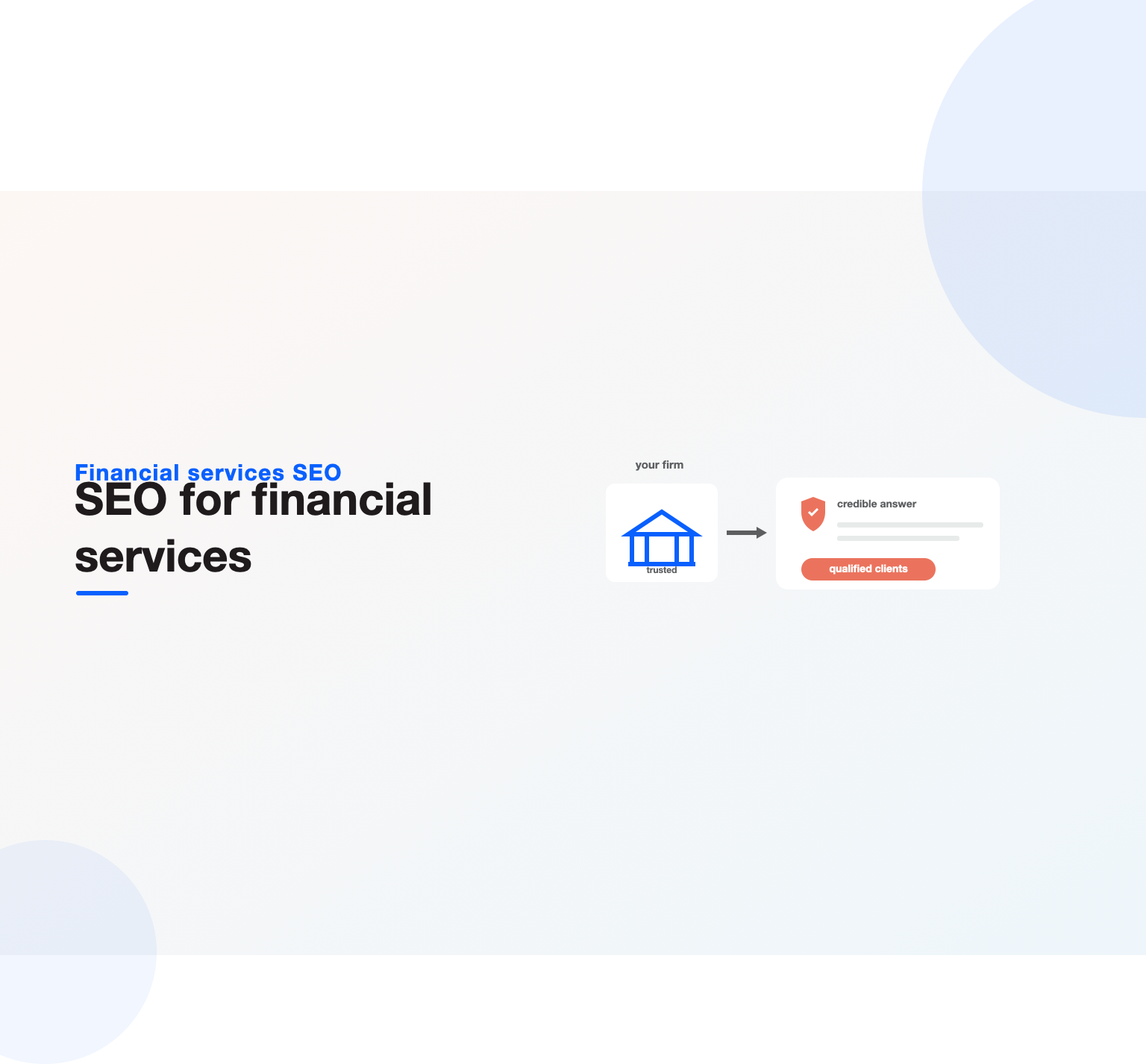
Quick Answer
SEO for financial services is the work of helping banks, advisors, insurers, lenders and fintechs rank in search while meeting the unusually high bar that money-related content must clear. Because financial topics affect people’s livelihoods, search engines scrutinize who is behind the content and whether it is trustworthy, so winning takes genuine expertise, clear author credentials, strong trust signals, and content that is both helpful and compliant with the rules that govern financial marketing. Done properly, SEO for financial services turns a firm’s website into a steady source of qualified leads and clients, but it demands more care around accuracy, authority and compliance than almost any other industry.
Key Highlights
- SEO for financial services faces the strictest trust bar in search, since money topics sit squarely in the your-money-your-life category.
- Expertise and author credentials matter unusually much: content should be written or reviewed by qualified professionals.
- Compliance is a design constraint, so marketing must respect the regulations that govern financial advice and advertising.
- Consideration is long and high-stakes, so content that builds trust across the journey outperforms quick-win tactics.
- Watch for red flags: guaranteed rankings, generic anonymous content, and providers who ignore compliance and the trust bar.
What SEO for financial services really involves
People make major financial decisions online, choosing a bank, comparing advisors, researching a loan or an insurance policy, and every one of those journeys begins with a search. SEO for financial services is the discipline of making sure a firm appears, credibly, at those moments, by earning visibility for the searches prospective clients run and by satisfying the elevated standards search engines apply to money-related content. It is as much about proving trustworthiness as it is about keywords, because in finance a page that ranks without credibility rarely converts, and one that lacks the signals of expertise rarely ranks at all.
The commercial value is substantial, which is why the effort is worth the added rigor. A financial client can be worth a great deal over their lifetime, so a page that ranks for a high-intent financial search can justify an entire program many times over. At the same time, the cost of getting it wrong is higher than in most industries, since inaccurate or non-compliant content can mislead people, damage a firm’s reputation and even create regulatory exposure. That dual reality, high reward and high responsibility, shapes everything about how search should be approached in this sector.
It also reaches beyond the classic results page. As clients research through comparison tools and AI assistants that weigh trust heavily, the same authoritative, accurate, well-structured content that ranks also feeds those surfaces, so a careful program earns visibility wherever people evaluate financial providers. Treating search as one connected, credibility-first effort is what turns it into a durable source of qualified business.
Why financial search is uniquely demanding
Generic advice falls short in finance because the category is held to a standard few others face, and a firm that ignores that reality wastes effort on content that will not rank. Understanding what makes financial search distinct is the first step in any credible plan.
The highest trust bar. Financial topics fall into what search engines treat as your-money-your-life content, where the potential to harm someone means extra scrutiny of expertise, authoritativeness and trustworthiness. Pages backed by real credentials and accurate information carry weight; anonymous, generic filler struggles to rank at all, however well optimized on the surface.
Compliance is not optional. Financial marketing is governed by regulations that vary by product and jurisdiction, covering how firms may describe services, present performance, and make claims. Marketing that ignores these rules creates genuine risk, so effective work in this sector treats compliance as a constraint to design within rather than an obstacle to route around.
Long, high-stakes consideration. People rarely choose a financial provider on impulse; they research carefully over weeks or months because the decision matters. That creates an opening for firms that answer the many questions along the way, building trust early and staying credible until the client is ready to act, long before a competitor who appears only at the final search.
Expertise must be visible. It is not enough to be knowledgeable; the expertise has to be evident to both readers and search engines. Clear authorship, credentials, and content that reflects genuine professional understanding are what convince a cautious prospect and a careful algorithm alike that a firm deserves to be trusted with money.
The foundations that win clients in finance
With the demands understood, the work organizes into a few high-leverage layers, and a strong program in this sector balances all of them with particular attention to trust.
Demonstrable expertise and authority. Content written or reviewed by qualified professionals, with clear credentials and genuine depth, is the foundation of ranking financial terms. This is where a firm proves it belongs in results that search engines guard carefully, and a capable SEO services partner builds the program around it rather than treating it as an afterthought.
Trust signals across the web. Genuine reviews, credible mentions, professional affiliations and accurate listings tell search engines a financial firm is legitimate and well-regarded. In a sector where trust decides everything, these off-site signals carry unusual weight, and building them is patient, reputation-driven work rather than a quick campaign.
Compliant, helpful content. Pages that genuinely help, explaining products, clarifying decisions, answering real client questions, while staying within regulatory bounds, are what attract and convert cautious prospects. The discipline is producing content that is simultaneously useful, accurate and compliant, which is harder than it sounds and central to SEO for financial services.
Security and technical health. A fast, secure, crawlable site is table stakes in an industry built on protecting people’s money and data, and search engines expect it. Beyond the trust it signals, clean technical foundations let everything else count, which is why a serious program fixes them before chasing rankings.
Different financial businesses, different emphases
Finance is not one market but many, so the right emphasis depends on the kind of firm. A local advisor or insurance agent serving a community wins first through local trust signals, reviews and a strong presence in their area, supported by solid local SEO, because many clients want a professional they can meet. For this kind of firm, the work centers on being the trusted local expert.
A national bank, lender or fintech competing across a wider market leans harder on content, authority and technical scale, since it must win contested terms against well-resourced rivals and cannot rely on proximity. A B2B financial provider selling to institutions faces long, relationship-driven sales cycles where authoritative thought leadership matters more than transactional pages. Recognizing which model a firm fits prevents a common waste of effort and keeps SEO for financial services pointed at the specific clients it can realistically win.
Content that builds financial authority
Because trust is everything in this sector, content is where a firm proves it deserves to rank, and generic material simply will not do. Pages written or reviewed by qualified professionals, explaining products accurately, walking clients through decisions, and answering the real questions people have about their money, earn the authority that ranking financial terms requires. The most effective firms treat content as a demonstration of expertise, showing rather than claiming that they understand the field, which reassures a cautious prospect while satisfying the algorithm’s scrutiny.
Accuracy and compliance are inseparable from quality here. Because financial content affects real decisions, pages that oversimplify, overpromise or stray from the rules do a disservice and create risk, so careful review is part of the process rather than an add-on. The same authority that earns rankings increasingly influences whether an answer engine cites a firm when someone asks a financial question, and whether it appears in the generative engine results people increasingly use to compare providers. Building genuine, compliant authority is slow work, and it is exactly what separates the financial firms clients trust from the ones they never find.
How to choose a financial services SEO provider
Once you understand the demands, judging a partner becomes concrete. Use the following as a scorecard, and treat vague answers as a warning rather than a style.
Compliance awareness. The partner must understand that financial marketing is regulated and be willing to work within those rules. A provider who treats a financial firm like any other business, indifferent to compliance, is a liability regardless of their ranking promises.
Expertise-first content. Strong providers build content around genuine professional expertise and clear authorship, because they understand the trust bar. One that plans generic, anonymous articles misunderstands what it takes to rank in finance.
Lead-focused reporting. The best partners tie rankings to qualified inquiries and clients, not just positions. A report showing movement on terms you cannot connect to real business is measuring the wrong thing.
Transparent, lock-in-free terms. You should know exactly what you are buying, on what timeline, and be free to leave if it is not working. For strategy questions, a candid SEO consulting conversation should feel educational rather than evasive.
White-hat methods only. In a sector this scrutinized, manipulative tactics invite penalties that can be devastating. Durable results come from earning trust the right way, and any hint of shortcuts is a reason to walk.
What financial services SEO costs
Pricing tends to run higher than many industries, reflecting the added rigor, the competition, and the value of a financial client. The structure still follows a familiar shape: more effort upfront to audit the site, fix technical and security issues, establish authorship and build authoritative pages, then an ongoing rhythm of compliant content, reputation building and reporting. Be wary of two extremes, a suspiciously cheap retainer that buys thin, non-compliant output, and a premium fee justified only by jargon. The fair middle is a scope you can read line by line, priced against defined deliverables, and our broader SEO cost guide explains the models in depth.
Judge the investment by return rather than raw cost. Given the lifetime value of a financial client, a program that reliably produces even a few qualified inquiries a month can pay for itself many times over. A good partner frames it that way and shows the math, because SEO for financial services is a client-acquisition engine, not an expense to minimize into ineffectiveness or, worse, into non-compliant shortcuts.
Measuring results over a long cycle
Financial decisions take time, so measurement must account for a longer, more considered journey than a quick-purchase industry. Track qualified inquiries, consultations booked and clients won from organic search, and tie them to the pages and searches that started the relationship, understanding that the first visit and the eventual client may be weeks or months apart. That longer horizon makes patient, trust-building content look more valuable than it might over a short window, and it protects a firm from judging the program too soon or rewarding only the final-click terms. Reporting that connects search effort to real clients, even across a long cycle, is what keeps SEO for financial services honest and worth the investment.
Common mistakes financial firms make
Several errors reliably undermine financial search programs. Publishing generic, anonymous content tops the list, because it fails the trust bar that money topics face and rarely ranks. Ignoring compliance is a close and dangerous second, since it turns a marketing effort into a regulatory risk. Neglecting the expertise signals, credentials, authorship, genuine depth, that finance uniquely demands leaves even accurate content underpowered. Chasing quick wins instead of building the durable authority that long consideration rewards wastes effort, and measuring only final-click terms undervalues the trust-building content that actually starts client relationships. Avoiding these traps, more than any single tactic, is what makes SEO for financial services reliably produce qualified clients.
Finance discovery in the age of AI answers
How people research financial providers is broadening, and firms that understand the shift early gain an edge. Clients increasingly ask AI assistants for guidance and read the cited answers those tools return, and because financial topics demand trust, the assistants lean heavily on sources that demonstrate expertise, accuracy and authority, exactly the qualities a careful firm already cultivates. So the trust-first work a financial firm does to rank also positions it to be surfaced and cited by an assistant, without a separate program. A firm with clear credentials, accurate compliant content and genuine reputation is prepared for this, while one relying on thin, anonymous material is exposed as these trust-weighted surfaces grow, including the emerging AI search layer that finance clients increasingly consult.
Understanding the experience and expertise standard
The framework search engines use to judge quality places unusual emphasis, in finance, on experience, expertise, authoritativeness and trustworthiness, and a firm that grasps this designs its whole program around it. Experience means content that reflects real, first-hand understanding of financial situations rather than paraphrased generalities. Expertise means the people behind the pages are genuinely qualified, and that this is made visible through bylines, credentials and about information. Authoritativeness means the wider web recognizes the firm as a legitimate voice, through mentions, affiliations and reviews. Trustworthiness ties it together, covering accuracy, transparency, security and honest presentation. In lighter industries a firm can rank while treating these loosely; in finance they are close to prerequisites, which is why serious work here begins by strengthening each of them deliberately rather than hoping good keywords compensate.
Making expertise visible is a practical exercise, not an abstract one. Attaching real authors with real qualifications to content, maintaining thorough profiles of the professionals involved, citing reputable sources, and keeping information current all send the signals that money-related search rewards. A capable partner treats these as core deliverables, and a candid SEO consulting engagement will often start by auditing how well a firm currently demonstrates the qualities the algorithm is looking for. The firms that invest here find that credibility, once built, lifts everything else they publish.
Security and technical foundations for finance
An industry built on safeguarding money and data is expected, by both regulators and search engines, to run a secure, well-maintained site, so the technical layer carries extra weight here. A properly secured site is non-negotiable, page speed affects both rankings and the patience of a prospect comparing providers, and a clean, crawlable structure lets search engines reach every service and location page. Structured data that marks up the organization, its people and its offerings helps engines understand a firm and can earn richer listings. None of this is visible to a client directly, yet it underpins both the trust signals finance depends on and the reach a broader SEO program is trying to build, which is why a serious effort fixes the foundation before pursuing rankings.
Consistency reinforces the base. Keeping the firm’s name, registrations, addresses and contact details accurate and identical across the site, professional directories and listings tells search engines the business is exactly who it claims to be, which matters more in a regulated sector than almost anywhere else. This tidy, consistent, secure presence also makes a firm easier for AI assistants to read and trust, so the same discipline that satisfies compliance and search engines also prepares the firm for the newer, trust-weighted discovery surfaces.
Handling it in-house versus hiring a specialist
The demands of financial search push many firms toward specialist help, though the choice still depends on resources. Building the capability in-house offers control and deep familiarity with the firm’s products and compliance obligations, which is valuable, but it requires learning a fast-moving field alongside the day job, and mistakes in a regulated sector carry real consequences. Hiring a specialist buys expertise, focus and, crucially, experience navigating the trust bar and compliance landscape, at the cost of a fee and the need to choose a partner who genuinely understands finance.
A blend is common and often sensible: the firm’s own professionals supply and review the substance to ensure accuracy and compliance, while a partner handles technical work, strategy, authority building and the heavier optimization. This pairing plays to each side’s strength, the firm’s domain expertise and the specialist’s search knowledge, and it keeps compliance close to the people who own it. Whatever the arrangement, the decision should rest on total value and the partner’s genuine grasp of the sector, and the evaluation approach in our guide on how to choose an SEO agency applies with extra force where compliance is at stake.
A phased plan for a financial firm
A firm new to search does best with a careful, staged approach rather than an ambitious program bought on faith. The first phase strengthens the foundations that finance uniquely demands: securing and auditing the site, establishing clear authorship and professional profiles, and reconciling listings and registrations. The second phase builds the priority pages, the services and questions closest to winning clients, with content written or reviewed by qualified professionals and kept within compliance. The third phase adds momentum through helpful, authoritative content, earned trust signals, and the reviews that reassure cautious prospects. Tracking is set up from the start so results are visible over the long consideration cycle finance involves. Following that order keeps risk low and lets evidence, not optimism, guide how far to invest, and the disciplined sequencing mirrors what our SEO for business guide recommends for any considered purchase.
Building trust signals the durable way
Of everything that lifts a financial firm in search, off-site trust is both the hardest to fake and the most decisive. Genuine reviews from real clients, mentions in reputable financial and local publications, membership in recognized professional bodies, and accurate presence on trusted directories all tell search engines a firm is legitimate and respected. This reputation cannot be rushed honestly, and the manipulative shortcuts that promise to, bought links and fabricated praise, are especially dangerous in a scrutinized sector where penalties can be severe. Patient, earned trust is the version that lasts, and it compounds, since each credible signal makes the next ranking easier to win and each real review reassures the next cautious prospect. A strong local presence often anchors this for advisors and agents, while national firms build it through authoritative content that the wider industry references.
Key Takeaways
- SEO for financial services faces the strictest trust bar in search, so genuine expertise and clear credentials are essential.
- Treat compliance as a design constraint, producing content that is helpful, accurate and within the rules at once.
- Build authority through professional-grade content and real trust signals, since finance rewards credibility above tricks.
- Measure over a long consideration cycle, valuing the trust-building content that starts client relationships.
- Choose a compliance-aware, expertise-first provider, and reject guarantees, anonymous content and manipulative tactics.
Frequently asked questions
Direct answers to the questions financial firms ask most about search.
Why is SEO harder for financial services than other industries?
Because financial topics sit in the your-money-your-life category, search engines apply extra scrutiny to expertise, authoritativeness and trustworthiness, and marketing must also respect regulations. That raises the bar on who can rank and how, so generic or anonymous content that might work elsewhere struggles in finance, where credibility and compliance are prerequisites rather than nice-to-haves.
Does financial content need to be written by an expert?
Ideally yes. Content written or reviewed by qualified professionals, with clear authorship and credentials, carries far more weight in financial search than anonymous filler, both for the trust bar search engines apply and for the cautious prospects reading it. Demonstrable expertise is one of the strongest levers in SEO for financial services.
How does compliance affect financial SEO?
Compliance shapes what you can say and how, so it must be built into the content process rather than bolted on. Marketing that ignores the regulations governing financial advice and advertising creates real risk, which is why a good program treats compliance as a design constraint and works with the rules to produce material that is both effective and safe.
How long does SEO for financial services take?
Expect a longer horizon than many industries, both because competition and the trust bar are high and because financial decisions themselves take time. Early movement on lower-competition, high-intent terms often appears within months, with broader authority-driven gains following as credibility accumulates and trust signals build.
Is local or national SEO better for a financial firm?
It depends on the firm. A local advisor or agent gains most from local trust signals and reviews, while a national bank, lender or fintech competes through content, authority and technical scale. Matching the emphasis to the model, and to the clients you can realistically win, is what makes the investment efficient.
How do I measure results with such a long sales cycle?
Track qualified inquiries, consultations and clients from organic search, and connect them to the pages and terms that began the relationship, accepting that the first visit and the eventual client may be far apart. That longer view rewards the trust-building content that actually drives finance decisions and prevents judging the program on final-click terms alone.
Can a smaller financial firm compete in search?
Yes, especially by demonstrating genuine expertise, earning local and professional trust signals, and answering the specific questions its ideal clients ask. A focused smaller firm that establishes real authority in its niche can out-rank larger rivals on the searches that matter to it, long before it could match them on the broadest terms.
What is the biggest mistake financial firms make with SEO?
Publishing generic, anonymous content while ignoring compliance and the expertise the sector demands. Both undermine the trust that financial search is built on, one by failing the quality bar and the other by creating risk. Firms that succeed lead with demonstrable expertise, compliant helpful content and real reputation, which is exactly what the trust bar rewards.
How does financial SEO connect to my wider marketing?
It reinforces everything else. The authority and trust a firm builds through a credible search program and a strong local presence lift its brand across referrals, events and paid channels, and the same accurate, well-structured foundations feed the newer generative engine and answer results too. Treating search as one connected, trust-first effort makes every marketing dollar work harder for a financial firm.
Are reviews and testimonials allowed in financial marketing?
It depends on the jurisdiction and the specific rules that apply to your firm, since some financial regulators restrict how testimonials and performance claims may be used. That is precisely why compliance must be built into the process: genuine reviews are a powerful trust signal, but a financial firm should gather and display them within the rules that govern it, ideally with guidance from a partner who understands the sector and works alongside your answer-engine visibility rather than against your obligations.
Is SEO or paid advertising better for a financial firm?
They serve different purposes. Paid search delivers instant, controllable visibility but charges for every click and stops when you pause it, and regulated financial ads face their own approval requirements. Search builds a compounding, credibility-led asset that keeps earning qualified inquiries over time. Most firms use both, letting ads capture urgent demand while authoritative organic visibility grows underneath and lowers the long-run cost of acquiring a client.
How do I keep financial content compliant as rules change?
Build review into the process and revisit published pages on a schedule rather than treating compliance as a one-time check. Assign qualified people to approve claims, keep records of what was said and when, and update pages as products, disclosures or regulations change. A partner experienced in the sector will design this maintenance into the program, so your content stays accurate and within the rules as both the market and the guidelines evolve over time. This ongoing discipline is not merely a legal safeguard; it also protects the hard-won trust that makes a financial firm rank in the first place, since outdated or non-compliant pages quietly erode the credibility that took years to build. In a sector where a single misleading statement can trigger both a regulatory issue and a loss of client confidence, treating maintenance as a core part of the program rather than an occasional chore is simply good business as well as good marketing.
Financial Advisors: search across every surface
Win financial advisors across classic search, local, and the AI answers, each is its own discipline, and they reinforce each other.
Ready to put this into practice?
Talk to the team that runs SEO, AI search and paid growth programs every day.
Book a Strategy Call →