 Skip to content
SEO Cost: How Much Does SEO Really Cost?
SEO cost explained: the pricing models, what drives the price up or down, why cheap SEO is the most expensive, how to budget by business size, and how to judge value.
Quick Answer
SEO cost is what a business pays to earn visibility in search, and it varies widely because the work scales with competition, goals and scope rather than following a fixed price. Most businesses see monthly retainers, hourly consulting rates, one-off project fees, or a blend, and the right number depends on how competitive your market is and how fast you want results. A fair way to judge SEO cost is not the sticker price but the return: a program that reliably produces qualified leads or sales usually pays for itself, while a suspiciously cheap package that delivers nothing is the most expensive option of all.
Key Highlights
- SEO cost is driven by competition, scope and goals, so identical services can carry very different prices across markets.
- The common pricing models are monthly retainers, hourly rates, per-project fees, and performance-based deals, each suiting different needs.
- Very cheap SEO usually means thin, templated work that never ranks, making it the costliest choice once you count the wasted months.
- Judge the price by return, not by the number: a program that produces qualified leads justifies its fee many times over.
- Watch for red flags: guaranteed rankings, secret tactics, and long lock-in contracts that protect the agency rather than you.
What SEO cost really covers
Owners often ask a single question, how much does search optimization run, and expect a single number, but the honest answer is that it depends. The price reflects a bundle of work: technical fixes to the site, research into the terms your buyers use, building and improving pages, earning trust through content and links, and the ongoing analysis that keeps it all pointed at results. Because that bundle scales with how hard your market is and how ambitious your goals are, the same menu can total very different amounts for two different businesses. Understanding what sits inside the price is the first step to judging whether a quote is fair.
The value on the other side of the equation is what makes SEO cost worth weighing carefully. Paid advertising stops delivering the moment the budget runs out, while a page that ranks keeps earning clicks for free long after the work is done. That compounding return is why search is usually measured as an investment rather than an expense, and why the cheapest option is rarely the smartest. A program priced to be genuinely effective builds an asset; one priced to be merely cheap tends to build nothing.
It also helps to see search as one connected effort. The same clean, authoritative pages that rank in classic results increasingly feed AI answers and comparison tools, so a well-scoped budget works across several surfaces at once. Framing the spend that way, as building durable visibility wherever buyers look, puts the SEO cost question in its proper context.
The common pricing models
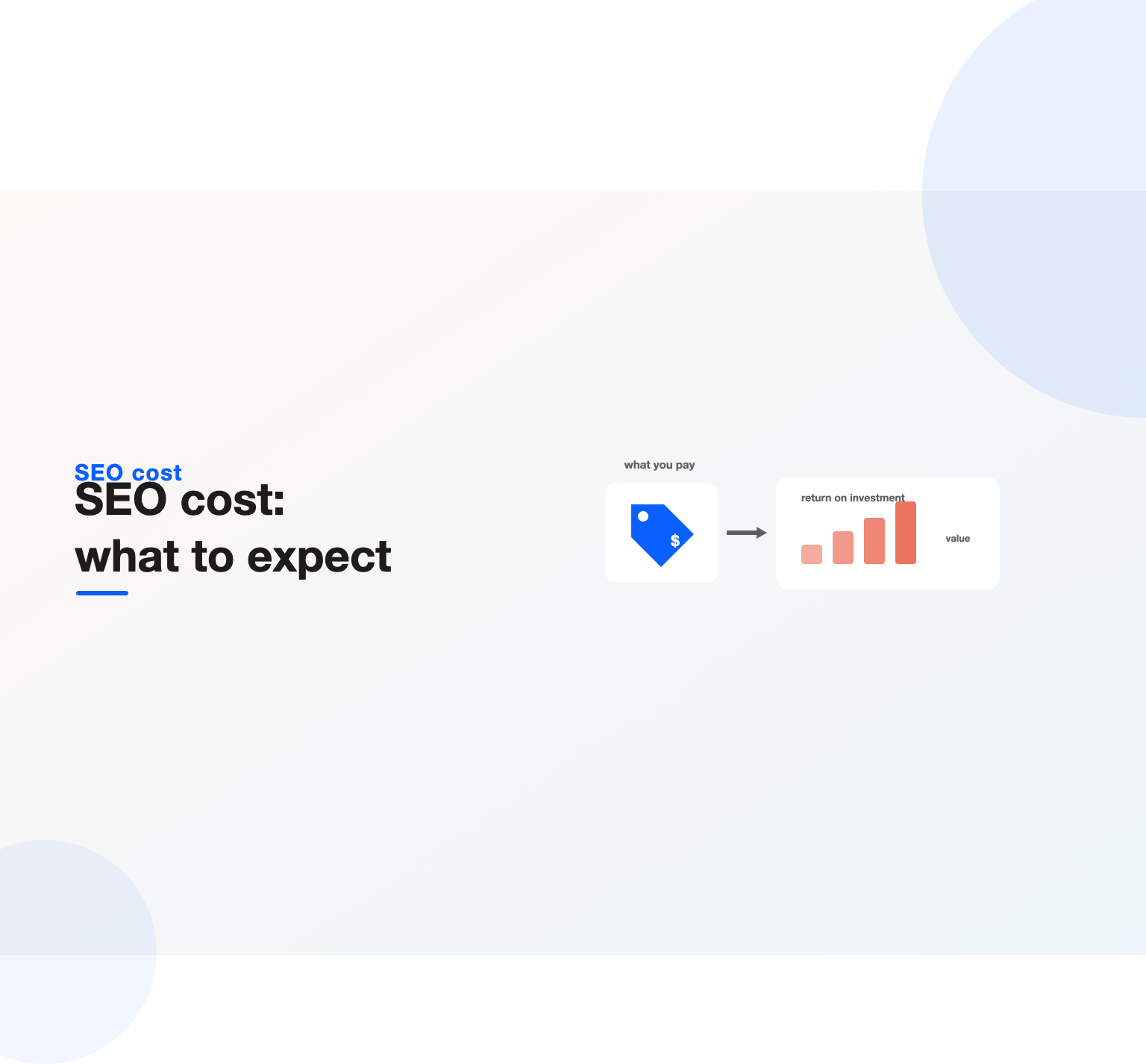
Providers package their fees in a few recognizable ways, and knowing them helps you compare quotes fairly. Each model suits a different situation, and the best fit depends on your goals, your timeline and how much you want to keep in-house.
Monthly retainers. The most common arrangement, a retainer covers ongoing work, content, technical improvements, link building and reporting, for a set fee each month. It suits businesses that want steady, compounding progress and a partner accountable over time. Retainers vary widely with scope, so the number matters less than what the retainer actually delivers.
Hourly consulting. Some engagements bill by the hour, which fits businesses that have an in-house team and need expert guidance rather than full execution. A focused SEO consulting arrangement can be efficient when you mostly need strategy, audits and direction while your team does the work.
Per-project fees. One-off work, a technical audit, a site migration, a batch of new pages, is often priced as a project with a defined scope and deliverable. This model suits a specific need with a clear beginning and end rather than an ongoing program.
Performance-based deals. A minority of providers tie part of their fee to results. These can align incentives, but they invite caution, since no one controls the algorithm and a promise of guaranteed outcomes often signals a misunderstanding of how search works. Treat aggressive guarantees as a warning rather than a bargain.
What drives the price up or down
Two businesses can receive quotes that differ by a wide margin, and the gap usually comes down to a handful of factors. Knowing them lets you understand a quote instead of just reacting to it.
Competition in your market. The single biggest driver. Ranking in a crowded, high-value field takes far more effort than ranking in a quiet niche, so a competitive industry raises the SEO cost simply because more work is required to win. A local service in a small town and a national brand in a contested category are not buying the same thing.
Your goals and timeline. Ambitious targets and faster timelines demand more resources. Wanting to dominate many terms quickly costs more than steady progress on a focused set, so being clear about goals helps a provider scope an honest price rather than a padded one.
The state of your site. A clean, modern site needs less remedial work than one riddled with technical debt, thin pages or a messy structure. Early SEO cost often runs higher precisely because the foundation needs fixing before growth can begin, after which the ongoing spend usually settles.
Scope of the work. A program covering content, technical work, local optimization and link building costs more than a narrow slice of the same. Deciding what you actually need, rather than buying everything by default, is one of the clearest ways to control the price.
Provider experience. Seasoned specialists charge more than beginners, and often deliver more per dollar because they avoid the mistakes that waste months. The lowest hourly rate is not the lowest true SEO cost once results are counted.
Why cheap SEO is the most expensive
The temptation to pick the lowest quote is understandable, yet in search it usually backfires. A suspiciously cheap package almost always means thin, templated output, a flood of low-quality pages, or link schemes that risk a penalty. None of it ranks, so you pay every month for effort that produces nothing, and after half a year you have spent real money and lost time you cannot recover. Worse, some cheap tactics actively harm the site, leaving you paying again to clean up the damage before you can even start growing. Measured honestly, that is a far higher SEO cost than a fair price would have been.
The healthier way to think about it is return per dollar rather than dollars alone. A slightly higher fee that reliably produces qualified leads is cheaper, in every sense that matters, than a bargain that produces silence. When you evaluate a quote, the right question is not whether it is the lowest number, but whether the work behind it can realistically win the customers you are paying to reach. That framing turns SEO cost from a line item to minimize into an investment to judge on results.
Estimating your return
Because search is an investment, the sensible way to size a budget starts from value, not from a price list. Work out what a new customer is worth to you, then ask how many extra qualified inquiries a program would need to produce to justify its fee. For many businesses the math is forgiving: if a single client is worth a meaningful sum, even a handful of extra leads a month covers a serious program and then some. That calculation reframes the SEO cost conversation, moving it from what does this cost to what would this return, which is the question that actually matters.
Tracking makes the estimate real over time. Set up simple measurement so you can see which queries and pages produce inquiries, and review them against the spend. This turns the budget into a feedback loop where you invest more in what works and trim what does not, and it protects you from paying for activity that never converts. A provider comfortable being judged this way, on leads and revenue rather than vanity rankings, is one worth keeping, and the discipline keeps every dollar of SEO cost pointed at customers. For guidance on choosing that partner, our guide on how to choose an SEO agency lays out the questions to ask.
Budgeting by business size and stage
The right budget depends on where you are, and matching the spend to the stage avoids both under-investing and overspending. A small local business often gets the most from a focused program centered on the Google Business Profile, reviews and a few strong local pages, which keeps the SEO cost modest while targeting the highest-intent searches. The fundamentals in our small business SEO guide apply directly, and a lean, disciplined effort frequently outperforms a larger, unfocused one.
A growing or mid-sized business competing in a broader market typically needs a fuller program, covering content, technical work and link building, and the budget rises to match the ambition and competition. Larger brands and competitive ecommerce operations invest more still, because the terms are contested and the potential return is large, and a dedicated ecommerce SEO effort earns its keep through compounding organic sales. The through-line is simple: scope the spend to your market and goals, and judge it by the return rather than by comparison to a business in a different situation.
Doing it yourself versus paying a provider
The lowest visible SEO cost is doing the work yourself, and for the foundations that route is realistic. An owner willing to learn can claim and optimize the Google Business Profile, write original pages, gather reviews and publish helpful content, spending mainly time rather than money. The hidden cost is that time, plus the learning curve and the mistakes that come with a fast-moving field, which can quietly outweigh a modest fee once you value your hours honestly.
Paying a provider buys speed, focus and expertise. A capable partner fixes the foundation correctly the first time, concentrates on the work that converts, and frees you to run the business, which is often the better economic choice even though the sticker SEO cost is higher. Many businesses land on a hybrid, keeping reviews and simple updates in-house while a partner handles technical work, content and strategy. Whatever the split, the decision should rest on total value, the results produced against the total cost in money and time, rather than on the smallest number alone. A short SEO services conversation can help you scope what genuinely needs a specialist and what you can keep in-house.
Red flags in SEO pricing
A few signals reliably mark a quote worth avoiding, whatever the price. Guaranteed rankings top the list, because no one controls the algorithm, and a guarantee betrays either ignorance or dishonesty. Secret tactics are a second warning, since anything that cannot be explained plainly rarely survives an algorithm update and often invites a penalty. Extremely low prices point to thin, templated work that will not rank, and long mandatory lock-in contracts protect the agency rather than the client. Reporting that hides behind vanity metrics, and a refusal to connect the work to leads or revenue, round out the list. A fair SEO cost comes with transparency, a scope you can read, and a willingness to be judged on results, and any provider unwilling to offer that is best passed over regardless of the number.
SEO cost by type of work
It helps to see where the money goes, because a quote is really the sum of several distinct activities. Technical work, fixing site speed, structure, crawlability and structured data, tends to be front-loaded, with more effort early and less once the foundation is solid. Content, the writing and optimizing of pages that target real buyer queries, is usually the steadiest ongoing line, since search rewards depth produced consistently over time. Local optimization, the Google Business Profile, citations and reviews, is often the most affordable high-impact work for a location-based business, which is why it anchors many lean budgets. Link building and reputation, the patient earning of trust from credible sources, is the hardest to shortcut honestly and frequently the largest ongoing component in competitive fields. Seeing the SEO cost broken down this way lets you decide what to prioritize rather than buying a bundle you do not fully need.
The mix shifts with your situation. A store in a contested category leans heavily on content and links, while a local service invests first in the profile and reviews that reach nearby buyers. A partner who scopes the work honestly will show you this breakdown and let you weight it to your goals, which keeps the SEO cost tied to what actually moves your business. That same clarity also reveals where a cheaper quote has quietly removed the work that would have made the program succeed, a trap that looks like a saving until the months pass with nothing to show.
How to compare quotes fairly
When two proposals name very different numbers, the difference almost always lies in scope and quality rather than a simple markup. Read each quote for what it actually includes: how many pages, how much content, what technical work, what link building, and what reporting. A low SEO cost that omits content or link building is not cheaper; it is a smaller, weaker program that happens to cost less because it does less. Comparing the deliverables side by side, rather than the headline figures, turns a confusing choice into a clear one.
Reporting deserves close attention in any comparison. A provider that ties its work to leads, calls and revenue is selling outcomes, while one that reports only positions on terms you cannot connect to sales is selling activity. The first justifies its SEO cost by results; the second asks you to trust that motion equals progress. Insisting on outcome-based reporting before you sign filters out a surprising number of weak proposals, because providers who cannot connect their work to your revenue rarely want to be measured that way. Our guidance on picking the right partner, including questions that expose these gaps, mirrors the approach in our law firm SEO and Shopify SEO guides, where competition makes scope discipline essential.
Hidden costs worth knowing about
Beyond the headline fee, a few costs can surprise owners who did not plan for them. Content at scale is the most common: ranking competitive terms often needs more writing than a small retainer includes, so the real price of an ambitious plan may exceed the first quote once the content volume is honest. Tools and tracking are another, though for most businesses a modest analytics and call-tracking setup suffices. Site fixes can add up if the foundation is weak, which is why a good audit prices the remediation openly rather than discovering it later. And the cost of doing nothing is real too, since competitors who invest while you wait occupy the results your shared customers see, and reclaiming that ground later costs more than holding it now.
None of these should deter a sensible investment; they simply argue for a clear scope and an honest partner. When the plan names the work plainly and the reporting ties it to results, surprises shrink and the SEO cost becomes predictable. The businesses that feel burned by search almost always bought a vague package from a provider unwilling to be measured, not a transparent program judged on leads. Choosing the latter is the surest way to keep the spend both controlled and worthwhile, and it connects naturally to the wider AI search and answer engine visibility that the same clean foundations unlock.
SEO cost against other channels
Judging the price in isolation misses the point, because the real question is how search compares to the alternatives for winning customers. Paid advertising charges for every click and stops delivering the instant you pause it, so its cost per acquired customer stays flat or rises as competition grows. Search, by contrast, front-loads the effort and then compounds, so the effective cost per customer tends to fall over time as ranked pages keep earning visits for free, which is a core reason a strong SEO program is judged on lifetime value rather than the first invoice. For many businesses the two work best together, with ads capturing urgent demand while organic visibility builds the durable, lower-cost channel underneath.
The comparison also extends to the newer surfaces. As buyers increasingly research through AI assistants and comparison tools, the same authoritative content that lowers your organic cost per customer also positions you to be recommended there, at no extra spend. That multiplier is part of why a well-scoped search investment often looks expensive on day one and cheap by the end of the year. Framed against the alternatives and across every surface a buyer might use, a fair SEO cost is less an expense to minimize than a compounding asset to build, and it pairs naturally with a strong local presence and broader generative engine visibility.
Setting your first budget
For a business new to search, the smartest first budget is modest, focused and measured. Rather than committing to an ambitious program before you have evidence, start with the highest-intent work for your situation and prove the return, then scale what works. A local business might begin with the Google Business Profile, a handful of strong pages and steady reviews; a store might begin by fixing technical debt and rewriting its best-selling category and product pages. Concentrating a small budget on the pages and searches closest to revenue produces visible wins that justify the next round, while spreading the same money thinly across many fronts produces movement on none. This staged approach keeps risk low and lets results, not a sales pitch, decide how far to invest, and it echoes the disciplined small business sequencing that works for lean operators.
Set expectations honestly from the start. Search compounds over months rather than delivering overnight, so a first budget should fund enough time for the work to show, not just a single month of activity. A partner who scopes a realistic runway, and who ties the plan to leads rather than vanity rankings, is setting you up to judge the investment fairly. If the early signals are good, scaling up is straightforward; if they are not, a focused start means you have risked little while learning what your market actually requires. A brief consulting conversation can help size that first step without overcommitting.
Common questions about value
Owners often worry they cannot tell a fair price from a padded one, but a few habits make it clear. Ask every provider to connect the plan to the customers it will produce, insist on a scope you can read line by line, and require reporting that ties the work to leads and revenue. When those three things are present, the number becomes far easier to judge, because you can see exactly what you are buying and what it should return. The businesses that feel misled almost always skipped these steps and bought a vague promise, whereas those that insisted on clarity rarely regret the spend. Treating search as a measured investment, with a clear program and honest reporting, turns an intimidating decision into a manageable one.
Frequently asked questions, continued
Should a new business invest in SEO right away?
Often yes, but modestly and with focus. Starting early means you build the compounding asset sooner and avoid ceding results to competitors, but a new business should begin with the highest-intent work and a realistic runway rather than an oversized program. Prove the return on a focused start, then scale what works, so the risk stays small while the learning is real.
How do I measure the return on my search spend?
Track which queries and pages produce calls, form fills and sales, mark those as goals, and review them against what you invested each month. When you can see the leads and revenue tied to specific work, the value becomes obvious and you can double down on what performs. A provider comfortable being judged on those outcomes, rather than on positions alone, is one worth keeping. Over a few quarters this record also tells you when to scale the budget up and when to hold, so the investment grows in step with the results it produces rather than on guesswork.
Key Takeaways
- SEO cost varies with competition, scope, goals and site condition, so there is no single price, only a fair one for your situation.
- The main models are monthly retainers, hourly consulting, per-project fees and performance deals, each suiting a different need.
- Cheap SEO is usually the most expensive once you count wasted months and cleanup, so judge value, not the lowest number.
- Size the budget from return: what a customer is worth and how many extra leads would justify the fee.
- Insist on transparency and results-based reporting, and reject guarantees, secret tactics and long lock-in contracts.
Frequently asked questions
Direct answers to the questions businesses ask most about the price of search.
How much does SEO cost per month?
It ranges widely because the work scales with competition and scope, so a modest local program and a competitive national campaign occupy very different levels. Rather than fixate on a single figure, look at what the fee actually buys and whether that work can realistically win your target searches, then judge the SEO cost by the leads it produces.
Why is SEO so expensive?
It reflects skilled, ongoing work in a competitive space: technical fixes, research, content, authority building and analysis, all aimed at winning terms that other businesses also want. In contested markets more effort is required, which raises the price, but the compounding return from ranking often makes it one of the higher-value marketing investments available.
Is cheap SEO worth it?
Usually not. Very low prices typically mean thin, templated work or risky tactics that never rank and can even harm your site, so you pay for months with nothing to show. Once wasted time and possible cleanup are counted, cheap SEO is often the most expensive route, which is why value matters more than the sticker number.
What pricing model is best?
It depends on your needs. A monthly retainer suits steady, compounding progress with an accountable partner; hourly consulting fits teams that need guidance while doing the work themselves; project fees suit a defined one-off need. Aggressive performance guarantees deserve caution, since no one controls the algorithm.
How do I know if I am overpaying?
Compare the fee to the work and the results, not to another business in a different market. If the scope is clear, the reporting ties to leads and revenue, and the return justifies the spend, the SEO cost is fair even if it is not the lowest quote. Vague scope and vanity-metric reports are the real warning signs.
Can I do SEO myself to save money?
Yes, especially the foundations: optimize your Google Business Profile, write original pages, gather reviews and publish useful content. The trade is your time and a learning curve, which can outweigh a modest fee once valued honestly, so many owners keep the basics in-house and bring in a partner for technical work and strategy.
Does SEO cost more than paid ads?
They work differently. Paid ads charge for every click and stop the moment you pause them, while SEO builds a compounding asset that keeps earning visits for free once pages rank. Upfront, ads can feel cheaper to start, but over time the SEO cost per acquired customer often falls well below paid channels.
How long before SEO pays for itself?
Typically a few months, as trust and rankings build. Lower-competition queries and local wins often move first, with broader gains following. Because the returns compound while the core investment holds steady, the payback period shortens as the program matures and the earned visibility keeps working.
Ready to put this into practice?
Talk to the team that runs SEO, AI search and paid growth programs every day.
Book a Strategy Call →