 Skip to content

What Is Web Development? A Complete Guide
What is web development? A plain guide to building websites and web apps: front-end vs back-end, core languages, the process, frameworks, cost, and how it affects SEO.
Quick Answer
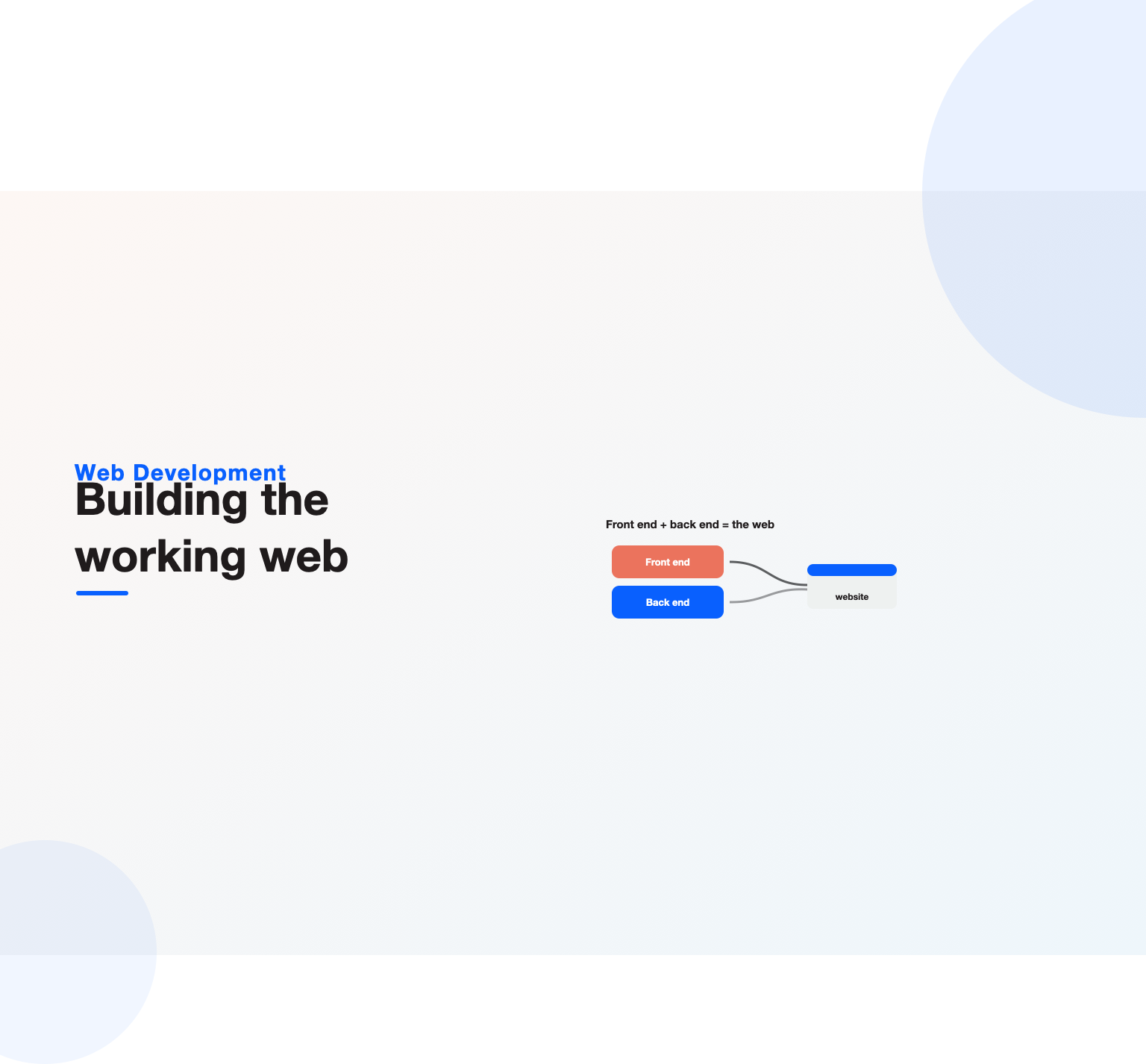
Web development is the work of building and maintaining websites and web applications, everything that makes a site function on the internet rather than just look good on a screen. In short, what is web development if not the engineering behind the web: it spans front-end code that runs in your browser, back-end code that runs on servers, and the databases, APIs, and infrastructure that connect them. Developers use languages like HTML, CSS, and JavaScript on the front end and languages such as Python, PHP, or Node.js on the back end to turn a design into something people can actually use. It ranges from a simple brochure site to complex, data-driven applications like online banking or streaming platforms.
Key Highlights
- Two broad halves. Front-end builds what users see and interact with; back-end powers the logic, data, and servers behind it.
- Core languages are universal. HTML structures content, CSS styles it, and JavaScript makes it interactive, the foundation every developer learns.
- It is more than design. In brief, design decides how a site looks and feels; development makes it work.
- Frameworks speed everything up. Tools like React, Django, and Laravel let teams build faster and more reliably than coding from scratch.
- Performance and SEO are built in. How a site is developed directly shapes its speed, accessibility, and search visibility.
What is web development, defined properly?
At its core, what is web development comes down to translating an idea or a design into working software that runs on the web. When you open a website, type in a search box, add an item to a cart, or log into an account, code written by developers is executing behind every one of those actions. That code has to load quickly, behave predictably across devices and browsers, and keep working as the site grows, which is why development is an engineering discipline rather than a purely creative one.
It helps to distinguish the pieces. The front end is everything rendered in your browser: the layout, buttons, forms, and animations you interact with directly. The back end is the machinery you never see: the servers, application logic, and databases that store your data and decide what the front end should show. Bridging them are APIs, the messengers that let front end and back end talk. Understanding what is web development means seeing how these layers combine into a single experience that feels seamless to the user even though several very different technologies are cooperating underneath.
The scope is broad. A local restaurant’s one-page site and a global platform like an online marketplace are both products of web development, yet they sit at opposite ends of complexity. That range is why the field splits into specialisms, and why the phrase covers everyone from a solo freelancer building small business sites to large teams engineering software used by millions.
Front-end, back-end, and full-stack development
The clearest way to organise the field is by where the code runs. Front-end development, sometimes called client-side, builds the part of a site that lives in the browser. Front-end developers turn a designer’s mockups into responsive, interactive interfaces, obsessing over layout, usability, and how the page behaves on everything from a phone to a widescreen monitor. Their world is HTML, CSS, and JavaScript, plus frameworks that make complex interfaces manageable.
Back-end development, or server-side, handles the logic and data that power the site. Back-end developers build the systems that process a payment, authenticate a login, or pull the right products from a database, working in languages like Python, PHP, Ruby, Java, or JavaScript via Node.js. Their concerns are security, performance, and reliability, because a slow or insecure back end undermines even the most beautiful interface. Databases such as PostgreSQL, MySQL, or MongoDB store the information the application depends on.
Full-stack developers work across both halves. Rather than specialising in one side, they can build a feature end to end, from the button a user clicks to the database record it updates. Full-stack skills are prized by smaller teams and startups that need versatile builders, though even full-stack developers usually lean deeper on one side. Knowing which type of developer a project needs is a practical part of what is web development in the real world, because hiring a front-end specialist for a database-heavy application, or vice versa, is a common and expensive mismatch.
The core front-end technologies
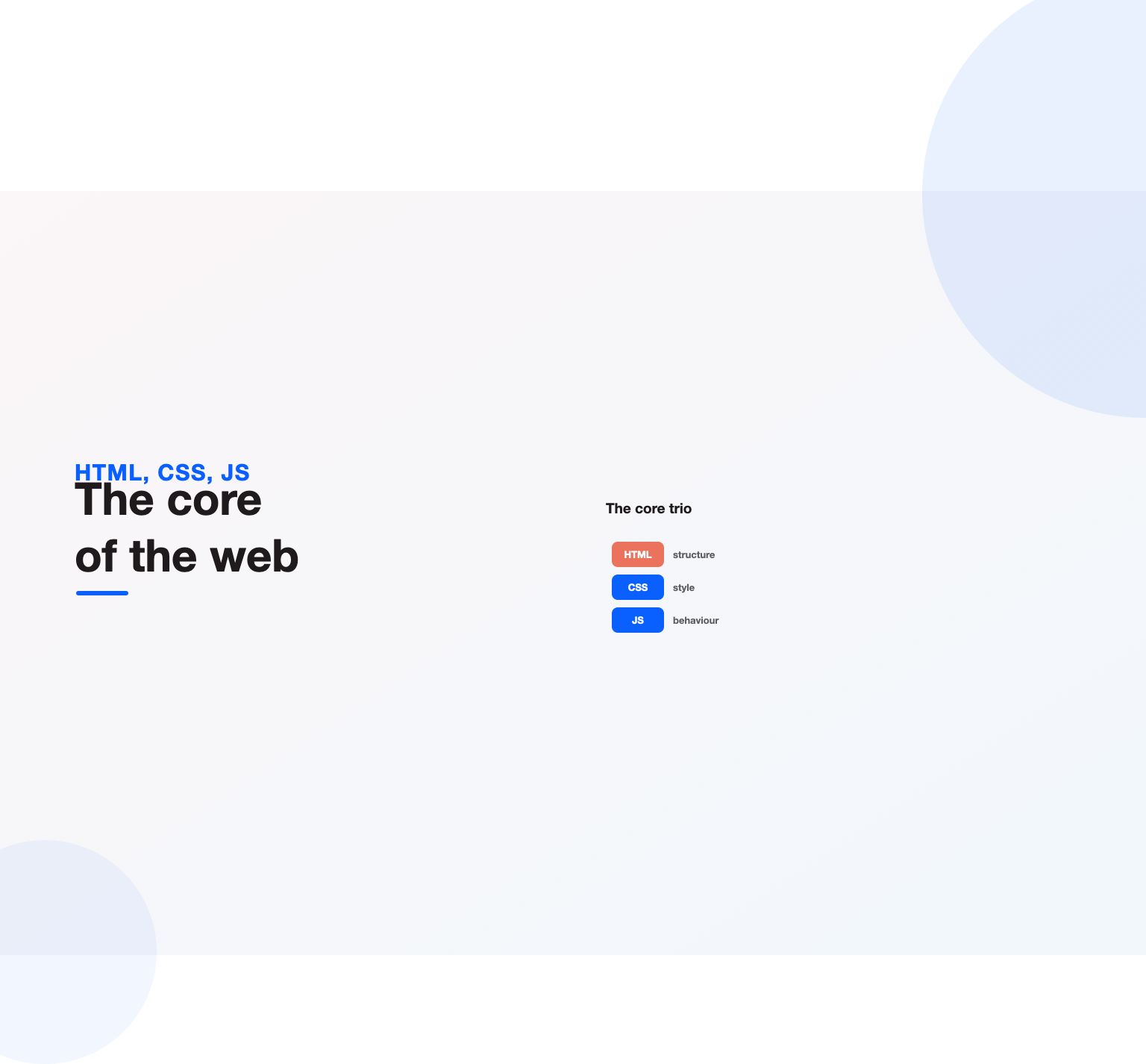
Three technologies form the bedrock of everything a browser displays, and they map neatly onto three jobs. HTML, HyperText Markup Language, provides structure: it defines headings, paragraphs, images, links, and forms, the skeleton of every page. Without it there is no content for a browser to render. The MDN documentation maintained by Mozilla is the reference developers reach for here.
CSS, Cascading Style Sheets, handles presentation: colours, fonts, spacing, and the responsive layouts that let a single site look right on any screen size. If HTML is the skeleton, CSS is the skin and clothing. JavaScript then adds behaviour, turning a static document into an application that responds to clicks, validates forms, updates content without reloading, and drives the rich interactivity modern users expect. Together these three are non-negotiable foundations, and any honest answer to what is web development starts with them, because every framework and tool that follows is built on top of this trio.
Back-end languages, databases, and APIs
Behind the interface sits a different set of tools chosen for logic, scale, and safety. Server-side languages each have their strengths: Python is loved for readability and rapid development, PHP still powers a huge share of the web including WordPress, Node.js lets teams use JavaScript across the whole stack, and Java and C# dominate large enterprise systems. The choice depends on the project’s scale, the team’s expertise, and the ecosystem around each language.
Databases are where the application’s information lives, and they come in two broad families. Relational databases like PostgreSQL and MySQL store structured data in tables and suit applications with clear relationships between records. NoSQL databases like MongoDB store more flexible, document-style data and suit rapidly changing or unstructured needs. APIs, application programming interfaces, are the connective tissue that lets systems exchange data, whether between a site’s own front and back ends or with third-party services like payment processors and mapping tools. Grasping how these back-end pieces fit is a large part of what is web development beyond the visible surface, and it is where much of an application’s real complexity and value lives.
The web development process, step by step
Building a site well follows a recognisable sequence, even if teams adapt the details. It begins with planning and requirements: defining what the site must do, who it serves, and what success looks like, because building without this clarity wastes effort. Design usually comes next, producing wireframes and visual mockups that developers will bring to life, ideally with close collaboration so the design is actually buildable.
Development itself then splits across front and back ends, often in parallel, with the two integrating through agreed APIs. Testing runs throughout and intensifies before launch: checking functionality, cross-browser and cross-device compatibility, performance, security, and accessibility. Deployment moves the finished site onto live servers, a step that itself involves configuration, domains, and often a content delivery network for speed. Crucially, the work does not end at launch. Maintenance, updates, security patches, and improvements continue for the life of the site, which is why what is web development is better understood as an ongoing practice than a one-time build.
Is your website slowing down your marketing?
Our team reviews your current setup and shows you where the opportunities are. See how our web development services work.
Types of web development projects
The label covers several distinct kinds of build, each with its own demands. Static websites are the simplest, a fixed set of pages ideal for small brochures and portfolios, fast and cheap to build. Dynamic websites generate content on the fly from a database, which is what most modern sites are, allowing personalisation and easy updates.
Applications push the idea further, delivering software-like functionality in the browser, think email clients, project tools, or design apps that rival desktop software. Ecommerce development is a specialism in its own right, handling product catalogues, carts, payments, and the technical demands of selling online at scale. Content management systems, most famously WordPress, sit in a middle ground, giving non-technical users a way to manage content while developers customise the underlying platform. Matching the type of project to the right approach and technology is a foundational decision, and misjudging it, building a bespoke application when a CMS would do, or forcing a CMS to behave like custom software, is one of the more expensive errors in the field.
Frameworks, libraries, and tools
Few developers build everything from raw code, because frameworks and libraries solve common problems so teams can focus on what makes their project unique. On the front end, libraries and frameworks like React, Vue, and Angular structure complex interfaces and manage how data flows through them, making large applications maintainable. On the back end, frameworks like Django for Python, Laravel for PHP, and Express for Node.js provide tested foundations for handling requests, security, and databases.
Beyond frameworks, developers rely on a wider toolkit: version control systems like Git to track changes and collaborate, package managers to handle dependencies, and build tools that bundle and optimise code for production. This ecosystem evolves quickly, and staying current with it is part of the job, though the underlying fundamentals change far more slowly than the tools built on them. For anyone learning what is web development, the reassuring truth is that mastering the foundations makes each new framework much easier to pick up, because most are variations on the same core ideas.
Web development vs web design
The two terms are often confused, yet they describe different work. Design is about how a site looks and feels: layout, colour, typography, imagery, and the overall user experience. Designers decide what the site should be; they work in visual tools and think about aesthetics, branding, and how a visitor moves through the pages. Their output is typically a set of mockups and a design system.
Development is about making that vision function. Developers take the designer’s work and build it into a living site with working code, handling the logic, data, and performance that design alone cannot provide. The relationship is collaborative and sequential: strong design guides development, and skilled development honours design while making it real and reliable. Some professionals blend both roles, but on larger projects they are distinct disciplines. Clarifying the difference matters when you hire, because asking a visual designer to engineer a complex application, or a back-end developer to craft a brand experience, sets both up to disappoint.
How web development affects SEO and performance
How a site is built has a direct and often underestimated impact on whether it can be found. Search engines reward fast, accessible, well-structured sites, and every one of those qualities is a development decision. Bloated code, oversized images, and heavy scripts slow a site down, hurting both rankings and the experience for real visitors, which is why performance is a shared concern of developers and marketers alike.
The way a site is coded also determines how easily search engines can read it. Clean, semantic HTML helps engines understand content, while heavy reliance on client-side JavaScript can hide content from crawlers if not handled carefully. These choices sit at the intersection of engineering and marketing, and they connect development directly to technical SEO and the broader SEO work that drives organic traffic. Building performance and search-friendliness in from the start is far cheaper than retrofitting them, so the smartest teams involve SEO thinking during development rather than after launch, a principle our complete guide to SEO reinforces.
Common web development mistakes
Certain errors recur across projects of every size, and knowing them saves money and rework. Neglecting mobile is a frequent one: with most traffic on phones, a site that is not fully responsive fails a majority of its visitors, yet teams still treat mobile as an afterthought. Ignoring performance is another, shipping heavy, unoptimised sites that load slowly and lose users before the page even appears.
Weak security is more dangerous still, leaving forms, logins, and data exposed to attacks that can damage both users and reputation. Poor accessibility excludes people with disabilities and increasingly carries legal risk, besides being the right thing to fix. On the process side, skipping proper planning and testing leads to scope creep, bugs, and sites that break under real use. None of these is inevitable, and avoiding them is less about talent than discipline, which is why an experienced team or a careful process matters as much as raw coding skill when the outcome actually needs to hold up in production.
How much does web development cost, and how to hire
Pricing varies enormously because the term covers everything from a template site to bespoke software. A simple brochure site built on a CMS sits at the low end, a custom dynamic website in the middle, and a complex web application with custom functionality at the high end, potentially by orders of magnitude. The main drivers are complexity, custom functionality, design requirements, and ongoing maintenance, so a realistic quote depends entirely on a clear scope.
When hiring, match the provider to the project. A freelancer suits smaller, contained builds; an agency brings a full team for larger or more complex work; and specialised partners fit particular platforms. Look for relevant portfolio work, ask how they handle performance, security, and SEO, and confirm what maintenance is included after launch. Because the deliverable is engineering that must keep working, cheap can be expensive when it produces a fragile site you pay to rebuild. Whether you need a marketing site, an ecommerce store, a WordPress build, or a custom application, the right route depends on scope, and our web development services span those needs alongside dedicated WordPress development and Shopify development for platform-specific projects.
How to get started learning web development
For those who want to build rather than buy, the path is well-trodden and more accessible than ever. People asking how to become a web developer usually begin with the core web development languages, then specialise in frontend development, backend development, or the full range as a full stack developer. The sensible starting point is the front-end trio: learn HTML to structure content, CSS to style it, and JavaScript to add interactivity, in that order, because each builds on the last. Free, high-quality resources abound, from MDN’s learning guides to interactive platforms that teach by doing.
Progress comes from building, not just reading. Small projects, a personal site, a simple app, a clone of a familiar interface, cement concepts far better than passive study, and they become the portfolio that gets you hired or wins clients. From the front end, learners often move into a framework like React, then into back-end languages and databases if they want full-stack range. The field rewards persistence and curiosity more than credentials, and because it evolves continually, learning never really stops. Whether your goal is a career, a side project, or simply understanding what is web development well enough to brief a team, starting with the fundamentals and building steadily is the route that reliably works.
Emerging trends shaping the field
The discipline never stands still, and a few shifts are reshaping how sites get built. AI-assisted coding tools now help developers write, debug, and refactor faster, changing the day-to-day work without removing the need to understand the fundamentals, since someone still has to judge whether the generated code is correct and safe. Low-code and no-code platforms let non-developers assemble simple sites and apps visually, expanding who can build while leaving complex, custom work firmly in developer hands.
Architecturally, approaches like headless setups and the JAMstack separate the front end from the back end, letting teams serve fast, secure pages from a content delivery network while managing content through flexible APIs. Progressive web apps blur the line between websites and native mobile apps, offering offline support and app-like behaviour from a browser. Standards bodies such as the W3C continue to evolve the underlying web platform, and Google’s web.dev tracks the performance and capability changes that follow. Keeping an eye on these trends is part of what is web development today, though the core skills that underpin them change far more slowly than the headlines suggest.
Choosing the right technology stack
One of the earliest and most consequential decisions in any project is the technology stack, the combination of languages, frameworks, and databases a team will use. There is no universally best stack; the right choice depends on the project’s goals, expected scale, the team’s existing skills, and how the site will be maintained. A content-heavy marketing site has very different needs from a real-time application handling thousands of concurrent users.
For many businesses, a mature content management system is the pragmatic answer, offering proven foundations and a large ecosystem, which is why platforms like WordPress power so much of the web and dedicated WordPress development remains in high demand. Online stores often lean on specialised commerce platforms, supported by Shopify development for merchants who want a hosted, scalable base. Ambitious or unusual products may justify a fully custom stack or an AI application build. Choosing well early avoids costly rebuilds later, and it is an area where experienced guidance pays for itself, because a stack that fits the problem makes every subsequent stage of what is web development smoother and cheaper.
Want a fast website built to convert?
Book a free 30-minute strategy call and leave with a clear next step for your business.
What business owners should know
You do not need to write code to commission a site well, but a working grasp of the field protects your budget. The most common mistake owners make is under-specifying the project, then blaming the builder for a result that never had a clear target. A tight brief, what the site must do, who it serves, and how success will be measured, is the single highest-leverage thing a non-technical client can provide, and it makes every quote you receive more comparable and honest.
It also pays to think past launch. A website is not a one-off purchase but an asset that needs hosting, security updates, and improvement over time, so ask any provider what maintenance is included and what happens when something breaks. Insist that performance, accessibility, and search-friendliness are built in rather than bolted on, because retrofitting them is expensive and a slow or invisible site undermines the marketing that depends on it, including your ecommerce SEO if you sell online. Whether you build in-house, hire a freelancer, or engage a team for full web development services, understanding what is web development at this level lets you ask sharper questions and tell substance from sales patter, which is worth far more than any single technical detail you might memorise.
Maintaining and improving a site after launch
Launch is a milestone, not the finish line, and treating it as the end is where many sites quietly decay. Software dependencies age, security vulnerabilities emerge, browsers update, and content grows stale, so a living site needs regular attention to stay fast, safe, and effective. Neglected sites accumulate technical debt in the same way ignored buildings accumulate repairs, until a small, cheap fix becomes a large, expensive one.
Ongoing work falls into a few buckets. Security maintenance keeps the platform and its components patched against known threats, which is non-negotiable for any site handling user data or payments. Performance monitoring catches speed regressions before they cost rankings and conversions, tying directly to the Core Web Vitals that shape search visibility. Content and feature updates keep the site relevant as the business evolves, and analytics review turns real user behaviour into a roadmap for improvement.
Migrations deserve special mention here, because at some point most sites are redesigned, replatformed, or moved, and each of those events carries real risk to hard-won rankings if handled carelessly. Planning such changes as deliberate technical projects, with proper redirect mapping and testing, protects the traffic you have already earned, as our guide to website migration explains. Viewed this way, the answer to what is web development stretches well beyond the initial build into a continuous cycle of protecting, measuring, and improving an asset the business increasingly depends on.
How the web works behind every web development project
Every page you build in web development sits on the same basic chain of events, and understanding it makes debugging and performance work far easier. MDN’s guide to how the web works is an excellent reference.
- The address is looked up. When someone types a domain, the Domain Name System (DNS) translates it into the IP address of the server that hosts the site.
- A connection is opened. The browser connects to that server, usually over HTTPS, which encrypts the traffic with a TLS certificate.
- The browser asks for the page. It sends an HTTP request; the server, or a content delivery network close to the user, replies with HTML.
- Extra files are fetched. The HTML references CSS, JavaScript, images and fonts, which the browser requests next.
- The page is built and drawn. The browser parses the HTML into a document tree, applies styles, runs scripts and paints pixels on screen.
- The page talks back. Forms, logins and live data send further requests to back-end APIs, which read and write the database.
Most speed problems come from steps four and five: too many large files, render-blocking scripts or heavy images. Most security problems come from step six, where user input reaches the server.
Web development roles and a practical learning roadmap
Web development covers several distinct jobs, and teams usually combine them.
- User-interface specialists (front-end developers) build what users see and interact with, using HTML, CSS, JavaScript and frameworks such as React or Vue.
- Server-side specialists (back-end developers) build servers, APIs and databases using languages such as Node.js, Python, PHP, Java or C#.
- Full-stack developers work across both and are common in startups and small teams.
- DevOps and platform engineers manage hosting, deployment pipelines, monitoring and security.
- CMS developers specialise in platforms such as WordPress, Shopify or headless systems for content-led sites.
A sensible learning path is: HTML and CSS until you can build a responsive page; JavaScript fundamentals and the DOM; Git and the command line; one front-end framework; one back-end language with a database and a simple API; then deployment, testing and performance. Community roadmaps such as roadmap.sh lay out these steps in detail. Building small real projects at every stage teaches more than finishing courses.
Accessibility and security in web development
Two responsibilities apply to every project, whatever its size.
Accessibility means people with disabilities can use the site with screen readers, keyboards and other assistive tools. The W3C’s Web Content Accessibility Guidelines are the standard. In practice that means semantic HTML, text alternatives for images, sufficient colour contrast, visible focus states, labelled form fields and content that works when zoomed. Accessible sites also tend to rank and convert better, because the same structure helps search engines and every user.
Security starts with the OWASP Top Ten list of common web risks. Essentials include HTTPS everywhere, validating and escaping all user input, strong authentication, access checks on the server, keeping frameworks and plugins updated, secure handling of passwords and keys, and regular backups. For WordPress sites in particular, outdated plugins remain one of the most common ways sites are compromised.
Bringing it together
For all its branches and jargon, the field rests on a simple idea: turning designs and ideas into working software that people can use on the web. Everything else you have read here, the split between front and back end, the many languages and frameworks, and the full process from planning through launch to ongoing maintenance, is really just detail layered on that one simple foundation. Whether you plan to build sites yourself or simply commission them, the value of understanding the discipline is the same. It lets you make better decisions: choosing the right type of build, the right stack, and the right people, and knowing what good work looks like when you see it. Technology will keep changing, new tools will arrive, and the specifics will shift, yet the fundamentals of structure, logic, performance, and user experience endure. Grasp those, and you can navigate whatever comes next with confidence rather than confusion, which is ultimately the most useful thing a clear understanding of the field can give a founder, marketer, or aspiring developer alike as the web continues its relentless evolution year after year. If you are planning a project, our guide to website design pricing shows what each type of site typically costs.
Key takeaways
- Web development builds and runs websites and web apps. It is the engineering that makes the web function, not just look good.
- Front end, back end, and full stack. The field divides by where code runs, and projects need the right specialism.
- HTML, CSS, and JavaScript are the foundation. Every framework and tool is built on this core trio.
- Development is not design. Design decides how a site looks; development makes it work reliably.
- How you build shapes SEO and performance. Speed, structure, and accessibility are development decisions that affect visibility.
Frequently asked questions
What is web development in simple terms?
It is the work of building and running websites and web applications, the code and systems that make a site function on the internet. It covers the front end you interact with, the back end that powers it, and the databases and APIs that connect them.
What is the difference between front-end and back-end development?
Front-end development builds what users see and interact with in the browser, using HTML, CSS, and JavaScript. Back-end development builds the server-side logic, databases, and systems that power the site behind the scenes. Full-stack developers work across both.
Is web development the same as web design?
No. Design is about how a site looks and feels, its layout, colours, and user experience. Development is about making it function with working code. They are collaborative but distinct disciplines, though some professionals do both.
What languages do I need for web development?
Start with the front-end trio: HTML, CSS, and JavaScript. For the back end, common choices include Python, PHP, Node.js, Java, or Ruby. Which back-end language you learn depends on the projects and ecosystems you want to work in.
How long does it take to learn web development?
Basic front-end skills can be usable within a few months of consistent practice, while becoming job-ready or full-stack typically takes a year or more. Because tools evolve constantly, learning is ongoing, but the core fundamentals stay stable and transfer across frameworks.
How much does it cost to develop a website?
It ranges widely with complexity, from a modest CMS-based brochure site to a costly custom web application. The main drivers are functionality, design requirements, and maintenance, so an accurate price depends on a clear scope of what the site must do.
Does web development affect SEO?
Yes, significantly. Site speed, clean semantic code, mobile-friendliness, and how content is rendered all influence whether search engines can crawl and rank a site. Building with SEO and performance in mind from the start is far cheaper than fixing it later.
Should I hire a freelancer or an agency for web development?
A freelancer suits smaller, contained projects and offers direct access at lower cost. An agency brings a full team for larger or more complex builds and provides more continuity. Match the choice to your project’s scale, complexity, and need for ongoing support.
Ready to put this into practice?
Talk to the team that runs SEO, AI search and paid growth programs every day.
Book a Strategy Call →