 Skip to content

What Is Technical SEO? A Complete Guide
What is technical SEO? A plain guide to the foundation of search: crawling, indexing, site speed, Core Web Vitals, structured data, architecture, and how to audit and fix it.
Quick Answer
Technical SEO is the practice of optimising a website’s infrastructure so search engines can crawl, render, index, and rank its pages without friction. In short, what is technical SEO if not the foundation layer of search: it covers site speed, crawlability, indexation, structured data, mobile-friendliness, and site architecture, everything that lets great content actually get discovered and understood. It sits apart from on-page SEO (which optimises content) and off-page SEO (which builds authority), yet without it the other two underperform. When technical foundations are broken, even excellent pages stay invisible, which is why technical SEO is usually the first thing an audit examines and the first thing a specialist fixes.
Key Highlights
- It is the foundation. Crawling, indexing, and rendering must work before content or links can pay off.
- Speed and Core Web Vitals matter. Google uses page experience signals, so slow, unstable pages lose ground.
- Structure guides discovery. Clean architecture, internal links, and sitemaps help engines find and prioritise pages.
- Structured data earns rich results. Schema markup helps engines understand content and can win enhanced listings.
- It is never truly finished. Sites change constantly, so technical health needs ongoing monitoring, not a one-off fix.
What is technical SEO, defined properly?
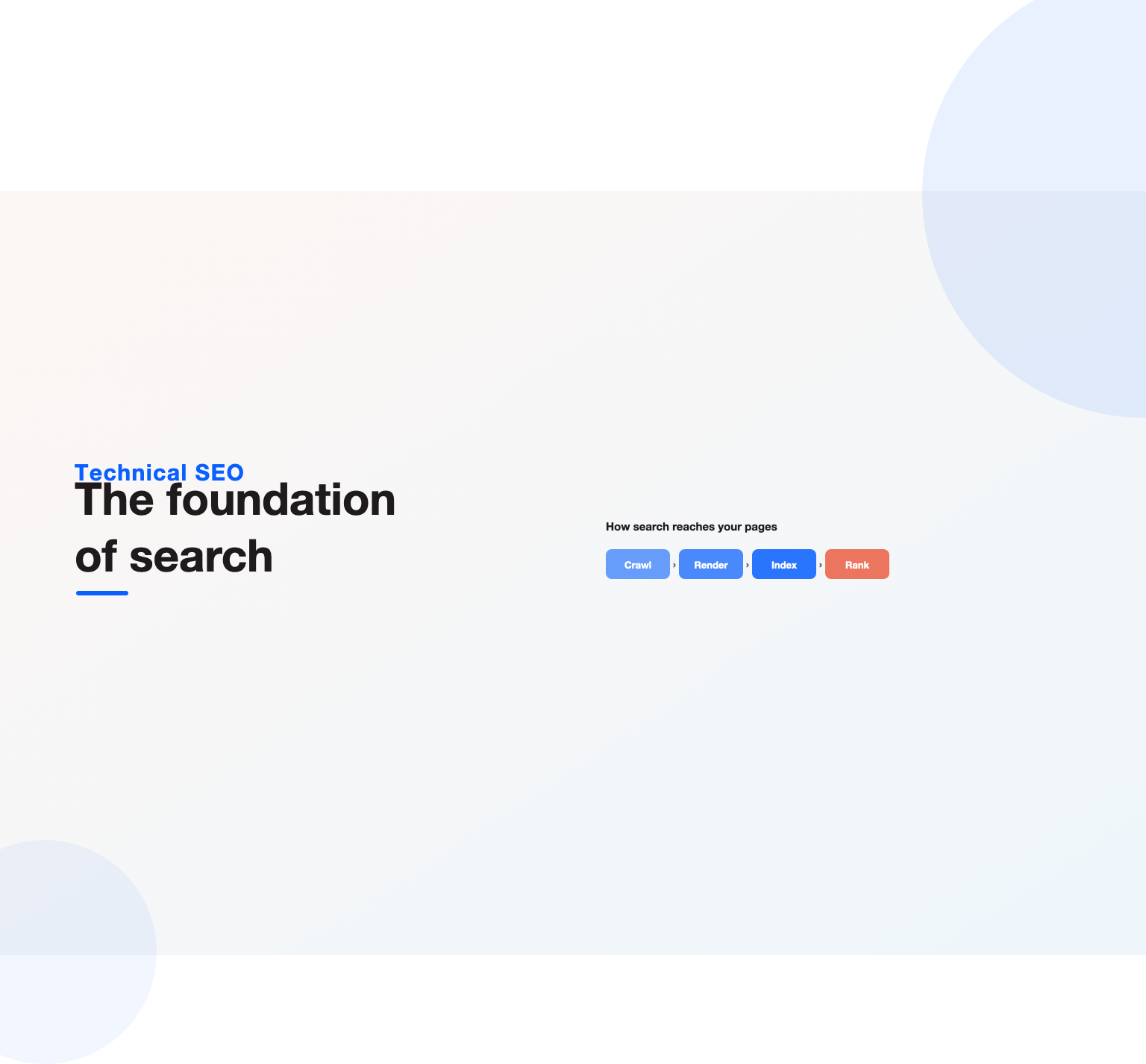
At its core, what is technical SEO comes down to removing every obstacle between your pages and a search engine’s ability to use them. Search engines send crawlers to discover URLs, render the page as a browser would, decide whether to store it in the index, and then judge where it should rank. The discipline makes each of those four stages, crawl, render, index, rank, run smoothly. Google’s own documentation on how Search works lays out this pipeline, and technical work is about clearing friction at every step.
A useful analogy is a physical store. On-page SEO is your products and signage; off-page SEO is your reputation in town; technical SEO is whether the doors open, the aisles are navigable, and the lights are on. Shoppers cannot buy what they cannot reach, and search engines cannot rank what they cannot access. That is why understanding what is technical SEO matters before you invest in content: publishing more pages on a site crawlers struggle with is like stocking shelves in a shop nobody can enter.
Why technical SEO matters
The payoff of technical work is leverage. A single fix, resolving a crawl block, correcting canonical tags, cutting load time, can lift the performance of hundreds or thousands of pages at once, which rarely happens with content changes made page by page. On large sites especially, technical SEO is the highest-leverage discipline available, because it compounds across the whole domain rather than one URL.
It also protects what you already have. Site migrations, redesigns, and platform changes routinely erase rankings when technical details are mishandled, so sound technical governance is as much about defence as offence. And as search engines lean harder on page experience and structured understanding, the technical bar keeps rising. A site that was technically fine three years ago may be quietly losing ground today, which is the practical reason technical SEO belongs in every serious SEO programme rather than as an afterthought.
Crawling and indexing: the foundation
Everything begins with crawling. If search engines cannot reach a page, nothing else you do to it counts, so a core part of what is technical SEO involves controlling and guiding crawlers. Your robots.txt file tells crawlers which areas to skip, and misconfiguring it is a classic way to accidentally hide an entire site. An XML sitemap does the opposite, handing engines a clean list of the URLs you want found.
Indexing is the next gate. A crawled page is not automatically indexed; engines decide whether it is worth storing based on quality, duplication, and directives like noindex tags and canonicals. Common problems here include important pages blocked by accident, thin or duplicate pages bloating the index, and canonical signals that point to the wrong URL. Diagnosing these is a staple of any SEO audit, and the Index Coverage report in Search Console is where most of the evidence lives.
Site speed and Core Web Vitals
Page experience is now a ranking consideration, and speed sits at its centre. Google’s Core Web Vitals measure three things: loading (Largest Contentful Paint), interactivity (Interaction to Next Paint), and visual stability (Cumulative Layout Shift). Pages that load slowly, respond sluggishly, or jump around as they render frustrate users and give engines a reason to prefer a competitor.
Improving these metrics is squarely technical work: compressing and correctly sizing images, deferring non-critical scripts, caching aggressively, and trimming render-blocking resources. The business case is not only rankings but conversion, because faster pages keep more visitors. This is one of the clearest examples of what is technical SEO delivering double value, better search performance and a better experience for the humans who arrive.
Site architecture and internal linking
How your pages connect shapes how engines understand and prioritise them. A flat, logical architecture, where important pages sit few clicks from the homepage, helps crawlers reach and value them. Deep, tangled structures bury pages and dilute their signals. Thoughtful internal linking then distributes authority to the URLs that matter most, guiding both users and engines toward your priority content, a discipline our guide to on-page SEO touches on as well.
Architecture also clusters topics. Grouping related pages and linking them coherently signals topical depth, which supports the authority-building work described in our off-page SEO guide. Getting structure right early is far cheaper than retrofitting it later, so it deserves attention at the design stage, not after a site has sprawled into thousands of disconnected URLs.
Structured data and schema markup
Structured data is code that tells search engines exactly what your content means, not just what it says. Using the vocabulary from Schema.org, you can label a page as a product, an article, an FAQ, a recipe, or dozens of other types, which helps engines interpret it and can unlock rich results like star ratings, prices, and FAQ dropdowns in the listings.
Beyond richer listings, structured data is increasingly important for AI-driven search, where engines assemble answers from sources they can parse cleanly. Well-marked-up content is easier for these systems to extract and cite, which links technical work to the emerging fields of answer and generative engine optimisation. Implementing schema correctly, and validating it, is a technical task, and it is one of the more accessible wins when people first learn what is technical SEO can do for visibility.
Not sure why your pages are not ranking or bringing enquiries?
Our team reviews your current setup and shows you where the opportunities are. See how our SEO services work.
Mobile, HTTPS, and other essentials
Google indexes the mobile version of your site first, so a site that works poorly on phones is a site that struggles everywhere. Responsive design, readable text, and tap-friendly controls are baseline requirements, not niceties. Security is another baseline: HTTPS is a lightweight ranking signal and a trust signal, and browsers now warn users away from pages served over plain HTTP.
Several other essentials round out the discipline. Canonical tags resolve duplicate-content confusion by naming the preferred version of a page. Hreflang tags tell engines which language and region each page targets, which matters for international sites. Clean, descriptive URLs and correct HTTP status codes, 200 for live pages, 301 for permanent moves, 404 for genuinely missing ones, keep the whole system legible. None of these is glamorous, but each is part of what is technical SEO in practice, and neglecting any of them leaks performance.
JavaScript SEO and modern sites
Modern frameworks build much of the page with JavaScript in the browser, which creates a rendering challenge: if key content or links only appear after scripts run, engines may miss them. Google can render JavaScript, but it does so on a delay and not always completely, so heavy client-side reliance is a real risk for discovery.
The fixes are technical choices about how pages are built and served, such as server-side rendering or pre-rendering so that content and links exist in the initial HTML. For any site built on a modern framework, this facet of technical SEO can be the difference between full indexation and large sections of the site never ranking. It is also a reminder that technical SEO evolves with the web itself, which is why staying current matters as much as knowing the fundamentals.
How to audit and fix technical SEO
A technical audit works methodically through the pipeline, and many teams work from a structured technical SEO checklist so no critical step is skipped. It starts with crawlability and indexation, then site speed and Core Web Vitals, then architecture and internal linking, then structured data, mobile, and security, and finally the long tail of canonicals, redirects, and status codes. Tools speed this up: Search Console surfaces indexing and page-experience data straight from Google, while crawlers simulate how engines traverse your site and flag errors at scale.
The output should be a prioritised list, not a data dump. Fixes that unblock crawling or indexing come first because they gate everything else, followed by high-impact speed and structure improvements, then refinements. Because sites change with every deployment, the smartest teams treat technical SEO as continuous monitoring rather than a one-time project. If your site is large or complex, or you are planning a migration, this is the point where expert help earns its fee, and our broader guide to SEO shows how the technical layer fits with content and authority.
Technical SEO vs on-page vs off-page
The three disciplines work together, and separating them clarifies where technical work fits. On-page SEO optimises the content and HTML of individual pages: titles, headings, keyword coverage, and internal links aimed at matching search intent. Off-page SEO builds authority and trust from outside your site, mainly through earned links and mentions. It makes the whole site accessible, fast, and understandable so the other two can work.
Think of it as a stool with three legs. Strong content with no authority struggles to rank; strong authority on an inaccessible site is wasted; and flawless technical health with thin content has nothing to rank. A balanced programme invests in all three, but because technical issues can silently cap everything else, they are usually addressed first. That sequencing is the practical answer to why what is technical SEO gets so much attention at the start of an engagement.
Common technical SEO mistakes to avoid
Most technical problems are not exotic; they are the same handful of errors repeated across sites of every size. Accidentally blocking pages is the classic one: a stray disallow rule in robots.txt or a leftover noindex tag from a staging site can wipe whole sections out of the index overnight, and because nothing looks broken to a human visitor, the damage often goes unnoticed for months. Duplicate content is another frequent culprit, where the same page is reachable through multiple URLs, splitting signals and confusing engines about which version to rank.
Slow pages remain stubbornly common, usually caused by oversized images, bloated scripts, and no caching. Broken internal links and long redirect chains waste crawl budget and frustrate users, while missing or incorrect canonical tags let duplicate URLs compete with each other. Orphan pages, those with no internal links pointing to them, quietly fail to rank because engines struggle to find or value them. None of these is hard to fix once spotted, which is why a structured audit pays for itself; the difficulty is almost always detection, not repair. A disciplined approach to what is technical SEO turns these silent leaks into a short, prioritised fix list.
Scaling up: large and ecommerce sites
Scale changes the game. On a ten-page brochure site, technical issues are contained; on a site with tens of thousands of URLs, small percentage problems become enormous in absolute terms. Crawl budget, how many pages an engine will fetch in a given period, becomes a real constraint, so large sites must stop engines wasting time on low-value or duplicate URLs and steer them toward pages that matter. This is where enterprise SEO leans heavily on technical governance.
Ecommerce sites face their own pattern of challenges. Faceted navigation, the filters that let shoppers sort by size, colour, or price, can generate millions of near-duplicate URLs if left uncontrolled, ballooning the index and draining crawl budget. Product pages that go out of stock, seasonal categories, and pagination all need deliberate handling. Getting these right is central to ecommerce SEO, and it is a vivid demonstration of what is technical SEO doing at scale: the same principles, applied to far more surface area, with far higher stakes when they go wrong.
Migrations: the highest-risk moment
Few moments carry more technical risk than a migration. Whether you are changing domains, redesigning, replatforming, or restructuring URLs, the potential to lose years of accumulated rankings in a single launch is real and common. The cause is almost always technical: broken redirects, changed URL structures without proper mapping, accidental noindex tags carried over from staging, or a new site that renders content differently from the old one.
A safe migration is a technical project managed carefully from start to finish: a full inventory of existing URLs and their performance, a one-to-one redirect map from old to new, careful handling of canonicals and metadata, and close monitoring of crawling and indexing after launch. Our guide to website migration SEO details the safeguards. Because the downside is so severe, migrations are the single most common reason companies bring in outside technical expertise before, rather than after, the launch, when problems are far cheaper to prevent than to diagnose in the wreckage.
How to get started with technical SEO
Beginning does not require boiling the ocean. Start by connecting your site to Google Search Console, which is free and shows how Google actually sees your pages, including indexing status and page-experience data straight from the source. Review the Index Coverage report first to confirm your important pages are indexed and nothing critical is blocked, because that single check often surfaces the highest-impact problems.
From there, work down the priority order: fix anything blocking crawling or indexing, then tackle site speed and Core Web Vitals, then check mobile-friendliness and HTTPS, then review internal linking and structured data. Pair this with real keyword research so your technical improvements support the pages that target genuine demand. For small sites, the fundamentals of what is technical SEO are learnable and doable in-house; for large, complex, or fast-changing sites, or when a migration looms, expert help usually pays for itself. Either way, understanding what is technical SEO gives you the vocabulary to brief a developer precisely and to judge whether the work is actually being done.
Measuring the impact of technical SEO
Technical work can feel invisible, so measuring it keeps the effort honest and fundable. Leading indicators move first: the number of pages indexed, crawl errors resolved, Core Web Vitals passing, and average load time. These shift within weeks of a fix and prove the foundation is improving before rankings respond.
Lagging indicators follow: impressions and average position in Search Console for your priority queries, then organic sessions to the pages you fixed, and finally the conversions and revenue those pages drive. Attributing gains precisely is harder than with a content launch, because technical fixes often lift many pages at once, but the pattern is usually clear, broad improvement across a template or section after a structural fix. Tracking this way reframes what is technical SEO from a cost centre into an investment with a visible return, and it gives you the evidence to keep prioritising the unglamorous work that quietly underpins everything else in a search programme.
Page experience, explained
Search engines increasingly try to reward pages that people genuinely enjoy using, and page experience is how that intent shows up in the algorithm. Speed is the headline, but the wider set of signals matters too: a page should be stable as it loads, safe to browse over HTTPS, free of intrusive interstitials that block the content, and comfortable on a phone. Each of these is a technical property of how the page is built and served, not a content decision.
The reason this bundle deserves attention is that it doubles as conversion optimisation. Every improvement that pleases the algorithm, faster loads, fewer layout shifts, cleaner mobile layouts, also keeps human visitors on the page and moving toward a goal. That alignment is unusual in marketing, where tactics often trade one audience against another. Here the same fix serves both the engine and the customer, which makes page-experience work some of the easiest to justify to a sceptical finance team. When rankings and revenue move in the same direction from a single change, the business case writes itself.
Want a team to run this SEO work for you?
Book a free 30-minute strategy call and leave with a clear next step for your business.
How technical SEO supports AI search
The way people search is broadening beyond a list of links into AI assistants and AI Overviews that assemble answers from sources they can read cleanly. That shift raises the value of solid technical foundations, because systems that generate answers favour content they can crawl, parse, and trust without ambiguity. A fast, well-structured page with accurate markup is far easier for these engines to extract and cite than a slow, tangled one.
This is where the technical layer connects to newer disciplines. Being surfaced inside AI answers is the goal of answer engine optimization, while earning a place as a source large language models quote is the aim of generative engine optimization. Both rest on the same foundations that traditional search rewards: clean structure, genuine authority, and content that resolves the query. Far from being a separate track, optimising for AI search largely reinforces the technical fundamentals you should already be getting right, which means disciplined technical work future-proofs your visibility as search keeps evolving.
Who should own technical SEO in your team
Ownership is where many programmes stumble, because technical SEO lives in the overlap between marketing and engineering and can fall through the gap between them. Marketers understand why a fix matters for visibility but often cannot ship it; developers can ship it but may not see why it is a priority against a crowded product roadmap. Progress depends on bridging that divide with shared goals and a translator who speaks both languages.
In practice, the most effective setups give marketing responsibility for identifying and prioritising issues, engineering responsibility for implementing them, and a clear process for getting technical tickets into the development sprint with enough context that they are understood, not just queued. Reporting that ties each fix to a business outcome helps engineering see the return on what can feel like invisible plumbing. Smaller teams often lean on an outside specialist to play the translator role, auditing the site, writing developer-ready specifications, and keeping the work moving. However you resource it, the principle is the same: someone must own the discipline explicitly, because a responsibility shared by everyone is usually owned by no one, and technical debt accumulates fastest when nobody is watching the foundations.
The business case for prioritising it
Because the work is invisible to most stakeholders, it often loses the budget fight to flashier initiatives, and that is a costly mistake. The argument that wins boardrooms is leverage: content and links improve pages one at a time, whereas a single structural fix can lift an entire section of the site at once. When you frame a crawl-budget fix or a speed overhaul as something that raises the ceiling on every page beneath it, the return starts to look less like maintenance and more like infrastructure investment.
There is also a risk argument that resonates with leadership. The downside of neglect is not merely slower growth; it is sudden loss, the migration that erases rankings, the redesign that de-indexes key pages, the creeping decay of a site that quietly falls behind rising standards. Positioning sound foundations as insurance against those events reframes the spend as protecting revenue you already earn, not just chasing more. Finally, there is the compounding effect over time: a technically healthy site rewards every future content and link investment more fully, so the earlier you fix the foundations, the more valuable everything you build afterward becomes. That combination, leverage now, protection against disaster, and higher returns on future work, is why experienced teams refuse to treat these foundations as optional, and why they usually fund them before the more visible campaigns that depend on them.
Bringing it together
For all its depth, the discipline rewards a simple mindset: clear the path, then keep it clear. Search engines want to reach your pages, understand them, and serve them to the right people, and your job is to remove whatever gets in the way, whether that is a blocked URL, a sluggish load time, a confusing structure, or markup an engine cannot parse. Everything covered here, from crawling and indexing to speed, structure, schema, and migrations, is a variation on that single theme. Start with the fundamentals, confirm your key pages are indexed, fix whatever gates discovery first, and then build the habit of monitoring your foundations continuously rather than firefighting problems only once rankings have already slipped. Do that consistently and the foundations stop being a source of nasty surprises and become a quiet, compounding advantage, one that makes every article you publish and every link you earn work harder than it would on a shakier base. Foundations rarely get credit when they hold, but they are what everything else stands on, and the teams that respect that truth are the ones whose organic growth proves durable rather than fragile when the next algorithm update or redesign inevitably arrives.
Key takeaways
- Technical SEO is the foundation layer. It ensures engines can crawl, render, index, and rank your pages at all.
- It is high-leverage. One fix can lift thousands of pages, which content changes rarely do.
- Speed, structure, and structured data lead. Core Web Vitals, clean architecture, and schema are the biggest recurring wins.
- Modern sites add new risks. JavaScript rendering and mobile-first indexing need deliberate technical choices.
- Treat it as ongoing. Sites change constantly, so monitor technical health rather than fixing it once.
Frequently asked questions
What is technical SEO in simple terms?
It is the work of making a website easy for search engines to crawl, render, index, and rank. It covers speed, site structure, indexation, structured data, mobile-friendliness, and security, the foundation that lets your content and links actually perform.
How is technical SEO different from on-page SEO?
On-page SEO optimises the content of individual pages, such as titles, headings, and keyword coverage. It optimises the site’s infrastructure so those pages can be discovered and understood in the first place. You need both, but technical issues are usually fixed first.
Is technical SEO hard to learn?
The concepts are learnable, but implementation often needs developer skills, especially for speed, JavaScript rendering, and structured data. Many teams handle the basics in-house and bring in a specialist for complex issues, migrations, or large sites.
What are the most important technical SEO factors?
Crawlability and indexation come first, followed by site speed and Core Web Vitals, mobile-friendliness, clean site architecture with strong internal linking, structured data, HTTPS, and correct canonical and redirect handling.
How often should I do a technical SEO audit?
Run a full audit at least once or twice a year, after any major site change or migration, and monitor core signals continuously through Search Console. Sites change with every deployment, so ongoing monitoring catches problems before they cost rankings.
Does technical SEO help with AI search?
Yes. Clean structure, fast pages, and accurate structured data make content easier for AI systems to parse and cite, which supports visibility in AI Overviews and assistants alongside traditional rankings.
Can good content rank without technical SEO?
Sometimes on small, simple sites, but it is a gamble. If crawlers cannot access pages, indexing is misconfigured, or the site is painfully slow, even excellent content will underperform. It removes those ceilings.
What tools do I need for technical SEO?
Google Search Console is essential and free. A site crawler helps you audit at scale, and a page-speed tool helps diagnose Core Web Vitals. Those three cover most of what you need to find and prioritise technical issues.
Ready to put this into practice?
Talk to the team that runs SEO, AI search and paid growth programs every day.
Book a Strategy Call →