 Skip to content

What Is Conversion Rate Optimization? A Guide
What is conversion rate optimization? A plain guide to CRO: the process, A/B testing, landing page optimization, what a good conversion rate is, best practices, and how to start.
Quick Answer
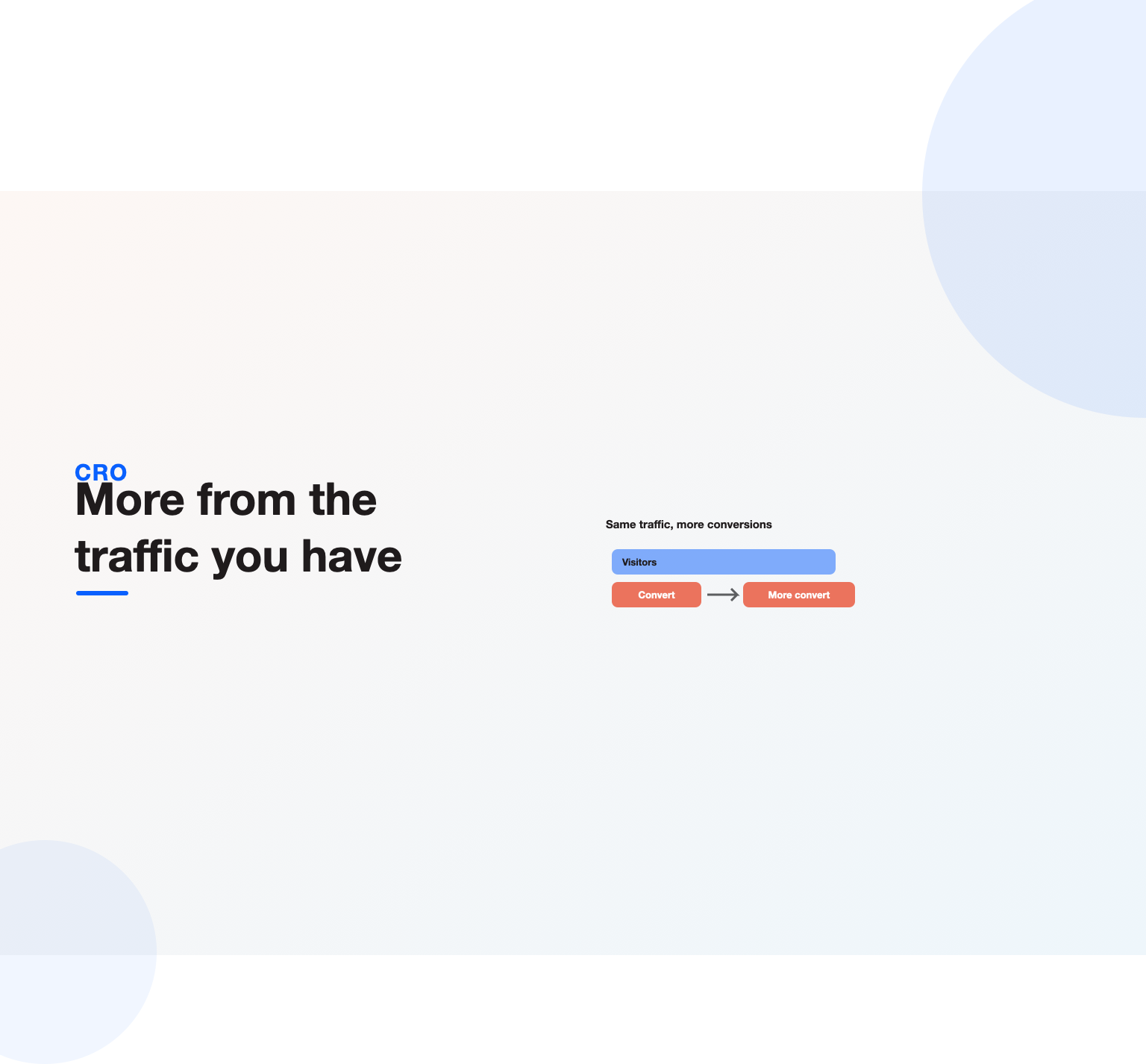
Conversion rate optimization (CRO) is the systematic process of increasing the percentage of website visitors who take a desired action, such as making a purchase, filling out a form, or signing up. In short, what is conversion rate optimization if not getting more value from the traffic you already have: instead of spending more to attract visitors, you improve your site so more of them convert. It relies on data, user research, and testing rather than guesswork, using tools and experiments to understand why people do or do not act, then making evidence-based changes. Because it improves the return on every other marketing channel feeding your site, CRO is one of the highest-leverage disciplines in digital marketing.
Key Highlights
- More results from existing traffic. You lift conversions without paying for more visitors, improving the ROI of every channel.
- It is data-driven, not guesswork. Analytics, user research, and testing reveal what actually changes behaviour.
- Testing is the engine. A/B and multivariate tests prove which changes work before you roll them out.
- It compounds with other channels. A better converting site makes SEO, PPC, and email all more profitable.
- Small gains add up. Modest percentage lifts on high-traffic pages translate into significant revenue.
What is conversion rate optimization, defined properly?
At its core, what is conversion rate optimization comes down to a simple ratio and a disciplined way of improving it. Your conversion rate is the share of visitors who complete a goal, so if 100 people visit and two buy, your conversion rate is two percent. It is the structured practice of raising that number by understanding your visitors and systematically removing the friction that stops them from acting. Rather than redesigning on a hunch, practitioners gather evidence, form hypotheses, test changes, and keep what demonstrably works.
The discipline blends several skills: analytics to see what is happening, psychology to understand why, design and copywriting to craft better experiences, and experimentation to prove causation. This is sometimes called cro marketing when framed as a growth function, and it sits at the intersection of marketing, user experience, and data. Understanding what is conversion rate optimization means recognising it as an ongoing, evidence-led process rather than a one-time fix, because visitor behaviour, competitors, and expectations keep shifting, so optimisation never truly finishes.
It is worth stressing what CRO is not. It is not blindly copying competitors, applying generic best-practice checklists without testing, or making changes based on the highest-paid person’s opinion. Those approaches ignore the specifics of your audience, and CRO exists precisely to replace opinion with evidence about what your actual visitors respond to.
Why conversion rate optimization matters
The economic case is compelling because CRO multiplies the value of everything else you do. Every visitor you attract through SEO, paid ads, or email costs money or effort, and if only a small fraction convert, most of that spend is wasted. Improving your conversion rate means more of that existing traffic turns into customers, effectively lowering your cost per acquisition without spending an extra cent on traffic. On a site with meaningful volume, even a small percentage lift can translate into substantial additional revenue.
There is also a compounding relationship with other channels. A higher-converting site makes paid advertising more profitable, because each click is worth more, which in turn lets you bid more aggressively than competitors. It makes SEO more valuable, because the organic traffic you work hard to earn converts better, and it makes email and social efforts pay off more fully. Seen this way, what is conversion rate optimization becomes a force multiplier across your entire marketing programme rather than an isolated tactic, which is why sophisticated teams invest in it alongside their traffic-driving channels rather than treating it as an afterthought.
How CRO works: the process
Effective optimisation follows a repeatable cycle rather than random tweaks. It begins with research and data gathering: using analytics to find where visitors drop off, heatmaps and session recordings to see how they behave, and surveys or user testing to understand why. This stage turns vague dissatisfaction into specific, evidence-backed problems worth solving.
From there, you form a hypothesis, a testable prediction that a specific change will improve a specific metric for a specific reason. You then build and run an experiment, usually an A/B test comparing the original against a variation, and let real user behaviour and statistical significance decide the winner rather than opinion. Winning changes are implemented, losing ones discarded, and the cycle repeats on the next opportunity. The Nielsen Norman Group research library is a respected source for the usability principles that inform these hypotheses. This disciplined loop, research, hypothesise, test, learn, is the heart of what is conversion rate optimization done properly, and it is what separates genuine CRO from cosmetic redesigns.
What is a good conversion rate?
One of the most common questions is what a good conversion rate actually looks like, and the honest answer is that it depends heavily on your industry, traffic source, and what counts as a conversion. Average website conversion rates often sit in the low single digits, but a high-intent audience or a low-commitment action can convert far higher, while a cold audience or a big-ticket purchase converts lower. Comparing your rate to a generic benchmark can therefore mislead more than it helps.
A more useful framing is to treat your own current rate as the baseline and focus on improving it steadily, rather than chasing someone else’s number. Segmenting matters too, because a blended site-wide rate hides big differences between traffic sources, devices, and pages. The most valuable comparison is you today versus you last quarter, and against your own targets tied to profitability. Rather than obsessing over whether a rate is objectively good, understanding CRO means committing to a process of continuous improvement from wherever you currently stand.
Landing page optimization
Landing pages are where much of the highest-return optimisation happens, because they are the focused entry points where visitors decide whether to act. Effective landing page optimization strips away distraction and aligns every element toward a single goal: a clear, benefit-led headline that matches what brought the visitor there, persuasive copy that addresses objections, trust signals like testimonials or guarantees, and one prominent call to action rather than competing choices.
Message match is critical, since a visitor who clicks an ad or link expecting one thing and lands on something misaligned will leave immediately. Speed and mobile experience matter enormously too, because a slow or awkward page loses people before they even read it, which ties landing page work directly to technical foundations. For paid traffic especially, strong landing pages are what make PPC profitable, because they convert the clicks you paid for. Optimising these focused pages often delivers faster, larger gains than site-wide changes, making them a natural place to begin.
Plenty of visitors, too few enquiries?
Our team reviews your current setup and shows you where the opportunities are. See how our CRO services work.
A/B testing and experimentation
Testing is what makes CRO a science rather than a guessing game, and A/B testing is its workhorse. In an A/B test, you show the original version to half your visitors and a variation to the other half, then measure which drives more conversions, letting real behaviour settle the question objectively. Multivariate testing extends this to multiple elements at once, though it needs more traffic to reach reliable conclusions.
The discipline lies in the details: testing one clear hypothesis at a time, running the test long enough to reach statistical significance rather than stopping at the first promising result, and accounting for factors like seasonality that can distort short samples. A frequent mistake is calling a winner too early on too little data, which produces false confidence and changes that do not hold up. Done rigorously, experimentation removes opinion and politics from decisions, replacing “I think” with “the data shows”. This evidence-first mindset is the backbone of what is conversion rate optimization, and it is a capability worth building deliberately, whether in-house or through dedicated CRO support.
How to improve conversion rate: practical levers
While every site is different, certain levers reliably move the needle when tested. Clarity is foremost: visitors who are confused do not convert, so clear value propositions, simple navigation, and unambiguous calls to action consistently help. Reducing friction is next, removing unnecessary form fields, cutting steps in a checkout, and eliminating anything that adds effort or doubt between intent and action.
Trust is another powerful lever, since people hesitate to act when unsure, so social proof, reviews, security signals, and guarantees ease that hesitation. Speed and mobile experience underpin everything, because a fast, smooth experience keeps people moving toward the goal. Strong, benefit-focused copy that speaks to the visitor’s needs rather than the company’s features turns interest into action, which is where skilled content and copywriting earns its keep. Knowing how to improve conversion rate is ultimately about testing these levers against your own audience rather than assuming, because what works spectacularly for one site may do nothing for another.
CRO best practices
A handful of principles separate mature programmes from scattered tinkering, and following these cro best practices keeps effort productive. Always start with data rather than opinion, because the biggest wins usually address problems you did not know you had until the numbers revealed them. Prioritise ruthlessly, focusing testing effort on high-traffic, high-value pages where improvements produce the most revenue, rather than optimising pages few people see.
Test one meaningful change at a time so you can attribute results clearly, and resist the urge to implement untested ideas just because they sound good. Document everything, because a record of what you tested and learned prevents repeating mistakes and builds institutional knowledge over time. Above all, treat CRO as continuous rather than a project with an end date, since there is always a next hypothesis worth testing. These practices are less about clever tricks than disciplined habits, and they are what make what is conversion rate optimization deliver compounding returns rather than one-off bumps.
Common CRO mistakes to avoid
Predictable errors undermine many optimisation efforts. Testing without enough traffic or for too short a time produces unreliable results that mislead rather than inform, and acting on them can hurt performance. Making decisions based on opinion or imitation rather than data ignores the specifics of your own audience, which is the very thing CRO exists to understand.
Copying competitors assumes their choices are optimised, when often they are guessing too. Focusing only on the point of conversion while ignoring the full journey misses friction that occurs earlier, and optimising for a micro-metric like clicks while ignoring revenue can improve a number without improving the business. Perhaps the most common mistake is impatience, abandoning the process after a few tests when CRO rewards sustained, disciplined effort. Avoiding these traps matters more than any single tactic, because a rigorous process reliably beats clever ideas applied carelessly, and it is central to what is conversion rate optimization practised well.
CRO tools and how to get started
A practical toolkit supports each stage of the work. Analytics platforms show what is happening and where visitors drop off, behavioural tools like heatmaps and session recordings show how people actually interact, and survey tools reveal why. Testing platforms run the A/B and multivariate experiments that prove which changes work. None of these replaces strategy, but together they turn optimisation from guesswork into evidence.
Getting started does not require a big budget or a large team. Begin by setting up proper analytics and conversion tracking so you can see your current performance, because you cannot improve what you cannot measure. Identify your most important pages and biggest drop-off points, form a hypothesis about one clear problem, and run your first test. From that foundation, build the habit of continuous testing and learning, expanding as you see results. Whether you develop the capability internally or partner for CRO services, understanding what is conversion rate optimization well enough to start measuring and testing is the first step, and it pairs naturally with the traffic work in our complete guide to SEO and broader growth marketing.
CRO and the wider marketing system
Conversion optimisation does not operate in isolation; it amplifies every channel that sends traffic to your site. When you improve your conversion rate, the leads you generate through lead generation cost less per acquisition, the organic visitors from SEO convert at higher rates, and the clicks you buy through paid search return more revenue. This multiplier effect is why CRO is often the most cost-effective investment available once you have meaningful traffic.
It also feeds insight back into those channels. What you learn about visitor motivations and objections through testing informs your ad copy, your content topics, and your positioning, making the whole system smarter. The data revealed by optimisation, which messages resonate, which fears block action, is some of the most valuable market research a business can gather. Treating what is conversion rate optimization as an integrated part of the marketing system rather than a siloed activity is what unlocks its full value, because its gains compound with every other investment you make in attracting and nurturing an audience.
The psychology behind conversions
Beneath the metrics and tests, optimisation is really about human decision-making, and understanding a few psychological principles explains why certain changes work. People are guided by cognitive biases and mental shortcuts rather than pure logic, so how choices are presented often matters as much as the choices themselves. Social proof is powerful because we look to others when uncertain, which is why reviews and testimonials reliably lift conversions. Scarcity and urgency tap our fear of missing out, though they must be genuine to avoid eroding trust.
Reducing perceived risk is another lever grounded in psychology, since guarantees, clear return policies, and security signals lower the anxiety that stops people acting. The principle of cognitive load matters too: every extra decision or field taxes the visitor, so simplifying choices tends to increase completion. Research from usability specialists like the Baymard Institute quantifies how friction in forms and checkouts drives abandonment. Grounding hypotheses in these principles makes testing smarter, because you are not guessing randomly but predicting behaviour based on how people actually think, which is a large part of conversion optimisation at a sophisticated level.
Quantitative and qualitative research
Great optimisation draws on two complementary kinds of evidence, and using only one leaves you half-blind. Quantitative data, from analytics and testing, tells you what is happening: which pages lose visitors, how many convert, where drop-offs cluster. It is objective and measurable, but it cannot explain motivation, only reveal patterns. Relying on numbers alone often surfaces problems without illuminating their cause.
Qualitative research fills that gap by revealing why. Session recordings show real struggles, heatmaps expose where attention goes, surveys capture hesitations in visitors’ own words, and user testing uncovers confusion you would never spot in aggregate data. The strongest programmes combine both: quantitative data identifies where to look, and qualitative research explains what to fix, together producing hypotheses far better than either alone. This blend of evidence is a hallmark of mature practice, and it reflects the same rigour that underpins growth marketing generally, where decisions rest on triangulated evidence rather than a single metric.
CRO for ecommerce and lead generation
The discipline adapts to what you are optimising for. In ecommerce, conversions are purchases, so the work centres on product pages, cart, and checkout, reducing the friction and abandonment that lose sales at the final step. Clear pricing, trust signals, streamlined checkout, and strong product presentation drive measurable revenue, and this work pairs naturally with ecommerce SEO that brings the traffic in the first place.
For lead-generation businesses, the conversion is usually a form submission or enquiry, so optimisation focuses on the value exchange: making the offer compelling, the form frictionless, and the trust sufficient for someone to hand over their details. Improving both the quantity and quality of leads here directly strengthens the pipeline, which connects CRO to lead generation and demand generation. The core method stays the same, research, test, learn, but the specific levers and metrics differ, so applying a generic ecommerce playbook to a lead-gen site, or vice versa, misfires. Matching the approach to the conversion type is part of applying CRO intelligently rather than mechanically.
Want more of your existing traffic to convert?
Book a free 30-minute strategy call and leave with a clear next step for your business.
Building a CRO program
Turning occasional tests into a sustained capability requires people, process, and commitment. The roles involved span analysis, design, copywriting, and development, which is why CRO is often a collaborative effort rather than one person’s job. Smaller teams may combine these skills or bring in outside help, while larger organisations build dedicated optimisation teams with their own testing roadmap.
Process is what makes it sustainable: a documented pipeline of hypotheses prioritised by potential impact and effort, a testing calendar, and a shared record of what has been learned so knowledge compounds rather than resets with staff changes. Executive support matters too, because optimisation sometimes challenges cherished assumptions, and a culture that respects evidence over hierarchy gets better results. The reward for building this properly is a compounding engine of improvement that keeps lifting performance quarter after quarter. Whether you build it internally or engage specialist CRO support alongside your broader marketing, the goal is the same: an ongoing, disciplined practice rather than sporadic tinkering, which is the essence of the discipline done as a genuine program.
Measuring success and proving ROI
Because optimisation competes for budget and attention, measuring it convincingly is what keeps it funded. The headline metric is the conversion rate itself, but the number that persuades leadership is the revenue or pipeline impact of the improvements you make. Framing results in business terms, additional revenue per month, reduced cost per acquisition, higher return on ad spend, turns optimisation from a technical activity into a clear investment with a return.
Rigorous measurement also means attributing gains honestly. A test that lifts conversions by a given percentage on a page with known traffic and value can be translated into a concrete revenue figure, and tracking these cumulative wins over time builds a compelling record. Guidance from analytics resources like Google Analytics documentation helps teams set up the conversion tracking this depends on. It is worth measuring the losses too, because a disciplined program learns as much from tests that fail as from those that win, and documenting both prevents repeating dead ends. Proving impact this way is what secures the resources to keep optimising, and it reflects the same accountability that should run through every marketing channel.
Bringing it together
For all its tools, tests, and terminology, optimisation rests on a straightforward commitment: understand your visitors, remove what stops them from acting, and prove every change with evidence rather than opinion. That discipline is what turns a website from a static brochure into an asset that steadily improves, and it is why the practice delivers some of the best returns available in digital marketing once you have traffic worth optimising. The teams that win are not the ones with the flashiest ideas; they are the ones that test rigorously, respect the data, and keep improving while competitors guess. Start by measuring where you stand, fix the biggest friction first, and build the habit of continuous, evidence-led testing. Do that consistently, and better conversion rates stop being a lucky accident and become a repeatable, compounding advantage that makes every visitor, and every dollar you spend attracting them, work harder for the business over time.
When to prioritise optimisation
Timing matters, because the discipline pays off most under certain conditions. The clearest signal is meaningful traffic that is not converting as well as it could: if you are already attracting visitors but too few act, optimisation is often the fastest route to more revenue without spending more on acquisition. Rising traffic costs are another trigger, since when paid channels get more expensive, squeezing more value from existing visitors protects your margins better than simply bidding higher.
There are situations where it should wait, too. A site with very little traffic lacks the volume for reliable testing, so early-stage businesses may get more from first building an audience through content and search, then layering optimisation on once the numbers support it. Similarly, a fundamentally broken product or offer cannot be fixed by tweaking a button; optimisation improves how well you communicate and convert genuine value, not the value itself. The honest guidance is to invest once you have traffic worth improving and a real offer worth converting, because at that point the returns compound quickly. Weighing your own stage and traffic against these conditions tells you whether now is the moment to make optimisation a priority or to keep building the foundations that will make it worthwhile later. For most businesses that already have steady visitors and a proven offer, that moment has usually arrived, and the longer optimisation is delayed, the more revenue quietly leaks through a site converting below its potential every single day, which is why so many growth-focused teams treat conversion optimisation not as an optional extra but as a permanent, funded discipline that runs continuously alongside their traffic acquisition efforts, compounding quietly in the background while competitors keep paying more for visitors they never learn to convert.
Key takeaways
- CRO lifts results from existing traffic. It raises the share of visitors who convert, improving the ROI of every channel.
- It is evidence-led. Research, hypotheses, and testing replace opinion and guesswork.
- A/B testing is the engine. Rigorous experiments prove which changes actually work before you roll them out.
- Focus and patience win. Prioritise high-value pages, test one change at a time, and treat it as continuous.
- It multiplies everything else. A better-converting site makes SEO, PPC, email, and lead gen all more profitable.

Frequently asked questions
What is conversion rate optimization in simple terms?
It is the process of increasing the percentage of website visitors who take a desired action, like buying or signing up. Instead of paying for more traffic, you improve your site so more of your existing visitors convert, using data and testing rather than guesswork.
What is a good conversion rate?
It depends on your industry, traffic source, and goal, so generic benchmarks can mislead. Average rates often sit in the low single digits, but the most useful comparison is your own rate over time. Focus on steady improvement from your baseline rather than a universal number.
How do I improve my conversion rate?
Start with data to find where visitors drop off, then test changes to clarity, friction, trust, speed, and copy. Improve one thing at a time, prove it with an A/B test, and keep what works. The reliable path is disciplined testing against your own audience.
What is A/B testing in CRO?
A/B testing shows the original version of a page to half your visitors and a variation to the other half, then measures which converts better. It lets real behaviour decide objectively, replacing opinion with evidence, and it is the core method of conversion rate optimization.
Is CRO better than buying more traffic?
They are complementary, but CRO is often more cost-effective once you have meaningful traffic, because it improves the return on every visitor you already attract. A higher-converting site also makes paid traffic more profitable, so the two reinforce each other.
How much traffic do I need for CRO?
Enough for tests to reach statistical significance in a reasonable time. Very low-traffic sites can still improve using qualitative research and best practices, but reliable A/B testing needs sufficient volume, so higher-traffic pages are usually the best place to focus.
How long does CRO take to show results?
Individual tests typically run for a few weeks to reach reliable conclusions, and meaningful cumulative gains build over months of continuous testing. It is an ongoing discipline rather than a one-time fix, so the biggest returns come from sustained effort.
Do I need special tools for CRO?
You need analytics and conversion tracking at minimum, plus a testing platform for A/B tests and ideally behavioural tools like heatmaps to understand user behaviour. These turn optimisation into an evidence-based process, but strategy and disciplined testing matter more than any single tool.
Ready to put this into practice?
Talk to the team that runs SEO, AI search and paid growth programs every day.
Book a Strategy Call →