 Skip to content


What Is Growth Marketing? A Plain Guide
What is growth marketing? A data-driven, experiment-led approach that optimises the whole customer journey, acquisition, activation, retention, referral, and revenue, rather than just the top of the funnel.
Quick Answer
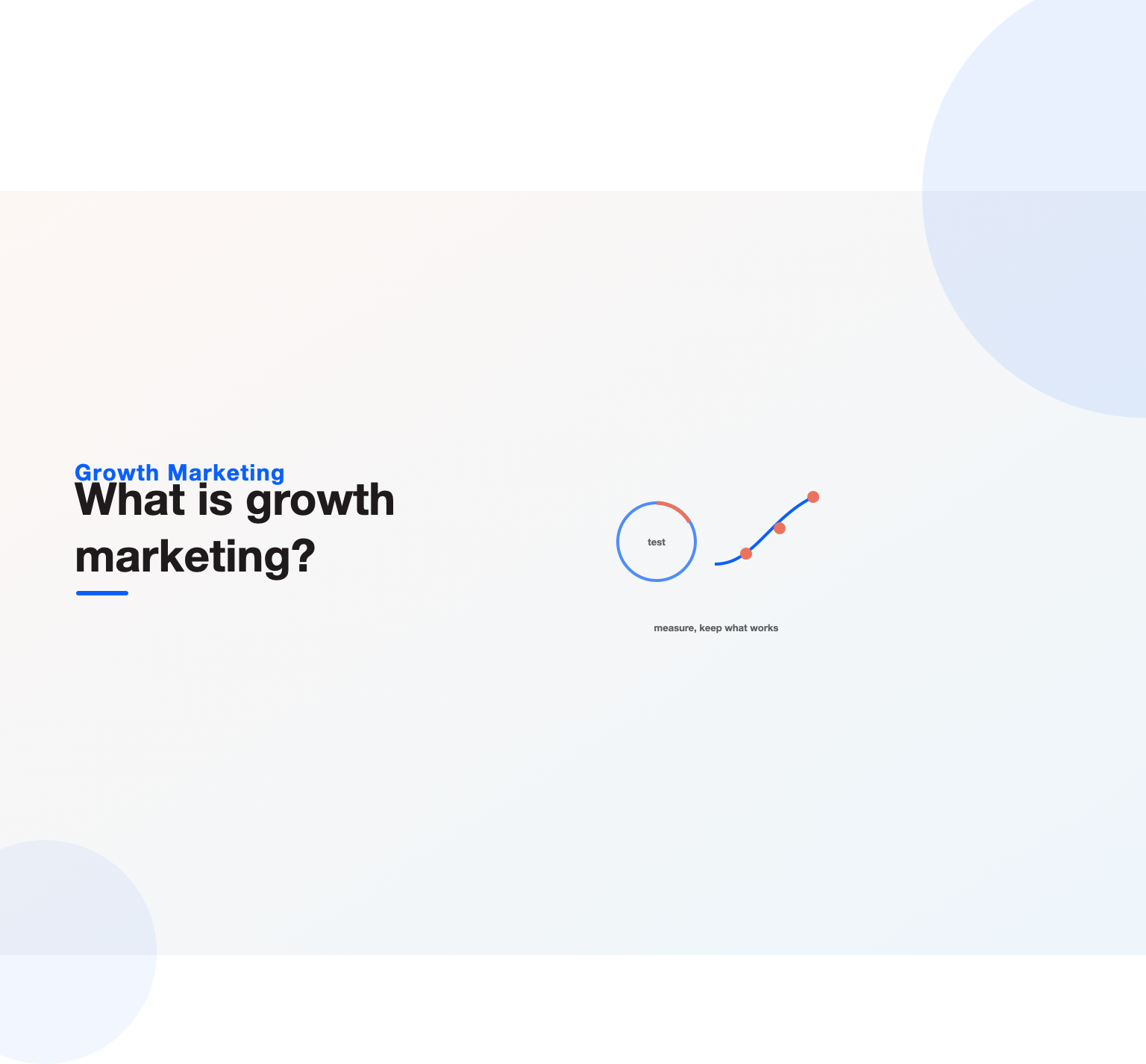
Growth marketing is a data-driven approach to growing a business that optimises the entire customer journey, not just the top of the funnel, through continuous experimentation. Rather than running one-off campaigns aimed only at acquisition, it treats acquisition, activation, retention, referral, and revenue as one system to be tested and improved together, using rapid experiments and hard data to find what actually moves the numbers. In short, growth marketing is marketing run like a scientific discipline: form a hypothesis, test it cheaply, measure the result, keep what works, and compound those wins across the whole journey rather than chasing vanity metrics at the top.
Key Highlights
- Growth marketing optimises the whole customer journey, not just acquisition at the top.
- It runs on continuous, data-driven experiments rather than one-off campaigns.
- The framework spans acquisition, activation, retention, referral, and revenue together.
- Retention and referral often matter more than raw acquisition to sustainable growth.
- It relies on measurement and testing to find what genuinely moves the numbers.
- It differs from traditional marketing by being iterative, full-funnel, and metric-led.
What growth marketing actually is
At its core, the approach is the practice of using experimentation and data to grow a business across its entire customer lifecycle. Where traditional marketing often focuses on awareness and acquisition, this discipline treats the whole journey, from a stranger first hearing of you to a loyal customer referring others, as a connected system to be optimised. Every stage is a place where growth can be won or lost, so all of them get attention rather than just the top.
The defining feature is the method: rather than launching a big campaign and hoping, a growth marketer forms a hypothesis about what might improve a metric, runs a small test, measures the result, and scales what works while discarding what does not. As a discipline closely related to growth hacking, it borrows the experimental mindset of a startup but applies it durably and at scale. This makes growth marketing less a set of tactics than a way of working: systematic, curious, and relentlessly focused on what the data says actually drives growth.
How it differs from traditional marketing
The clearest way to grasp it is by contrast with the traditional approach it evolved from. Traditional marketing tends to focus on the top of the funnel, awareness and acquisition, and to run in campaigns with fixed creative and a set budget, judged largely on reach and impressions. It is valuable, but it treats getting attention as the main job and often leaves what happens after acquisition to other teams.
This wider approach spans the whole funnel and narrows the method to continuous testing. Rather than a few big campaigns, it runs many small experiments across every stage, measures each against a real business metric, and iterates. Rather than judging success by impressions, it judges it by activation, retention, referral, and revenue. The two are not enemies, traditional brand-building still matters, but the practice adds the discipline of testing and the breadth of the full funnel, which is why it tends to produce more efficient, compounding results for businesses that can measure their customer journey.
The full funnel it optimises
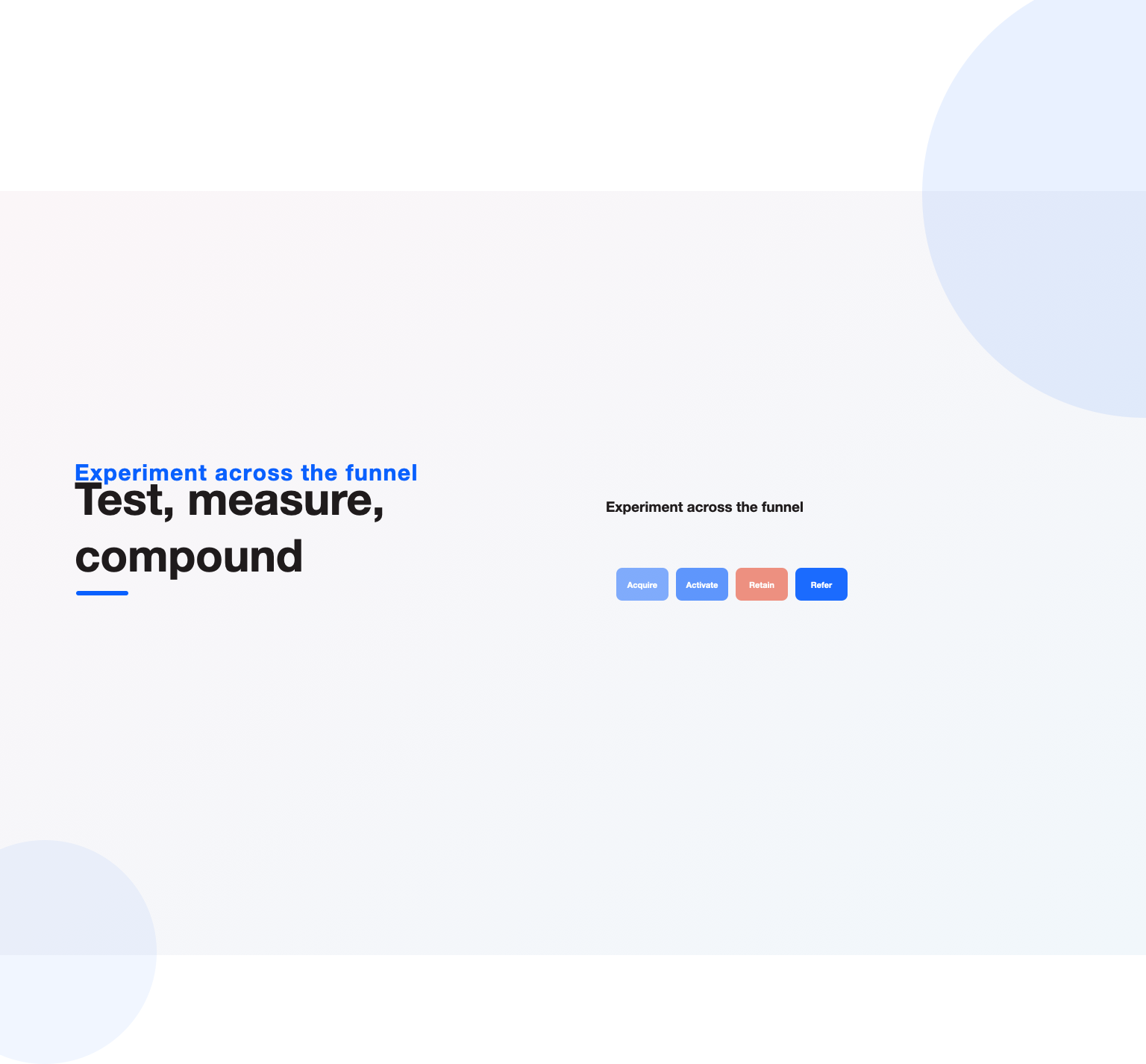
A central idea in growth marketing is that growth is won across the whole funnel, often summarised as acquisition, activation, retention, referral, and revenue. Acquisition is getting people to discover you; activation is the first experience that shows them value; retention is keeping them engaged and returning; referral is turning them into advocates; and revenue is monetising the relationship well. Each stage multiplies the others, so a weakness anywhere caps the whole.
The insight that sets the discipline apart is that acquisition is usually not where the biggest wins are. A business that pours everything into acquiring new users while leaking them at activation or retention is filling a leaky bucket, and fixing the leak often beats pouring in more. This is why the discipline looks hard at retention and referral, stages traditional marketing frequently neglects, because improving them compounds every acquisition dollar. Seeing the funnel as one connected system, rather than as acquisition plus someone else’s problem, is the shift that makes the approach so effective.
Experimentation is the engine
What powers growth marketing is a disciplined cycle of experimentation rather than intuition or one-off bets. The loop is simple: identify the metric you want to move, form a hypothesis about what might move it, design the smallest test that could prove or disprove it, run it, measure honestly, and either scale the winner or learn from the loss. Speed and volume of experiments matter, because more shots on goal, each cheap, find more wins than a few expensive campaigns.
The technique that underpins much of this is controlled testing, comparing a change against a baseline to see whether it genuinely helped. As a form of A/B testing, it removes guesswork by letting the data decide, which is what keeps a program honest. The mindset matters as much as the mechanics: a good growth marketer expects most experiments to fail and treats those failures as cheap learning rather than wasted effort. Building a culture that runs many small tests, kills losers quickly, and doubles down on winners is the real engine, and it is what compounds small improvements into large gains over time.
The channels this approach uses
Growth marketing is channel-agnostic, using whatever moves the metric rather than favouring a fixed set. In practice that spans content and search, which attract and compound over time; paid acquisition through channels like a well-run Meta ads program, which buys fast, measurable reach; email and lifecycle messaging, which drive activation and retention; product changes that improve activation and referral; and referral mechanics that turn users into a growth channel. The choice of channel follows the experiment, not the other way around.
This breadth is why growth marketers work closely with product, data, and engineering as much as with creative, because a change to an onboarding flow can move growth as much as a new campaign. Content and a disciplined SEO program provide the compounding acquisition that lowers cost over time, while a well-run paid search program buys speed where it pays. The rule is to let evidence, not habit, decide where effort goes, so the mix shifts as experiments reveal what actually works for a given business rather than staying fixed out of convention.
Data is the foundation
None of the method works without reliable data, because the whole discipline depends on measuring what happened accurately enough to act on it. That means tracking the customer journey end to end, defining the metrics that matter for each stage, and having the tooling to see whether an experiment moved them. Without trustworthy data, testing becomes guessing, and the supposed rigour of the approach collapses into opinion dressed up as science.
The practical implication is that a growth program has to invest in its measurement foundation before its experiments can be trusted. That includes clean analytics, a single view of the customer across tools, and the discipline to define success metrics before a test rather than rationalising afterwards. Much of this rests on connected systems, often coordinated through revenue operations, so the data behind every decision is sound. The lesson is that data is not a reporting afterthought in growth marketing but the foundation the entire method stands on, and a program built on shaky measurement will chase noise no matter how many experiments it runs.
The discipline in the Indian market
In India, the discipline fits a fast-scaling digital economy where startups and established businesses alike are adopting experiment-led growth. The large, mobile-first, price-sensitive market rewards the discipline’s focus on activation and retention, because acquiring users cheaply is only valuable if they stay and convert, and India’s competitive digital landscape makes retention especially decisive. The data and talent for running structured experiments are maturing quickly, particularly in the technology hubs.
Local texture shapes how it is applied. Channels like WhatsApp play a central role in activation and retention here, so experiments often run there as much as in email, and regional-language and mobile-first experiences matter for activation across a diverse market. Long, relationship-driven journeys in B2B raise the value of retention and referral experiments over pure acquisition. Pairing an experiment-led approach with a coordinated demand generation program tuned to these realities is what lets an Indian business grow efficiently rather than simply spending more to acquire users it then loses.
The metrics growth marketing lives by
Because it is a measured discipline, the approach lives or dies by the metrics it chooses, and choosing the right ones is half the battle. The best programs identify a small set of metrics that genuinely reflect growth, often a north-star metric that captures the core value the product delivers, plus stage metrics for acquisition, activation, retention, referral, and revenue. Vanity metrics like raw impressions or follower counts are deliberately avoided, because they can rise while real growth stalls.
The rule is to tie every experiment to a metric that matters, so that a win is a genuine improvement in the business rather than a bump in a number nobody should care about. This focus on meaningful measurement is also what makes the practice accountable: because success is defined in advance and measured honestly, it is clear which experiments worked and which did not. The lesson is that measurement is not the reporting at the end of the work but the compass that directs it, and a program that measures the wrong things will optimise its way toward the wrong outcomes with great efficiency.
A worked example of the method
An example makes the method concrete. Picture a subscription app that is spending heavily to acquire users but growing slowly. A traditional response would be to buy more ads; the experimental response is to look at the whole funnel and find where users are actually lost. On inspection, plenty of people install the app but few complete onboarding, so the biggest leak is activation, not acquisition, and pouring more money into ads would only fill a leakier bucket faster.
From that diagnosis, the team runs a series of small experiments on the onboarding flow: a shorter signup, a clearer first-value moment, a well-timed prompt. Each is tested against a baseline, measured on the share of new users who reach activation, and either kept or discarded. A winning change to onboarding lifts activation by a few points, which compounds through every later stage and every acquisition dollar, producing more growth than any ad spend would have. The team then moves to the next-biggest leak and repeats. The example shows the whole philosophy in miniature: measure the funnel, fix the biggest leak with cheap experiments, and compound the wins, rather than assuming the answer is always more traffic. Sharpening the conversion points along the way, the kind of work a disciplined conversion rate optimisation effort does, is often where the fastest gains hide.
Who owns growth and how a team works
A practical question is who actually does this work, and the answer has shifted as the discipline matured. Early on, a single versatile marketer or founder runs the experiments alongside everything else. As a business scales, it builds a dedicated growth function, often a small, cross-functional team that pairs marketing skill with data and, crucially, access to the product, because so many of the highest-impact experiments are changes to the product experience rather than to a campaign.
That cross-functional shape is what distinguishes a growth team from a traditional marketing one. It typically includes people who can analyse data, design and run experiments, write copy or build creative, and implement changes in the product, or who can work closely with engineers who do. Reporting to a leader who owns a growth metric rather than a channel keeps the team pointed at outcomes rather than activity. Underpinning the whole thing with clean, connected data, often coordinated through revenue operations, is what lets the team trust its own results. The lesson is that this is a team sport played across functions, and placing it where it can touch the whole journey, not just the top of the funnel, is what lets it do its job.
Where product and marketing meet
One of the defining features of the discipline is that it blurs the old line between product and marketing, because activation, retention, and referral are shaped as much by the product experience as by any campaign. A referral loop built into the product, an onboarding flow that gets users to value faster, or a feature that increases how often people return can move growth more than any amount of advertising, which is why growth marketers work so closely with product teams.
This is where the approach departs most sharply from traditional marketing, which usually stops at acquisition and hands the rest to other teams. By owning experiments across the product experience as well as the marketing channels, a growth function can improve the stages that compound most, and it treats the product itself as a growth channel rather than as something separate from marketing. Feeding the top of that funnel still matters, which is why the discipline pairs naturally with a coordinated demand generation program, and capturing the interest it creates is covered in our guide to how to generate leads. As a modern branch of marketing, its willingness to reach into the product is exactly what makes it effective at stages traditional marketing never touched. The lesson is that in this discipline, product and marketing are two levers on the same machine, and pulling only one leaves growth on the table.
Common misconceptions about growth marketing
- It is just growth hacking. Hacking implies quick tricks; the discipline is sustained, systematic experimentation at scale.
- It is only about acquisition. The whole point is optimising the full funnel, especially retention and referral.
- It replaces brand marketing. It complements brand-building with testing and full-funnel rigour rather than replacing it.
- It is only for startups. Any business that can measure its customer journey can apply the method.
- Every experiment should win. Most experiments fail; cheap failures are the cost of finding the wins.
- It is a set of hacks. It is a mindset and a process, not a list of tricks to copy.
Each misconception hides the real point, which is that this discipline is a disciplined, full-funnel, experiment-led way of working, not a bag of quick tricks or an acquisition-only tactic.
How to start with growth marketing
Starting with the approach does not require a large team, but it does require the right foundations and sequence. Begin by getting your measurement in order, tracking the customer journey and defining the metric that best captures real value, because without trustworthy data no experiment can be trusted. Then map your funnel and find the stage that is leaking most, since fixing the biggest leak usually beats optimising a stage that is already working.
With the weak point identified, run your first small experiments there: form a clear hypothesis, test the smallest change that could prove it, measure against your metric, and scale or learn. Build the habit of running experiments regularly, documenting what you learn, and compounding the wins across stages. Much of the activation and retention work runs on marketing automation, which lets a small team test and personalise at scale, and much of the acquisition experimentation leans on content and a disciplined SEO program that compounds cheaply over time. The point is not to buy an elaborate stack up front but to put in place just enough measurement and tooling to run honest tests, then let the program’s own results justify each further investment as it grows, so the toolset expands in step with the evidence rather than ahead of it. Starting lean this way also keeps the focus where it belongs, on running honest experiments and acting on what they show, rather than on assembling an impressive stack of tools that never gets used to anything like its full potential in practice. The sequence matters: measurement first, then find the leak, then experiment, then compound. Starting with a fashionable tactic before the measurement is in place usually just produces motion without knowing whether it helped.
The mindset that makes it work
Beyond the frameworks and channels, what really distinguishes growth marketing is a mindset, and a team can have every tool and still fail without it. The first trait is intellectual honesty: a willingness to let the data overturn a favourite idea, to call an experiment a loss when it loses, and to resist the urge to rationalise a flat result into a win. Without that honesty, the rigour is theatre, and the program optimises toward comfortable conclusions rather than real growth.
The second trait is comfort with failure, because most experiments do not work, and a team that fears losing runs too few tests to find the winners. Treating a failed experiment as cheap, useful learning rather than as wasted effort is what keeps the volume of tests high enough to matter. The third is a bias toward the whole system over any single channel, so that growth marketing stays focused on the metric that reflects real value rather than on whichever number is easiest to move. Curiosity ties them together: the best practitioners keep asking why a number moved, not just whether it did. Cultivated deliberately, this mindset is what turns the mechanics of growth marketing into a genuine engine, because the process only compounds when the people running it are honest about what the evidence shows and patient enough to let the winners accumulate over time.
How the discipline fits the wider engine
Seen whole, growth marketing is the discipline that ties the rest of the growth engine together by insisting every part be measured and improved. Demand generation and content fill the funnel, lead generation and sales convert it, and customer success retains it, but the approach is what tests and optimises the handoffs and the stages so the whole system compounds rather than leaking. It is less a separate function than a way of running all of them with rigour.
This is why the approach is best understood not as one more channel but as the experimental, full-funnel mindset applied across the go-to-market engine. A business can run marketing without it, but it tends to leave growth on the table at the stages nobody is testing. For the acquisition side that feeds it, our guide to demand generation strategies covers how demand is created and captured, and the tactical, experiment-heavy end of the discipline is explored in our guide to growth hacking, which shares its mindset while focusing on rapid experiments.
Key Takeaways
- Growth marketing is a data-driven, experiment-led approach that optimises the whole customer journey.
- It spans acquisition, activation, retention, referral, and revenue as one connected system.
- Retention and referral often deliver bigger, more durable wins than raw acquisition.
- Continuous experimentation, most of which fails cheaply, is the engine that compounds small wins.
- Reliable data and meaningful metrics, not vanity numbers, are the foundation it stands on.
- In India, activation and retention experiments and channels like WhatsApp make it especially effective.
- Start with measurement, find the biggest leak, experiment there, then compound the wins across every stage.
- The mindset, honesty, comfort with failure, and a whole-system view, matters as much as the tools and frameworks.
Frequently asked questions
What is growth marketing in simple terms?
It is a data-driven way of growing a business that optimises the whole customer journey, not just acquisition, through continuous experimentation. Instead of running one-off campaigns aimed at awareness, it treats acquisition, activation, retention, referral, and revenue as one system to test and improve together, using small experiments and hard data to find what actually moves the numbers. In simple terms, it is marketing run like a science: form a hypothesis, test it cheaply, measure the result, keep what works, and compound those wins across every stage of the journey.
In what way does it differ from traditional marketing?
Traditional marketing tends to focus on the top of the funnel, awareness and acquisition, and to run in fixed campaigns judged by reach and impressions. The growth approach widens the lens to the whole funnel and narrows the method to continuous testing, running many small experiments across every stage and judging success by activation, retention, referral, and revenue rather than impressions. The two are complementary rather than opposed: brand-building still matters, but the practice adds the discipline of experimentation and the breadth of the full funnel, which tends to produce more efficient, compounding results.
Is growth marketing the same as growth hacking?
They share a mindset but differ in scope. Growth hacking, a term from the startup world, implies rapid, clever experiments to find quick wins, often with limited resources. As a scaled practice, it takes the same experimental, data-driven approach but applies it as a sustained, scalable discipline across the whole customer journey rather than as a search for one-off tricks. Think of growth hacking as the scrappy, early-stage expression of the same underlying method that the discipline runs durably and at scale, with more emphasis on process, measurement, and compounding wins over time.
What skills does a growth marketer need?
A growth marketer blends analytical and creative skills with a strong bias for experimentation. They need to be comfortable with data and measurement, to design and interpret tests, and to understand the whole funnel rather than a single channel. They also work closely with product, engineering, and data teams, so collaboration and a systems view matter. Above all they need the mindset: curiosity, comfort with most experiments failing, and the discipline to let evidence rather than opinion decide what to scale. The mix of analytical rigour and creative hypothesis generation is what defines the role.
Does growth marketing work for small businesses?
Yes. Any business that can measure its customer journey can apply the method, and small businesses often benefit most because experimentation lets them find efficient growth without large budgets. The key is to start simple: get basic measurement in place, find the stage of the funnel leaking most, and run small, cheap experiments there. A small business does not need a data team to test a new onboarding email or a different landing page and measure the result. It scales down as well as up, because its core is a way of thinking rather than an expensive toolset.
What metrics show growth marketing is working?
Measure it against a small set of metrics that genuinely reflect growth, ideally a north-star metric that captures the core value your product delivers, plus stage metrics for acquisition, activation, retention, referral, and revenue. Every experiment should be tied to one of these, so a win is a real improvement in the business rather than a bump in a vanity number like impressions or followers. Success is defined in advance and measured honestly, which makes the discipline accountable: it is always clear which experiments moved a meaningful metric and which did not, so the program keeps learning.
Ready to put this into practice?
Talk to the team that runs SEO, AI search and paid growth programs every day.
Book a Strategy Call →