 Skip to content


ChatGPT for Marketing: 15 Use Cases, Copy-Ready Prompts and What Marketers Search For (2026)
How to use ChatGPT for marketing: 15 use cases, copy-ready prompts for SEO, social, email and ads, a 30-day rollout plan, and what 3,800 monthly searches reveal.
Quick Answer
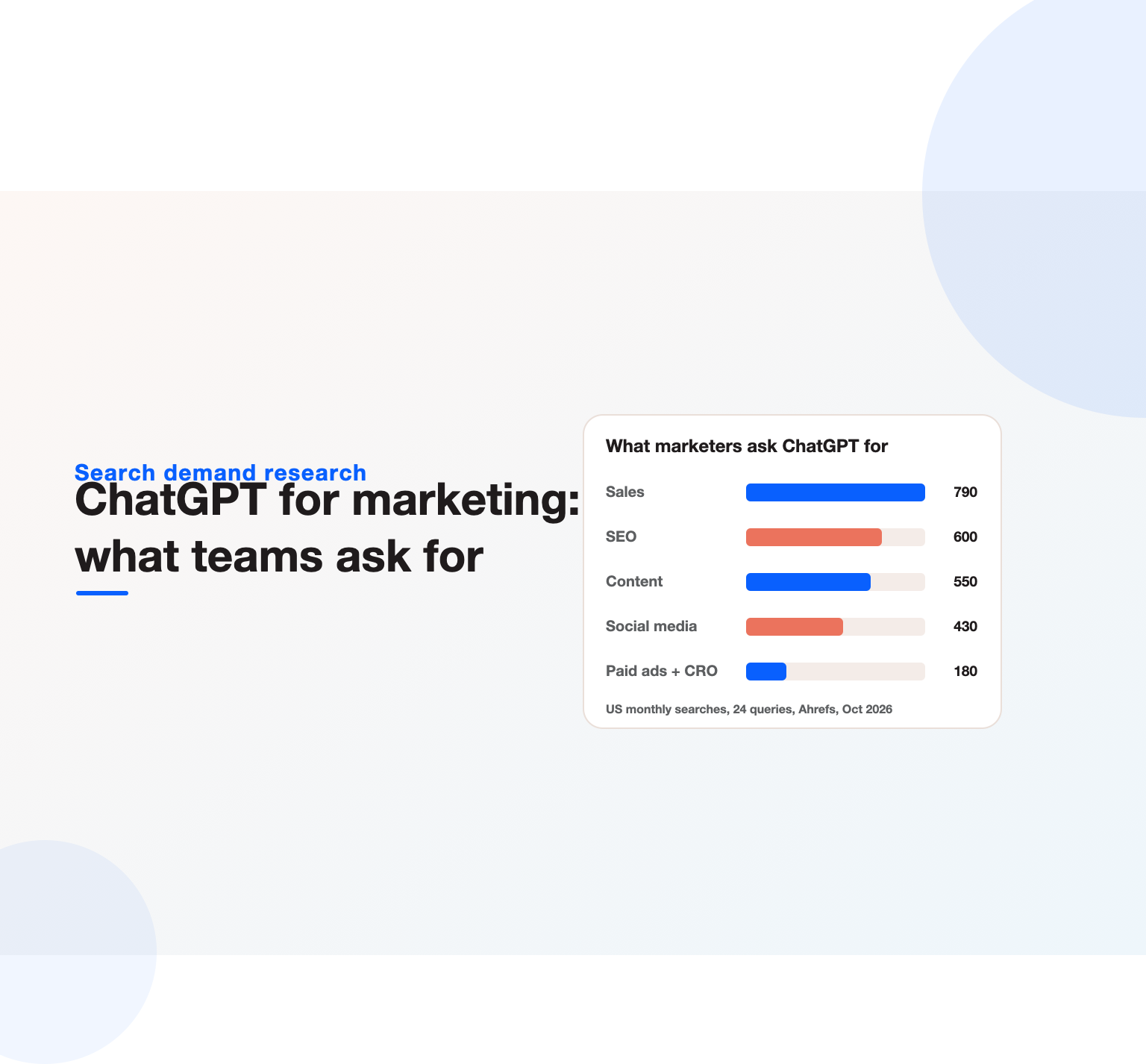
ChatGPT for marketing means using OpenAI’s assistant to speed up research, planning, writing, analysis and reporting across SEO, content, social media, email, ads and sales. The highest-value uses are first drafts, repurposing one asset into many, customer and competitor research synthesis, campaign ideas, data analysis from spreadsheets, and building prompt-driven workflows your team can repeat. To see what marketers actually want help with, we analysed 24 search queries about using ChatGPT for marketing tasks: sales (790 monthly US searches), SEO (600) and content (550) draw far more interest than paid ads (180), even though ads are where many teams spend most of their budget.
Key Highlights
- We analysed 24 US search queries about using ChatGPT for specific marketing tasks, totalling about 3,800 searches a month.
- Task-specific demand is led by sales (790), SEO (600), content (550) and social media (430).
- Paid ads and conversion optimisation draw only 180 searches a month, about a third of SEO interest.
- The best results come from structured prompts with context, a role, examples and a clear output format.
- Treat ChatGPT as a drafting and thinking partner, not a fact source: verify every statistic, claim and citation.
- Teams get the most value by turning good prompts into shared, repeatable workflows.
What ChatGPT for marketing really means
Most people who try ChatGPT for marketing first use it to write something faster: a headline, an email, a social post. That is useful, but it is the smallest part of the opportunity. The bigger gains come from using it as a research analyst, a planning partner and a data assistant that never tires of the tenth revision.
Think of the work in four layers:
- Thinking: brainstorming angles, stress-testing positioning, planning campaigns.
- Research synthesis: summarising reviews, interview notes, survey answers and competitor pages you provide.
- Production: first drafts, variations, repurposing and editing.
- Analysis: reading exported spreadsheets, spotting trends and explaining results in plain language.
OpenAI’s own marketing use-case guide covers similar ground, and its business page for sales and marketing shows how the company positions team plans. This guide focuses on the practical side: what to use it for, how to prompt it and where it goes wrong.
Our research: what marketers ask ChatGPT to help with
Search data shows what people are trying to do. We pulled US search volumes from Ahrefs in October 2026 for 24 queries of the form “how to use ChatGPT for…” and “ChatGPT prompts for…” that relate to marketing and sales tasks, then grouped them by task.
| Task group | Example queries | US searches per month |
|---|---|---|
| General marketing | chatgpt for marketing, chatgpt prompts for marketing | 900 |
| Sales | how to use chatgpt for sales professionals, for account managers | 790 |
| SEO | how to use chatgpt for seo keyword research, prompts for seo research | 600 |
| Content | prompts for copywriting, blog posts, content creation | 550 |
| Social media | chatgpt prompts for social media marketing, social media posts | 430 |
| Paid ads and CRO | prompts for facebook ads, landing page optimization | 180 |
| Affiliate marketing | chatgpt prompts for affiliate marketing | 150 |
| Legal marketing | chatgpt for legal marketing | 150 |
| Ecommerce | how to use chatgpt for ecommerce | 80 |
What the data shows
- Sales leads task-specific demand. Revenue teams search for help with account management and selling more than marketers search for any single marketing channel.
- SEO is the top marketing channel. SEO queries draw 600 searches a month, led by keyword research. It is also where ChatGPT is most likely to mislead, because it has no live search volume data.
- Content and social are close behind. Together they account for nearly 1,000 searches, which matches the copywriting habits most teams start with.
- Paid ads lag. Facebook ads and landing page prompts draw 180 searches combined, about a third of SEO. Ad teams may already use platform-native AI tools, or may not yet see ChatGPT as part of performance work.
- Niche verticals appear. Legal marketing alone draws 150 searches, showing that regulated industries want guidance on safe use.
ChatGPT for marketing: 15 high-value use cases
1. Customer research synthesis
Paste anonymised reviews, sales call notes or survey answers and ask for the top pains, desired outcomes, objections and exact phrases customers use. This is one of the most valuable and underused tasks, because it feeds every message you write afterwards.
2. Positioning and messaging
Give it your product facts, three competitors’ homepages and your best customer quotes. Ask for three positioning options, each with a one-line value proposition and proof points, then argue with it.
3. Campaign planning
Describe the goal, audience, budget and timeline. Ask for a channel plan, key messages per stage and a calendar, then adjust it with your own judgement.
4. SEO keyword ideas and briefs
ChatGPT is good at expanding topics, grouping keywords by intent and drafting content briefs. It cannot tell you real search volumes or difficulty, so validate ideas in a keyword tool. Our guide to ChatGPT SEO covers the other side: getting your brand mentioned in ChatGPT’s own answers.
5. First drafts of long-form content
Supply an outline, your point of view, data and examples. Ask for a draft section by section. Then edit heavily: add experience, cut generic lines and check facts.
6. Repurposing
Turn one webinar transcript or report into a blog post, newsletter section, ten social posts and a sales email. This is the fastest win for most teams.
7. Social media posts
Give examples of your best-performing posts and ask for new ones in the same voice, with different hooks. Keep a person approving everything public.
8. Email marketing
Draft subject lines, nurture sequences and personalised first lines from CRM notes. Test variants rather than trusting the first output.
9. Ad copy variations
Generate headlines and primary text for search and social ads within character limits. On Meta, prioritise genuinely different concepts over many similar variations; our Meta Andromeda analysis explains why.
10. Landing page reviews
Paste page copy and ask for a critique against clarity, relevance, proof and calls to action, from the point of view of a specific buyer.
11. Data analysis
Upload a campaign export and ask for trends, anomalies and charts. Always check the calculations on a sample, because errors in a spreadsheet summary can look convincing.
12. Competitor analysis
Paste competitor pages, ads or reviews and ask for messaging themes, gaps and likely target audiences. Our guide to the LinkedIn ads library shows where to collect competitor ads.
13. Sales enablement
Create battlecards, objection handling scripts and account research summaries. This matches the strong sales demand in our research.
14. Localisation
Adapt content for different markets, including tone and examples, then have a native speaker review it.
15. Internal documentation
Write process documents, briefs and onboarding guides so the team works consistently, which also makes future automation easier.
Not sure which marketing channels are worth your budget?
Our team reviews your current setup and shows you where the opportunities are. See how our digital marketing consulting work.
How to write prompts that get marketing-quality output
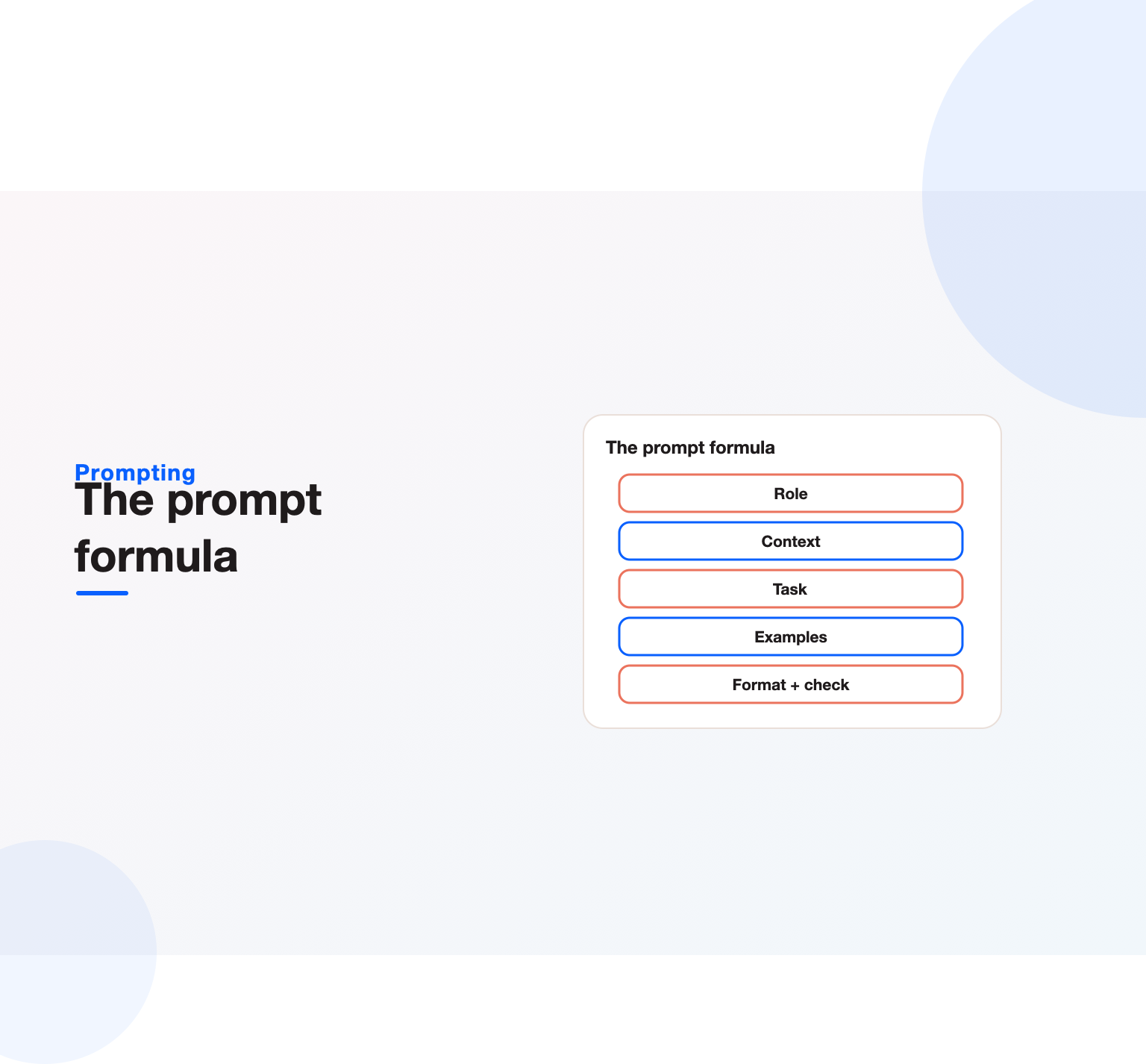
Generic prompts produce generic copy, and this is the single biggest reason teams give up on ChatGPT for marketing too early. A simple structure fixes most problems:
- Role: who the assistant should act as, for example “a B2B SaaS content strategist”.
- Context: product, audience, goal, constraints and anything already decided.
- Task: exactly what to produce.
- Examples: one or two samples of the style or quality you want.
- Format: length, structure, tone and what to leave out.
- Check: ask it to list assumptions and questions before or after the answer.
Iterate rather than restarting. Ask for three options, pick the best, then refine it: shorter, more specific, more evidence, less jargon.
One more principle ties all of these uses together: ChatGPT amplifies the quality of what you give it. A team with sharp positioning, real customer insight and clear standards will get sharper output faster. A team without them will simply produce more average content. That is why the most effective teams invest first in the inputs, research, messaging and examples, and only then scale production. The prompts below assume you have done that groundwork.
Copy-ready ChatGPT prompts for marketing
Replace the bracketed parts with your own details.
Customer research
“You are a customer research analyst. Below are [number] anonymised customer reviews of [product]. Identify the top five pains, the top five desired outcomes and the exact phrases customers repeat. Quote the phrases. Present as a table, then list three messaging angles these suggest.”
Positioning
“Here are our product facts, three competitor homepages and five customer quotes. Suggest three positioning statements for [audience], each with a headline, a one-sentence value proposition and three proof points drawn only from the material provided. Flag any claim that needs evidence.”
SEO brief
“Act as an SEO content strategist. Our target keyword is [keyword] for [audience]. Draft a content brief with search intent, a suggested title, an H2 outline, questions to answer, and internal links to these pages: [list]. Do not invent statistics.”
Social media posts
“Here are our three best LinkedIn posts. Write five new posts about [topic] in the same voice, each with a different hook: a statistic, a question, a contrarian view, a story and a checklist. Maximum 1,200 characters each. No hashtags.”
Email sequence
“Write a four-email nurture sequence for [audience] who downloaded [asset]. Goal: book a [meeting type]. Each email under 120 words, one idea per email, plain text style, with a clear single call to action.”
Ad copy
“Write ten Meta ad concepts for [product] aimed at [persona]. Each concept needs a different angle: problem, outcome, proof, comparison, offer. For each, give primary text under 125 characters and a headline under 40 characters.”
Landing page critique
“You are a conversion copywriter reviewing this landing page for [persona] arriving from [ad or keyword]. Score clarity, relevance, proof and call to action from 1 to 5, explain each score and suggest three specific rewrites.”
Campaign analysis
“Attached is a CSV of last month’s campaigns. Summarise performance by channel, identify the three biggest changes versus the previous month, suggest likely causes and list what data would confirm them. Show your calculations.”
Sales battlecard
“Create a battlecard comparing [our product] with [competitor] using only the facts below. Include where we win, where they win, common objections with responses, and three discovery questions that expose their weaknesses.”
ChatGPT prompts for social media marketing
Social is where many teams start. Beyond the post prompt above, three more are worth saving:
- Content calendar: “Plan a four-week LinkedIn calendar for [brand] around these themes: [list]. Three posts a week, mixed formats, each with a one-line idea and the goal it serves.”
- Repurposing: “Turn this transcript into eight short posts for LinkedIn and X, each standing alone, each with a different insight.”
- Replies: “Draft polite, helpful replies to these five comments in our brand voice. Do not promise anything not stated in our policies.”
How to use ChatGPT for marketing: a 30-day plan
Teams that get lasting value treat adoption as a small project rather than a free-for-all. This plan works for a team of two to twenty.
Week 1: pick three workflows
Choose tasks that happen weekly, take real time and are easy to judge: for example repurposing webinars, drafting nurture emails and summarising campaign results. Record how long each takes today.
Week 2: build the context pack
Write a one-page brand voice guide with examples, a product fact sheet with approved claims, short persona descriptions and a list of words and phrases to avoid. Load these into a shared project or custom GPT so every prompt starts from the same foundation.
Week 3: write and test prompts
Draft a prompt for each workflow, run it on five real examples and compare the output with what your best marketer would produce. Refine until at least four of five outputs need only light edits.
Week 4: roll out and measure
Share the prompts in a team library, agree review rules, and track time per asset and performance for a month. Keep what works, fix what does not, and add the next three workflows.
The result is a repeatable system for ChatGPT for marketing rather than a handful of people with private tricks.
ChatGPT for marketing by role
Different roles get value from different uses. Here is where each typically starts.
- Content marketers: outlines, first drafts of sections, repurposing, headline testing and editing passes for clarity. Keep original research, opinions and examples human.
- SEO specialists: topic expansion, intent grouping, briefs, title and meta description options, schema drafts and internal linking suggestions, validated against real tools.
- Social media managers: post variations, calendars, comment replies, and turning long content into short formats.
- Email and lifecycle marketers: sequences, subject lines, segmentation ideas and personalised copy from CRM fields.
- Performance marketers: ad concepts, search ad assets, landing page critiques and analysis of exported campaign data.
- Product marketers: positioning drafts, battlecards, launch messaging and synthesis of customer interviews.
- Marketing leaders: planning, board summaries, scenario thinking and turning messy notes into clear decisions.
The role list also explains our demand data: the most searched tasks map to the roles with the most writing and research work.
Custom GPTs and projects for marketing teams
Two features make the biggest difference for teams. Projects keep files, instructions and conversations together, so a campaign’s context stays in one place. Custom GPTs package instructions and reference files into a reusable assistant, for example a “brand voice editor” that rewrites any draft to your guidelines, or a “brief builder” that turns a keyword and audience into a standard content brief. Build a few narrow assistants rather than one that tries to do everything, name an owner for each, and update their reference files whenever positioning or products change.
ChatGPT for marketing in regulated industries
Legal, healthcare, financial services and other regulated sectors can use ChatGPT safely, but with tighter rules. Our search data showed 150 monthly searches for ChatGPT in legal marketing alone, which suggests firms want guidance. Practical rules: never paste client or patient information into a tool your compliance team has not approved; keep a list of claims that require substantiation and disclaimers; have a qualified person review anything that could be read as advice; and keep records of what was published and who approved it. Used this way, it speeds up the safe parts of the work, such as plain-language explainers, FAQs and social posts, without creating new risk.
Measuring the return on ChatGPT
Track three things. First, time: hours per asset before and after, across a month of real work. Second, quality: edit rate, approval rate and performance of AI-assisted assets against comparable human-only assets. Third, output: how many more campaigns, tests or pieces the team can ship. Most teams find the gain shows up less as headcount savings and more as capacity for work that was previously skipped, such as testing more ad concepts or refreshing old content.
Before and after: improving a weak prompt
The difference between disappointing and useful output is usually the prompt. Here is a typical example.
Weak prompt: “Write a LinkedIn post about our new feature.”
The result is predictable: an enthusiastic, generic announcement full of words like “excited” and “game-changing” that could describe any product.
Better prompt: “You are a B2B product marketer. We launched [feature], which lets finance teams close the month two days faster by matching invoices automatically. Our audience is finance managers at companies with 200 to 2,000 employees who currently reconcile in spreadsheets. Here are two of our best-performing posts for tone. Write three post options under 900 characters. Open with the problem in the reader’s words, include one specific example, and end with a question. Avoid ‘excited’, ‘game-changing’ and exclamation marks.”
The second prompt supplies the role, audience, specific benefit, proof, examples, format and banned phrases. The output is specific enough to edit rather than rewrite. The same pattern applies to every task in this guide: the time you spend on context is repaid many times in editing time saved.
A second technique is to ask for critique before creation. Paste your draft and ask, “What would make a sceptical finance manager scroll past this?” The answers often reveal vague claims and missing proof faster than any rewrite.
ChatGPT for marketing in India
India is one of the largest markets for searches about using ChatGPT at work, and marketing teams there face a few specific considerations. Content often needs to work in English and one or more Indian languages, so test translations with native speakers and watch for tone, not just accuracy. WhatsApp is a primary customer channel for many brands, so prompts for short conversational messages and broadcast templates are especially useful; our guide to WhatsApp marketing strategy covers the rules. Data protection obligations also apply to customer information, so agree what can be pasted into any AI tool. For B2B exporters selling to the US or Europe, ChatGPT is valuable for adapting messaging to each market’s expectations and vocabulary.
Teams with ambitious content plans should also connect AI-assisted production to a clear content marketing strategy, so faster output goes into the topics and formats that actually drive pipeline.
Where ChatGPT falls short for marketers
- Facts and statistics. It can produce plausible numbers and sources that do not exist. Never publish a figure without checking the original source.
- Live data. Search volumes, competitor spend and current prices need real tools.
- Brand voice drift. Without examples and rules, output sounds like everyone else’s.
- Originality. It recombines what exists. Original data, experience and opinion still have to come from you; that is what earns links and AI citations.
- Compliance. Claims in regulated industries, endorsements and comparisons need human and sometimes legal review. Advertising rules on truthful claims and endorsements apply to AI-written copy just as to any other.
- Confidential data. Check your plan’s data settings and company policy before pasting customer or financial information.
Want a marketing plan built around your numbers?
Book a free 30-minute strategy call and leave with a clear next step for your business.
Comparing ChatGPT with other AI tools for marketing
| Need | ChatGPT | Specialist tools |
|---|---|---|
| Flexible drafting and thinking | Strong | Varies |
| Brand governance across a team | Basic, via custom GPTs and projects | Stronger in tools such as Jasper or Writer |
| Live SEO data | None | Ahrefs, Semrush and similar |
| Acting inside your CRM or ad account | Limited | Built-in agents in HubSpot, Salesforce and others |
| Images and video | Image generation built in | Canva, Adobe and video tools |
Many teams use ChatGPT as the general-purpose assistant and add specialist tools where they need data or governance. For tasks that act inside your systems, see our guide to AI agents for marketing, and for a wider list see AI tools for digital marketing.
Building a team workflow around ChatGPT
- Collect the prompts that work. Keep a shared library organised by task, with an example output for each.
- Create reusable context. Store brand voice rules, product facts, personas and approved claims in a project or custom GPT so everyone starts from the same base.
- Define review steps. Decide what needs fact-checking, legal review or manager approval.
- Measure time saved and quality. Track hours per asset and performance against human-only baselines.
- Revisit monthly. Retire prompts that produce weak output and add new ones as models improve.
Using ChatGPT for marketing in a small business
For a small team, the biggest gain is coverage: producing consistent social posts, emails and website updates without an extra hire. Start with three routines: a weekly content batch from one long piece, a monthly review of website copy, and a quick competitor scan before each campaign. Our guide to digital marketing strategy for small businesses shows where these routines fit.
Using ChatGPT in B2B marketing
B2B teams benefit most in research and enablement: account research, persona development, battlecards and repurposing technical content into clear messaging. The sales demand in our research points to the same opportunity: marketing can build prompt libraries for sales and own the quality of what goes to buyers. Pair this with a clear B2B demand generation plan so faster production serves a strategy rather than replacing one.
Why ChatGPT marketing now includes being found in ChatGPT
Marketers use it, and so do buyers. People ask it to recommend products and vendors, and OpenAI has begun testing ads. That makes ChatGPT both a tool and a channel. Our research on ChatGPT ads tracks which brands are preparing for paid placements, and our guide on how to rank in ChatGPT covers earning organic mentions. If you want to measure how often you appear, see our comparison of AI visibility tools.
Setting team rules for data and privacy
Before rolling out ChatGPT widely, agree a short policy that everyone can remember. It should answer five questions. Which plan does the team use, and are its data controls configured so business inputs are handled the way your company requires? What may never be pasted in, such as customer personal data, unreleased financials or confidential contracts? Which outputs need review before publishing, and by whom? How should AI assistance be disclosed internally or to clients, if at all? And who owns the shared prompt library and custom assistants?
A one-page policy with examples is enough for most teams. Revisit it every quarter, because both the tools and the rules around them change quickly. Clear rules also make people more willing to use the tool, because they no longer worry about doing something wrong.
Common mistakes
- Publishing first drafts. Readers and search engines can tell. Edit for specifics, experience and voice.
- Trusting numbers. Verify every statistic at its source.
- Prompting without context. The more you give, the better the output.
- Using it only for writing. Research and analysis often save more time.
- No shared library. Every marketer reinventing prompts wastes the team’s learning.
- Ignoring data policies. Agree what can and cannot be pasted in.
Methodology
In October 2026 we used Ahrefs Keywords Explorer (United States) to collect keyword ideas for the seed phrases “chatgpt prompts for”, “how to use chatgpt for” and “chatgpt for marketing”. From the results we selected 24 queries that refer to marketing, sales or related tasks and recorded their estimated monthly US search volume. Queries were grouped by task. Generic queries (such as “chatgpt prompts for writing”) and non-marketing tasks (such as photo editing, job search or trading) were excluded. Volumes are estimates and change monthly; the grouping is our own. The dataset is available on request.
Key Takeaways
- ChatGPT for marketing is most valuable for research synthesis, planning, drafting, repurposing and analysis, not just copywriting.
- In our analysis of 24 search queries, task-specific demand is led by sales, SEO and content, while paid ads lag at about a third of SEO interest.
- Structured prompts with role, context, examples and format produce far better output.
- Verify every fact and keep humans in charge of claims, voice and compliance.
- Turn individual prompts into shared team workflows to multiply the gains.
Want help building AI into your marketing workflows? Talk to our team or see our digital marketing consulting services.
Frequently asked questions
How can I use ChatGPT for marketing?
Use it to synthesise customer research, plan campaigns, draft and repurpose content, write email and ad variations, critique landing pages, analyse campaign data and create sales materials. Give it context and examples, and review everything before publishing.
What are the best ChatGPT prompts for marketing?
The best prompts include a role, detailed context, a specific task, examples of the desired style and a clear output format. This guide includes copyable prompts for customer research, positioning, SEO briefs, social posts, emails, ads, landing pages, analysis and battlecards.
Can ChatGPT do SEO keyword research?
It can brainstorm and group keyword ideas by intent, but it has no live search volume or difficulty data. Validate its suggestions in a keyword research tool before planning content.
Is content written with ChatGPT bad for SEO?
Search engines judge content on quality and usefulness, not on how it was produced; see Google’s guidance on generative AI content. Unedited, generic AI text tends to perform poorly; edited content with original insight, data and experience can perform well.
Is ChatGPT free for marketing use?
There is a free plan with usage limits. Paid individual and team plans add higher limits, newer models, file analysis and workspace controls, which most marketing teams find worthwhile.
Can ChatGPT replace a marketing team?
No. It speeds up research, drafting and analysis, but strategy, judgement, relationships, original insight and accountability for results still sit with people.
Ready to put this into practice?
Talk to the team that runs SEO, AI search and paid growth programs every day.
Book a Strategy Call →