 Skip to content

B2B Marketing Automation: The Complete Guide
B2B marketing automation explained: buying committees, lead scoring, MQL to SQL handoff, CRM sync, intent data, attribution, platforms and a 90 day rollout.
Quick Answer
B2B marketing automation is the use of software, data, and rules to run the repetitive parts of business-to-business marketing at scale: capturing leads, scoring them, nurturing whole buying committees over long sales cycles, syncing every touch to the CRM, and handing sales-ready accounts to reps at the right moment. Unlike consumer automation, which optimizes quick individual purchases, it is built around accounts, multiple stakeholders, and deals that can take months to close. Done well, it gives marketing and sales one shared view of every account, removes manual follow-up, and makes pipeline contribution measurable. Done badly, it becomes an expensive email blaster. The difference is the operating model behind the software, not the software itself.
Key Highlights
- Built for committees, not individuals. Real deals involve several stakeholders, so nurture must work at the account level as well as the contact level.
- Lead scoring and the MQL to SQL handoff are the core. Automation decides who is ready for sales and routes them in minutes instead of days.
- The CRM is the system of record. A clean, two-way sync between the automation platform and the CRM matters more than any single feature.
- Intent and engagement data change the timing. Signals about research activity tell you which accounts are in market right now.
- Attribution keeps the program honest. Multi-touch reporting ties campaigns to pipeline and revenue, not just opens and clicks.
- A phased rollout beats a big bang. Start with data, scoring, and one nurture track, then expand once the basics are trusted.
What B2B marketing automation actually means
Strip away the vendor language and b2b marketing automation is a set of if-this-then-that rules that run on top of your customer data. A prospect downloads a guide, so the system tags their interest, adds points to their score, enrolls them in a relevant nurture sequence, and alerts the account owner if the company is already in an open opportunity. A target account visits the pricing page three times in a week, so the platform raises the account score, notifies the sales development rep, and switches the ads that account sees. None of this is magic. It is the codified version of what a disciplined marketer would do by hand if they had unlimited time.
The word that matters is business. Business buyers rarely act alone, rarely buy on impulse, and rarely buy small. A software purchase, an industrial component contract, or a professional services engagement can involve finance, IT, legal, procurement, and the end users who will live with the decision. Each person needs different information at a different moment. Consumer tools are built to push a single shopper toward a cart. Business tools have to keep a whole group informed and aligned over a period that can stretch past a fiscal quarter.
That is why the category overlaps with demand generation, sales operations, and revenue operations. If you want the broader picture of why automation pays off across any business model, our pillar on marketing automation benefits covers the general case. This guide narrows to the B2B specifics that decide whether an investment produces pipeline or just activity.
How B2B buying differs from consumer buying
Every design decision in a business automation program flows from four facts about how companies buy. Ignore them and you end up copying consumer playbooks that do not fit.
Buying groups, not single buyers
Research from Gartner on the B2B buying journey describes purchases made by buying groups of several decision makers, each arriving with information gathered independently, and notes that buyers spend a limited share of their buying time with potential suppliers. Put those together and the implication is clear: most of the persuasion happens when your sales team is not in the room, through content, peers, and digital touchpoints that automation can orchestrate.
Long and nonlinear cycles
Enterprise deals often run for months. Buyers loop back, stall for budget cycles, add new stakeholders, and restart evaluations. A linear funnel model, where a lead marches neatly from awareness to purchase, rarely survives contact with reality. Automation has to handle re-entry, pauses, and parallel tracks for different people at the same account.
Most of the market is not buying today
The LinkedIn B2B Institute popularized the 95-5 rule, drawn from work by Professor John Dawes at the Ehrenberg-Bass Institute: at any given time, only around five percent of B2B buyers are in market for a given solution. The other 95 percent will buy later. This changes the job of automation. It is not only about converting the few who are ready now. It is about staying memorable and useful to the many who will be ready next year, without burning them out with sales pressure today.
Higher stakes and more risk
A wrong business purchase can cost someone their credibility or their job. Buyers therefore seek reassurance: proof, references, implementation detail, security documentation, and total cost of ownership. Nurture content needs to reduce perceived risk at each stage, not just pitch features.
The table that explains the difference
Here is a side-by-side view of how b2b marketing automation differs from consumer or ecommerce automation in practice.
| Dimension | Consumer automation | Business automation |
|---|---|---|
| Unit of focus | Individual shopper | Account plus every contact in the buying group |
| Typical cycle | Minutes to days | Weeks to many months |
| Main trigger events | Cart abandonment, browse, purchase | Content downloads, pricing visits, intent surges, meetings |
| Primary goal | Transaction and repeat purchase | Qualified pipeline and closed revenue |
| Handoff | Usually none, self-serve checkout | Marketing to sales handoff with SLAs |
| Key system | Ecommerce platform | CRM as system of record |
| Success metric | Revenue per recipient | Pipeline sourced and influenced, win rate, velocity |
The core components of a working program
Platforms bundle dozens of features, but dependable b2b marketing automation rests on six components. Get these right and the rest is configuration.
1. A clean, unified data layer
Everything downstream depends on knowing who a person is, which account they belong to, and what they have done. That requires consistent fields, deduplication, lead-to-account matching, and enrichment for firmographics such as industry, company size, and region. Most stalled programs we see are not stalled by lack of features. They are stalled by duplicate records, unmatched leads, and fields that mean different things to marketing and sales.
2. Lead and account scoring
Scoring combines fit (does this company and role match the ideal customer profile?) with engagement (how actively are they researching?). Fit tells you whether to care. Engagement tells you when to act. Good models score both the person and the account, so three moderately engaged people at the same target company can trigger action even if none of them crosses the threshold alone.
3. Nurture and orchestration
Automated lead nurturing delivers the right content to the right role at the right stage. In business contexts, orchestration (covered further in our automation benefits pillar) extends beyond email to include retargeting ads, website personalization, sales tasks, direct mail, and event invitations, all coordinated so the account receives a coherent story rather than random messages from different teams.
4. CRM sync and routing
The automation platform and the CRM must agree in near real time. When a lead qualifies, it should be routed to the right owner based on territory, segment, or account ownership, with a task and context attached. Slow or broken routing is one of the most common ways marketing-generated demand quietly dies.
5. Lifecycle stages and service level agreements
Shared definitions for stages such as subscriber, lead, marketing qualified lead, sales accepted lead, sales qualified lead, opportunity, and customer give both teams a common language. Service level agreements then define how quickly sales follows up and how marketing recycles leads that are not ready.
6. Measurement and attribution
Reporting connects campaigns to pipeline and revenue. Without it, the program defaults to vanity metrics and loses budget the first time finance asks what it produced.
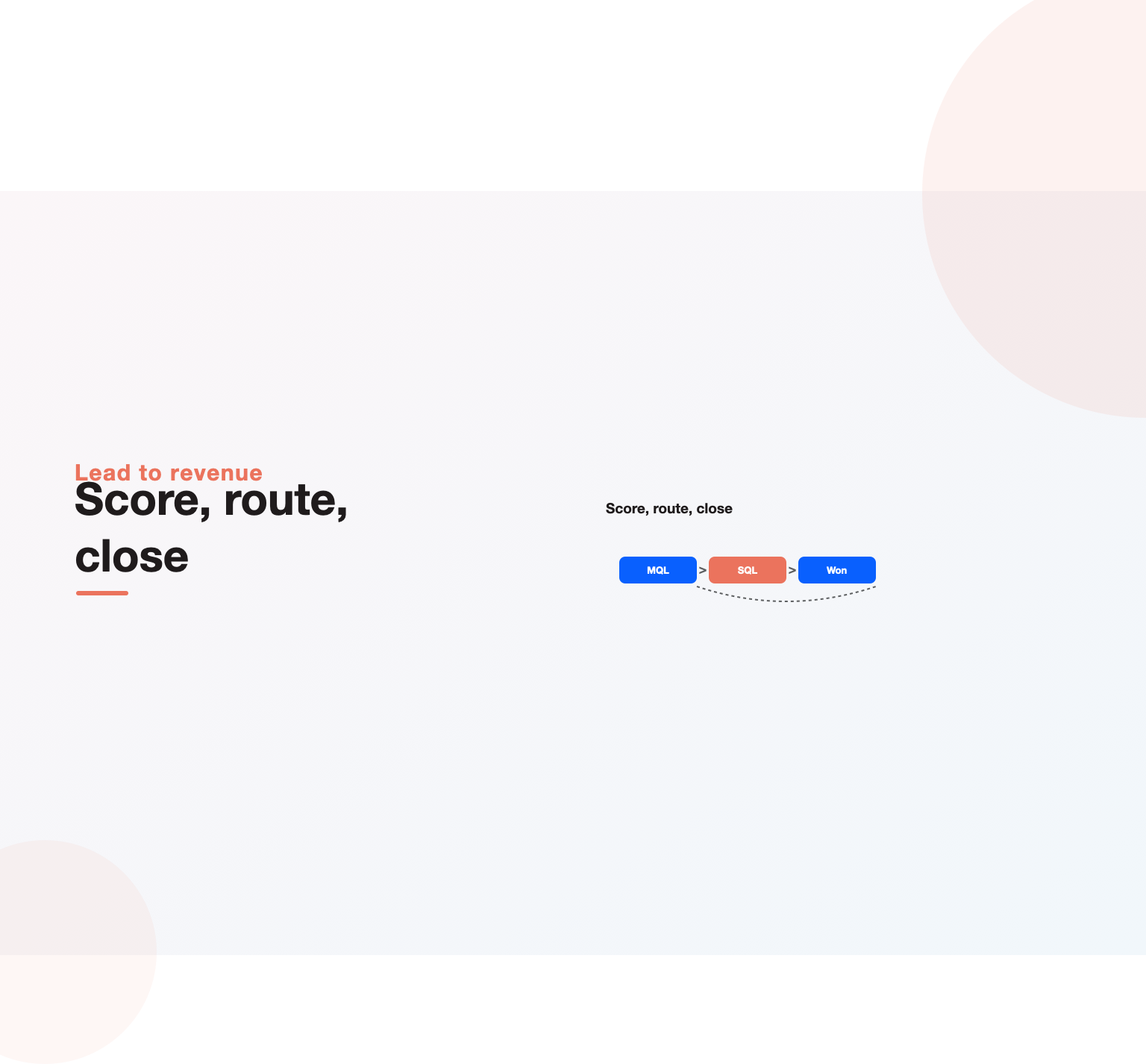
Lead scoring and the MQL to SQL handoff
If you only perfect one thing in b2b marketing automation, make it the handoff. It is where marketing investment turns into sales conversations, and where most leakage happens.
Designing a scoring model people trust
Start with closed-won data, not opinions. Pull the last one or two years of won deals and look at the companies and roles involved, the content they consumed, and the actions that preceded opportunity creation. Weight the behaviors that genuinely correlate with buying, such as pricing page visits, demo requests, comparison content, and repeat visits from multiple people at one account. Give low or zero weight to activity that rarely predicts anything, such as a single newsletter open.
Add negative scoring too. Competitors, students, job seekers, and existing customers researching support topics should not flood sales queues. Apply score decay so that interest from six months ago does not count the same as interest from this week.
A simple scoring framework
| Signal type | Example | Typical weight |
|---|---|---|
| Fit: firmographic | Target industry and company size | High |
| Fit: role | Decision maker or influencer title | Medium to high |
| Engagement: high intent | Demo request, pricing page, contact form | Very high, often routes immediately |
| Engagement: research | Guide download, webinar attendance | Medium |
| Engagement: light | Email open, single blog visit | Low |
| Negative | Competitor domain, careers page, unsubscribe | Subtracts points |
Treat the weights as a starting hypothesis. Review conversion from MQL to SQL monthly and adjust. A model that sales ignores is worse than no model at all, so involve sales leaders in setting the thresholds.
Making the handoff fast
Speed matters because interest decays. Automate routing so qualified leads land with an owner instantly, with a summary of what the person and their colleagues have engaged with. Set an agreed response time, track it, and create an automatic escalation if a lead sits untouched. Recycle leads that sales rejects into a dedicated nurture track with a reason code, so marketing learns why and the prospect is not lost.
Account-based nurture for buying committees
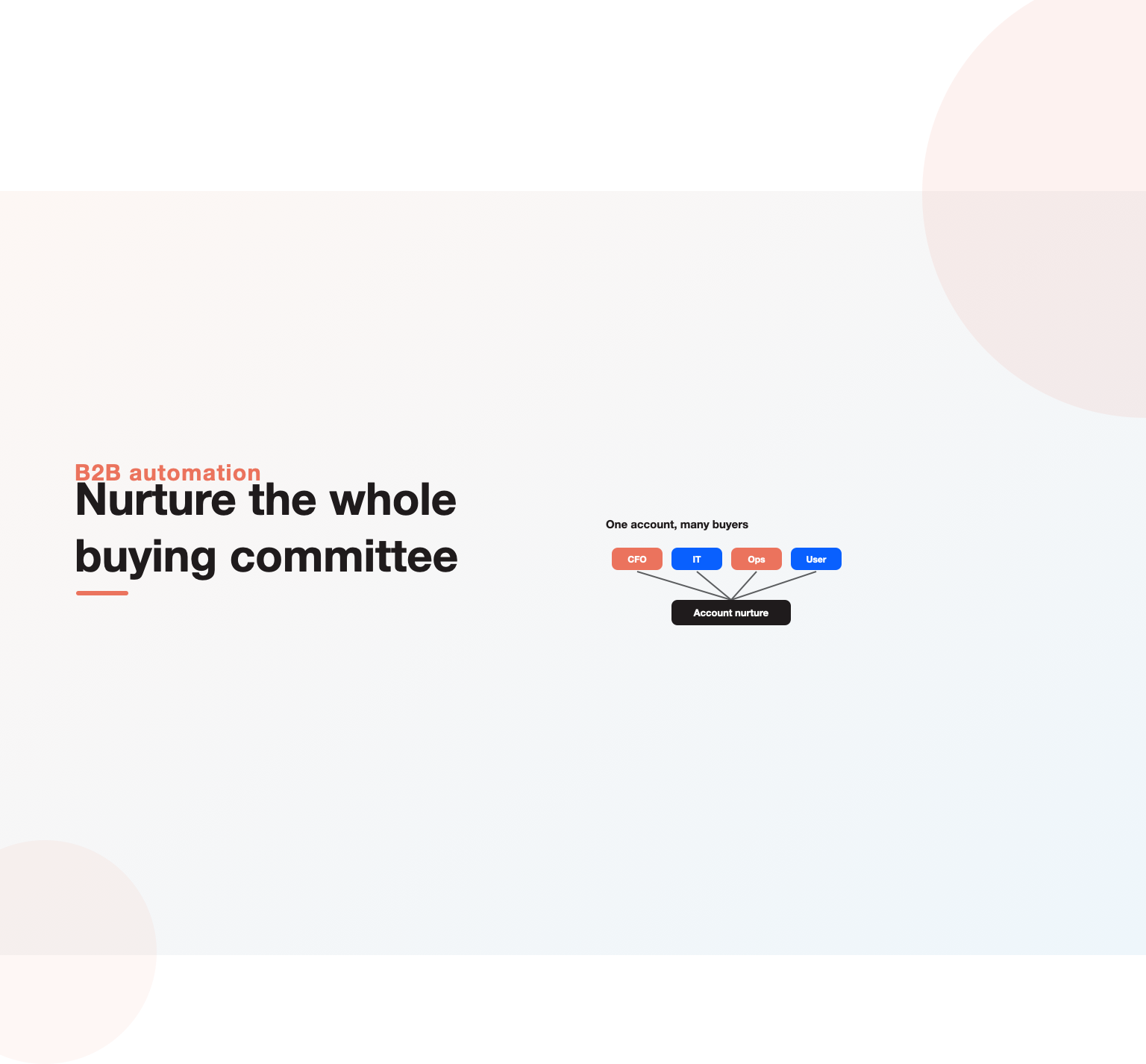
Because purchases are group decisions, mature b2b marketing automation moves from treating leads as isolated individuals to treating accounts as the unit of progress. This is where account-based marketing and automation meet.
Map the roles you typically see in a deal: the economic buyer, the technical evaluator, the day-to-day user, procurement, and sometimes legal or security. Each cares about different things. A finance leader wants payback and risk. A technical evaluator wants integration detail and security posture. A user wants to know whether the product will make their week easier. Build content and sequences for each role, then let the platform deliver the right track based on job title and behavior.
Next, watch account-level engagement. When several people from one target company engage in a short window, that cluster is often a stronger buying signal than any single lead score. Trigger an account alert, notify the owner, and shift the account into a more sales-assisted track with tailored ads and personal outreach. Connecting this to wider demand programs is the job of a coordinated demand generation program, where paid, content, and automation pull together toward the same target list.
Finally, keep the 95 percent warm. Accounts that fit the profile but show no current intent should still receive useful, low-pressure content at a sensible cadence. When their buying window opens, you want to be the vendor they already trust.
Intent data and timing
Within b2b marketing automation, intent data tells you which accounts are actively researching topics related to your category. It comes in two flavors. First-party intent is behavior on your own properties, such as site visits, content consumption, and product usage. Third-party intent is aggregated research activity across other websites and publishers, purchased from data providers. Buyer studies from vendors such as 6sense research report that business buyers often complete much of their journey and form a shortlist before they ever contact a vendor. If that is true for your market, waiting for a form fill means arriving late.
Use intent carefully. Third-party signals are probabilistic and can be noisy, so treat them as a prioritization input, not a trigger for aggressive outreach. Good uses include raising account scores, adjusting ad spend toward surging accounts, and alerting reps to accounts worth researching. Poor uses include emailing a contact to say you noticed they were researching a topic, which tends to feel invasive.
Content by funnel stage
B2B marketing automation only distributes content. If the content is generic, faster distribution just spreads generic messages more efficiently. Map assets to stages and to roles.
| Stage | Buyer question | Useful content | Automation trigger |
|---|---|---|---|
| Problem aware | Do we have a problem worth solving? | Benchmarks, research reports, educational guides | First visit or content download |
| Solution exploring | What approaches exist? | Comparison guides, frameworks, webinars | Repeat visits, webinar registration |
| Vendor evaluating | Who should we shortlist? | Case studies, ROI tools, product tours | Pricing page, comparison pages |
| Deciding | Is this safe and worth it? | Security docs, implementation plans, references | Open opportunity in CRM |
| Customer | How do we get value fast? | Onboarding, training, expansion use cases | Closed-won status |
Notice that the last row extends past the sale. Retention and expansion are where many business models make their margin, and the same automation that nurtures prospects can drive onboarding, adoption, renewal reminders, and cross-sell. For a deeper treatment of sequencing and planning, see our guide to marketing automation strategy.
CRM sync: the unglamorous foundation
A surprising number of programs fail not on creative or strategy but on plumbing. The automation platform holds engagement data. The CRM holds account ownership, opportunities, and revenue. If the two disagree, nobody trusts the reports, sales ignores the scores, and the program loses credibility.
Get these basics right before launching ambitious campaigns:
- Decide which system owns each field, and sync in a defined direction.
- Match leads to accounts automatically using domain and company rules.
- Prevent duplicate creation at the point of entry, not after the fact.
- Write campaign membership and lifecycle stage changes to the CRM with timestamps.
- Audit sync errors weekly and assign someone to fix them.
This is classic revenue operations territory. If marketing, sales, and customer success each run their own tools and definitions, a revenue operations consulting engagement is often the fastest route to one shared data model and one set of numbers.
Multi-touch attribution without the theater
Because business deals involve many people and many touches over months, single-touch attribution almost always misleads. First-touch credits whatever introduced one contact, often ignoring the webinar that convinced the economic buyer. Last-touch credits the demo request and ignores the year of nurture that made it happen.
Multi-touch models spread credit across touches. Common options include linear (equal credit), time-decay (more credit to recent touches), and position-based or W-shaped models that emphasize first touch, lead creation, and opportunity creation. No model is objectively true. Pick one that matches your sales motion, apply it consistently, and use it to compare channels against each other rather than as an exact revenue ledger.
Pair attribution with simpler, harder-to-argue metrics: pipeline created from marketing-sourced opportunities, pipeline influenced by campaigns, and win rates for engaged versus unengaged accounts. Analysts at Forrester B2B marketing research have long pushed teams to measure buying groups and opportunities rather than isolated leads, which is a useful corrective if your dashboards still celebrate raw lead volume.
The platform landscape, described factually
The vendor market behind b2b marketing automation is mature, and most leading products cover the basics of email, forms, landing pages, scoring, and CRM integration. The real differences lie in data model, scale, ecosystem, and how much operational effort they require. Here is a neutral overview of the main categories rather than a ranked list, since software selection is only one decision inside a larger enterprise marketing automation or mid-market program.
All-in-one suites
These combine CRM, marketing automation, and often service and sales tools in one database. The advantage is a single data model and lower integration effort, which suits small and mid-sized teams. The trade-off can be less depth in advanced scoring or account-based features at the very top of the enterprise market.
Enterprise marketing automation suites
Enterprise marketing automation products, such as those offered within large cloud ecosystems like Salesforce marketing automation and Adobe, are built for complex organizations with multiple business units, regions, brands, and strict governance. They offer deep customization, granular permissions, and strong CRM integration, but typically require dedicated administrators and a longer implementation.
Account-based and intent platforms
These focus on account identification, intent data, advertising to target accounts, and account scoring. They usually sit alongside a core automation platform rather than replacing it.
Specialist and adjacent add-ons
Data enrichment, chat and conversational tools, webinar platforms, sales engagement software, and attribution products all plug into the stack. Each solves a specific gap but adds integration and cost, so add them only when a clear use case exists.
If you want a vendor-by-vendor comparison, our roundup of the best marketing automation tools goes product by product. Whatever you shortlist, judge each candidate on how well they fit your CRM, your team skills, and your sales motion, not on feature checklists alone.
Questions to ask before you buy
- How does the platform model accounts, and can it score at the account level?
- What does the native CRM integration sync, how often, and in which direction?
- Who on our team will administer it day to day, and do they have the skills?
- What will the total cost be at our contact volume in two years?
- How easily can we export our data if we switch later?
Building a B2B marketing automation strategy
Technology is the easy part to buy. A b2b marketing automation strategy is the part that decides whether it pays back. A sound strategy answers five questions in writing before anyone builds a workflow.
- Who exactly are we targeting? Define the ideal customer profile by firmographics and the buying roles within those accounts.
- What does the buying journey look like? Map the stages, the questions buyers ask, and the content that answers each one.
- What counts as qualified? Agree on lifecycle stage definitions and the scoring thresholds that move people between them.
- What happens at handoff? Document routing rules, response time commitments, and the recycle process.
- How will we measure success? Choose pipeline and revenue metrics, an attribution approach, and a reporting cadence.
Write this down in a short operating document that marketing and sales leaders both sign. It sounds bureaucratic, but it prevents the most common failure: two teams quietly working from different definitions and blaming each other for the results. Research by McKinsey on growth, marketing and sales repeatedly points to the link between commercial alignment, data-driven personalization, and above-market growth, and alignment starts with shared definitions.
A 90 day implementation roadmap
Trying to launch everything at once is the fastest way to stall. A phased rollout builds trust and shows value early.
Days 1 to 30: foundation
- Audit existing data: duplicates, missing fields, unmatched leads, and sync errors.
- Agree lifecycle stages and the ideal customer profile with sales.
- Configure the CRM integration, field mapping, and lead-to-account matching.
- Set up tracking on the website and key forms, and confirm consent capture meets privacy rules in your markets.
Days 31 to 60: first value
- Launch a first version of fit and engagement scoring based on closed-won analysis.
- Build automated routing with response time alerts.
- Launch one high-value lead nurturing workflow, usually for leads who engaged but are not ready for sales.
- Create a basic dashboard: leads by stage, MQL to SQL conversion, and speed to follow-up.
Days 61 to 90: expand
- Add role-based tracks for the main buying committee members.
- Introduce account-level scoring and alerts for target accounts.
- Connect paid media audiences to lifecycle stages so ads reflect where each account is.
- Select an attribution model and run the first pipeline review with sales and finance.
After 90 days, shift to a monthly optimization rhythm: review scoring accuracy, nurture performance, routing speed, and pipeline contribution, then make one or two meaningful changes at a time.
Metrics that matter to a revenue leader
To judge b2b marketing automation, remember that activity metrics such as open rates and click rates help diagnose individual emails, but they do not tell a leadership team whether the program is working. Focus on a short list that connects to revenue.
| Metric | What it tells you | Review cadence |
|---|---|---|
| Marketing-sourced pipeline | Value of opportunities that started with marketing | Monthly |
| Marketing-influenced pipeline | Opportunities where campaigns touched the buying group | Monthly |
| MQL to SQL conversion rate | Whether scoring identifies real buyers | Monthly |
| Speed to lead | How quickly sales acts on qualified leads | Weekly |
| Pipeline velocity | How fast opportunities move to closed | Quarterly |
| Win rate, engaged vs unengaged accounts | Whether nurture improves outcomes | Quarterly |
| Customer expansion revenue | Whether post-sale automation drives growth | Quarterly |
Set baselines before you change anything. Without a before picture, every improvement becomes an argument rather than a fact.
B2B marketing automation examples from real operating patterns
Abstract frameworks are easier to apply with concrete scenarios. The b2b marketing automation examples below are composite patterns we see across programs, not named client results, and each shows how one rule set changes buyer engagement.
Example 1: the stalled opportunity revival
An opportunity sits in the CRM with no activity for 45 days. The system detects the gap from crm data, enrolls the buying group in a short sequence of implementation and ROI content, and alerts the owner if any contact re-engages. Sales gets a reason to call that is grounded in what the account actually read.
Example 2: the multi channel campaign for a target list
A target account list receives coordinated ads, role-based email, and a webinar invite in the same fortnight. That multi channel campaign is governed by one set of lifecycle rules, so a contact who books a meeting is pulled out of generic sends immediately.
Example 3: marketing automation for b2b service businesses
Firms that sell expertise rather than software, such as consultancies, IT services, and agencies, have shorter content libraries and relationship-led sales. Marketing automation for b2b service businesses usually works best with a narrow focus: capture referrals and event contacts, nurture them with case-based insight, and route any reply straight to a partner. Fewer workflows, executed reliably, beat a sprawling build.
Example 4: ai driven personalization on the website
Once an account is identified, the site swaps headlines and proof points for that industry. Used with restraint, ai driven personalization shortens customer journeys because visitors see relevant evidence without hunting for it. Our automation team typically pilots this on two or three high-traffic pages before scaling.
Behind every example sits marketing operations discipline: documented rules, named owners, and a change log. Teams running enterprise suites such as Adobe Marketo or Microsoft Dynamics need that discipline even more, because a single misconfigured workflow can touch hundreds of thousands of records. Whatever the stack, marketing automation b2b teams that win treat workflows as products with releases, testing, and retirement dates. For channel coordination beyond email, see our demand gen services.
Common mistakes and how to avoid them
Buying the platform before defining the process
Software purchased without agreed stages, scoring logic, and routing rules ends up configured around guesses. Define the operating model first, then configure tools to support it.
Over-emailing the database
Automation makes sending cheap, which tempts teams to send constantly. Volume without relevance drives unsubscribes and spam complaints, which damage deliverability for everyone. Set frequency caps and suppress people in active sales cycles from generic campaigns.
Scoring on noise
Models that reward opens and generic page views flood sales with unqualified leads, and reps stop trusting the system. Weight high-intent actions, add negative scoring, and validate against closed-won data.
Ignoring the account
Treating every contact as an independent lead misses the cluster of activity that signals a real buying group. Add account-level views as early as your data allows.
Neglecting maintenance
Workflows break quietly. Forms change, fields get renamed, and integrations fail. Assign an owner, keep documentation, and run a quarterly audit of active workflows.
For a fuller checklist of operating habits, our guide to marketing automation best practices covers governance, testing, and deliverability in more detail.
Where AI fits in business automation
Generative and predictive AI features are now common across b2b marketing automation products. Our demand generation primer explains where these signals feed the wider funnel. Useful applications include predictive scoring trained on your historical deals, draft generation for email variants, smarter send-time selection, summarizing account activity for reps, and suggesting next best actions. These can save real time, particularly for lean teams.
Keep two cautions in mind. First, predictive models need enough clean historical data to be reliable, and many mid-sized companies simply do not have enough closed deals for the model to learn well. Second, AI-generated copy still needs human review for accuracy and brand fit, especially in regulated industries. Treat AI as an accelerator for a sound process, not a replacement for one.
Is it worth it for your company?
Automation earns its keep when you have enough leads that manual follow-up is breaking, a sales team that needs better prioritization, and content worth distributing. If you generate only a handful of inbound leads a month and close deals mainly through founder relationships, a full platform may be premature. A simple CRM with basic sequences might be enough for now.
The clearest signs you are ready: leads are falling through the cracks between marketing and sales, nobody can say which campaigns produce pipeline, reps waste time on unqualified contacts, and the same manual tasks repeat every week. If two or more of those describe your team, the case for investing is strong. Good industry surveys, such as the HubSpot State of Marketing report, are a helpful way to benchmark how peers are prioritizing automation and AI budgets, though your own data should drive the final call.
How Unified Platforms can help
We build and run b2b marketing automation programs for growth-stage and enterprise teams, starting with the operating model rather than the tool. That usually means a data and CRM audit, a scoring model built from your closed-won history, a clean routing and handoff process, and nurture tracks mapped to your buying committee. We work across the major platforms and focus on pipeline and revenue reporting so leadership can see what the program produces.
If you are planning a new rollout or rescuing a stalled one, explore our marketing automation services, or talk to our team about where your program stands today. When the gap is broader alignment across marketing, sales, and success, our RevOps consultants can help unify the data and definitions underneath.
Key takeaways
- B2B marketing automation is built for accounts, buying committees, and long cycles, which makes it fundamentally different from consumer automation.
- The scoring model and the MQL to SQL handoff are where marketing investment turns into pipeline, so design them from closed-won data and agree them with sales.
- A clean, two-way CRM sync is the foundation that makes every report and score trustworthy.
- Intent data improves timing, but treat third-party signals as prioritization input rather than a reason for aggressive outreach.
- Choose platforms for fit with your CRM, team skills, and sales motion, then roll out in phases over roughly 90 days.
- Measure pipeline sourced, pipeline influenced, conversion, speed to lead, and win rates, not just opens and clicks.
Frequently asked questions
What is b2b marketing automation in simple terms?
It is software plus rules that automatically capture, score, nurture, and route business leads and accounts, so marketing can keep many prospects engaged over long sales cycles and hand the ready ones to sales at the right time.
How is it different from regular marketing automation?
Business programs focus on accounts and buying groups, long cycles, lead scoring, and the handoff to a sales team, with the CRM as the system of record. Consumer programs focus on individual shoppers and fast transactions, often with no sales handoff at all.
Which kind of platform should we choose?
No single option wins for everyone. All-in-one suites suit small and mid-sized teams, enterprise suites suit complex organizations, and account-based platforms add intent and targeting. Choose based on CRM fit, team skills, account-level features, and total cost.
What is enterprise marketing automation?
It refers to platforms and practices designed for large organizations with multiple brands, regions, or business units. They emphasize governance, permissions, deep CRM integration, and scale, and usually require dedicated administrators.
How long does implementation take?
A focused rollout can deliver core value in about 90 days: data and CRM foundations in the first month, scoring, routing, and a first nurture track in the second, and account-based and attribution features in the third. Complex enterprise migrations can take longer.
What is the difference between an MQL and an SQL?
A marketing qualified lead has shown enough fit and engagement for marketing to consider it worth sales attention. A sales qualified lead has been reviewed by sales and confirmed as a real potential opportunity worth active pursuit.
How do you measure ROI from automation?
Track marketing-sourced and influenced pipeline, conversion between lifecycle stages, speed to lead, pipeline velocity, and win rates, then compare against the cost of the platform, data, and people. Set baselines before launch so improvements are provable.
Do small B2B companies need it?
Not always. If lead volume is low and deals close through personal relationships, a CRM with simple sequences may be enough. The investment makes sense once manual follow-up breaks down and you need consistent scoring and handoff.
Ready to put this into practice?
Talk to the team that runs SEO, AI search and paid growth programs every day.
Book a Strategy Call →