 Skip to content

What Is PPC? A Complete Guide to Pay-Per-Click
What is PPC? A plain guide to pay-per-click advertising: how the auction works, platforms, campaign types, key metrics, budgeting, setup, and how PPC and SEO work together.
Quick Answer
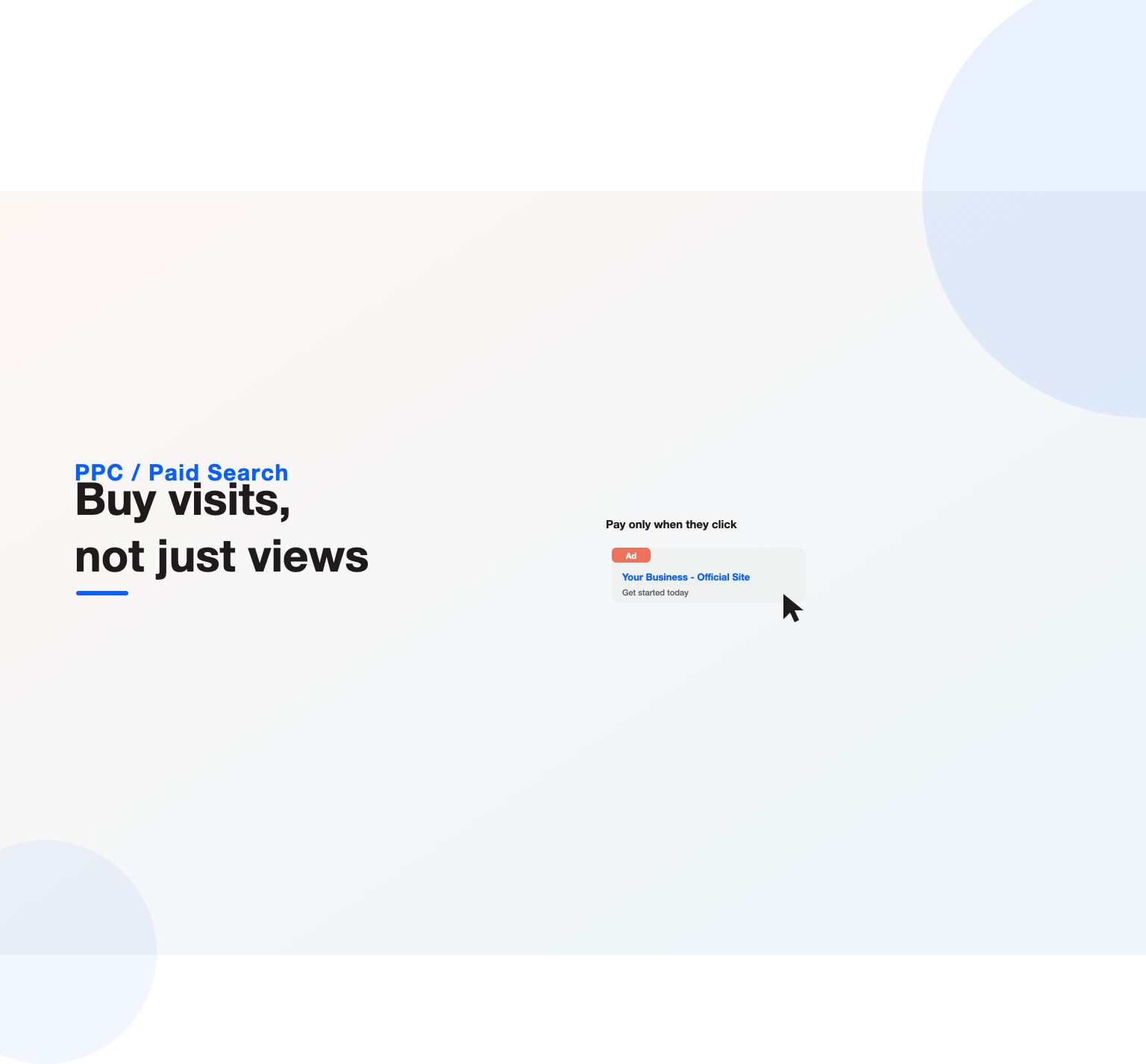
PPC, or pay-per-click, is a form of online advertising where you pay a fee each time someone clicks your ad, effectively buying visits rather than earning them. In short, what is PPC if not renting instant visibility: you bid to show ads on search engines, social platforms, and websites, and you only pay when a user actually clicks through. The best-known form is paid search, where ads appear above organic results for a query, but PPC also spans social ads, display banners, and shopping listings. Its appeal is speed and control: unlike SEO, which builds over months, a PPC campaign can drive targeted traffic within hours, with precise control over budget, audience, and messaging.
Key Highlights
- You pay per click, not per view. Budget goes toward people who actually engage, making spend measurable.
- Results are fast. Campaigns can deliver targeted traffic the same day, unlike the slow build of organic search.
- Targeting is precise. You choose who sees ads by keyword, location, device, interest, and more.
- It is an auction. Rankings depend on both your bid and your ad quality, so relevance lowers cost.
- Everything is measurable. Clicks, conversions, and return on ad spend are tracked, enabling constant optimisation.
What is PPC, defined properly?
At its core, what is PPC comes down to a straightforward trade: advertisers pay platforms for the traffic those platforms can send, and the fee is charged per click rather than per impression. This model aligns cost with engagement, because you are paying for a visit, someone who cared enough to click, not merely for being seen. That is what makes PPC so measurable and, when managed well, so profitable, since every dollar can be traced to a click and, ideally, to a conversion.
The model appears across many surfaces. Paid search ads show on engines like Google and Bing when someone searches a relevant term, capturing high-intent demand at the moment of interest. Paid social ads appear in feeds on platforms like Facebook, Instagram, and LinkedIn, reaching people based on who they are rather than what they searched. Display ads show as banners across websites, and shopping ads showcase products with images and prices directly in results. Understanding what is PPC means seeing it as a family of ad formats united by one pricing model, each suited to a different stage of demand.
It sits opposite organic marketing on a key axis. Organic traffic from SEO or content is earned and durable but slow; PPC traffic is bought and instant but stops the moment you stop paying. Neither is better in the abstract; they serve different needs, and most mature marketing programmes run both, using each for what it does best.
How PPC actually works: the auction
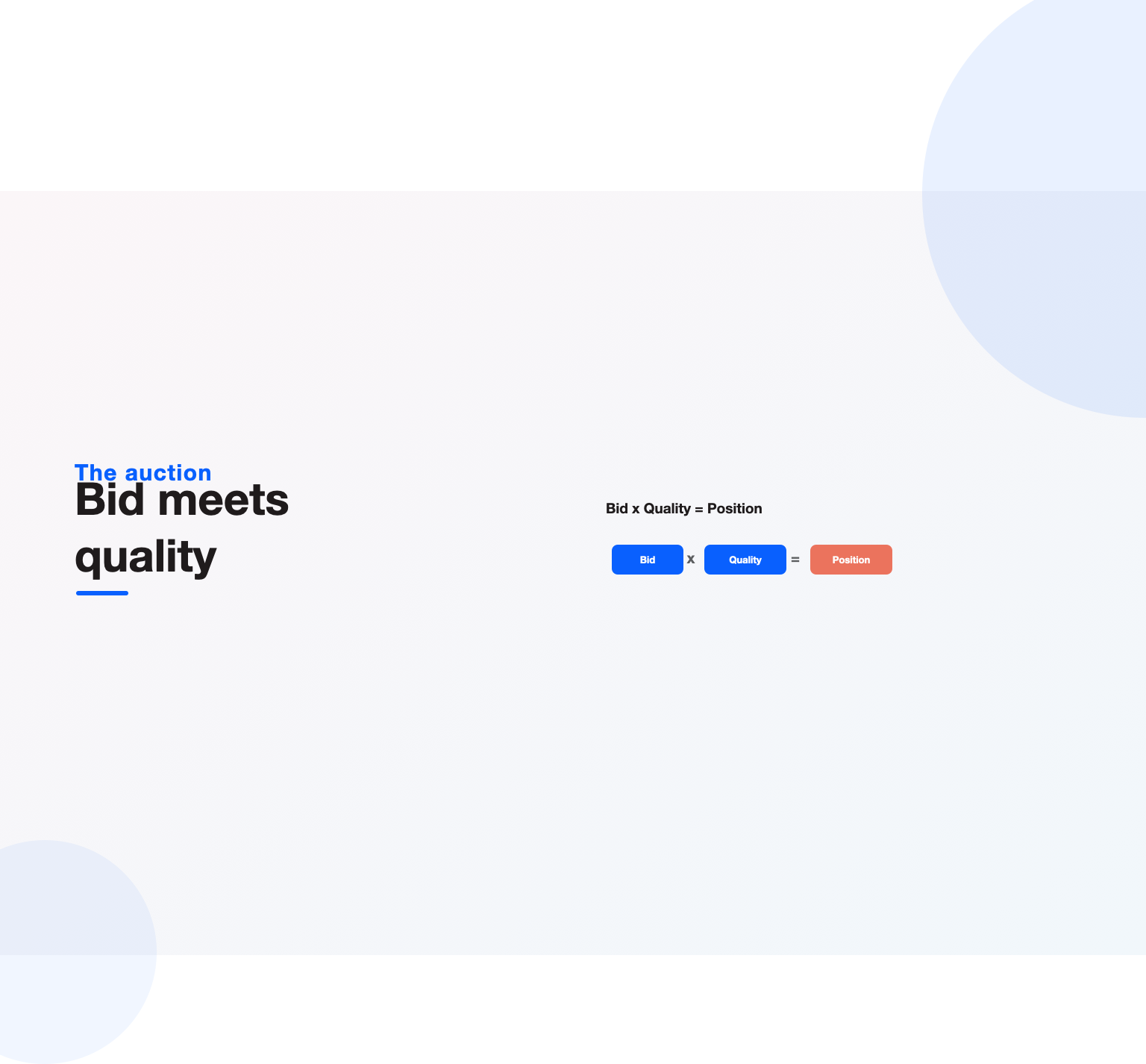
Behind every paid search result is an auction that runs in milliseconds, and grasping it explains why PPC rewards more than just the biggest budget. When someone searches, the platform holds an instant auction among advertisers bidding on that term. Crucially, the winner is not simply whoever bids most; the platform combines your bid with a quality measure to decide placement, so a relevant, well-built ad can outrank a higher bidder who is less relevant.
This quality dimension, Google calls it Quality Score, rewards ads and landing pages that genuinely match the searcher’s intent. A high Quality Score lowers the price you pay per click and lifts your position, which means relevance is not just good practice but a direct cost saving. The Google Ads documentation explains how this scoring works in detail. The practical lesson is that what is PPC rewards is a combination of smart bidding and genuine relevance, not spending alone, which is why skilled management consistently beats simply throwing money at a campaign.
The main PPC platforms
Advertisers have many venues, and each fits different goals. Google Ads is the giant of paid search, offering unmatched reach across the world’s dominant search engine plus its display network and YouTube, making it the default starting point for capturing active demand. Microsoft Advertising runs ads on Bing and partner sites, often at lower cost per click and with a valuable audience, so it rewards advertisers who look beyond the obvious.
On the social side, Meta’s platforms, Facebook and Instagram, excel at reaching people by interest and behaviour, ideal for demand generation and visually driven products, which is why dedicated Meta Ads management is its own discipline. LinkedIn Ads target professionals by job title, industry, and company, making them powerful for B2B despite higher costs. Beyond these, platforms like TikTok, Pinterest, and Amazon serve specific audiences and intents. Choosing where to run depends on where your audience is and what you sell, and part of understanding what is PPC in practice is matching the platform to the goal rather than defaulting to one everywhere.
Types of PPC campaigns
Within these platforms, campaigns come in distinct types suited to different objectives. Search campaigns target keywords and capture high-intent demand, showing text ads to people actively looking, which makes them the workhorse for direct response. Display campaigns place visual banners across websites to build awareness and retarget past visitors, trading intent for reach.
Shopping campaigns show product images, prices, and titles directly in search results, driving ecommerce sales with high commercial intent, and they are central to ecommerce PPC. Video campaigns on platforms like YouTube build awareness and engagement through sight and sound. Remarketing campaigns re-engage people who already visited your site, often converting at high rates because they target warm audiences. Performance-based automated campaign types now blend several of these using machine learning. Selecting the right campaign type for each goal is fundamental, and misusing them, running a broad awareness campaign when you need direct sales, for instance, is a common way budgets underperform despite the tools themselves working exactly as designed.
Key PPC metrics that matter
Because everything in paid advertising is measurable, knowing which numbers matter keeps a campaign honest. Cost per click, CPC, is the price you pay for each click and reflects competition and quality. Click-through rate, CTR, measures how compelling your ad is by showing the share of viewers who click, and it feeds into quality scoring. Conversion rate reveals how many of those clicks turn into a desired action, whether a sale, lead, or sign-up.
The metrics that connect to profit matter most. Cost per acquisition, CPA, tells you what each conversion costs, and return on ad spend, ROAS, shows the revenue generated per dollar spent, the ultimate measure of whether a campaign pays. Beginners often fixate on cheap clicks or high CTR, but a campaign with expensive clicks that convert profitably beats a cheap one that never sells. Mastering paid media means reading these numbers together, because optimising one in isolation, chasing low CPC while ignoring conversions, reliably leads to spending efficiently on the wrong outcome.
How to set up a PPC campaign
A successful campaign follows a deliberate sequence rather than guesswork. It starts with goals: define exactly what you want, sales, leads, sign-ups, or awareness, because the objective shapes every later choice. Keyword and audience research comes next, identifying the terms or audiences worth targeting and, just as important, the negative keywords that prevent wasted spend on irrelevant clicks.
From there you structure the account into logical campaigns and tightly themed ad groups, which keeps ads relevant and Quality Scores high. Writing compelling ads that match search intent and include a clear call to action is where relevance meets persuasion. Crucially, the landing page must deliver on the ad’s promise, because sending clicks to a weak or mismatched page wastes the money you paid to earn them, a link between ads and pages that connects PPC directly to conversion rate optimisation. Finally, conversion tracking must be in place before launch, since running a campaign without it means flying blind. Getting this foundation right is most of what is PPC success in practice.
PPC budgeting and bidding
Deciding how much to spend and how to bid trips up many newcomers, yet the logic is manageable. Budget should be tied to goals and unit economics: if you know the value of a customer and your conversion rates, you can work backward to a sustainable cost per click and a sensible daily budget. Starting modestly, gathering data, and scaling what works beats committing a large budget to unproven assumptions.
Bidding strategy is the other lever. Manual bidding gives fine control, while automated strategies use the platform’s machine learning to optimise toward goals like a target CPA or ROAS, which increasingly outperform manual approaches once enough conversion data exists. The key is patience and data: platforms need conversions to learn, so starving a campaign of budget or changing it constantly prevents the algorithms from optimising. A disciplined approach to what is PPC budgeting treats early spend as the cost of buying data, then reinvests into the campaigns, keywords, and audiences that prove profitable, rather than spreading spend thin across everything at once.
Common PPC mistakes to avoid
Predictable errors drain budgets across accounts of every size. Neglecting negative keywords is among the most costly, letting ads show for irrelevant searches that burn money without ever converting. Sending all traffic to a homepage instead of a relevant, dedicated landing page squanders clicks by adding friction between intent and action. Ignoring mobile experience fails the majority of users who now click from phones.
Poor account structure, with broad, unfocused ad groups, drags down relevance and inflates costs. Setting a campaign live and forgetting it lets waste accumulate, because PPC rewards ongoing optimisation, not a one-time setup. Perhaps the most fundamental mistake is running without proper conversion tracking, which makes it impossible to know what works and turns optimisation into guesswork. Fixing these is rarely about spending more; it is about spending deliberately, and it is why understanding what is PPC well enough to avoid these traps often improves results more than any budget increase could.
PPC vs SEO, and how they work together
The two dominant search strategies are often framed as rivals, but they are complements. Search ads deliver instant, controllable traffic that stops when spending stops, making them ideal for launches, promotions, and capturing high-intent demand immediately. SEO builds durable organic visibility that compounds over time but takes months to mature, making it the foundation of sustainable traffic. One is rented, one is owned; using only one leaves value on the table.
Together they create advantages neither achieves alone. Campaign data reveals which keywords convert, informing SEO strategy before you invest months in ranking for them. Dominating both paid and organic results for key terms increases total visibility and crowds out competitors. And technical foundations that help paid landing pages load fast also help organic rankings, linking PPC to technical SEO. A sophisticated programme runs them in concert, as our complete guide to SEO describes, so understanding what is PPC fully includes understanding how it strengthens, rather than competes with, organic search.
Managing PPC: in-house, freelance, or agency
Running paid campaigns well is a skilled, ongoing job, and how you resource it shapes results. Managing in-house gives control and deep product knowledge but requires expertise that takes time to build, and a poorly managed account can waste money quickly. A freelancer offers specialist skills and flexibility for smaller accounts, while an agency brings a team, cross-account experience, and the tooling to manage complex or high-spend campaigns efficiently.
The economics often favour expert management, because a skilled manager typically improves performance by more than their fee costs, turning wasted spend into profitable conversions. The larger and more competitive your spend, the more that expertise pays off, which is why businesses investing seriously in paid channels frequently turn to dedicated Google Ads management. Whatever route you choose, the goal is constant, informed optimisation rather than set-and-forget, because that is the discipline at the heart of what is PPC done profitably rather than merely spent.
Is PPC worth it?
Whether paid advertising pays off depends on your situation, and honesty here saves money. The channel works well when your customers actively search for or can be targeted for what you sell, when you understand your unit economics well enough to bid profitably, and when you can commit to managing and optimising rather than setting it and walking away. For businesses with healthy margins and clear conversion tracking, it can be one of the most scalable and measurable growth channels available.
It is a poor fit in the opposite cases. Thin margins can make profitable bidding impossible in competitive auctions, and without conversion tracking you cannot tell winners from losers. For some businesses, investing first in organic foundations makes more sense, with paid layered on later. The reassuring truth is that PPC is measurable enough to test cheaply: a small, well-tracked campaign quickly reveals whether the economics work. Answering what is PPC worth for your business is therefore an empirical question you can settle with a modest, disciplined experiment rather than a leap of faith.
Writing ads that actually convert
The ad itself is where budget meets persuasion, and small differences in copy produce large differences in results. A strong paid ad matches the searcher’s intent precisely, echoing the language they used so the ad feels like the obvious answer to their query. It leads with the benefit that matters most to that audience, not a generic brand statement, and it includes a clear, specific call to action that tells the reader exactly what to do next.
Relevance is not only persuasive but economical, because platforms reward ads that earn clicks and match intent with higher quality scores and lower costs. Testing is the engine of improvement here: running multiple ad variations and letting data decide the winner steadily lifts performance over time. Extensions and additional assets, sitelinks, callouts, and structured snippets, expand an ad’s footprint and give users more reasons to click. Industry benchmarks published by advertising analysts show how much click-through and conversion rates vary by industry, underscoring that there is no single right number, only steady improvement against your own baseline. Treating ad copy as a living experiment rather than a one-time write is central to what is PPC done well.
Landing pages: where campaigns win or lose
Clicks are only the halfway point; what happens after the click decides whether the money was well spent. A common and expensive mistake is pouring budget into ads that send traffic to a weak or generic page, so the visitor arrives, finds friction or a mismatch, and leaves without converting. The click is paid for regardless, which makes a poor landing page one of the fastest ways to waste a budget.
Effective landing pages share a few traits: they continue the ad’s message so the visitor feels in the right place, they load fast, they focus on a single clear action without distraction, and they build trust with proof like testimonials or guarantees. Because so much of paid performance hinges on what happens post-click, this work overlaps heavily with conversion rate optimisation, and page speed ties it to technical foundations as well. Optimising landing pages often lifts return more than tweaking bids, because it improves the conversion rate on traffic you are already paying for, which is why experienced advertisers treat the page and the ad as a single system rather than separate jobs.
Advanced targeting, retargeting, and automation
Beyond the basics, modern paid advertising offers powerful ways to reach the right people at the right moment. Audience targeting lets you show ads based on demographics, interests, behaviours, and even past interactions with your brand, moving well beyond keywords alone. Retargeting is especially potent: showing ads to people who already visited your site keeps your brand present during their decision and often converts at far higher rates than cold traffic, because these audiences are already familiar with you.
Automation has transformed the field, with platforms using machine learning to optimise bids and even generate or assemble ads toward your goals. Used well, this frees marketers to focus on strategy, creative, and offers while the system handles the real-time bidding math humans cannot match. The catch is that automation needs clean conversion data and clear goals to work, so the fundamentals remain essential rather than optional. Google’s and Meta’s own business help resources document these audience and automation tools in depth. Layering these capabilities onto a well-built foundation is where what is PPC becomes genuinely sophisticated, and it connects paid work to broader demand generation and lead generation across the funnel.
How PPC fits different business types
The way paid advertising delivers value shifts with the business model. For ecommerce, the path is direct and measurable: shopping and search ads drive sales you can attribute cleanly to spend, and success hinges on product margins, feed quality, and efficient scaling across large catalogues, the domain of specialised ecommerce campaigns supported by strong keyword research. For lead-generation businesses, the goal is capturing enquiries at a cost the sales team can convert profitably, which puts a premium on landing pages, lead quality, and tracking that follows a click all the way to closed revenue.
For local businesses, geographically targeted ads capture nearby demand at the moment of need, often with excellent return because intent and proximity align. For software and subscription businesses, longer sales cycles mean paid works best alongside nurturing, feeding a funnel rather than expecting instant sales, which ties it closely to broader digital strategy. Matching the approach to the model is essential, because a tactic that thrives for a high-margin ecommerce store may fail for a thin-margin service business. Recognising these differences is part of understanding what is PPC in the real world, where the same auction mechanics produce very different playbooks depending on what you sell and how you make money.
Getting started with PPC the right way
Launching well is less about spending big and more about setting up to learn. Begin with a clear, single goal and a modest budget you are comfortable treating as the cost of gathering data, because early spend buys knowledge as much as clicks. Choose one platform where your audience clearly is, rather than spreading a small budget thin across several, and build a tightly themed campaign around a focused set of keywords or audiences with negative keywords in place from day one.
Before anything goes live, install conversion tracking, since a campaign without it cannot be judged or improved. Write a handful of ad variations, point them at a purpose-built landing page, and then resist the urge to fiddle constantly, giving the campaign enough time and data to reveal what works. From that base, optimise methodically: cut what wastes money, scale what converts, and expand only once the economics are proven. This disciplined, test-and-learn path is how what is PPC turns from a gamble into a predictable, scalable channel, and it mirrors the same evidence-first mindset that underpins durable results across growth marketing as a whole.
Bringing it together
For all its dashboards, auction mechanics, and jargon, paid advertising rests on a simple promise: you can buy relevant attention instantly and measure exactly what it returns. That combination of speed and measurability is what makes it such a powerful complement to slower, compounding channels, and it is why it remains a cornerstone of digital marketing even as platforms and features evolve. The advertisers who succeed are rarely the ones with the deepest pockets; they are the ones who understand their numbers, match the right campaign to the right goal, and treat every campaign as an experiment to be refined rather than a switch to be flipped.
The path to success is therefore less mysterious than it first appears. Know your unit economics so you can bid profitably. Respect relevance, because the auction rewards it with lower costs and better positions. Build strong landing pages, because clicks only pay off when they convert. Track everything, so decisions rest on evidence rather than instinct. And optimise continuously, since the accounts that win are the ones that keep improving while competitors set and forget. Layer paid alongside organic search rather than choosing between them, and you capture both immediate demand and durable growth at once. Remember, too, that the channel rarely stands alone: the data it produces about which messages and keywords convert is some of the most valuable market research a business can buy, quietly sharpening your content, your positioning, and your organic strategy long after the clicks themselves have been counted. Few marketing investments teach you as much about your own customers as a well-instrumented paid campaign does. The keywords people click, the offers they respond to, and the messages they ignore all become concrete evidence you can feed straight back into every other channel, from your landing pages to your email nurture to the topics your content team prioritises next quarter, turning what looks like an advertising cost into a continuous source of customer insight that quietly compounds in value across the entire business over time. Approached with that discipline, paid media stops being an expensive gamble and becomes one of the most controllable, scalable, and accountable growth levers a business can pull, one whose results you can read clearly, improve steadily, and expand with confidence as the economics prove themselves month after month.
Key takeaways
- PPC means paying per click for instant, targeted traffic. You buy visits across search, social, and display, paying only when people engage.
- It is an auction of bid and quality. Relevant ads and landing pages lower cost and lift position, so relevance beats budget alone.
- Profit metrics matter most. Optimise toward CPA and ROAS, not just cheap clicks or high CTR.
- Setup and tracking are everything. Clear goals, tight structure, strong landing pages, and conversion tracking make or break results.
- Paid and organic are complements. Paid delivers speed and data; organic delivers durability. Run them together.
Frequently asked questions
What is PPC in simple terms?
PPC, or pay-per-click, is online advertising where you pay a fee each time someone clicks your ad. You buy visits across search engines, social platforms, and websites, paying only when a user actually engages, which makes it fast and highly measurable.
How is PPC different from SEO?
It buys instant, targeted traffic that stops when you stop paying. SEO earns organic traffic that builds slowly but compounds and lasts. One is rented and immediate, the other owned and durable. Most effective programmes use both together rather than choosing one.
How much does PPC cost?
It varies widely by industry, platform, and competition, since you pay per click in an auction. Rather than a fixed price, focus on unit economics: if a customer’s value and your conversion rates support a given cost per click, the spend is profitable.
Which PPC platform should I start with?
Google Ads is the usual starting point for capturing active search demand. If your audience is better reached by interest or job role, Meta or LinkedIn may fit better. The right platform depends on where your audience is and what you sell.
What is a good ROAS or CPA?
It depends entirely on your margins and business model. A profitable ROAS for a high-margin product differs from a low-margin one. The right target is whatever cost per acquisition or return on ad spend keeps each conversion profitable for you.
Do I need conversion tracking for PPC?
Yes, absolutely. Without conversion tracking you cannot tell which keywords, ads, and campaigns actually drive results, making optimisation guesswork. Setting it up before launch is essential, because it turns spend into measurable, improvable performance.
Can I manage PPC myself?
Yes, for smaller, simpler accounts, using each platform’s guidance. But skilled management often improves results by more than its cost, especially as spend and competition grow, so many businesses hire a specialist or agency once the stakes rise.
How quickly does PPC show results?
Traffic can arrive within hours of launching, which is PPC’s speed advantage over SEO. However, optimising toward profitable performance takes time and data, as platforms need conversions to learn and you need results to refine targeting and bids.
Ready to put this into practice?
Talk to the team that runs SEO, AI search and paid growth programs every day.
Book a Strategy Call →