 Skip to content

Keyword Match Types in Google Ads: Reach vs Control
Keyword match types, broad, phrase and exact, control how closely a search matches your keyword. Learn how they work today, the reach-control trade-off, and how to combine them.
Quick Answer
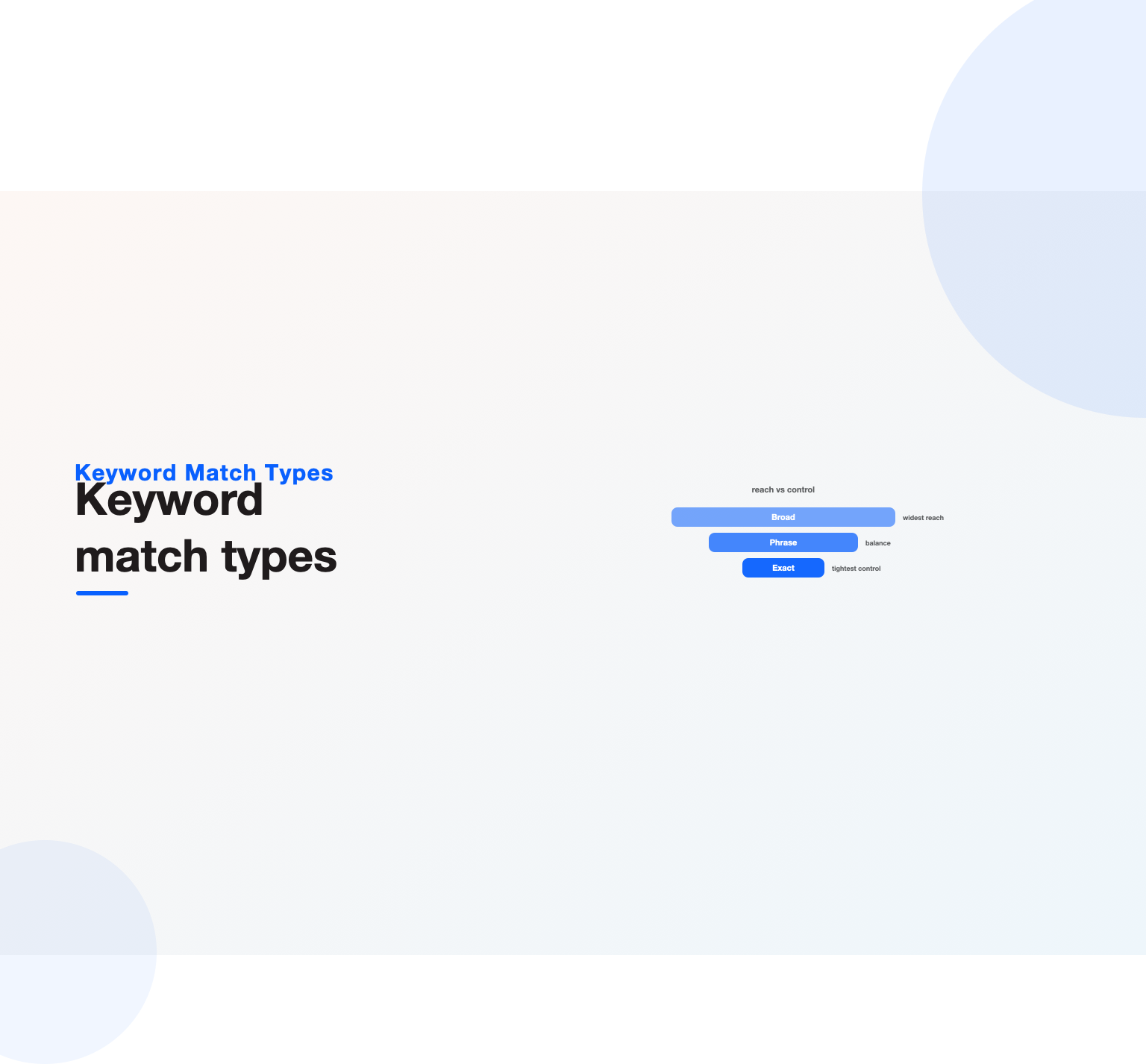
Keyword match types in Google Ads control how closely a person’s search has to relate to your keyword for your ad to show, and choosing them well is one of the main levers over how much of your budget reaches the right searches. There are three: broad match, which reaches the widest range of related and loosely related queries; phrase match, which requires the search to include the meaning of your keyword; and exact match, which limits your ad to searches that mean the same thing as your keyword. Each is a trade-off between reach and control, broad casts the widest net but risks irrelevant clicks, exact is the tightest but captures less volume, and phrase sits between. Modern keyword match types are looser than they once were, since Google now matches on meaning and intent rather than literal wording, which makes negative keywords essential for keeping any match type disciplined. This guide explains how each match type works today, the reach-versus-control trade-off, how they pair with automated bidding, and how to combine them into a structure that captures valuable searches without wasting spend.
Key Highlights
- Keyword match types, broad, phrase and exact, control how closely a search must relate to your keyword for your ad to show.
- They trade reach for control, with broad reaching the most queries, exact the fewest but most relevant, and phrase in between.
- Modern match types are looser than before, matching on meaning and intent rather than literal wording, so behavior has shifted.
- Negative keywords are essential with any match type, and especially with broad, to keep the traffic disciplined.
- Paired with smart bidding, broad match uses conversion data to keep its wide reach targeted.
- The best accounts combine match types deliberately rather than relying on one, matching the type to the goal of each keyword.
How the three match types work
The three keyword match types form a spectrum from widest reach to tightest control, and understanding where each sits is the foundation for using them. The broad type, the default and widest, lets your ad show for a large range of searches related to your keyword, including synonyms, related concepts and queries Google judges relevant even when they share no words with your keyword, so it maximizes reach but with the least control over exactly which searches trigger your ad. Its wide net can find valuable searches you never thought to target, and also plenty you did not want, which is why the type is only as good as the discipline you wrap around it. Left alone it wanders; guided by negatives, clean conversion data and the right bidding strategies, that same reach becomes an asset rather than a liability.
The phrase type narrows things by requiring the search to include the meaning of your keyword, so it shows for searches that contain your keyword’s intent, typically in a recognizable form, while excluding the unrelated queries a broad match might otherwise catch. The exact type is the tightest, limiting your ad to searches that mean the same thing as your keyword, though even it now includes close variants and same-meaning rephrasings rather than only the literal words. Across these types, the pattern is consistent: as you move from broad to exact, you trade reach for relevance and control, and choosing where on that spectrum each keyword belongs, for its own goal and its own level of surrounding control, is the core skill, one that disciplined Google Ads management applies keyword by keyword.
The reach-versus-control trade-off
At the heart of choosing a match type is a single trade-off between reach and control, and every decision about them comes back to it. At the wide end, broad match gives you maximum reach, putting your ad in front of the widest range of potentially relevant searches, which is powerful for discovering new queries and capturing demand you had not anticipated, the kind of long-tail searches no keyword list would ever have guessed, but that reach comes with the least control, so without discipline it spends on irrelevant searches. At the tight end, exact match gives you the most control, ensuring your ad shows only for searches that closely match your intent, but it reaches the least volume and can miss valuable searches phrased in ways you did not target.
The right balance depends on your goal for each keyword and how much you trust the surrounding discipline. Where precision and efficiency matter most, and especially where budget is tight, tighter match types protect spend; where discovery and volume matter and you have the negatives and bidding to keep wide reach in check, broader types find more opportunity. There is no universally correct answer, only the right choice for a given keyword, goal and level of control, which is why treating keyword match types as a deliberate decision rather than a default is what separates efficient accounts from wasteful ones, a judgment reinforced by every thorough Google Ads audit.
How match types have changed
Anyone returning to Google Ads after a few years needs to understand that keyword match types behave very differently than they used to, because Google has steadily loosened them to match on meaning rather than literal words. It once meant precisely the words you entered; now exact match includes close variants, misspellings, and rephrasings that share the same meaning, so an exact-match keyword reaches a broader set of same-intent searches than the name suggests. Phrase match similarly expanded to focus on meaning rather than strict word order, absorbing much of what old broad-match modifier keywords used to do before that option was retired altogether, another sign of how much the ground has shifted for anyone managing these settings.
The broad type, by contrast, has been repositioned around intent and paired with automated bidding, so it now leans heavily on Google’s understanding of a searcher’s goal and on your conversion data to decide relevance. The practical upshot is that all three types are looser and more intent-driven than their names imply, which means you can no longer assume a match type will behave literally, and you must rely more on negative keywords and on watching the search-terms report to see what you are actually matching. Understanding this shift is essential, because managing modern match types with an outdated mental model leads to both wasted spend and missed reach, a gap that shows up quickly in any careful review.
Why negatives matter with every match type
Because modern match types all match more loosely than their names suggest, negative keywords have become essential rather than optional for keeping traffic disciplined. Even exact match, now that it includes same-meaning variants, can occasionally match to searches you did not intend, and phrase and broad match do so far more often, so a strong, well-maintained negative keyword list is the counterweight that keeps any match type from spending on irrelevant queries. Without negatives, broader match types in particular spray budget across loosely related searches, which is the single most common way accounts waste money on the wrong traffic, and one of the first leaks a spend review looks for. The remedy is never to abandon a match type but to wrap it in the discipline that keeps it honest.
The discipline that ties match types and negatives together is the search-terms report, which shows the actual queries your keywords matched to. Reviewing it regularly reveals what each match type is really capturing, so you can add negatives to block the irrelevant queries and let the valuable ones through, tightening the account without abandoning the reach broader types provide. This pairing, broad reach guided by disciplined negatives, is how modern accounts get discovery without waste, and it is why the negative list and the match-type strategy have to be managed together, a relationship our guide to negative keywords explores in depth and one every Google Ads audit checks closely.
Match types and automated bidding
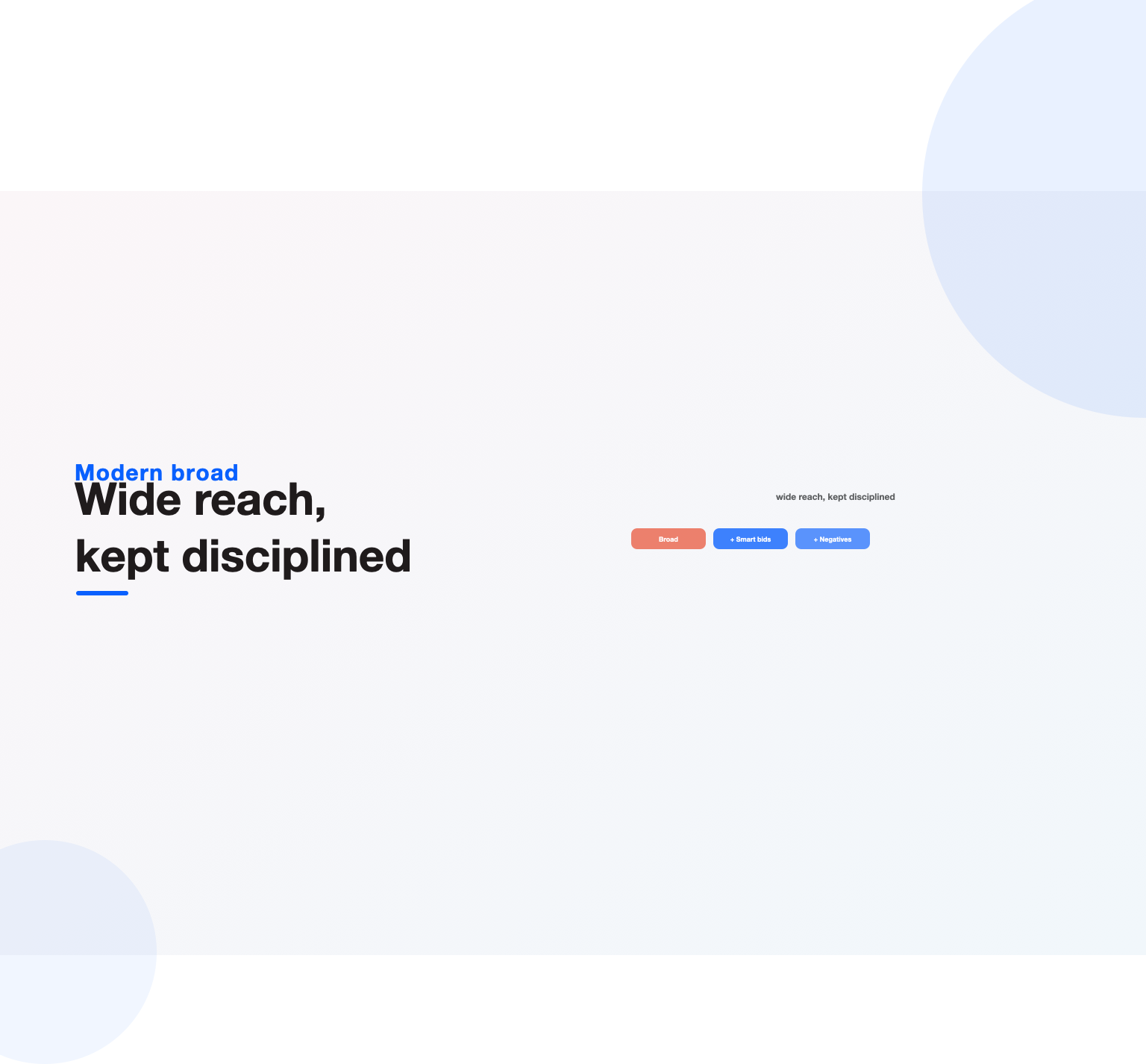
The modern approach to keyword match types cannot be understood apart from automated bidding, because the two now work as a pair, especially with broad match. The broad type used to be dangerous precisely because it reached so widely with no way to keep the reach targeted, but paired with smart bidding, which uses conversion data to bid up on the promising searches within that wide net and down on the rest, it becomes a controlled discovery engine rather than a budget drain. This combination is why broad match has been rehabilitated from a beginner’s trap into a strategy sophisticated accounts deliberately use.
The prerequisite is the same as for any smart bidding: accurate, plentiful conversion data. This pairing relies on the automation reading conversion signals to find the good searches, so an account with broken tracking or too few conversions cannot control broad match this way and is better served by tighter match types until the data supports automation. Where the data is strong, combining broad match with smart bidding and a solid negative list can outperform a tightly controlled account by capturing valuable searches manual targeting would miss, which is why the choice of match type is now inseparable from your bidding strategies.
Combining match types in an account
The strongest accounts rarely rely on a single match type; they combine keyword match types deliberately, using each where it fits. A common approach runs exact match on your proven, high-value keywords for control and efficiency, phrase match where you want a balance of reach and relevance, and broad match with smart bidding for discovery, letting the wide net surface new valuable queries that can then be promoted into tighter match types. This layered structure captures the reliable volume you know converts while continuously discovering new opportunity, rather than forcing a single trade-off across the whole account.
Structuring this well takes care so the match types complement rather than compete. Negative keywords steer traffic to the right match type, high-performing search terms discovered by broad match get added as exact or phrase keywords, and the account is organized so each keyword’s match type suits its role. Managed this way, keyword match types become a system that balances control and discovery across the account rather than a setting applied uniformly, and getting that balance right is a continuous part of the steady Google Ads optimization that keeps an account both efficient and growing.
Match types for a tight budget
When budget is limited, the choice among keyword match types leans toward control, because there is less room to absorb the wasted clicks that broad reach can bring. Tighter match types, exact and carefully managed phrase, concentrate a small budget on the searches most likely to convert, which protects it from being spread thin across loosely related queries that a broad match might capture. For a small advertiser without the conversion volume to control broad match through smart bidding, starting tight and expanding as budget and data grow is usually the disciplined path.
This does not mean broad match is off-limits for smaller accounts, but that it should be used cautiously and with strong negatives where used at all. As an account builds conversion data and budget, it can gradually introduce broader match types with the bidding and negatives to control them, expanding reach as it can afford to. Matching the match-type strategy to the budget available, tight when spend is scarce, broader as it grows, keeps a limited budget efficient, a principle that ties directly to planning a realistic Google Ads budget and matters as much for a local Google Ads for contractors account as for any large advertiser.
Monitoring and refining match types
Choosing match types is not a one-time decision, because what each captures shifts as search behavior changes and as Google adjusts how the types behave, so ongoing monitoring is part of managing them. The search-terms report remains the essential tool, showing what your keywords are actually matching to, so you can see whether a broad match is drifting into irrelevant territory, whether a phrase match is capturing the intent you wanted, and where valuable new queries are appearing that deserve their own tighter keywords. Reading it regularly turns match-type management from a guess into an evidence-based practice.
Refinement follows from what the report reveals. Adding negatives to discipline a match type that is straying, promoting high-performing discovered searches into exact or phrase keywords, and adjusting which match types you rely on as results come in all keep the account sharp. Because the platform keeps evolving how keyword match types work, staying current and watching the actual search terms rather than assuming a type will behave as it did last year is what prevents both creeping waste and missed reach. This continuous attention is exactly the kind of upkeep that separates a maintained account from a neglected one, whatever the vertical, including specialized accounts like Google Ads for SaaS.
Match types and account structure
The way you organize keywords into campaigns and ad groups interacts with match types, so the two are best planned together rather than in isolation. Some accounts separate match types into their own ad groups or even campaigns, running exact-match keywords in one and broad-match discovery in another, which makes it easy to control budgets and see how each is performing without one bleeding into the other. This separation also lets you apply different bidding and negatives to each, giving the tight, proven keywords one treatment and the wide, exploratory ones another.
Whether or not you formally separate them, the principle is that a keyword and its match type together define what an ad group is trying to capture, so an ad group should be coherent in both. Mixing a broad discovery keyword with tightly controlled exact keywords in the same ad group muddies the ads and the reporting, whereas grouping keywords by both theme and intended reach keeps everything legible and controllable. Thinking about structure and match type as one decision, rather than bolting a match type onto whatever structure exists, is part of building an account that stays manageable as it grows, a discipline that pays off across verticals from retail to Google Ads for real estate agents.
Promoting discovered search terms
One of the most valuable things broader match types do is surface searches you never thought to target, and capitalizing on that discovery is a skill worth building deliberately. When a broad or phrase keyword matches to a query that converts well, that query is a candidate to become its own keyword, usually as exact or phrase match, so you can control and bid on it specifically rather than leaving it to the wide net. This continual promotion of proven search terms into tighter keywords is how an account grows its reliable, high-control core over time.
The workflow ties everything together. The search-terms report reveals the winning queries, you add them as tighter keywords and often add negatives so the broad keyword stops competing for them, and the account steadily converts discovery into controlled, efficient volume. Done consistently, this turns broader match types from a gamble into a research engine that feeds your exact-match core, which is exactly the balance of discovery and control that skilled management aims for, and it depends on the same disciplined use of negative keywords that keeps the wide net from wasting spend. Over months, an account run this way accumulates a growing set of proven keywords earned from real search data rather than guesswork.
Common match type mistakes
Several recurring errors keep advertisers from getting the best from keyword match types. The most common is using broad match without the negatives and smart bidding needed to control it, so it sprays budget across irrelevant searches, which is the classic way accounts waste money. Its opposite, relying entirely on exact match, is also a mistake, since it caps reach and misses valuable searches phrased in ways you did not target, leaving opportunity on the table. Managing match types with an outdated mental model, expecting exact to be literal or broad to be uncontrollable, leads to decisions that no longer fit how the types actually behave.
Other frequent missteps include never reviewing the search-terms report to see what each match type is really capturing, failing to build negatives alongside broad match, using broad match on an account without the conversion data to control it, and applying one match type uniformly rather than matching each to its keyword’s role. The thread through these errors is treating keyword match types as a set-and-forget setting rather than a deliberate, monitored decision. Advertisers who choose match types to fit each keyword’s goal, pair them with disciplined negatives and appropriate bidding, and refine them from the search-terms report get both control and reach, while those who neglect them lose one or the other, a pattern our Google Ads audit reliably surfaces.
When to get help with match types
Understanding and managing keyword match types is within reach of a capable marketer, and for a smaller account, choosing sensible match types, building negatives, and reviewing the search-terms report is a realistic, high-value habit anyone can build. The core ideas, the reach-versus-control trade-off, the need for negatives, the pairing with bidding, are more about judgment than technical difficulty, and a diligent owner who watches what their keywords actually match to can manage them well.
Expert help pays off as accounts grow and the match-type strategy becomes more involved, when combining broad match and smart bidding for discovery demands careful negative management, when large budgets make small inefficiencies costly, or when nobody in-house has time to monitor search terms consistently. An experienced practitioner structures match types to balance control and discovery, manages the negatives and bidding that keep them disciplined, and refines them from the data as routine, so folding this into ongoing Google Ads services often captures reach and efficiency an unmanaged account leaves untapped. Whichever route you take, the essentials of keyword match types stay the same: match the type to the keyword’s goal, pair broader types with negatives and bidding, and refine continuously from the search-terms report.
Stepping back, the modern reality of keyword match types is that the old certainties are gone and judgment matters more than memorized rules. When exact meant exactly your words and broad was simply reckless, the choices were mechanical; now that every type matches on meaning and broad match can be a disciplined discovery tool, using them well is about understanding the reach-versus-control trade-off, pairing each type with the right negatives and bidding, and watching what your keywords actually match to. The advertisers who thrive are the ones who treat the search-terms report as their compass and adjust deliberately, rather than setting a match type once and assuming it behaves as it did years ago. That evidence-led, adaptable approach, more than any fixed formula, is what turns match types into a lever for both efficiency and growth, and it is the same mindset that runs through a disciplined ecommerce PPC management program and every serious Google Ads budget plan.
Key Takeaways
- Keyword match types, broad, phrase and exact, control how closely a search must relate to your keyword, trading reach for control.
- Modern match types match on meaning and intent, not literal words, so they behave more loosely than their names suggest.
- Negative keywords are essential with every match type, and especially broad, to keep the traffic disciplined.
- Broad match now pairs with smart bidding and clean conversion data to turn wide reach into controlled discovery.
- Combine match types deliberately, exact for control, phrase for balance, broad for discovery, rather than applying one uniformly.
- Monitor the search-terms report and refine continuously, applying the ongoing discipline a Google Ads optimization routine demands.
Frequently asked questions
What are keyword match types in Google Ads?
Keyword match types are settings that control how closely a person’s search has to relate to your keyword for your ad to show. There are three: broad match, which reaches the widest range of related and loosely related queries; phrase match, which requires the search to include the meaning of your keyword; and exact match, which limits your ad to searches that mean the same thing as your keyword. Each is a trade-off between reach and control, broad casts the widest net but risks irrelevant clicks, exact is the tightest but captures less volume, and phrase sits between. Choosing the right match type for each keyword is one of the main levers over how efficiently your budget reaches the right searches.
What is the difference between broad, phrase and exact match?
The difference is how widely each matches. Broad match shows your ad for the widest range of searches related to your keyword, including synonyms and related concepts, even queries sharing no words with it, so it maximizes reach with the least control. Phrase match narrows this by requiring the search to include your keyword’s meaning, excluding unrelated queries a broad match might catch. Exact match is the tightest, showing only for searches that mean the same thing as your keyword, though it now includes close variants and same-meaning rephrasings rather than only the literal words. Moving from broad to exact trades reach for relevance and control, which is the core decision in choosing match types.
Which keyword match type should I use?
It depends on your goal for each keyword and your level of control. Exact match suits proven, high-value keywords where precision and efficiency matter most, and it is safest when budget is tight. Phrase match offers a balance of reach and relevance for keywords where you want some flexibility without broad’s width. Broad match suits discovery, finding new valuable queries, but only when paired with smart bidding and a strong negative keyword list to keep it disciplined. The best accounts combine all three, using each where it fits rather than applying one uniformly. The key is to match the type to the keyword’s role and to the discipline you have around it.
Is broad match good or bad?
It is neither inherently; it depends on how you use it. This type once earned a bad name because it reached so widely with no way to keep the reach targeted, earning a reputation as a budget drain. Paired with smart bidding, which uses conversion data to bid up on promising searches within its wide net and down on the rest, and backed by a strong negative keyword list, it becomes a controlled discovery engine that sophisticated accounts deliberately use. The prerequisite is accurate, plentiful conversion data for the automation to read. Without that data, or without negatives, broad match still wastes budget, so it is good when controlled and bad when left unmanaged.
Do I still need negative keywords with exact match?
Yes, though less than with broader types. Exact match once meant precisely the words you entered, but it now includes close variants and same-meaning rephrasings, so it can occasionally match to searches you did not intend. Negative keywords let you block those, keeping even exact match disciplined. The need is far greater with phrase and especially broad match, which match much more loosely and will spend on irrelevant queries without a strong negative list. In practice, negatives are essential with every match type because modern matching is based on meaning rather than literal words, and the search-terms report is what reveals which negatives to add.
How have Google Ads match types changed?
Google has steadily loosened match types to match on meaning rather than literal words. Exact match once meant precisely your words; it now includes close variants, misspellings and same-meaning rephrasings. Phrase match expanded to focus on meaning rather than strict word order, absorbing much of what the old broad-match modifier did, which has since been retired. Broad match was repositioned around intent and paired with automated bidding, leaning on Google’s understanding of the searcher’s goal and on your conversion data. The upshot is that all three types are looser and more intent-driven than their names imply, so you must rely more on negatives and the search-terms report and cannot assume a type behaves literally.
Ready to put this into practice?
Talk to the team that runs SEO, AI search and paid growth programs every day.
Book a Strategy Call →