 Skip to content

Webflow SEO: How to Rank a Webflow Site (2026 Guide)
Webflow SEO explained: why Webflow is strong for SEO, the full setup checklist, CMS and programmatic SEO, the real limits and workarounds, and how to get a Webflow site cited in AI search.
Quick Answer
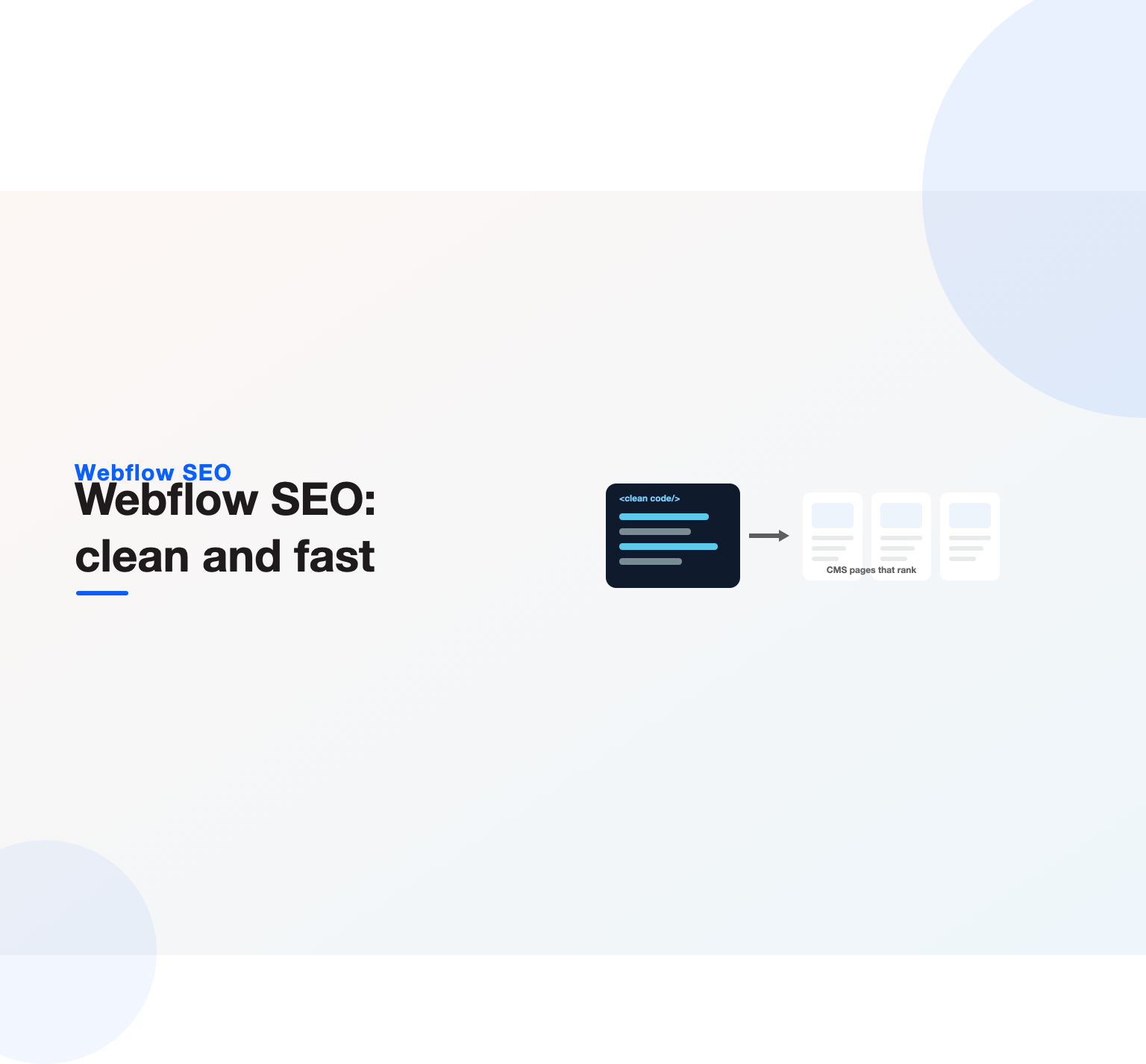
Doing SEO on a Webflow site means optimizing it to rank and get found, and the good news is that Webflow is genuinely strong for SEO. It outputs clean, semantic code, loads fast, and gives you full control over titles, meta descriptions, slugs, headings, alt text, canonical tags, redirects and structured data, which is more raw control than most hosted builders offer. Its CMS also makes scalable, programmatic SEO practical. The real considerations are not whether Webflow can rank, it can, but working within its CMS limits, using its controls well, and, like any platform, backing the setup with genuinely useful content. This guide covers Webflow’s SEO strengths, the full setup, its limits and workarounds, and how to make a Webflow site visible in AI search.
Key Highlights
- Webflow is strong for SEO out of the box: clean semantic code, fast performance, and full control over the on-page fundamentals.
- The platform exposes titles, meta, slugs, headings, alt text, canonicals, redirects and structured data, more control than most hosted builders give.
- The CMS makes scalable and programmatic SEO practical, turning collections into hundreds of well-structured pages.
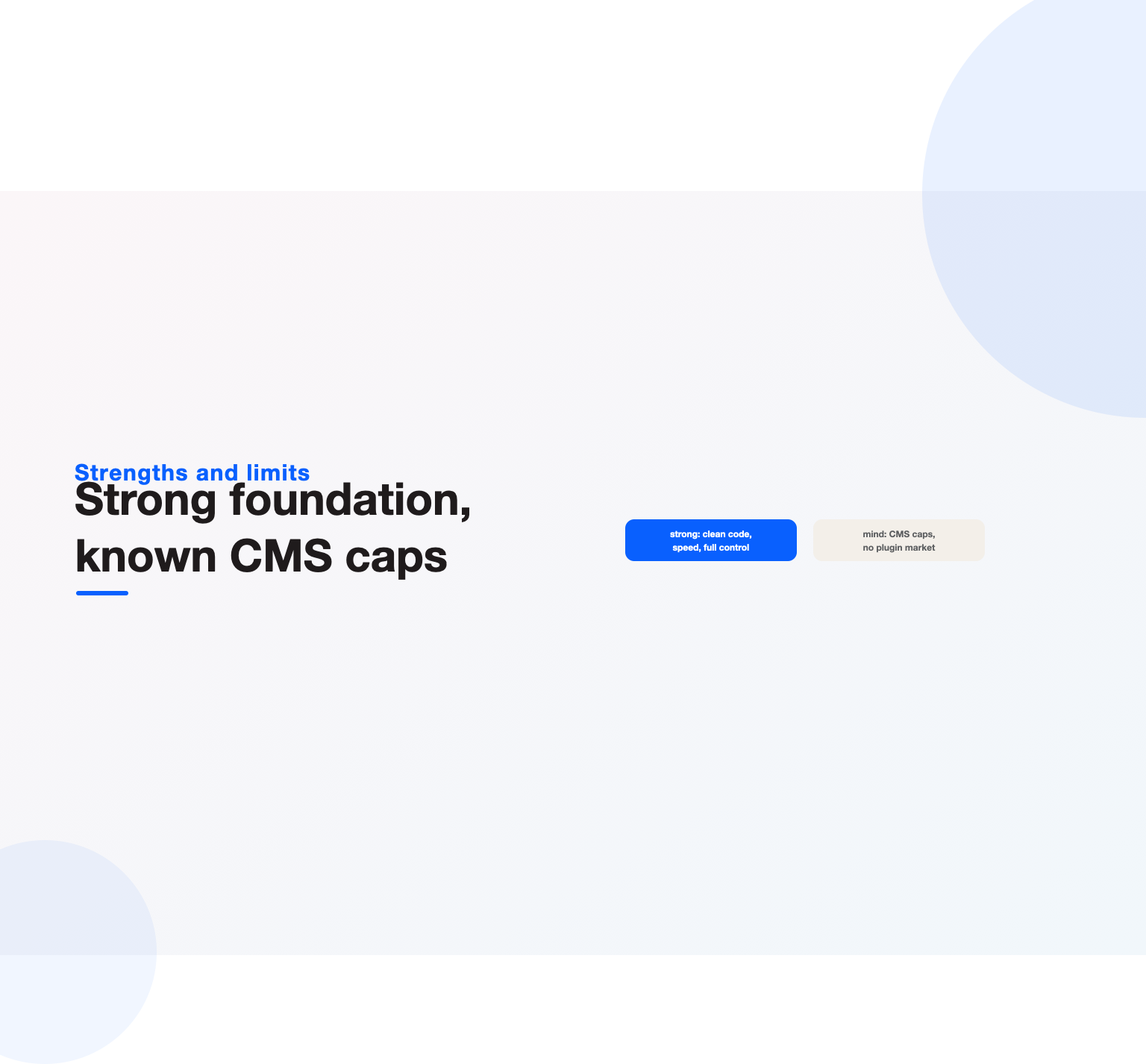
- Real limits exist, mainly CMS item caps and the absence of a WordPress-style plugin ecosystem, but most have clean workarounds.
- A Webflow site can be optimized for AI search and citations, not just blue links, using its structured-data and content controls.
- As always, content and keywords decide rankings; Webflow gives you an excellent foundation, but the useful content is on you.
Is Webflow good for SEO?
Unlike some website builders, Webflow enters the SEO conversation with a good reputation, and it is largely deserved. The platform generates clean, standards-based HTML rather than the bloated markup some builders produce, it hosts on fast infrastructure with a global CDN, and it hands you direct control over the technical elements that matter. For developers and designers who care about performance and semantic structure, that combination makes Webflow one of the more SEO-capable visual platforms available.
What that means in practice is that a Webflow site starts with advantages many platforms make you fight for: fast load times, mobile-responsive output, HTTPS, an automatically generated sitemap, and per-page control over every important tag. You can edit titles and meta descriptions, customize slugs, set canonical URLs, add structured data, manage redirects, and control indexing, all without plugins or code workarounds. So the honest answer to whether Webflow is good for SEO is yes, and the more useful question is how to use its controls well and work within its limits, which is what the rest of this guide addresses.
That said, capability is not the same as automatic results. The platform gives you an excellent foundation, but a foundation still needs a building on top of it: keyword-targeted content, genuine authority, and ongoing optimization. A beautifully built Webflow site with nothing useful to say will rank no better than any other empty site, so treat the platform’s strengths as a head start rather than a substitute for the work. Winning on Webflow means pairing the platform’s clean foundation with real content and real authority, the same fundamentals that govern any SEO program.
Where Webflow is strong for SEO
It is worth being specific about where Webflow SEO has genuine advantages, because they shape how you should use the platform. Clean code is the first: The platform outputs lean, semantic HTML, which is easier for search engines to crawl and understand than the heavy, nested markup some builders generate, and it supports the fast rendering that both users and engines reward. That cleanliness is a quiet but real ranking and experience advantage.
Speed is the second strength. The platform hosts on fast, CDN-backed infrastructure and handles much of the performance optimization automatically, so a well-built Webflow site tends to score well on Core Web Vitals without the plugin-juggling a self-hosted site often requires. Control is the third: you get direct, per-page access to titles, descriptions, slugs, headings, canonical tags, redirects, indexing and structured data, which is more than most hosted builders expose and enough for serious technical SEO. Together these mean a Webflow site can compete on the technical fundamentals with far less effort than many platforms demand, which frees your attention for content and authority, where rankings are actually decided. The mechanics behind the speed side are covered in our guide to Core Web Vitals.
The Webflow SEO setup checklist
Getting Webflow SEO right is mostly a matter of using the platform’s controls deliberately rather than leaving defaults in place. Here is the practical setup, in a sensible order.
- Write unique title tags: give every page a distinct, descriptive title that leads with its primary keyword; Webflow lets you set these per page and per CMS template.
- Write real meta descriptions: not a ranking factor, but they drive clicks, so write a compelling description for each key page rather than leaving it blank or duplicated.
- Customize slugs: keep URLs short, readable and keyword-relevant, and set clean slugs on both static pages and CMS items.
- Structure headings: use one clear H1 per page and logical H2s and H3s through Webflow’s heading elements, not just large styled text.
- Add alt text to images: Webflow lets you set alt text on every image, which helps accessibility and image search, and keep assets compressed for speed.
- Set canonical tags and indexing: use Webflow’s per-page controls to set canonicals where needed and to noindex only the pages that should be hidden.
- Manage redirects: use the built-in 301 redirect manager when URLs change, so you never leave broken links or lose link equity.
- Add structured data: use custom code embeds or Webflow’s fields to add schema for articles, products, FAQs and your business.
- Generate and submit the sitemap: enable Webflow’s automatic sitemap and submit it in Search Console, and verify the site there.
Work through that list and a Webflow site has a technical foundation as strong as anything on the web, most of it built in rather than bolted on. The discipline is identical to the broader on-page work in our SEO audit checklist, and because Webflow exposes these controls cleanly, the setup is faster than on many platforms.
Scaling with the CMS and programmatic SEO
One of Webflow SEO’s biggest opportunities is the CMS, which makes scalable and programmatic SEO genuinely practical. The CMS Collections let you build templated pages driven by structured data, so a single well-designed template can generate hundreds of consistent, well-optimized pages, one per item, location, use case or category, each with its own title, slug, meta and content pulled from the collection. For the right site, that turns the CMS into a scalable ranking engine.
This is powerful for businesses with natural page-level structure: a directory, a location-based service, a product or resource library, or any model where many similar-but-distinct pages serve real searches. The key is that each generated page must be genuinely useful and distinct rather than thin and near-duplicate, because programmatic SEO done carelessly produces exactly the low-value pages search engines discount. Used well, with unique data and real value per page, Webflow’s CMS lets a small team compete at a scale that would take far more effort on other platforms, which is why programmatic SEO is one of the platform’s standout SEO strengths and a major reason developers choose it for content-heavy sites.
Content and keywords on Webflow
As with any platform, Webflow SEO is ultimately won on content and keywords, not on settings. The cleanest, fastest Webflow site will not rank for terms it does not genuinely address, so once the technical foundation is set, the real work is researching what your audience searches and building pages that satisfy those searches better than the competition. Webflow’s CMS is well suited to a structured blog and resource library, letting you publish and organize content that targets informational queries and builds topical authority around your offering.
The approach is the same discipline that governs SEO everywhere: choose a clear primary intent per page, answer it thoroughly, and write for people rather than for a keyword counter. Plan coverage against genuine demand rather than guesswork, the method in our SEO guide, so the effort goes into pages that bring in buyers. The platform gives you an excellent surface to publish on and the structure to organize it well; the ideas, expertise and quality are what turn that surface into rankings, and increasingly into the AI citations covered below.
Limitations and how to work around them
An honest Webflow SEO guide has to name the platform’s limits, because they shape what it suits. The most cited is the CMS item cap: Webflow plans limit how many CMS items a site can hold, which matters for very large content or catalog sites and can constrain aggressive programmatic SEO at the top end. The platform also lacks the vast plugin ecosystem of WordPress, so some functionality that a WordPress user would add with a plugin has to be built with custom code or a third-party integration on Webflow.
For most sites these limits are manageable, and where they bite there are workarounds. The CMS cap is generous enough for the large majority of business and content sites, and genuinely huge sites can architect around it or reconsider whether a different platform fits their scale. Missing plugins are usually replaced by Webflow’s custom-code embeds, its native features, or integrations, and the trade is often worth it for the cleaner output. The realistic guidance is to match the platform to the site: for a design-led business site, a marketing site, a content or resource site, or a structured directory, Webflow’s strengths far outweigh its limits, and only a genuinely massive content or commerce operation should weigh whether the CMS ceiling is a real constraint. Naming the limits honestly is what lets you decide with eyes open rather than discovering a wall later.
Optimizing a Webflow site for AI search
Here is the part most Webflow SEO guides have not caught up to. A growing share of discovery now happens inside AI answers from ChatGPT, Perplexity, Gemini and Google’s AI Overviews, and a Webflow site can be optimized to be cited by them, not just to rank a blue link. Webflow’s clean code and full control over structured data actually make this easier than on many platforms, since the same features that support classic SEO support machine understanding.
Making a Webflow site citable comes down to a few things you control directly: lead each page with a clear, self-contained answer to the question it targets so an engine can extract it, use custom code or fields to add thorough structured data for articles, FAQs and your business, keep the writing factual and well-structured, and ensure pages are indexable and fast so crawlers reach them, which Webflow already helps with. These are the core moves of answer engine optimization, and Webflow’s technical cleanliness gives them a strong base. Treating AI visibility as part of your Webflow SEO from the start, rather than an afterthought, is the forward move that separates a site that keeps growing from one that plateaus as search changes, and it connects your Webflow work to the wider discipline of AI search optimization.
Choosing between Webflow and WordPress
The Webflow versus WordPress question is common, and both can rank extremely well, so the choice should turn on fit rather than a myth about capability. The platform suits teams that want clean output, fast performance, strong design control and a visual, low-maintenance platform with SEO built in, without managing hosting, security and updates. For a design-led marketing or business site, that combination is a genuine advantage, and the built-in performance and clean code are real SEO positives.
WordPress offers a vast plugin ecosystem and unlimited flexibility, which matters for very large, complex or highly specialized sites, and it removes the CMS item ceiling, but it also puts hosting, security, updates and performance on you, and a poorly configured WordPress site can easily do worse SEO than a well-built Webflow one. So the real decision is about scale, flexibility needs and who maintains the site, not about which platform is allowed to rank. For many design-focused and content sites, Webflow SEO is more than capable and the cleaner foundation is worth it; for the largest or most plugin-dependent projects, WordPress may fit better. If you are weighing the trade-offs for a significant build, our web development team can advise before you commit, and our companion guide to Wix SEO covers the hosted-builder comparison from the other side.
Apps, integrations and custom code
Because Webflow does not have a WordPress-style plugin marketplace, teams sometimes assume it cannot be extended, but in practice Webflow SEO is extended through custom-code embeds, native features and integrations rather than plugins. You can inject structured data, analytics, and third-party scripts through the custom-code areas at the site and page level, connect tools through Webflow’s integrations and automation platforms, and use its native fields for the SEO settings a builder would otherwise need an add-on for.
The practical upshot is that most functionality a WordPress user would reach for a plugin to get, advanced schema, redirects, analytics, form handling, is available on Webflow through built-in features or a small amount of custom code, often with cleaner output than a plugin would produce. The discipline is to add only what genuinely serves the site, since every script adds weight, and to keep the custom code tidy so it does not undermine the clean foundation that makes Webflow SEO strong in the first place. Used with restraint, Webflow SEO loses little to the plugin ecosystem and keeps the performance edge that plugins often erode.
Local SEO on a Webflow site
For a business serving a physical area, local visibility is a major part of Webflow SEO, and the platform supports it well even though the heaviest lifting happens off-site. The most important asset is your Google Business Profile, so claim, verify and fully complete it, because it drives the map results where most local searches are decided. On the Webflow site itself, keep your name, address and phone consistent with the profile and directories, add local business structured data through custom code so engines understand where you operate, and build genuinely useful pages for each service and location you serve rather than thin near-duplicates.
Webflow’s CMS makes multi-location structure clean: a location collection can generate a well-optimized page per location, each with its own details and content, without the duplication a careless build creates. Publishing content that speaks to your community and the problems local customers search rounds out the local presence. The full playbook lives in our local SEO resources, but a Webflow site gives a local business every control it needs to compete, and the platform’s clean output means those local pages load fast for the phone searchers who make up most local demand.
How long Webflow SEO takes
Results on Webflow take about as long to show as SEO on any platform, which means months rather than days, because rankings depend on content, authority and trust building over time, not on the platform. A clean Webflow foundation can help you avoid the technical delays that hold some sites back, and you may see early movement on low-competition terms within weeks, but meaningful results on competitive keywords typically take several months of consistent content and optimization. The platform does not change that timeline materially; your niche’s competitiveness and how consistently you publish do.
What Webflow SEO does offer is a faster path to a technically sound starting point, since the clean code, speed and built-in controls remove a class of setup problems, so more of your time goes into the content and authority work that actually compounds. Set a baseline, publish consistently, and judge the program over quarters rather than weeks, the same patience any serious SEO strategy requires, and a well-built Webflow site rewards it. Track whether new content earns impressions, whether pages climb, and whether you are being cited in AI answers, and treat those signals, not your feelings about the platform, as the verdict on the work. Because the platform removes so many technical excuses, a Webflow site that underperforms almost always needs more or better content and stronger authority rather than a platform change, the same conclusion our off-page SEO guidance reaches, and appearing in AI search results for your priority questions is the newest signal worth adding to that verdict.
Optimizing a Webflow ecommerce store
For a store built on Webflow Ecommerce, Webflow SEO adds a product dimension on top of the fundamentals. Product and category pages need unique, keyword-led titles and descriptions, clean slugs, product structured data with price and availability, and genuinely useful descriptions rather than manufacturer boilerplate, so each product can rank for the specific searches shoppers make. Optimizing a store also means keeping the catalog technically clean as it grows, no thin or duplicate product pages, sensible handling of out-of-stock items, and collection pages that target broader category searches.
The platform’s clean output and CMS structure help here, but the CMS item cap is worth checking against catalog size before committing a large store to it. For most small and mid-sized catalogs Webflow SEO handles ecommerce well, and the same discipline in our ecommerce SEO resources applies directly, tuned to Webflow’s controls.
Common Webflow SEO mistakes
Even on a strong platform, a few avoidable mistakes hold Webflow sites back, and none is the platform’s fault. The most common is leaving the defaults in place, publishing pages and CMS items with missing or duplicated titles, empty meta descriptions and unedited slugs, which wastes the excellent control Webflow gives you. A close second is treating a beautiful site as finished, with no ongoing content, since a static Webflow site ranks no better than a static site anywhere.
Other frequent errors include careless programmatic SEO that generates thin, near-duplicate CMS pages, forgetting to set canonicals or accidentally noindexing important pages, neglecting alt text and image compression despite Webflow making both easy, and overlooking structured data even though the platform makes it straightforward to add. The pattern is clear: the mistakes are about neglecting the work, not about Webflow, and a team that uses the platform’s controls deliberately, unique titles and content, clean slugs, real structured data, distinct CMS pages, ongoing publishing, will find Webflow SEO performs excellently. The platform removes many of the technical excuses; what remains is the content and authority work that always decides rankings.
Measuring results and getting help
Judge Webflow SEO by outcomes, not settings, and the measurement toolkit is the same as any platform once Search Console is connected: watch the queries and pages earning impressions and clicks, your rankings for target terms, indexation status, and the conversions that search traffic produces. Webflow’s clean analytics integrations plus Search Console give a complete view of what is working and where to invest next, and setting a baseline before you make changes lets you prove the impact of the work.
Plenty of teams run their own Webflow SEO successfully, since the platform is built for capable designers and marketers, and this guide is deliberately complete enough to follow without outside help. Help earns its keep when a site is competitive and rankings have stalled despite a clean setup, when you want to exploit the CMS for serious programmatic SEO without creating thin pages, or when AI-search visibility matters and the readiness work is new to your team. In those cases a proper SEO program that respects the platform turns a well-built Webflow site into a consistently growing one, and a periodic pass against a full audit checklist keeps it healthy as it scales.
Key Takeaways
- Webflow is genuinely strong for SEO: clean semantic code, fast performance, and full control over the on-page and technical fundamentals.
- Use the platform’s controls deliberately, titles, meta, slugs, headings, alt text, canonicals, redirects, structured data, rather than leaving defaults.
- Exploit the CMS for scalable and programmatic SEO, but keep every generated page genuinely useful and distinct, not thin near-duplicates.
- Know the real limits, CMS item caps and no WordPress-style plugin ecosystem, but recognize they are manageable for most sites and have workarounds.
- Optimize for AI search from the start: Webflow’s clean code and structured-data control make earning citations, not just blue links, easier than on many platforms.
- Remember content and keywords decide rankings; Webflow gives an excellent foundation, so pair it with a proper local and organic content effort to win.
Frequently asked questions
Is Webflow good for SEO?
Yes, genuinely. The platform outputs clean, semantic code, loads fast on CDN-backed hosting, and gives you full control over titles, meta descriptions, slugs, headings, alt text, canonical tags, redirects, indexing and structured data, more than most hosted builders offer. It also generates a sitemap automatically and integrates with Search Console. Those strengths mean a Webflow site starts with technical advantages many platforms make you work for. Rankings still depend on content, keywords and authority, but as a foundation, Webflow is one of the more SEO-capable visual platforms available.
How do I optimize a Webflow site for SEO?
Use the platform’s built-in controls deliberately: write unique, keyword-led titles and real meta descriptions for every page and CMS template, customize slugs, structure headings with one clear H1 per page, add alt text to images, set canonicals and indexing correctly, manage redirects when URLs change, add structured data, and submit the auto-generated sitemap in Search Console. Then focus on content, publish genuinely useful, well-targeted pages and use the CMS to organize them. Because Webflow exposes these controls cleanly, the technical setup is fast, leaving your effort for the content and authority that drive rankings.
Is Webflow or WordPress better for SEO?
Both can rank extremely well, so the choice is about fit, not capability. It suits teams wanting clean output, fast performance, strong design control and low maintenance with SEO built in, ideal for design-led marketing and content sites. WordPress offers a vast plugin ecosystem and unlimited flexibility with no CMS item cap, which matters for very large or highly specialized sites, but it puts hosting, security and updates on you. A well-built Webflow site easily outperforms a poorly configured WordPress one, so weigh scale, flexibility and maintenance rather than assuming one platform ranks better.
Does Webflow have SEO limitations?
Yes, but they are manageable for most sites. The main one is the CMS item cap, a limit on how many CMS items a site can hold, which can constrain very large content or catalog sites and aggressive programmatic SEO at the top end. Webflow also lacks WordPress’s huge plugin ecosystem, so some functionality must be added with custom code or integrations. For the large majority of business, marketing and content sites these limits sit well above what is needed, and where they matter there are workarounds. Only a genuinely massive operation should treat the CMS ceiling as a real constraint.
Is Webflow good for programmatic SEO?
Yes, it is one of the platform’s standout strengths. The CMS Collections let you build templated pages driven by structured data, so a single template can generate hundreds of consistent, well-optimized pages, one per item, location, use case or category, each with its own title, slug, meta and content. That makes scalable, programmatic SEO practical for directories, location-based services and resource libraries. The caveat is that each generated page must be genuinely useful and distinct, since thin near-duplicates get discounted, and very large builds should check the CMS item cap fits the intended scale.
Can a Webflow site get cited in AI search?
Yes, and Webflow’s clean code and structured-data control make it easier than on many platforms. To be cited in AI answers from ChatGPT, Perplexity, Gemini and Google AI Overviews, lead each page with a clear, self-contained answer the engine can extract, add thorough structured data for articles, FAQs and your business, keep content factual and well-structured, and ensure pages are indexable and fast, which Webflow already supports. These are the core moves of answer engine optimization, and because Webflow gives you direct control over markup and performance, a well-built site has a strong base for earning AI citations.
Ready to put this into practice?
Talk to the team that runs SEO, AI search and paid growth programs every day.
Book a Strategy Call →