 Skip to content

Automotive SEO: Rank Your Dealership, Shop or Parts Store
Automotive SEO explained by business type: inventory SEO for dealerships, local SEO for repair shops, ecommerce SEO for parts sellers, plus winning near-me and AI recommendations.
Quick Answer
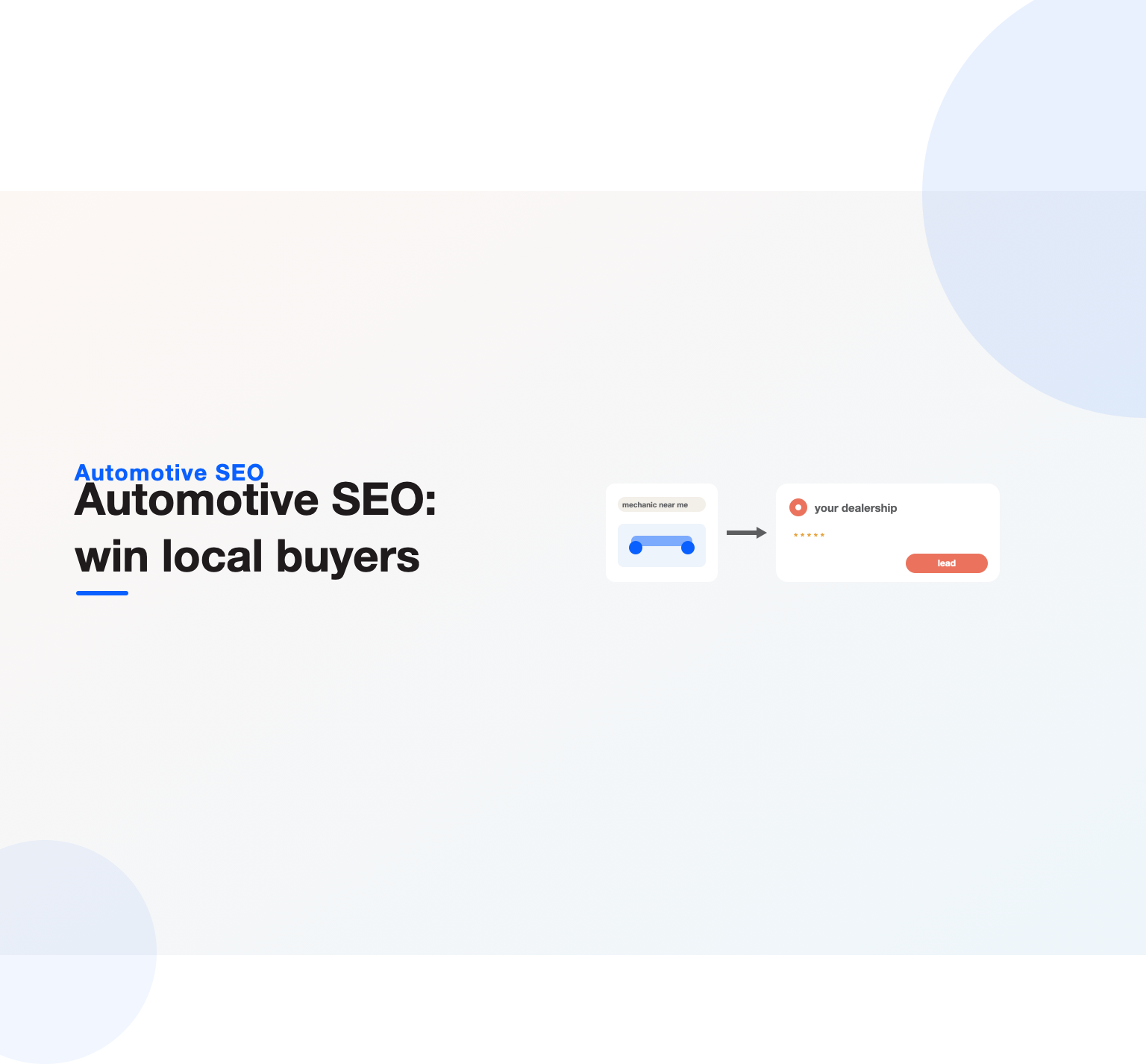
Automotive SEO is the work of helping car dealerships, repair and service shops, and auto parts sellers get found when nearby drivers search for vehicles, repairs and parts. Because most automotive searches are local and high-intent, someone looking for a specific car, an urgent repair, or a part they need now, the priorities are winning the Google map results with a complete business profile, earning steady reviews, and building pages that match how drivers actually search. The details differ by business type: dealerships live or die on inventory and vehicle pages, repair shops on local and service pages, parts sellers on ecommerce product SEO. Done well, automotive SEO becomes a dependable source of leads and sales that costs far less over time than paying for every click. This guide covers each automotive business type plus getting recommended in near-me and AI search.
Key Highlights
- Automotive searches are overwhelmingly local and high-intent, so map visibility and a complete business profile drive the most leads.
- The right playbook depends on the business: dealerships need inventory and vehicle-page SEO, repair shops need local and service pages, parts sellers need ecommerce SEO.
- Reviews are a major ranking and trust lever in automotive, where buyers and drivers weigh reputation heavily before calling or visiting.
- Drivers increasingly search “near me”, by voice and through AI assistants, and the same local signals decide who gets recommended.
- Owned automotive SEO reduces dependence on paid listings and lead brokers, improving the margin on every sale and repair.
- The automotive SERP is often weak and winnable, so a well-structured site can outrank larger, less attentive competitors in its area.
Why automotive SEO is local and high-intent
Drivers rarely research a car, a repair or a part in the abstract. They look for a specific model at a dealer near them, an urgent fix when something breaks, or a part that fits their exact vehicle, and they usually act quickly. That combination of strong local intent and frequent urgency makes search one of the most valuable channels an automotive business can win, because the person searching is a ready buyer choosing where to spend, often within a day. Appearing prominently at that moment, especially in the map results, is the difference between getting the call and watching it go to a competitor.
This local, high-intent character shapes the whole approach to automotive SEO. A dealership or shop competes within a defined drive-time radius, so the goal is to dominate local results for the vehicles, services and areas it covers rather than to rank nationally. That focus is an advantage, since local competition is far more winnable than national competition, and an attentive business can outrank larger, complacent rivals in its own territory. The prize is not abstract visibility but a steady flow of nearby drivers ready to buy, book or order.
The economics reinforce the case. Many automotive businesses lean on paid listings, third-party marketplaces and lead brokers that charge for every lead again and again, and those costs never stop. Building an owned search presence, a strong profile, real reviews, useful vehicle, service and part pages, creates an asset that generates leads at a steadily falling cost and reduces dependence on bought traffic. For a dealer or shop tired of paying a premium for each lead, that shift from renting leads to owning a channel is exactly what makes automotive SEO worth the effort, applying the same local discipline our overview of local SEO uses across service businesses.
Automotive SEO for car dealerships
For a dealership, automotive SEO is largely about inventory. Buyers search for specific makes, models, trims and price ranges, often adding a location, so the vehicle detail pages that describe each car in stock are the single most important SEO asset a dealer has. Those pages need to be crawlable, richly described with the details buyers search, and marked up with vehicle structured data so search engines understand the year, make, model, price and availability, which helps them surface in the specific searches buyers make.
The challenge is that inventory changes constantly, so a dealership needs a site that generates and updates vehicle pages cleanly, retires sold cars without leaving broken pages, and avoids the thin, duplicated pages that a poorly built inventory system produces. Beyond inventory, dealership automotive SEO covers model research pages that capture buyers earlier in the journey, finance and trade-in pages that answer common questions, and strong local pages for each location. A dealer that treats its inventory as a set of well-optimized, well-maintained pages rather than a feed dumped onto the site captures far more of the high-intent model-plus-location searches that turn into showroom visits, and pairs naturally with the broader SEO fundamentals every site needs.
Automotive SEO for repair and service shops
For an auto repair or service shop, automotive SEO is almost entirely local, and it works much like SEO for any urgent local trade. Drivers search for a specific service and a location, brake repair, oil change, transmission, or for an emergency fix when something fails, and they call the shop that appears first and answers. Winning the map results through a complete, active Google Business Profile is the highest-leverage move, followed by a steady stream of genuine reviews that reassure a driver trusting you with an expensive, safety-critical repair.
On the site, dedicated pages for each service and each area you serve capture those specific, high-intent searches far better than a single generic page. A page explaining a particular repair, what it involves, what it typically costs, how long it takes, both ranks for that service and reassures a driver unfamiliar with the work, while location pages speak to each community served rather than repeating a place name. Because so much repair demand carries emergency intent, responsiveness matters as much as ranking, so clear contact options and fast replies turn visibility into booked work. This is the same local discipline our local SEO resources apply to any service business, tuned to the urgency of a driver stranded with a broken car.
Automotive SEO for parts and accessories sellers
For a business selling auto parts and accessories online, automotive SEO is largely ecommerce SEO with a fitment twist. Buyers search for a specific part, often with a year, make and model to ensure it fits, so product and category pages need to be crawlable, richly described, and organized so a shopper can find the exact part for their vehicle. Fitment data, clear compatibility information, and product structured data with prices and availability all help both shoppers and search engines match a part to the searches buyers make.
The scale of a parts catalog makes technical SEO especially important: thousands of product pages must be crawlable without creating duplicate or thin pages, faceted navigation must not spin out endless low-value URLs, and out-of-stock or discontinued parts need handling that does not leave broken pages or dead ends. Category and fitment pages that target broader part-plus-vehicle searches capture demand higher in the funnel, while genuinely useful content, how to choose a part, how to install it, what fits a given model, reaches buyers researching before they purchase. Treating a parts store as a large, well-structured ecommerce site is the heart of automotive SEO for sellers, and the discipline mirrors our work on ecommerce SEO.
Own the map: Google Business Profile for automotive
Whatever the automotive business, the Google Business Profile is central, because it populates the map results where most local, high-intent searches are decided. Claiming, verifying and fully completing it is the highest-leverage move, starting with accuracy: the correct name, the right primary and additional categories (car dealer, auto repair, auto parts store, and the specifics), precise hours, service areas, and a link to your own site rather than only a marketplace listing.
Beyond the basics, the profile rewards ongoing attention many automotive businesses neglect. Add plenty of real photos, of the lot, the shop, the team, the work, since buyers and drivers choose with their eyes and a rich listing outperforms a bare one. Keep hours accurate, use posts to promote offers and new inventory, answer the questions drivers ask, and enable the attributes that matter, financing, appointments, specific services. Getting the local business basics right here pays back faster than almost anything else, because for a local automotive business the profile is the storefront most buyers see first.
Reviews: trust that drives automotive decisions
Buying a car or trusting a shop with a repair is a high-stakes, high-cost decision, so reviews carry enormous weight in automotive SEO, both for ranking in local results and for winning the customer. A dealership or shop with many recent, positive reviews ranks better in the map and converts far more of the searchers who see it, because a driver comparing two businesses almost always chooses the one others clearly trust. Reviews are a ranking lever and a closing tool at once, which is why earning them deliberately is central to the work.
Earning them consistently is a habit: ask every satisfied customer at the point of sale or service, make it effortless with a direct link or text, and keep the flow steady so fresh reviews keep arriving. Recency matters as much as volume, since a steady stream signals an active, reliable business, while a listing that gathered a few reviews years ago looks stale beside a competitor collecting them weekly. Responding completes the picture: thank customers for positive reviews and reply calmly to any critical one, which shows prospective buyers you stand behind your work. Because reputation is so central to automotive decisions, engaging with every review is one of the most persuasive things a business can do, tying directly into the broader local reputation work that wins nearby customers.
Content and keywords for automotive businesses
Beyond profiles and product or service pages, content builds the authority that lifts an automotive site and captures buyers earlier in their journey. Drivers research extensively before buying a car, booking a big repair or choosing a part, so genuinely useful content, model comparisons, buying and maintenance guides, cost explainers, how-to and fitment articles, reaches them while they are deciding and builds the topical authority that helps all of a site’s pages rank.
The key is to match content to how drivers actually search and to the specific automotive niche. A dealership benefits from model research and comparison content; a repair shop from service explainers and maintenance guides; a parts seller from fitment and installation content. Planning this against genuine demand rather than guesswork, the same discipline in our SEO guide, keeps the effort focused on the pages that bring in buyers rather than vanity traffic. Content is also what increasingly earns visibility in AI answers, so useful, well-structured automotive content works twice, once for classic search and once for the AI recommendations covered next.
Getting recommended in near-me, voice and AI search
How drivers find automotive businesses is broadening, and modern automotive SEO has to account for near-me searches, voice assistants and AI recommendations. A large share of automotive queries already carry the near-me pattern or an implied location, and the same strong local presence that wins the map, a complete profile, consistent information, genuine recent reviews, is what wins these too, so the fundamentals serve both at once. A business that has done the local work well is usually already the answer to nearby queries.
The newer frontier is drivers asking voice assistants and AI tools, “find a good mechanic near me,” “which dealership has this model,” “where can I get this part,” and having the assistant name a few options. These systems draw on the same signals that power the map, a well-regarded, clearly described, consistent presence with strong reviews, so the reputation and information you build for classic search also position you to be recommended. To strengthen that, keep your data structured and consistent, make your services, inventory and hours unambiguous, and lead key pages with clear answers an engine can extract. This is the automotive edge of answer engine optimization and the wider move toward AI search optimization, and the encouraging part is that doing the local fundamentals well prepares an automotive business for how drivers search now and next, without a separate project for each surface.
Technical SEO and site speed for automotive sites
Automotive sites, especially dealerships and parts stores, tend to be large and template-heavy, which makes technical SEO and speed matter more than owners expect. Thousands of inventory or product pages must stay crawlable and indexable without generating duplicates, sold or out-of-stock items need clean handling so they never leave broken pages, and faceted filters must not spin out endless low-value URLs that waste crawl budget. A site that grows without technical discipline quietly accumulates problems that suppress its rankings no matter how good the content is.
Speed matters too, because automotive searches skew mobile and drivers deciding on a phone abandon slow pages. Heavy vehicle images, autoplay media and bloated templates drag down the Core Web Vitals that feed into rankings and cost conversions on the traffic you already earn, so keeping images optimized and templates lean is worth the effort. The mechanics behind those metrics are covered in our guide to Core Web Vitals, and running a periodic pass against a full SEO audit checklist keeps a large automotive site as sound as a small one.
Multi-location dealer groups and franchises
A dealer group or multi-location service chain faces a distinct challenge: winning local search for every rooftop without the locations competing with one another. The foundation is a separate, fully optimized Google Business Profile for each location, each with its own accurate details, photos and reviews, because each competes in its own market and earns its own map visibility. Running several locations off one profile or a single generic page leaves most of them invisible where their buyers actually search.
On the website, give every location its own genuinely useful page with that location’s address, hours, inventory or services, and its own reviews, rather than near-identical pages that differ only by city name. Consistent information across the site, the profiles and the major directories matters even more at scale, since inconsistency multiplies across rooftops and erodes trust. Centralize what should be shared, brand content, model research, buying guides, while localizing what buyers search for at each location, and the group turns its footprint into an advantage, each location reinforcing the brand while winning its own local search. Managed well, a group compounds authority across locations; managed carelessly, the locations cannibalize each other and dilute the brand, which is why treating each rooftop as its own local effort within a coordinated program is the winning approach, backed by the same local SEO discipline that governs any multi-location business and measured against the return each location produces.
Seasonal and demand patterns in automotive
Demand in the car business rarely arrives evenly, and a smart program plans for the patterns specific to each part of it. New-model launches, end-of-year clearance, tax-refund season and holiday sales events drive buying spikes, while repair and service demand climbs with weather, winter tires and battery failures in the cold, cooling and travel-related work in summer. Preparing pages and offers ahead of each surge, rather than scrambling once it arrives, means a business is already visible when drivers begin searching, since search authority takes time to build and cannot be switched on overnight.
Aligning content and profile activity with these rhythms captures demand at its peak: a seasonal service page, a model-launch guide, or a clearance-event post published in advance is already ranking when the searches begin. Handling both the buying cycles and the service spikes well turns the channel from a steady baseline into one that flexes with the real patterns of the trade, and pairing it with the ongoing fundamentals in a proper audit routine keeps visibility holding through every peak.
Common automotive SEO mistakes
Several avoidable mistakes keep automotive businesses from winning local buyers even when they invest effort. The most common is an incomplete or unclaimed Google Business Profile, missing categories, old hours, few photos, no direct link, which is the single biggest reason a good dealership or shop fails to appear in the map. A close second, for dealerships and parts sellers, is a poorly built inventory or catalog that produces thin, duplicated or broken pages, quietly forfeiting the high-intent model and part searches a clean structure would capture.
Other frequent errors include a passive approach to reviews, gathering a few and then never asking again, a slow mobile site that loses phone searchers mid-decision, and relying entirely on marketplaces and lead brokers while neglecting the owned channel, paying commissions forever instead of building an asset. Thin, generic service or model pages that try to cover everything at once are another, since drivers search for specifics. The pattern is that these mistakes are about neglecting the fundamentals, not anything exotic, and an automotive business that does the basics thoroughly, complete profile, clean inventory or catalog, steady reviews, fast mobile site, specific pages, will find automotive SEO performs reliably.
Measuring what actually matters
An automotive business should judge SEO by the leads and sales it brings, not by abstract numbers, and local search is unusually measurable. The metrics that tie to the business are the ones to watch: calls and direction requests from the profile, form submissions and appointment bookings, clicks to inventory or product pages, and the map and local rankings for the vehicles, services and areas that matter. An owner watching calls, test-drive requests, bookings and orders grow as the profile, reviews and pages strengthen has clear evidence the work is paying off.
The profile itself reports much of this, showing how buyers found the business and what they did, and pairing that with website analytics and call tracking gives a complete view of which searches and pages drive revenue. Review this on a regular cadence rather than obsessively, since local SEO builds over weeks and months, and add a newer metric worth tracking now: whether you are recommended in AI answers for the questions drivers ask. Measuring against real leads and sales keeps automotive SEO honest and focused on a fuller lot and service bay rather than traffic that never becomes a customer.
Do you need help with automotive SEO?
Many dealers and shop owners handle the fundamentals of automotive SEO themselves, and the basics are within reach: claiming the profile, adding photos, gathering reviews, and keeping service or model pages useful. If you have the time, doing it yourself builds a useful understanding of how buyers find you, and this guide is deliberately complete enough to follow without outside help.
Help earns its keep in a few situations. When inventory or catalog scale creates real technical complexity, experience shortens the path from symptom to cause dramatically. When competition in your market is fierce and rankings have stalled despite a clean setup, an experienced eye usually finds the content and structure gaps a checklist misses. And when AI-search visibility matters, that readiness work is new enough that few in-house teams have done it before. In any of those cases, a proper SEO program tuned to your automotive niche turns a capable presence into a consistently full pipeline. Whichever route you take, the discipline is the same: own the map, build clean and specific pages, earn steady reviews, measure by leads and sales, and increasingly make sure your business is the one named when drivers ask an AI assistant, the emerging edge of AI search optimization, for a dealer, shop or part near them.
Key Takeaways
- Match the automotive SEO playbook to the business: inventory and vehicle-page SEO for dealerships, local and service pages for repair shops, ecommerce and fitment SEO for parts sellers.
- Own the map with a complete, active Google Business Profile, since most local, high-intent automotive searches are decided there.
- Earn a steady, recent flow of genuine reviews and respond to them, because reputation drives both rankings and the customer’s choice in automotive.
- Keep large inventory and catalog sites technically clean and fast, so thousands of pages stay crawlable without duplicates or broken links.
- Optimize for near-me, voice and AI recommendations by keeping data structured and consistent; the fundamentals that win the map win these too.
- Measure by calls, bookings, test drives and sales, and back the effort with a proper local SEO foundation when competition demands it.
Frequently asked questions
What is automotive SEO?
Automotive SEO is the practice of optimizing the online presence of automotive businesses, car dealerships, repair and service shops, and auto parts sellers, so they appear when drivers search for vehicles, repairs and parts. Because most automotive searches are local and high-intent, it focuses heavily on winning the Google map results, earning reviews, and building pages that match how drivers search, though the specifics differ by business type. Done well, automotive SEO brings in leads and sales directly, reducing dependence on paid marketplaces and lead brokers that charge for every customer.
How do car dealerships rank higher on Google?
Dealerships rank higher by combining strong local SEO with well-optimized inventory. That means a complete, active Google Business Profile with accurate details, photos and reviews, plus vehicle detail pages that are crawlable, richly described and marked up with vehicle structured data so engines understand the make, model, price and availability. A clean inventory system that updates and retires pages without creating duplicates or broken links matters enormously at dealership scale. Adding model research, finance and location pages, and earning steady reviews, lifts a dealer above competitors in its local market.
Is automotive SEO different for repair shops and dealerships?
Yes, significantly. A repair or service shop is an urgent local business, so its automotive SEO is almost entirely local: winning the map, earning reviews, and building service and location pages for the specific repairs and areas it covers. A dealership adds a large inventory dimension, where vehicle detail pages and a clean inventory system are the core SEO assets alongside local visibility. A parts seller is closer to ecommerce, where product, category and fitment pages dominate. The local fundamentals are shared, but the highest-value work differs by business type.
How important are reviews for automotive SEO?
Very. Buying a car or trusting a shop with a repair is a high-stakes decision, so reviews are both a strong local ranking factor and a primary reason customers choose one business over another. A dealership or shop with many recent, positive reviews ranks higher in the map and converts more of the drivers who see it. Recency matters as much as volume, so the goal is a steady flow: ask every satisfied customer, make it effortless, and respond to reviews to show you stand behind your work. Consistent, genuine reviews are among the most persuasive assets an automotive business can build.
Can drivers find my automotive business through AI search?
Increasingly, yes. Drivers ask voice assistants and AI tools for recommendations like “a good mechanic near me” or “which dealer has this model,” and those systems draw on the same signals that power the map: a complete, consistent profile, strong recent reviews, and clear information about your services, inventory and hours. To improve your chances of being named, keep your data structured and consistent, make your offerings unambiguous, and lead key pages with clear, factual answers an engine can extract. The local fundamentals that win Google Maps also position an automotive business to be recommended by AI.
Is automotive SEO worth it versus paid ads and marketplaces?
They serve different purposes, but building your own SEO reduces costly dependence on paid listings, marketplaces and lead brokers. Those channels bring customers but charge for every lead or sale, a cost that never stops, while an owned search presence brings customers at a steadily falling cost. Most automotive businesses benefit from doing both, using paid channels for reach while steering as many buyers as possible to direct contact through strong search visibility. Over time, shifting even part of your leads to owned search through automotive SEO meaningfully improves the margin on every sale and repair.
Ready to put this into practice?
Talk to the team that runs SEO, AI search and paid growth programs every day.
Book a Strategy Call →