 Skip to content

The SEO Audit Checklist (Including AI Search Readiness)
A complete, prioritized SEO audit checklist covering technical, on-page, content, backlinks, local and the AI-search readiness section most audits skip. Fix the high-impact issues first.
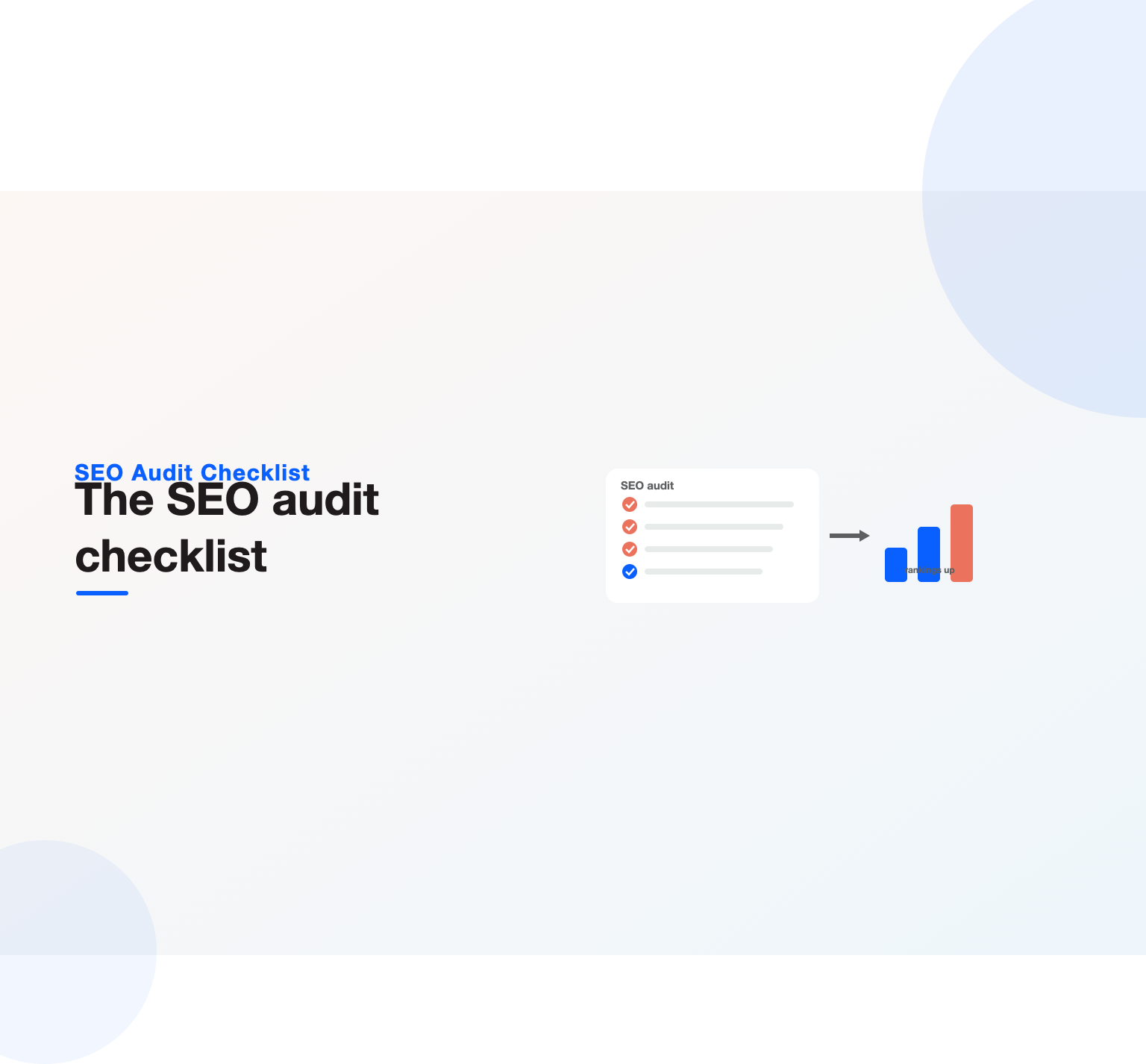
Quick Answer
An SEO audit checklist is the ordered set of checks that tells you why a site is not ranking and what to fix first. A complete one covers six areas: technical health (can search engines crawl and index the pages), Core Web Vitals and page experience, on-page optimization (titles, headings, content quality), content and keyword coverage (including cannibalization and thin pages), off-page authority (backlinks and reputation), and, increasingly, AI-search readiness (whether ChatGPT, Perplexity and Google AI Overviews can extract and cite your pages). Work through the checks in that order, record each issue with its impact and effort, and fix the high-impact, low-effort problems first. The checklist below is the exact one we run, including the AI-search section most audits still skip.
Key Highlights
- A useful SEO audit checklist is ordered by impact, not by tool output, so you fix what moves rankings before cosmetic issues.
- Technical and indexation problems come first: a page that cannot be crawled or indexed cannot rank no matter how good it is.
- Content and keyword checks catch the quiet killers, cannibalization, thin pages and intent mismatches, that flat checklists miss.
- Off-page authority still decides competitive terms, so the backlink review matters as much as the on-page pass.
- AI-search readiness is now a real audit section: buyers ask AI engines for recommendations, and pages that are not extractable get left out of the answer.
- Every finding should carry an impact and effort rating so the output is a prioritized plan, not a list of 80 undifferentiated tasks.
How to use this SEO audit checklist
Most published checklists hand you a long undifferentiated list and leave you to guess what matters. That is the opposite of how an audit should work. The point of an SEO audit checklist is to find the specific reasons a site underperforms and to rank those reasons so the first fixes produce the biggest gains. Work through the sections in the order below, because they run from the problems that block ranking entirely to the ones that refine it. A broken canonical tag or a noindexed template outranks a missing meta description as a priority every time, and a good process reflects that.
Record every issue as you go with two quick ratings: likely impact on rankings and traffic, and effort to fix. That single habit turns a raw list into a plan. When the pass is done you will have a short set of high-impact, low-effort fixes to start with, a set of high-impact, high-effort projects to schedule, and a long tail of minor items you can safely defer. Treat the ratings as directional, not scientific; the goal is sequencing, not false precision. If you want to sanity-check the payback of the bigger projects before you commit, our SEO ROI calculator gives you a quick model.
One more principle before the checks. An audit is diagnosis, not treatment, so resist fixing things mid-pass. Note the issue, rate it, and move on. Fixing as you go fragments your attention, hides patterns that only appear across the whole site, and usually means the low-value fix you happened to see first gets done before the high-value one you had not reached yet. Complete the diagnosis, then act on the prioritized plan.
1. Technical and indexation checklist
Technical health sits first because it gates everything else. If search engines cannot crawl a page, or are told not to index it, the quality of its content is irrelevant. Start every SEO audit checklist here, confirm the foundations, and you avoid the common and painful discovery that months of content work sat behind a stray noindex tag the whole time.
- Indexation: Check how many pages are indexed against how many should be. A large gap in either direction is a red flag, too few means pages are blocked or not discovered, too many means thin, duplicate or parameter pages are diluting the site. Google Search Console’s Pages report is the source of truth here.
- Crawlability: Review robots.txt for accidental blocks, confirm important sections are reachable by internal links, and look for crawl traps like faceted URLs generating infinite combinations.
- Noindex and canonical tags: Verify that money pages are indexable and that canonical tags point where they should. A self-referencing canonical on unique pages, and a consolidating canonical on duplicates, is what you want. Mismatched canonicals quietly suppress pages that should rank.
- XML sitemap: Confirm the sitemap exists, lists only indexable canonical URLs, returns current pages, and is submitted in Search Console. A sitemap full of redirects or noindexed URLs wastes crawl budget and confuses discovery.
- HTTPS and security: Every page should load over HTTPS with a valid certificate and no mixed-content warnings, and HTTP versions should redirect cleanly to HTTPS.
- Redirects and status codes: Hunt for broken internal links returning 404s, redirect chains and loops, and soft 404s where thin pages return a 200 they should not. Each wastes crawl budget and leaks link equity.
- Duplicate content: Look for the same content reachable at multiple URLs, http and https, www and non-www, trailing-slash variants, and resolve them to one canonical version.
- Structured data: Validate that schema markup is present where relevant and error-free, since malformed structured data can forfeit rich results.
Technical work is where a small, attentive site can beat a larger careless one, because these problems are common and most competitors leave some unresolved. If this section surfaces more than a handful of serious issues, it is usually the highest-return part of the whole audit, and it connects directly to the broader SEO fundamentals that everything else builds on.
2. Core Web Vitals and page experience checklist
Page experience is part technical, part user-facing, and it earns its own section because speed and stability affect both rankings and conversions. Google measures three Core Web Vitals, and your SEO audit checklist should record each against its threshold rather than a vague sense that the site feels slow.
- Largest Contentful Paint (LCP): The main content should render within about 2.5 seconds. Slow LCP usually traces to heavy images, render-blocking resources or a slow server response.
- Interaction to Next Paint (INP): The page should respond to input in under about 200 milliseconds. Poor INP points to heavy JavaScript blocking the main thread.
- Cumulative Layout Shift (CLS): Visual stability should stay under 0.1. Shifting layouts come from images without dimensions, injected ads or late-loading fonts.
- Mobile experience: Since indexing is mobile-first, check the site on real mobile conditions, tap targets, readable text, no horizontal scroll, and no intrusive interstitials.
- Field versus lab data: Prioritize field data from the Chrome User Experience Report over lab scores, because it reflects what real visitors experience.
Treat page experience as a supporting factor rather than a silver bullet. It rarely lifts a page from invisible to first, but on competitive terms where content and links are close, it is often the tiebreaker, and slow pages quietly cost you conversions on the traffic you already earn. If you want the mechanics behind each metric, our guide to Core Web Vitals goes deeper than this checklist can.
3. On-page optimization checklist
On-page checks cover how well each page communicates its topic to search engines and to readers. This is the section people think of first when they hear audit, and while it is not the whole story, it is where a lot of quick, high-impact wins hide. Go page by page for your most important URLs rather than sampling, because the money pages deserve individual attention.
- Title tags: Each important page needs a unique, descriptive title that leads with its primary keyword and reads naturally. Flag duplicates, missing titles and titles truncated by length.
- Meta descriptions: Not a ranking factor, but they drive click-through from the results, so check for missing, duplicate or auto-generated descriptions on pages that matter.
- Heading structure: One clear H1 per page describing the topic, with H2s and H3s that map the logical sub-sections. Multiple H1s or a jumbled hierarchy muddies the signal.
- Keyword targeting and intent: Confirm each page targets one clear primary intent and actually satisfies it. A page aiming at a commercial term with a thin informational post is a mismatch that no amount of tuning fixes.
- Content quality and depth: Judge whether the page genuinely answers the query as well as or better than what ranks. Thin, generic pages are a liability, not a neutral.
- Internal linking: Check that important pages receive contextual internal links with varied, descriptive anchors, and that no key page is orphaned. Internal links route authority and help engines understand structure.
- Image optimization: Descriptive file names and alt text help accessibility and image search, and compressed images help speed.
- URL structure: Short, readable, keyword-relevant URLs without dates or parameters age better and read more clearly in the results.
The highest-value on-page finding is usually not a missing tag but an intent mismatch, a page built for the wrong kind of query. Fixing those reshapes the page around what searchers actually want, and it tends to move rankings far more than tidying metadata. The on-page pass pairs naturally with the content review that follows.
4. Content and keyword checklist
Content checks step back from individual pages to the site as a whole, and they catch the quiet problems that flat checklists miss entirely. Two pages competing for the same term, a cluster of thin posts dragging down quality signals, or a page that never matched intent in the first place will hold a site back even when every technical box is ticked. A thorough SEO audit checklist treats content as a system, not a pile of URLs.
- Keyword cannibalization: Find cases where multiple pages target the same primary keyword and intent, splitting signals so neither ranks well. Consolidate, re-target one to a distinct intent, or merge them.
- Thin and low-value content: Identify pages with little unique value that add nothing for readers. Improve them, consolidate them, or remove them, because a mass of weak pages can weigh on the whole site.
- Outdated content: Flag pages with stale information, dead references or old years in the copy, and refresh the ones that still target live demand.
- Content gaps: Compare your coverage against the queries your audience searches and against what competitors rank for, and note the valuable topics you have not addressed.
- Search intent alignment: For each target keyword, check that your page format matches what ranks, a listicle where the SERP wants listicles, a guide where it wants guides. Format mismatch is a common, invisible reason for underperformance.
- Duplicate and near-duplicate pages: Beyond technical duplicates, look for near-identical content spun across locations or products, which reads as thin and manipulative.
Cannibalization deserves special attention because it is so common and so fixable. When you consolidate competing pages onto one strong URL, you concentrate the signals that were split and often see the survivor climb quickly. If a full content-demand review is on your list, our guidance on SEO strategy covers how to plan coverage against real demand rather than guesswork.
5. Off-page and backlink checklist
Off-page authority still decides the competitive terms, so the backlink review is not optional. A site can be technically flawless and beautifully written and still lose to a stronger domain on high-value queries. This part of the SEO audit checklist assesses the quality and shape of your link profile and how it compares to the sites you are trying to outrank.
- Backlink quality: Look at the profile for genuine, relevant, authoritative links versus low-quality or spammy ones. A smaller profile of strong links beats a large one of weak links.
- Toxic links: Identify clearly manipulative or spammy links. In most cases Google ignores them, but a pattern of paid or spammy links tied to past manipulation may warrant a disavow.
- Anchor text distribution: A natural profile skews toward branded and natural-phrase anchors. An unnatural concentration of exact-match commercial anchors is a risk signal.
- Link velocity: Steady, organic-looking growth is healthy; sudden unexplained spikes can indicate manipulation.
- Competitor link gap: Compare your profile against the pages that outrank you to see which sites link to them but not to you. That gap is a concrete, prioritized outreach list.
- Lost links: Recover valuable links that have dropped, often a quick win, by reclaiming a broken page or renewing a relationship.
Authority is the slowest area to change, which is exactly why the audit should surface it early, so the long-lead work starts now rather than after everything else is done. The tactics for building that authority are their own discipline; our breakdown of off-page SEO covers how to earn links that actually move rankings rather than chasing volume.
6. Local SEO checklist (if you serve a place)
Any business that serves customers in a physical area needs a local layer in its SEO audit checklist, because local rankings run on partly different signals from organic. Skip this section only if you genuinely have no geographic market.
- Business profile: Confirm your Google Business Profile is claimed, verified and fully complete, with the right primary and secondary categories, accurate hours, service areas and contact details.
- NAP consistency: Your name, address and phone number should be identical across your site and the major directories, since inconsistency erodes trust in the listing.
- Reviews: Check review volume, recency, rating and whether you respond. A steady flow of genuine recent reviews is one of the strongest local levers.
- Local content: Verify you have genuinely useful pages for each service and area you serve, not thin near-duplicates that swap a place name.
- Local citations: Confirm presence in the directories that matter for your industry and region, with consistent information.
Local visibility rewards thoroughness over cleverness, and a business that completes these fundamentals often outranks larger, less attentive competitors in its own area. The full playbook lives in our local SEO resources, but the checklist above catches the issues that matter most.
7. AI search and AEO readiness checklist
Here is the section almost every other SEO audit checklist still omits, and it is quickly becoming one of the most important. A growing share of buyers now research inside AI answers from ChatGPT, Perplexity, Gemini and Google’s AI Overviews, where the engine names a few sources and the rest are invisible. Ranking a blue link is no longer the whole game; being extractable and citable by these engines is a distinct capability, and an audit that ignores it misses where a real slice of discovery now happens.
- Citation presence: Run your real buyer questions through ChatGPT, Perplexity and Google AI Overviews and record whether your brand is named, where, and against which competitors. This is the AI-search equivalent of a rank check.
- Answer extractability: Confirm your key pages lead with a direct, self-contained answer to the query. Engines lift clean, factual passages, so a page that buries its answer under preamble is hard to cite.
- Structured, factual formatting: Check for clear question-and-answer blocks, definitive summaries, and scannable structure that a model can parse and quote.
- Schema and entity clarity: Verify relevant structured data (FAQ, article, organization, product) and consistent entity information, so engines understand what you are and can trust it.
- Demonstrable expertise: Confirm first-hand experience signals, named authors, real data and correct terminology, since AI engines, like Google, favor sources they can trust.
- Crawl access for AI: Review whether your robots directives and any llms.txt file allow the AI crawlers you want to be cited by, rather than accidentally blocking them.
Treating AI-search readiness as part of the audit is where a forward-looking program pulls ahead, because most competitors are still auditing only for blue links. The two disciplines that own this work are answer engine optimization, which structures content to be extracted and quoted, and AI search optimization, which works to make your brand a named source across the engines. Adding this section to your SEO audit checklist future-proofs the whole exercise.
Turning findings into a prioritized plan
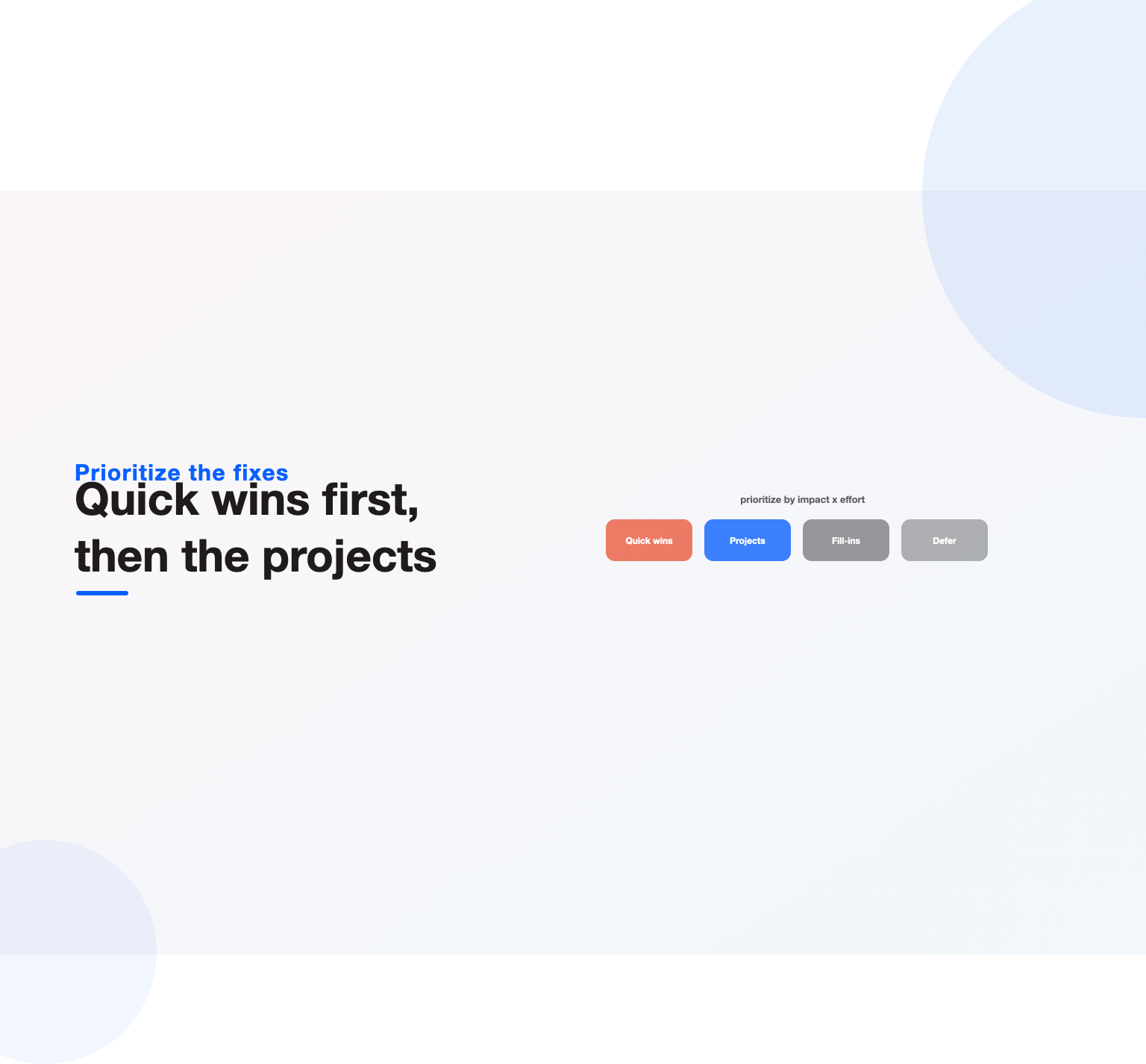
A pile of findings is not an audit; the value is in the sequencing. With every issue rated for impact and effort, sort them into four buckets and act in order. Quick wins, high impact and low effort, come first: fixing a noindexed money page, consolidating two cannibalizing posts, reclaiming lost links. These build momentum and often move rankings within weeks.
Major projects, high impact and high effort, come next and deserve a schedule and an owner: rebuilding a slow template, restructuring a thin content section, closing a real authority gap. Fill-ins, low impact and low effort, are worth doing when you have a spare hour but never at the expense of the first two buckets. Thankless tasks, low impact and high effort, are the ones to question hard and usually defer. Sorting this way is what separates an audit that changes results from a document that gathers dust, and it keeps the team focused on the work that pays.
Set a baseline before you start fixing, current rankings, organic traffic, indexed pages and, now, AI citations, so you can prove the impact of the work. An audit without a before-and-after is hard to defend and easy to deprioritize when other demands arrive. Measurement is what keeps the plan funded.
Add the AI-citation baseline deliberately, because it is the newest and the easiest to forget. Before you change anything, log whether your priority questions surface your brand in the major engines, then recheck after the fixes land, the same way you would track a keyword ranking. Pages restructured for extractability during the audit often start earning citations within a cycle or two, and treating that as a measured outcome rather than a hope is what makes the case for the work. The disciplines behind it, answer engine optimization and the wider AI search program, give you the levers, but the audit is where you decide which ones to pull first and prove they worked, alongside the classic local and organic gains.
Tools you need to run the audit
You can run most of an SEO audit checklist with a small, mostly free toolkit, and you do not need every premium platform to do it well. Google Search Console is non-negotiable and free: it reports indexation, Core Web Vitals field data, queries and manual actions straight from Google. Pair it with the PageSpeed Insights and the Rich Results test for page experience and structured-data validation.
A crawler such as Screaming Frog maps your site the way a search engine does, surfacing broken links, redirect chains, duplicate titles and noindex tags at scale. A backlink tool is needed for the off-page section, since Search Console shows your own links but not competitors’ profiles for the link-gap analysis. For the AI-search section, the most reliable tool is still manual: run your buyer prompts through the engines yourself and log the results, supplementing with a dedicated AI-visibility tracker once you are appearing regularly enough to monitor at scale. Choose tools to fit the audit, not the other way around; the checklist drives the process, and the tools simply speed it up.
How often to run an SEO audit
Cadence depends on the site, but a few patterns hold. Run a full SEO audit checklist at least once or twice a year for most sites, and quarterly for large or fast-moving ones where content and templates change constantly. Beyond the scheduled passes, run a focused audit after any major event, a site migration, a redesign, a platform change, or a sudden traffic drop, because those are exactly when new technical issues appear.
Between full audits, keep a light monitoring habit rather than waiting for the next scheduled pass. Watching Search Console for indexation and Core Web Vitals changes, and glancing at rankings and AI citations for your priority terms, catches problems while they are small. A migration or redesign in particular deserves a pre-launch and a post-launch check, since these projects introduce more SEO damage than almost anything else, and a traffic drop should trigger an immediate diagnostic, which our guide on recovering from a Google traffic drop walks through step by step.
Technical audit versus full SEO audit
People often use audit to mean two different things, and knowing which you need saves time. A technical SEO audit is a focused pass on crawlability, indexation, site speed, structured data and the mechanics that let engines access and understand a site. A full SEO audit checklist includes all of that but adds the on-page, content, off-page, local and AI-search sections above, so it evaluates not just whether the site can be crawled but whether it deserves to rank and get cited. The technical pass answers can search engines use this site; the full audit answers why is this site not winning the terms it should.
Run a technical-only audit when you suspect a specific mechanical problem, after a migration, a redesign, or a sudden indexation change, where speed matters and the scope is deliberately narrow. Run the full audit when the question is broader, when rankings have plateaued, when a new site needs a baseline, or on the regular cadence that keeps a program healthy. Many teams start technical because it is concrete and fast, then widen into the content and authority sections once the foundations check out. Both are valid; the mistake is running a narrow technical pass, finding nothing badly broken, and concluding the site is fine when the real problem is thin content or a missing authority base that only the full checklist would surface. If speed is the concern, our guide on how long SEO takes to work sets realistic expectations for when fixes show up in rankings.
Mistakes that make an audit useless
A thorough SEO audit checklist only pays off if the process around it is sound, and a few common mistakes quietly waste the effort. The most frequent is tool-dumping: running a crawler or an all-in-one platform, exporting its list of 300 issues, and treating that export as the audit. Those tools flag everything at one alarming severity, missing alt text beside a noindexed money page, so an unfiltered export buries the three findings that matter under hundreds that do not. The tool is an input; the judgment about what matters is the audit.
A second mistake is auditing without prioritizing. A list of eighty tasks with no impact rating is paralysing, and teams either freeze or fix whatever is easiest rather than whatever is most valuable. Rating each finding for impact and effort, as this checklist insists, is what turns the raw list into action. A third is fixing mid-pass, which fragments attention and hides the site-wide patterns, like a cannibalization problem across a whole content section, that only appear when you diagnose the whole site before touching anything.
The subtlest and most damaging mistake is auditing only the mechanics and ignoring intent and demand. A site can pass every technical check and still fail because its pages target the wrong queries or chase terms nobody searches. That is why the checklist pairs technical health with content, intent and, now, AI-search readiness, and why the real skill is connecting a symptom to its cause rather than ticking boxes. The same demand-first discipline underpins generative engine optimization and every other surface a modern audit has to consider. Finally, auditing without a baseline leaves you unable to prove impact; capture the numbers before you start so the after is defensible.
Doing it yourself versus getting help
A capable marketer can work through this SEO audit checklist and act on most of what it surfaces, especially the technical fixes, on-page improvements and content consolidation that make up the bulk of the wins. If you have the time and the willingness to learn the tools, doing it yourself builds understanding of your own site that no report can replace, and the checklist above is deliberately complete enough to follow without outside help.
The case for help is strongest in three situations. When the audit uncovers deep technical problems, complex indexation issues, JavaScript rendering, migration damage, experience shortens the path from symptom to cause dramatically. When authority is the bottleneck, closing a competitor link gap is specialist, relationship-driven work. And when AI-search visibility matters to your market, the readiness work is new enough that few in-house teams have done it before. If any of those fit, a senior-led audit pays for itself by finding the issues a checklist alone cannot, and by sequencing the fixes for fastest payback; that is exactly the kind of diagnostic our SEO services begin with. Whichever route you take, the discipline is the same: diagnose thoroughly, prioritize honestly, fix in order, and measure the result.
Key Takeaways
- Fix in order: clear technical and indexation problems first, because no on-page or content work matters on a page engines cannot crawl or index.
- Rate every finding by impact and effort, then start with the high-impact, low-effort quick wins; that sequencing is what makes an audit change results instead of gathering dust.
- Do not skip the AI-search readiness section. Discovery is shifting into AI answers, and it is exactly where competing checklists stop, so it is your clearest edge.
- Diagnose the whole site before fixing anything, and capture a baseline of rankings, traffic, indexed pages and AI citations so you can prove the gains.
- Re-audit on a schedule and after every migration, redesign or traffic drop, since those events are when new problems appear, and pair the work with the right SEO fundamentals to make the fixes stick.
Frequently asked questions
What is included in an SEO audit checklist?
A complete SEO audit checklist covers six areas: technical health and indexation, Core Web Vitals and page experience, on-page optimization, content and keyword coverage, off-page authority, and AI-search readiness, plus a local section for businesses that serve a place. The technical checks come first because a page that cannot be crawled or indexed cannot rank, and the AI-search section is the newest addition, covering whether engines like ChatGPT and Google AI Overviews can extract and cite your pages.
How do you perform an SEO audit step by step?
Work through the sections in order from technical to content to authority, recording each issue with an impact and effort rating rather than fixing as you go. Diagnose the whole site first, then sort the findings into quick wins, major projects, fill-ins and tasks to defer, and act on the high-impact, low-effort items first. Set a baseline of rankings, traffic, indexed pages and AI citations before you start so you can prove the impact of the fixes afterward.
How often should you run an SEO audit?
For most sites, do a full audit once or twice a year, and quarterly for large or fast-moving ones. Beyond the schedule, run a focused audit after any migration, redesign or sudden traffic drop, since those are when new technical issues appear. Between full passes, keep a light monitoring habit on indexation, Core Web Vitals and your priority rankings so problems are caught while they are small.
What is the difference between a technical SEO audit and a full SEO audit?
A technical SEO audit focuses on crawlability, indexation, speed and structured data, the mechanics that let engines access a site. A full SEO audit checklist includes all of that and adds on-page, content, off-page, local and AI-search checks, so it evaluates not just whether a site can be crawled but whether it deserves to rank and get cited. Choose technical when you suspect a specific mechanical fault, and the full audit when rankings have plateaued or a site needs a baseline.
Can I do an SEO audit myself, or do I need an agency?
A capable marketer can run most of the checklist and act on the technical, on-page and content fixes that make up the bulk of the wins. Bring in help when the audit uncovers deep technical problems, when authority is the bottleneck, or when AI-search visibility matters and the readiness work is new to your team. That is the diagnostic our SEO services start with.
Does an SEO audit include AI search and AEO?
It should now. A modern audit checks whether your pages are cited in AI answers, whether their answers are extractable, and whether schema and crawl access let engines use them, the core of answer engine optimization. Most published checklists still skip this, which is exactly why adding it is an advantage rather than a nice-to-have.
Ready to put this into practice?
Talk to the team that runs SEO, AI search and paid growth programs every day.
Book a Strategy Call →