 Skip to content
How to Choose an SEO Agency for AEO Visibility
How to choose an SEO agency for AEO visibility: the criteria, questions and red flags that separate a real answer-engine partner from a relabeled keyword shop.
Quick Answer
To choose an SEO agency for AEO visibility, hire one that treats answer engine optimization and classic SEO as a single program, can show real citations it has earned inside ChatGPT, Perplexity, Gemini and Google AI Overviews, and reports on citation share rather than only blue-link rankings. The right partner audits your entity footprint, structures content so engines can extract it, earns third-party mentions that build trust, and measures where your brand appears in AI answers. You want proof of AEO visibility on live queries, a clear method, and transparent pricing before you sign.
Key Highlights
- AEO visibility is earned through entities, extractable structure and third-party trust, so the agency you pick must own all three, not just keywords.
- The strongest partners run SEO and answer engine optimization as one engagement because both draw on the same foundations.
- Ask for live proof: a brand the agency has pushed into AI answers, and the exact queries where it now appears.
- Reporting on citation share and answer presence matters more than a ranking screenshot when AEO visibility is the goal.
- Watch for red flags: guaranteed placements, secret tactics, and a refusal to name the engines they optimize for.
Why AEO visibility now decides who wins the click
Buyers increasingly ask an assistant before they ever open a search results page. When someone types a question into ChatGPT or reads a Google AI Overview, the engine names a short list of brands and cites a handful of sources. If you are on that list, you are considered. If you are not, the decision often happens without you. That shift is why AEO visibility has become its own discipline: it is the practice of getting surfaced and cited inside AI answers, not just ranked in ten blue links.
Classic SEO still matters, because the same crawlable, authoritative pages feed both systems. The difference is what the engine does with them. A ranking system orders links; an answer engine extracts facts, attributes them to a source, and decides which brands to recommend. Choosing a partner for AEO visibility means finding an agency that understands both jobs and builds for the second one deliberately rather than hoping traditional rankings carry over.
Because the category is young, the market is noisy. Some agencies have rebranded keyword work as answer engine optimization without changing what they do. Others genuinely earn citations and can prove it. Telling them apart is the whole task, and a short, structured evaluation saves you from paying premium fees for a relabeled service.
What actually drives AEO visibility
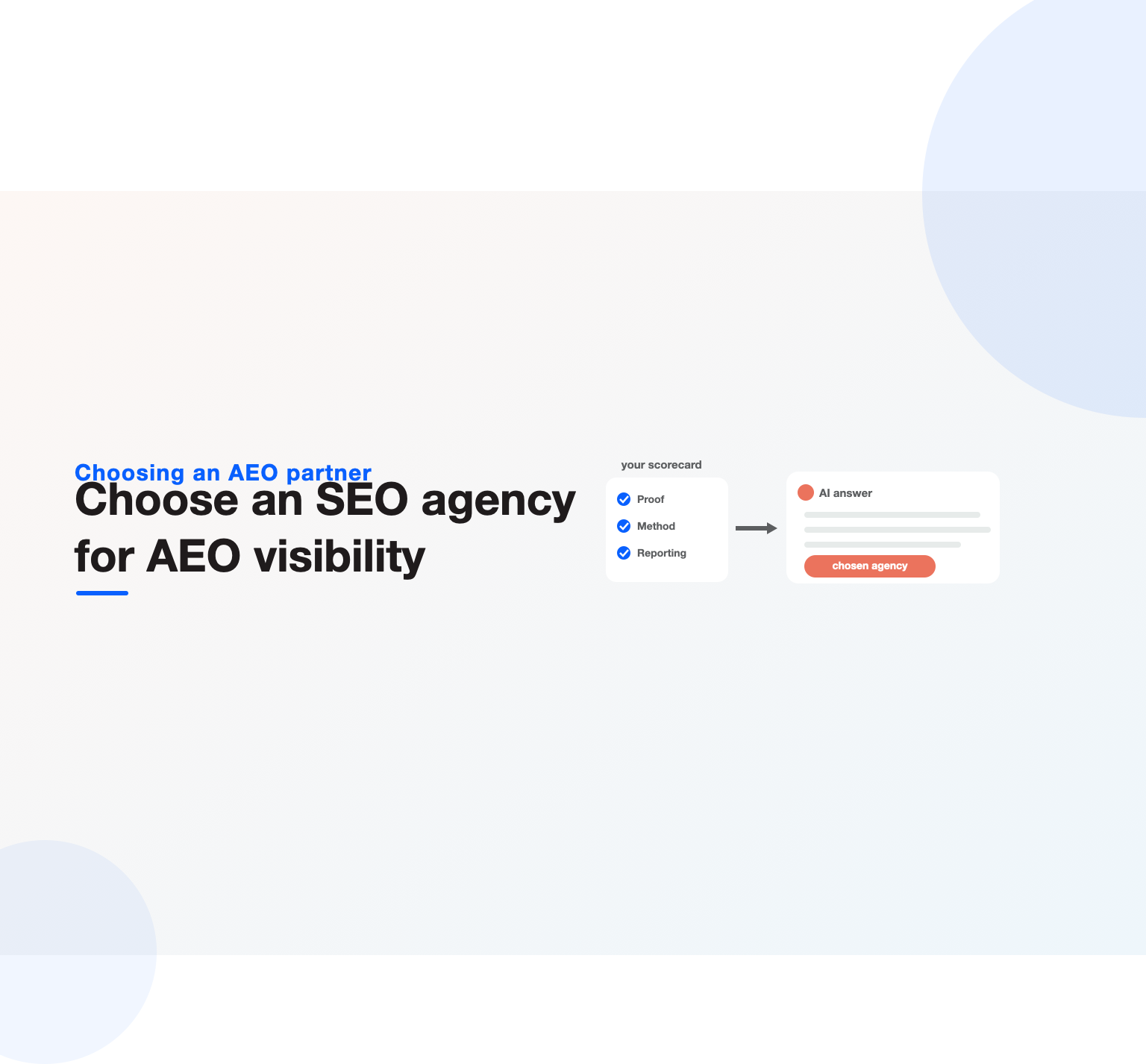
Before judging an agency, it helps to know the levers a competent one pulls. Three foundations decide whether an engine surfaces and cites you, and every credible method maps back to them.
Entities and authority. Engines need to understand who you are, what you do, and whether you can be trusted on a topic. That understanding comes from a consistent entity footprint: clear organization data, a claimed presence on the sources engines already trust, and a body of content that establishes topical depth. A partner serious about AEO visibility starts by mapping and strengthening your entity, the way a mature SEO program maps a topic, not by chasing a flat keyword list.
Extractable structure. Answer engines quote content that is easy to lift. Direct answers in the opening lines, question-shaped headings, tight definitions, comparison tables and clean FAQ blocks all make a page more quotable. A partner who understands answer engine optimization writes for extraction, formatting each page so a model can pull a self-contained passage and attribute it to you.
Third-party trust. Models weigh what other credible sites say about you. Citations, mentions and reviews across authoritative publications and directories raise the odds that an engine treats your brand as a safe recommendation. An agency that only touches your own site, and never earns outside signals, will struggle to move AEO visibility no matter how clean the on-page work looks.
Keep these three in mind as a lens. When an agency describes its process, you are listening for whether it addresses entities, structure and trust together, or leans on one and ignores the rest.
The criteria that separate a real AEO partner from a relabeled one
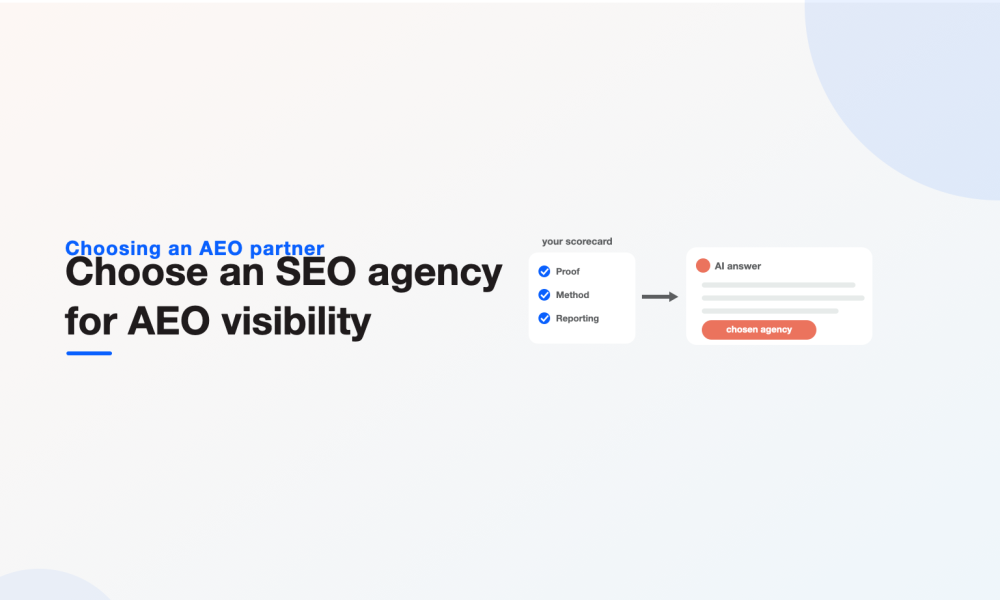
Use the following as a scorecard. A strong agency will clear most of these comfortably; a weak one will dodge several.
Proof of earned citations. The single best signal is evidence that the agency has already put a brand into AI answers. Ask to see a client the engines now cite, and the specific questions where that citation appears. Live proof beats any deck, and its absence on a topic this measurable is telling.
A named method, not a black box. A credible partner can explain, in plain language, how it builds entities, how it structures content for extraction, and how it earns outside trust. If the tactics are secret or vague, treat that as risk rather than sophistication.
SEO and answer engine optimization under one roof. Because both rely on the same foundations, splitting them across two vendors wastes budget and creates conflicting work. The best partners deliver a single program where rankings and citations reinforce each other, which is also more cost-effective for you.
Engine coverage they will name. Which engines do they optimize for? A confident answer covers Google AI Overviews, ChatGPT, Perplexity and Gemini, with a note on how the approach differs for each. A vague answer suggests they have not actually worked the surfaces.
Measurement built for answers. Traditional rank tracking cannot see AEO visibility. The agency should track citation share, presence in the answer sets for your priority questions, and branded lift, and it should be able to show you that dashboard before you sign.
Content depth over content volume. Engines reward genuine topical authority. A partner who pitches a flood of thin posts is optimizing for an old game. One that plans a focused cluster of authoritative, extractable pages is building for how answers get sourced today.
Transparent pricing and deliverables. You should know exactly what you are buying, on what timeline, and how success is defined. Clear scope is both a fairness signal and a competence signal.
Honest timelines. Answer engine optimization compounds over months as entities strengthen and citations accumulate. A partner promising overnight results is either misinformed or willing to mislead.
Questions to ask before you sign
A short interview surfaces most of what a proposal hides. Bring these to the call and listen for specifics rather than adjectives.
- Which brand have you pushed into AI answers, and on which exact queries can I see it today?
- How do you strengthen a client entity so engines trust it as a source?
- How do you structure a page so a model can extract and attribute a passage from it?
- Which engines do you optimize for, and how does your approach change across them?
- How will you report AEO visibility, and can I see the dashboard before we start?
- Do you run SEO and answer engine optimization as one program or as separate scopes?
- What does month one look like, and when do you expect the first citations to show?
The answers do not need to be perfect, but they need to be concrete. An agency that has genuinely earned AEO visibility will reach for examples; one that has not will reach for jargon.
Red flags that should end the conversation
Some signals reliably predict disappointment. Guaranteed placements top the list, because no agency controls what a model outputs, and a guarantee betrays a misunderstanding of how answers get sourced. Secret tactics are a second warning; anything that cannot survive daylight tends not to survive an algorithm update either. A refusal to name engines, a pitch built entirely on your own website with no plan to earn outside trust, and reporting that quietly reverts to blue-link rankings when you asked about AEO visibility all point the same direction. Finally, be wary of an agency that treats answer engine optimization as a premium add-on bolted onto the same old keyword retainer, since that framing usually means the underlying work has not changed.
How to verify an agency can actually deliver
You do not have to take claims on faith. Pick three questions your buyers really ask and run them through ChatGPT, Perplexity, Gemini and Google yourself. Note which brands and sources the engines cite. Then ask the agency to explain why those sources win and how it would earn you a place among them. A partner who can read the answer landscape and translate it into a plan is demonstrating the core skill; one who cannot is guessing.
It is also fair to ask for a small, time-boxed pilot on a single question cluster. A confident agency will welcome the chance to show movement in citation presence on a defined set of queries, because that is exactly the outcome it sells. Watching how a team scopes and measures a pilot tells you more than any case study, and it keeps your early risk small while you confirm the partnership is real.
SEO agency, AEO specialist, or in-house
Three routes exist, and the right one depends on your stage. A full-service SEO agency that has genuinely added answer engine optimization services is usually the best fit for most businesses, because you get the shared foundations, one accountable team, and coordinated reporting. It also helps to review how the contenders stack up, which is why a candid roundup of AEO agencies is a useful starting point before you build a shortlist. A boutique AEO specialist can suit a brand that already has strong classic SEO and only needs the citation layer, though you will want to confirm the two efforts stay aligned. Building the capability in-house is viable for larger teams with the time to learn a fast-moving field, but the learning curve is real and the tooling is still maturing. Whichever route you choose, the evaluation criteria above still apply, since the goal, durable AEO visibility, does not change with the org chart.
The three foundations, in practical depth
It is worth going one level deeper on entities, structure and trust, because the difference between a competent agency and a great one shows up in how thoroughly it works each layer.
On the entity layer, a strong partner begins by making your organization legible to machines. That means consistent name, role and location data across your site and the sources engines already read, a clear description of what you do and for whom, and connective tissue between your brand and the topics you want to be known for. When an engine can confidently say what your company is and what it is authoritative on, it becomes a safer candidate to cite. A weak agency skips this and jumps straight to publishing, which is why its content rarely gets attributed even when it ranks.
On the structure layer, the craft is writing so a machine can lift a clean, self-contained passage. Each important page should answer its core question in the first lines, use headings phrased the way people actually ask, define terms crisply, and present comparisons and steps in formats a model can quote without distortion. This is not keyword stuffing in a new costume; it is disciplined information design. A team that understands it will talk about passages and extractability, while a relabeled keyword shop will keep talking about density and volume.
On the trust layer, the work moves off your own domain. Getting named on the publications, directories and communities that engines treat as reliable raises the odds your brand is recommended, because models weigh the wider web when they decide who to trust. This is patient work: earned mentions, genuine reviews, and placements that a real editor approved. A partner with no plan beyond your website is missing the layer that most often decides AEO visibility.
How the work shifts across engines
The foundations are shared, but each surface has its own personality, and a partner worth hiring can describe the differences without prompting.
Google AI Overviews lean heavily on established authority and on content that already performs in classic search, so strong technical SEO and topical depth carry real weight there. ChatGPT reflects both its training data and, in browsing modes, live sources, which rewards brands with a durable, consistent presence across the web rather than a single optimized page. Perplexity is citation-first and visibly links its sources, making it the surface where clean, quotable pages and credible outside references pay off fastest, and it is often where a fresh generative engine optimization effort shows movement first. Gemini sits close to Google’s ecosystem and rewards clarity, structure and entity strength. A team that has actually worked these surfaces will tailor emphasis for each; a team that has not will describe them all the same way.
You do not need the agency to promise identical results everywhere. You need it to show that it understands why a page might get cited in Perplexity before it appears in an AI Overview, and to sequence the work accordingly. That judgment is a strong proxy for whether the team has earned AEO visibility before or is reasoning about it for the first time on your budget.
A realistic picture of how the gains arrive
Consider a mid-sized business that ranks decently in classic search but never appears when buyers ask an assistant for a shortlist. A capable agency would start by mapping the questions those buyers actually ask and checking where the engines currently source their answers. It would then strengthen the brand entity, rebuild the priority pages so each opens with a clean, quotable answer, and begin earning mentions on the sources those engines already trust. Within a couple of months, the first citations usually appear on the narrower, lower-competition questions, where the field is thinner. Over the following months, as authority and outside trust accumulate, presence spreads to broader, higher-value questions. None of this is guaranteed on a fixed date, but the sequence is predictable, and an agency that can narrate it credibly is showing you the map it actually uses.
The same example exposes a common failure. A shop that only publishes more posts, without touching entities or earning the outside trust engines weigh, will produce content that ranks in classic search yet never gets cited in an answer, which is why AI search optimization treats trust as core work. The pages are present in the index but absent from the answer, which is the precise gap AEO visibility work exists to close. Watching whether a prospective partner addresses that gap, rather than promising more articles, tells you most of what you need to know.
Fitting answer engine work into your existing SEO
Most businesses are not starting from zero; they already have an SEO program, an agency relationship, or an in-house lead. The goal is to add answer engine optimization without creating a turf war or duplicated effort. Because the underlying assets are shared, the cleanest arrangement is one team accountable for both, with a single content standard that serves rankings and citations at once. If you keep a separate SEO vendor, insist that the two coordinate on the same entity model and content structure, since conflicting guidance on those foundations is where budget quietly leaks. The agency you choose for AEO visibility should be comfortable either leading the whole program or slotting in beside an existing one, and it should tell you plainly which arrangement it recommends and why.
Integration also affects measurement. If rankings and citations are reported in separate silos by separate vendors, you lose the ability to see how they reinforce each other. A unified view, where classic rankings, citation share and answer presence sit on one dashboard, makes it far easier to judge whether the investment is compounding. When you interview an agency, ask how it would connect the new answer-focused metrics to the search data you already watch.
What engagements cost and how they are structured
Pricing varies with scope, but the structure tends to follow a pattern. Early work is front-loaded, because auditing your entity, rebuilding priority pages and setting up measurement takes effort before results show. Ongoing work then settles into a rhythm of content, outreach for earned mentions, and reporting. Beware two extremes: a suspiciously cheap retainer usually means thin, templated output that will not earn citations, while a premium fee justified only by the phrase answer engine optimization may be the same old service with a new label. The fair middle is a scope you can read line by line, priced against defined deliverables and a clear definition of success. A transparent agency will show you where the money goes and what changes if you scale up or down.
It is also reasonable to structure the relationship so early value is provable. A defined pilot, or a first phase with explicit milestones, lets you confirm the partnership is real before committing to a long contract. Tying part of the engagement to observable movement in AEO visibility, such as appearing for a named set of questions, keeps incentives aligned and protects you from paying indefinitely for activity with no outcome.
A sensible first ninety days
While every plan differs, a healthy engagement tends to move through recognizable phases. The opening weeks go to discovery and foundations: mapping buyer questions, auditing the entity, checking where engines currently source answers, and standing up measurement so there is a baseline to improve on. The middle stretch focuses on execution: rebuilding priority pages for extraction, strengthening entity signals, and beginning the patient work of earning outside mentions. The final weeks of the quarter are for reading early signals, doubling down on the questions showing movement, and planning the next cluster. If an agency cannot describe a shape like this, or if it promises the finish line in week one, the plan is not grounded in how AEO visibility is actually earned.
Common mistakes buyers make when hiring
Even careful buyers slip in predictable ways, and knowing the traps makes the choice easier. The first mistake is judging a partner on classic rankings alone. A team can lift you into the top links and still leave you absent from the answer, because ranking and citation are sourced differently. When you evaluate an SEO services provider for this goal, ask specifically what it will do to earn citations, not just positions.
A second mistake is buying volume. Flooding a site with thin posts was an old tactic that answer engines actively discount, since they reward genuine topical depth over raw output. A focused cluster of authoritative, extractable pages beats a hundred shallow ones, which is why serious answer engine optimization plans read like a small, deliberate library rather than a content mill.
A third mistake is ignoring the wider category. Getting cited by Perplexity, surfacing in Gemini, appearing when someone asks ChatGPT, and showing up in Google AI Overviews are related but distinct outcomes. A partner that only ever talks about one engine has a narrow view, and narrow views miss opportunities. This is also where generative engine optimization and broader AI search optimization come in, since the same foundations feed every generative surface at once.
A fourth mistake is treating measurement as an afterthought. If you cannot see citation share and answer presence, you cannot tell whether the money is working, and you will end up renewing on faith. Set the dashboard up before the work starts, agree on what good looks like, and review it together on a fixed cadence.
The last mistake is rushing the decision. The category is new enough that a short, structured evaluation, the scorecard and interview above, will separate the genuine partners from the relabeled ones far better than a slick proposal. A week of diligence protects months of budget.
Turning the criteria into a shortlist
Once you understand the levers and the traps, building a shortlist is straightforward. Start with three or four candidates that can each show real citations they have earned. Run your own buyer questions through the major engines and ask every candidate to explain the results and their plan to win a place in them. Score each against the criteria, weighting proof and method most heavily. Then narrow to the one or two that pair a credible approach with transparent pricing, and offer them a small pilot on a single question cluster. The finalist that moves citation presence on that cluster, and reports it clearly, has demonstrated the exact capability you are buying. That evidence, not a persuasive deck, should decide who earns your long-term investment in AEO visibility.
Handled this way, the choice stops being a gamble on marketing language and becomes a judgment grounded in observable results. You are hiring for a measurable outcome, presence and citation inside AI answers, so let the measurable outcome lead. A partner confident in its method will happily be judged on it, and that confidence, backed by proof, is the clearest signal you will find.
Key Takeaways
- Pick an agency that owns entities, extractable structure and third-party trust together, because AEO visibility depends on all three.
- Demand live proof of earned citations and the exact queries where a client now appears in AI answers.
- Favor a single program that runs SEO and answer engine optimization together over two disconnected vendors.
- Insist on measurement built for answers, citation share and presence, not a recycled ranking report.
- Treat guarantees, secret tactics and unnamed engines as reasons to walk away.
Frequently asked questions
Short, direct answers to the questions buyers ask most when choosing a partner for AEO visibility.
What is the difference between SEO and answer engine optimization?
Classic SEO earns rankings in a list of links, while answer engine optimization earns a place inside the generated answer itself, cited as a trusted source. They share foundations like crawlable content and authority, but answer engine optimization adds entity work, extractable structure and citation building so a model will surface and attribute your brand.
How do I know an agency can actually improve AEO visibility?
Ask for a client it has pushed into AI answers and the exact live queries where that citation shows today. Run those queries yourself to confirm. Genuine proof on live surfaces is the clearest evidence, because AEO visibility is directly observable in a way older promises never were.
Should SEO and answer engine optimization be handled by the same agency?
Usually yes. Both rely on the same crawlable, authoritative, well-structured content, so running them as one program avoids duplicated foundations and conflicting work, and it is more cost-effective than paying two vendors for overlapping tasks.
Which engines should an AEO agency optimize for?
A capable partner names Google AI Overviews, ChatGPT, Perplexity and Gemini, and explains how the work shifts across them, since each pulls sources a little differently. An agency that will not name the engines it targets has likely not worked those surfaces.
How is AEO visibility measured?
It is measured by citation share, presence in the answer sets for your priority questions, and branded search lift, tracked by querying the engines directly for those questions and logging where and how your brand appears over time. Traditional rank tracking alone cannot see it.
How long does it take to see results?
Expect a few months. Answer engine optimization compounds as your entity strengthens and citations accumulate across trusted sources, so early movement often shows first on lower-competition questions before broader gains follow.
Are guaranteed AI placements a good sign?
No. No agency controls what a model outputs, so a guaranteed placement signals a misunderstanding of how answers are sourced. Favor a partner that commits to a clear method and measurable movement instead of a promise it cannot keep.
Is a small pilot a reasonable way to test an agency?
Yes. A time-boxed pilot on one question cluster lets you watch how the team scopes, executes and measures citation presence while keeping your risk small. A confident agency will welcome it, because demonstrating movement on a defined set of queries is exactly what it sells.
Ready to put this into practice?
Talk to the team that runs SEO, AI search and paid growth programs every day.
Book a Strategy Call →