 Skip to content

Authority, Structure, Engagement: Breaking Down the Three Pillars of AEO
A tactical breakdown of the three pillars of answer engine optimization, Authority, Structure and Engagement: what each one asks of a page, the specific signals under it, and how to build all three.
Quick Answer
The ASE framework breaks AEO into three pillars, Authority, Structure and Engagement, that together determine whether AI engines cite you. Authority earns trust, structure makes content extractable, and engagement signals real usefulness.
Authority, structure and engagement are the three pillars that decide whether AI answer engines cite your content. Authority is whether the engine trusts your brand as a credible source, structure is whether it can extract a clean answer from your page, and engagement is whether that answer genuinely satisfies the person who reads it. This guide is the tactical breakdown of each pillar, the specific signals that sit under it, the concrete actions that move it, and how the three fit together, so you can turn the model into real work on your own pages rather than just a nice diagram. By the end you will know not only what each pillar is, but which one to fix first on your own site and how to tell when it is working.
Key Highlights
- Three pillars decide whether AI engines cite you: authority, structure and engagement.
- Authority is whether the engine trusts your brand as a credible source.
- Structure is whether a clean, self-contained answer can be extracted from your page.
- Engagement is whether that answer genuinely helps the person who asked.
- The pillars reinforce each other; a 90-day plan should build all three, not just one.
The three pillars, in one paragraph
Before the detail, here is the whole model in brief. Answer engine optimization succeeds when three things are true at once: the engine trusts your brand enough to quote it, your content is built so a clean answer can be lifted from it, and that answer genuinely helps the person who asked. We call these Authority, Structure and Engagement, and if the model itself is new to you, start with the overview in what is the ASE framework. This guide assumes you have the model and want the tactics, so it takes each pillar apart in turn and then shows how they combine into a single program you can run.
Pillar 1: Authority, does the engine trust you?
Authority is whether an answer engine recognises your brand as a credible entity worth quoting, and it is the deepest of the three pillars because it is built across the entire web rather than on any single page. An engine forms a picture of who you are from everywhere you appear, your own site, directories, reference sources, news, social profiles and the pages that mention you, and it leans toward brands it can identify and verify. The practical implication is that authority is not a switch you flip; it is a reputation you accumulate, and the work is to make that reputation consistent, credible and legible to a machine.
Several concrete signals sit under authority. The first is entity consistency: the same clear description of what you do, the same name and details, everywhere you appear, so the engine can resolve you to one confident identity rather than a fuzzy set of half-matches. The second is credible mentions: references from sources the engine already trusts, which corroborate that you are real and reputable. The third is demonstrable expertise, expressed through named, credentialed authors and a track record of accurate content on the topic. The fourth is presence in the knowledge bases and reference sources engines cross-check when they need to verify a claim about you.
To build authority, make your brand information identical across every profile and listing, publish under real experts with visible credentials, earn mentions from reputable sources in your field, and deepen your coverage of a focused set of topics until you are an obvious specialist rather than a generalist. This is slow work measured in months, which is exactly why it is defensible: a competitor cannot buy it overnight. Model familiarity, topical authority, E-E-A-T and knowledge graphs each go deeper on one part of this pillar.
Pillar 2: Structure, can a clean answer be extracted?
Structure is whether your content is built so an answer engine can lift a clean, self-contained passage and understand exactly what it means. It is the most mechanical of the three pillars and usually the fastest to fix, because it is about how you arrange and label what you already know rather than about earning anything over time. The test is simple: could a machine read one section of your page, lift a single passage, and present it as a correct, complete answer without needing the paragraphs around it? If yes, you are structured for citation; if the meaning only emerges after three paragraphs of build-up, you are not.
The signals under structure are concrete and checkable. Answer-first openings put the direct answer in the first sentence of a section, before the context and caveats. Question-shaped headings map your sections to the real questions people ask, so the engine can match a query to a passage. Self-contained passages make each answer stand on its own. Schema markup labels what each block is, an FAQ, an article, an organisation, a product, so the engine parses it correctly instead of guessing. Tables present comparisons in a form a machine can read, and clean formatting keeps the whole thing legible.
To build structure, rewrite your key pages so every section leads with its answer, align headings to genuine buyer questions, add the schema that accurately describes the content, and put comparisons in real tables rather than prose or images. None of this requires a rebuild, and it is often the highest-return work you can do because it is fast and entirely within your control. Our guides to answer-first content and what makes content citable are the practical companions for this pillar.
Pillar 3: Engagement, does the answer actually help?
Engagement is whether the answer genuinely satisfies the person who reads it, and it is the pillar teams most often skip because it cannot be faked with markup or bought with links. An answer engine ultimately wants to give responses that help, so it pays attention to whether the sources it cites actually deliver: whether people who reach your page find what they need, stay, and act, rather than bouncing back to look for a better answer. Content that games structure and borrows authority but does not truly resolve the question tends to lose its citations once those weak downstream signals accumulate.
The signals under engagement are softer but real: genuine completeness, so the reader’s question is fully answered rather than teased; clarity and readability, so the answer is easy to absorb; and the honest usefulness that makes someone stop searching. You earn engagement by making the content genuinely the best answer to the question, not the longest or the most keyword-stuffed, but the most complete and clear. That sounds obvious, yet it is the pillar most often sacrificed to volume, and it is precisely the one that keeps a citation holding over time rather than fading.
To build engagement, treat each target question as something you are trying to genuinely resolve for a real person: answer it fully, address the follow-up questions a thoughtful reader would have, cut the filler that pads word counts without adding substance, and make the page a pleasure to read. Engagement is where AEO stops being a technical exercise and becomes about the quality of the thinking on the page, which is ultimately what answer engines are built to reward.
How the three pillars interact
The pillars are not independent scores you can trade off against each other; they multiply. A recognised brand whose page is a mess of buried answers will lose to a clearer competitor despite its authority. A beautifully structured page from a brand the engine does not trust will be passed over despite its clarity. And a trusted, well-structured page that does not actually help will slowly lose its citations as engagement signals disappoint. Strength in one pillar raises the value of the others, and weakness in one caps what the others can achieve, which is why balance matters more than brilliance in any single dimension.
There is also a natural sequence. Structure is fastest, so it is usually where you start, making your existing content extractable. Authority is slowest, so you begin building it early and in parallel because it takes months to mature. Engagement is continuous, a standard you hold on every page rather than a phase you complete. Run in that order, structure now, authority steadily, engagement always, and the three compound into a position that is genuinely hard for a competitor to dislodge.
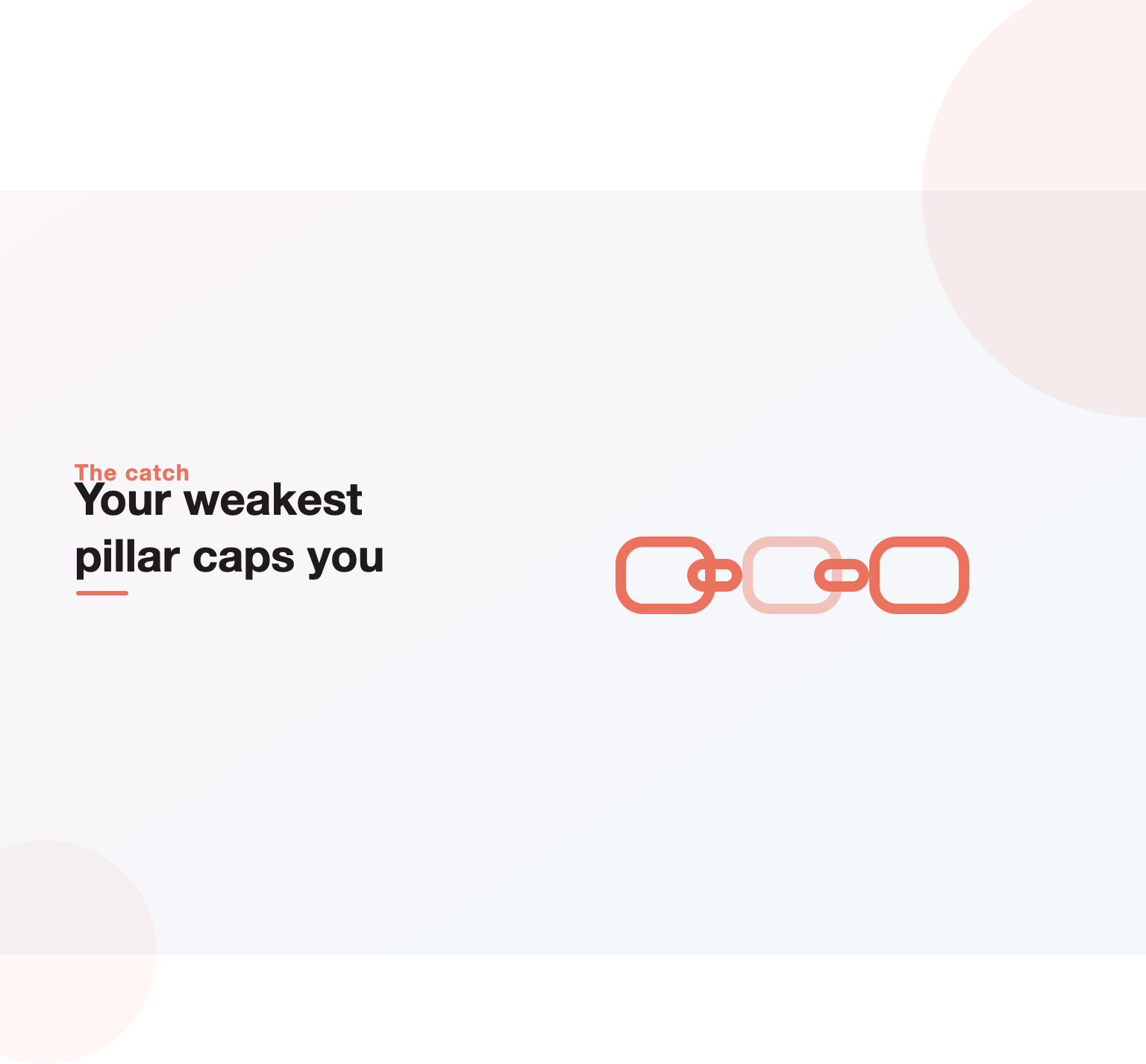
A useful way to picture the interaction is a chain: your citation odds are limited by your weakest pillar, not lifted by your strongest. A brand that is a nine out of ten on authority and structure but a three on engagement performs like a three, because the engine notices the answer does not satisfy and quietly stops citing it. Raising your weakest pillar almost always beats polishing your strongest, which is why the diagnosis of where you are weakest matters more than any single tactic you could apply.
Which pillar should you prioritise?
The right starting pillar depends on your situation, and the framework makes the diagnosis easy. A young brand with genuinely good content but little recognition has an Authority bottleneck: the engine may retrieve you but will not confidently quote a source it does not know, so the priority is entity consistency, credible mentions and expert authorship. An established brand whose pages ramble has a Structure bottleneck: the trust is there, but the answers are hard to lift, so answer-first rewriting is the fastest win available. A brand that ranks well and is trusted but still loses citations often has an Engagement problem, where the content is simply not as genuinely useful as what is currently cited.
Diagnose before you build. Ask your target question in the major engines, see who is cited, and judge which pillar your matching page is weakest on relative to the winners. That one judgement saves you from the common mistake of pouring effort into the pillar you already understand while ignoring the one that is actually holding you back. The point of breaking AEO into three pillars is precisely to make this prioritisation obvious rather than a matter of guesswork.
Measuring each pillar
Each pillar has its own rough measures, and tracking them keeps the work honest. For Authority, watch whether engines describe your brand accurately when asked about it, whether your entity information is consistent across the sources that matter, and whether credible mentions are accumulating. For Structure, audit whether your key pages lead with the answer, carry the right schema, and pass the extractability test, which is entirely within your control to check. For Engagement, look at whether people who arrive from AI citations stay and act, and whether your citations on a topic hold over time rather than fading.
Above all, track the outcome the pillars exist to produce: your citation rate and share of answer on the questions that matter to your buyers. The pillars are the levers; citation rate is the result. If you are advancing the pillars but the result is not moving, you are either working the wrong pillar for your situation or not going deep enough on it, and the diagnosis above tells you which. Our AI citation readiness audit and the complete AEO checklist turn these measures into a repeatable routine.
Why these three words hold the whole discipline
It is worth pausing on why authority, structure, engagement captures answer engine optimization so well when so many longer checklists do not. Almost every AEO tactic you will ever read about is really serving one of these three ends. Schema, headings and answer-first writing serve structure. Consistent brand data, credible mentions and expert authorship serve authority. Completeness, clarity and genuine usefulness serve engagement. When a new tactic appears, you do not have to add a line to an ever-growing list; you simply ask which of authority, structure, engagement it advances, and whether that is your bottleneck.
That is the quiet power of the framing. A discipline described as a hundred tips is impossible to prioritise and exhausting to keep current. The same discipline described as three pillars becomes legible: a writer knows whether a task is a structure job or an engagement job, a marketing lead can prioritise by pillar, and an executive can follow progress without learning every tactic. Answer engine optimization is young and its tactics will keep shifting, but the three outcomes engines reward, trust, extractability and genuine usefulness, are stable, which is why authority, structure, engagement is a durable way to hold the whole thing in your head.
A 90-day plan across the three pillars
Put together, the pillars turn into a simple quarter-long plan. In the first weeks, baseline your citation rate on your priority questions and fix Structure on the matching pages, since that is the fastest lever. Through the middle weeks, begin the slow Authority work, tightening entity consistency, adding credible authorship, and deepening topical coverage, knowing it will pay off over months rather than days. Throughout, hold the Engagement standard, refusing to publish a page that does not genuinely answer its question better than what is currently cited.
By the end of the quarter you will have a set of pages that are extractable today, an authority base that is compounding, and a quality bar that protects both. Then repeat the loop on the next set of questions. This is what it looks like to run answer engine optimization as a disciplined program rather than a collection of one-off fixes, and it all flows from keeping Authority, Structure and Engagement in view together. The pillar guide on answer engine optimization ties this back to the wider strategy.
We run answer engine optimization programs pillar by pillar, diagnosing whether Authority, Structure or Engagement is your bottleneck and working it, measured by citation rate and share of answer.
Key Takeaways
- Build authority through expertise and external recognition.
- Structure content answer-first so engines can extract it.
- Earn engagement that signals genuine usefulness.
- Strengthen the weakest pillar first for the biggest gain.
Frequently asked questions
What are the three pillars of AEO?
Authority, structure and engagement. Authority is whether an engine trusts your brand, structure is whether it can extract a clean answer from your page, and engagement is whether that answer genuinely satisfies the reader. Together they decide whether you get cited.
Which of the three pillars is most important?
None in isolation; they multiply. A trusted brand with a messy page loses to a clearer one, and a clean page from an untrusted brand gets passed over. Balance across all three beats brilliance in one.
Which pillar should I work on first?
It depends on your bottleneck. New brands usually need Authority, established brands with rambling pages need Structure, and brands that rank but do not truly help need Engagement. Diagnose by checking who gets cited for your questions and why.
How is Authority built for AEO?
Through entity consistency across the web, credible mentions from trusted sources, named expert authorship, and deep coverage of a focused set of topics. It is slow, months-long work, which is exactly what makes it defensible once earned.
Why do teams neglect the Engagement pillar?
Because it cannot be faked with markup or bought with links, it depends on the content genuinely being the best answer. That makes it the hardest pillar, so it gets skipped, and citations built on thin content quietly fade.
How do I measure progress on each pillar?
Authority: whether engines describe you accurately and mentions accumulate. Structure: whether pages lead with the answer and pass the extractability test. Engagement: whether visitors stay and citations hold. Above all, track citation rate and share of answer as the outcome.
Ready to put this into practice?
Talk to the team that runs SEO, AI search and paid growth programs every day.
Book a Strategy Call →