 Skip to content

How to Build an AEO Content Calendar
Build an AEO content calendar that gets you cited by AI: a free 2026 template, a 90-day plan, and the publishing cadence B2B teams use to win answer engines.
Quick Answer
An AEO content calendar plans content around the real questions your buyers ask AI engines, prioritising winnable, high-intent topics and scheduling the answer-first pieces, evidence, and authority-building that earn citations. It turns AEO from ad hoc effort into a repeatable pipeline.
To build an AEO content calendar, start from the real questions your buyers ask answer engines, organise them into pillar-and-spoke topic clusters, prioritise by commercial impact and citation gap, plan the internal linking up front, set a sustainable publishing cadence, and build in regular refreshes. A good calendar turns answer engine optimization from scattered posting into a compounding program that builds topical authority and gets you cited. This guide walks through each step, and gives you a simple structure to start from today.
Key Highlights
- Start from the real questions buyers ask answer engines, not from keyword lists.
- Organise those questions into pillar-and-spoke topic clusters that build authority together.
- Prioritise by commercial impact and citation gap, cover where you can win first.
- Plan internal linking up front so the cluster reads as one connected authority.
- Set a sustainable cadence and build in refresh cycles, AEO content decays without maintenance.
Why you need an AEO content calendar
An AEO content calendar turns answer engine optimization from scattered, reactive posting into a deliberate program that builds topical authority and covers the questions your buyers ask. Without one, teams publish whatever comes to mind, leave obvious questions unanswered, duplicate effort, and never build the comprehensive coverage that signals authority to AI engines. A calendar aligns your content to a strategy: which topics to own, in what order, with what internal linking, so each piece compounds the last instead of standing alone. It is the difference between a pile of articles and a coherent, citable body of work.
Start from the questions, not the keywords
An AEO calendar begins with the real questions your buyers ask answer engines, in their words, across every stage of their journey. Gather them from your sales and support teams, from the People Also Ask boxes and related questions in search, from the engines themselves, and from customer conversations. This question set is the backbone of the calendar. Traditional keyword volume still informs priority, but the unit of planning in AEO is the question, because that is what people ask an engine and what your content needs to answer cleanly enough to be cited.
Organise into content clusters and pillars
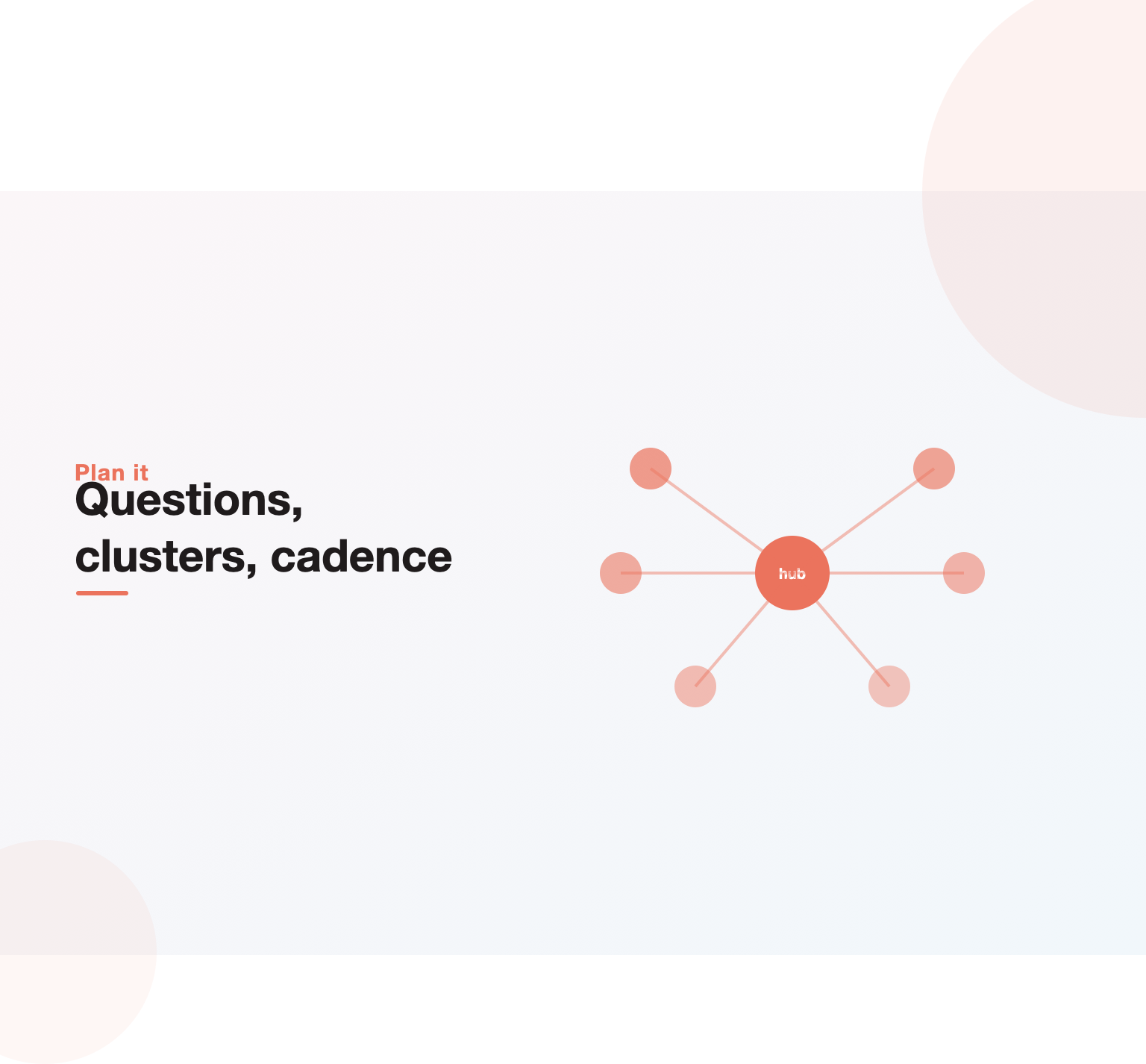
Group the questions into topic clusters, each anchored by a comprehensive pillar page with supporting spoke articles that answer specific sub-questions and link back to the pillar. This structure is not just tidy; it is how you build the topical authority that makes engines trust you on a subject. Covering a topic comprehensively, the pillar plus its spokes, signals genuine depth, while scattered one-off posts on unrelated topics signal none. Your calendar should be organised around completing clusters, so each publish moves a topic closer to full, authoritative coverage.
Prioritise by impact and gap
You cannot write everything at once, so sequence the calendar by a mix of commercial value and current gap. Prioritise questions that matter to your buyers and your revenue, where you are not yet cited, and where the competition is beatable. Start pillars early because their spokes depend on them, and front-load the clusters closest to your money pages so the authority you build feeds the pages that convert. A good calendar is ruthless about order: it does the work that moves visibility and pipeline first, not the work that is easiest or most interesting to write.
Plan the internal linking up front
Internal linking is part of the plan, not an afterthought. As you map the calendar, decide how spokes link up to their pillar, how related pieces link across, and how the whole cluster links to the money page it supports. Planning this up front means each new article slots into an intentional structure that distributes authority and helps engines understand how your content fits together. Retrofitting links later is harder and usually leaves gaps. The calendar should capture not just what you will publish, but how each piece connects to the rest.
Set a sustainable cadence
Consistency beats intensity. A steady, sustainable publishing cadence, whatever your team can genuinely maintain at quality, compounds over time and keeps clusters filling in, while a burst of content followed by months of silence does not build the authority engines reward. Match the cadence to your capacity, protect quality over volume, and build in time for the expansion and editing that answer-first, citable content requires. It is far better to publish fewer genuinely excellent, citable pieces on schedule than to flood a calendar with thin content that never gets cited.
Build in refresh and maintenance
An AEO calendar is not only about new content; it must schedule the updates that keep existing content citable. Reserve capacity every month for refreshing high-value and time-sensitive pages, because citations decay as content ages. A calendar that only ever adds new pages while old ones rot is a leaking bucket. Blend new publishing with planned maintenance so your whole library stays current, matching refresh frequency to how fast each page’s topic changes, as covered in our guide to how often to update content.
Measure and adapt the calendar
Treat the calendar as a living plan driven by results, not a fixed schedule you follow blindly. Track which published pieces earn citations and rankings, which clusters are gaining authority, and which questions you still lose, then feed that back into what you prioritise next. Double down on the topics and formats that perform, fill the gaps where competitors are cited and you are not, and drop plans that are not paying off. A calendar informed by real citation and ranking data gets sharper every quarter, which is what turns steady publishing into a compounding competitive advantage.
How an AEO content calendar builds topical authority
The real power of an AEO content calendar is that it builds topical authority on purpose rather than by accident. When your calendar is organised around completing clusters, each publish deepens your coverage of a subject, and comprehensive coverage is exactly what signals to answer engines that you are a genuine authority worth citing. A pile of unrelated one-off posts, by contrast, never accumulates into authority on anything. By sequencing the calendar cluster by cluster, pillar first, then the spokes that complete it, you move each topic from partial to comprehensive coverage deliberately, and you can watch authority and citations grow as each cluster fills in. The calendar is not just a schedule; it is the mechanism by which scattered effort compounds into the depth engines reward.
Balancing evergreen and timely content
A healthy calendar blends durable, evergreen pieces that keep earning citations for years with timely content that captures current interest and demonstrates that you are active and current on your topic. Lean too far toward evergreen and you miss the moments and trends your audience is asking about now; lean too far toward timely and you build a library that is stale within months and constantly needs replacing. The balance depends on your category, but most brands are served by a core of evergreen cluster content that builds lasting authority, punctuated by timely pieces on developments, data and trends. Plan both into the calendar deliberately rather than letting whichever is more urgent crowd the other out.
Common AEO content calendar mistakes
A few calendar mistakes recur. Planning around keywords or campaign themes instead of the questions buyers actually ask produces content that does not map to real queries. Chasing volume over quality fills the calendar with thin pieces that never get cited. Publishing scattered one-off posts instead of completing clusters means authority never accumulates. Ignoring refreshes lets earned citations decay while you chase new ones. And treating the calendar as fixed, rather than adapting it to what actually earns citations, keeps you repeating what does not work. Avoiding these is mostly a matter of planning around questions and clusters, protecting quality, and letting real results reshape the plan.
Adapting the calendar to your team’s size
The right calendar looks different for a solo marketer and a full content team, and pretending otherwise sets you up to fail. A small team should plan a modest, sustainable cadence, focus ruthlessly on one or two high-value clusters at a time, and lean on refreshing and extending existing pages as much as publishing new ones. A larger team can run several clusters in parallel, produce more ambitiously, and dedicate capacity to original research and data that smaller teams cannot. The principle is constant, questions, clusters, priority, cadence, refreshes, but the scale flexes to what you can genuinely sustain at quality. A calendar you cannot keep up with is worse than a smaller one you can, because consistency is what compounds.
Tools and templates for your calendar
You do not need specialist software to run an AEO content calendar; a well-structured spreadsheet or a project tool your team already uses is enough to start. What matters is that it captures the right fields: the cluster, the pillar and spoke questions, the target intent, the priority, the owner, the status from planned through published, the publish date and the last-refreshed date. Keyword and question research tools help you build the question set, and your analytics and periodic prompt tests feed the results back in. The tooling is secondary; the discipline of planning around questions and clusters and keeping the calendar current is what produces the compounding advantage, whatever tool you record it in.
How far ahead to plan your AEO content calendar
Plan far enough ahead to be strategic, but not so far that the plan becomes fiction. A practical horizon is a detailed quarter, the specific pieces, owners and dates for the next three months, sitting inside a looser annual view of which clusters you intend to build in what order. The quarter gives your team something concrete to execute; the annual view keeps each quarter pointed at the bigger goal of completing your priority clusters. Revisit the plan every quarter with real performance data in hand, promoting the topics that are earning citations and reordering around what you have learned. Planning at these two horizons keeps you both deliberate and adaptable, rather than either improvising week to week or rigidly following a year-old plan that no longer fits.
Fitting the calendar into your wider growth plan
An AEO content calendar should not sit in isolation from the rest of your marketing. The clusters you prioritise ought to map to the products and services you most want to sell, so the authority you build feeds the money pages that convert. Coordinate the calendar with your paid, social and email efforts so a strong piece of content gets amplified rather than left to find its own audience, and so the demand you create elsewhere lands on content ready to answer it. When the content calendar is wired into the wider growth plan this way, each article does double duty, building citations and authority while directly supporting pipeline, which is what turns a content program from a cost centre into a genuine growth engine.
Start small, then scale the calendar
The most common way an AEO content calendar fails is being too ambitious to sustain. It is far better to start with one or two priority clusters and a cadence you can genuinely hold than to plan a sprawling program that stalls after a month. Begin by fully covering your single most valuable topic, pillar and spokes, so you build real, demonstrable authority in one area rather than shallow coverage across many. Once that cluster is complete and earning citations, use what you learned to plan the next, and expand the calendar as your capacity and confidence grow. Early, visible wins also make it far easier to justify more resource for content, which lets the program scale on the back of proven results. A small calendar you execute completely beats a large one you abandon, every time, because in AEO it is finished, comprehensive coverage, not planned coverage, that earns the citations.
Keeping the calendar alive
A content calendar is only as good as your habit of returning to it, so build in a light recurring rhythm to keep it alive. Once a month, review what published, mark what earned citations or rankings, slot in the refreshes that are due, and adjust the coming weeks based on what you have learned. Once a quarter, step back to check whether your cluster priorities still match your commercial goals and reorder if they have shifted. This light governance stops the calendar from quietly dying the way most content plans do, abandoned after a burst of enthusiasm. It also keeps the plan honest, because a calendar reviewed against real results steadily concentrates your effort on the topics and formats that actually earn citations and pipeline. The discipline is modest, an hour or two a month, but it is the difference between a calendar that compounds into durable authority and one that becomes a stale document nobody opens.
A simple structure to start
If you are building your first AEO content calendar, keep it simple: a list of your priority topic clusters, the pillar and spoke questions under each, a priority order, a realistic monthly publishing and refresh cadence, and an owner for each piece. Track status from planned through drafted, published and last-refreshed. That is enough to turn scattered effort into a program. Sophistication can come later; what matters first is that your content is planned around the questions your buyers ask, organised into authoritative clusters, and produced consistently at a quality that earns citations.
We plan and produce answer-first content calendars built around your buyers’ questions, structured into authoritative clusters that earn citations across the major AI engines.
Where this fits in the bigger AEO picture
This guide is one piece of a larger system. For the whole framework, read the complete answer engine optimization guide and, if you are new, what AEO actually is. The mechanics behind it are in how AEO works and how engines choose which brands to cite, and the authority side in the E-E-A-T guide and building topical authority. Read together they turn individual tactics into a coherent, compounding program.
A sample 12-week AEO content calendar
Seeing a filled-in calendar makes planning much easier. Here is an example for a mid-sized B2B software company with one writer and part-time support from a subject expert.
Weeks 1 to 2: research. Collect 60 buyer questions from sales calls, support tickets, Search Console queries and People Also Ask results. Group them into four clusters and check which questions AI engines already answer with competitor content.
Weeks 3 to 4: pillar page. Publish a comprehensive guide for the most important cluster, with a direct answer to the core question at the top and sections for the main sub-questions.
Weeks 5 to 8: supporting pages. Publish one supporting article per week, each answering a specific sub-question in depth and linking back to the pillar page.
In practice, weeks 9 to 10: refresh. Update two older articles in the same cluster, adding direct answers, current figures and links to the new pages.
In many cases, weeks 11 to 12: measure and plan. Run the cluster’s questions through the main AI engines, record citations, and use the results to plan the next cluster.
This rhythm produces one complete cluster per quarter. It is modest, but a year of it delivers four well-covered topics, which is usually worth more than dozens of disconnected posts.
Fields to include in your calendar
A useful calendar holds more than titles and dates. Include these fields for each entry: the main question the piece answers, the cluster it belongs to, the primary keyword, the content type, the target publish date, the writer, the subject expert, the internal pages it must link to, the status and the review date for its first refresh.
Add two fields that are specific to AEO: the current citation status for the main question, and the competitor currently cited. These turn the calendar into a record of opportunity as well as production, and they make it easy to see later whether each piece achieved what it was meant to.
AEO content planning tool vs spreadsheets
Many teams wonder whether they need specialist software. For most small and mid-sized teams, a shared spreadsheet is enough. It is free, flexible and easy to adapt as the process evolves. Its weaknesses appear at scale: with several writers, many clusters and hundreds of pages, keeping statuses current and spotting overlaps becomes harder.
Dedicated planning tools and project management platforms help with workflows, approvals and deadlines. Some content and SEO platforms also suggest questions, track rankings and monitor AI citations, which reduces manual work. The trade-off is cost and the time needed to set them up properly.
A sensible approach is to start with a spreadsheet, run the process for two or three quarters, and only then choose a tool that fits the workflow you have proven. Buying software first often means bending your process to fit the tool rather than the reverse.
Getting input from across the business
The best calendars draw on people who hear customer questions every day. Ask sales to share the questions that come up on calls, support to share the most frequent tickets, and product teams to flag upcoming changes that will need new or updated content. A short monthly request, with a simple form, keeps the flow of ideas steady without adding meetings.
Subject experts are equally important. Engines and readers both reward first-hand expertise, and experts can supply the examples, data and opinions that make content citable. Schedule their time in the calendar itself, so interviews and reviews happen on time rather than delaying publication.
Adapting the calendar for different industries
Ecommerce brands should align clusters with seasonal demand, publishing buying guides well before peak periods. Local service businesses should plan clusters around their main services and the questions customers ask before booking, such as cost, timing and how to choose a provider. Professional services firms should plan around regulatory changes and client deadlines, which create predictable spikes in questions. Software companies should plan around product launches and the comparison questions buyers ask when evaluating alternatives.
Whatever the industry, keep the same core discipline: start from real questions, plan in clusters, link pages together and measure citations. An AEO content calendar built this way grows topical authority steadily, and it gives the team a clear plan for every week of the year. If you want help building one, our AEO services team can set it up with you.
Linking the calendar to your wider content library
Every new piece should strengthen what already exists. Before scheduling a topic, check which published pages cover related questions and plan links between them. Our guide on how to do keyword research explains how to find and group the questions that feed the calendar, and the AEO checklist covers what each published page should include.
Schedule refreshes alongside new content. Our guide on how often to update content for AI citations sets out sensible review intervals for different content types. Building those reviews into the same calendar ensures older pages keep supporting the new ones rather than drifting out of date.
Finally, keep the vocabulary consistent across the team. When writers, editors and stakeholders use terms in the same way, briefs are clearer and reviews faster. Our AEO glossary is a useful shared reference, and it helps new team members understand the calendar fields from their first week.
Reviewing the calendar each quarter
At the end of each quarter, compare what was planned with what was published and what results followed. Note which clusters earned citations quickly and which did not, and look for the reasons: question choice, depth, authority or freshness. Adjust the next quarter’s plan based on what you learn. Drop topics that no longer matter, bring forward questions that sales and support report more often, and add refreshes for pages that have started to slip.
This review keeps the calendar tied to results rather than habit. Without it, calendars tend to fill with topics chosen months earlier for reasons nobody remembers.
Keeping the team motivated
Content calendars often fade because the team never sees results. Share wins as they happen: a new citation in an AI answer, a page reaching the first page of Google, a lead that mentions a specific article. Post them in a shared channel and include them in the quarterly review. Recognition makes the routine work of planning, writing and refreshing feel connected to outcomes, and it keeps contributors from sales, support and product engaged in supplying questions and expertise month after month.
A calendar that is visibly producing results is also far easier to defend when budgets are reviewed.
When to change the plan mid-quarter
A calendar should be stable, but not rigid. Change it when something significant happens: a product launch, a regulatory change, a competitor move or a sudden rise in a new question from customers. In those cases, insert the new topic and push the lowest-priority item to the next quarter rather than overloading the team. Record the reason for each change so the quarterly review can assess whether the switch paid off. Small, deliberate adjustments keep the calendar relevant without losing the steady rhythm that makes it effective.
Over a full year, a calendar managed this way becomes a record of how your topical coverage grew, which questions you now own in AI answers and which still need work. That record is the best possible starting point for planning the following year, because it is built on your own results rather than on assumptions or generic industry advice about what should work.
Keep the plan simple, keep it visible and keep it tied to the questions your buyers actually ask.
Key Takeaways
- In practice, start from the buyer questions AI engines answer in your category.
- Prioritise winnable, high-intent topics with genuine demand.
- Schedule answer-first pieces plus the evidence and authority work.
- Review citation presence and adjust the calendar on a cadence.
Frequently asked questions
How do I build an AEO content calendar?
In many cases, start from the real questions your buyers ask answer engines, organise them into pillar-and-spoke topic clusters, prioritise by commercial impact and where you are not yet cited, plan internal linking up front, set a sustainable publishing and refresh cadence, and assign an owner to each piece.
How is an AEO content calendar different from a normal editorial calendar?
It is planned around questions rather than keywords or campaign themes, organised into pillar-and-spoke clusters to build topical authority, and it schedules refreshes of existing pages alongside new content, because citation readiness decays as content ages.
What should I publish first?
For most teams, start with the pillar pages of your highest-priority clusters, since spokes depend on them, and front-load the clusters closest to your money pages so the authority you build feeds the pages that convert. Sequence by commercial value and where you are not yet cited.
How often should I publish for AEO?
At whatever cadence your team can sustain at quality. Consistency compounds and keeps clusters filling in, while bursts followed by silence do not build authority. Protect quality over volume, and reserve capacity each month for refreshing existing pages.
Should an AEO calendar include content updates, not just new posts?
Yes. Citations decay as content ages, so a calendar that only adds new pages while old ones go stale leaks visibility. Blend new publishing with scheduled refreshes, matching update frequency to how fast each page’s topic changes.
How do I know if my content calendar is working?
Track which pieces earn citations and rankings, which clusters are gaining authority, and which questions you still lose, then feed that back into your priorities. A calendar informed by real citation and ranking data gets sharper every quarter.
Ready to put this into practice?
Talk to the team that runs SEO, AI search and paid growth programs every day.
Book a Strategy Call →