 Skip to content


AI Cold Calling: Is It Legal, What It Costs, and What 20 Vendors Do (and Don’t) Tell You (2026)
AI cold calling explained: autonomous AI callers vs AI dialers vs practice tools, TCPA rules after the FCC's 2024 ruling, and what 20 vendors publish on pricing and compliance.
Quick Answer
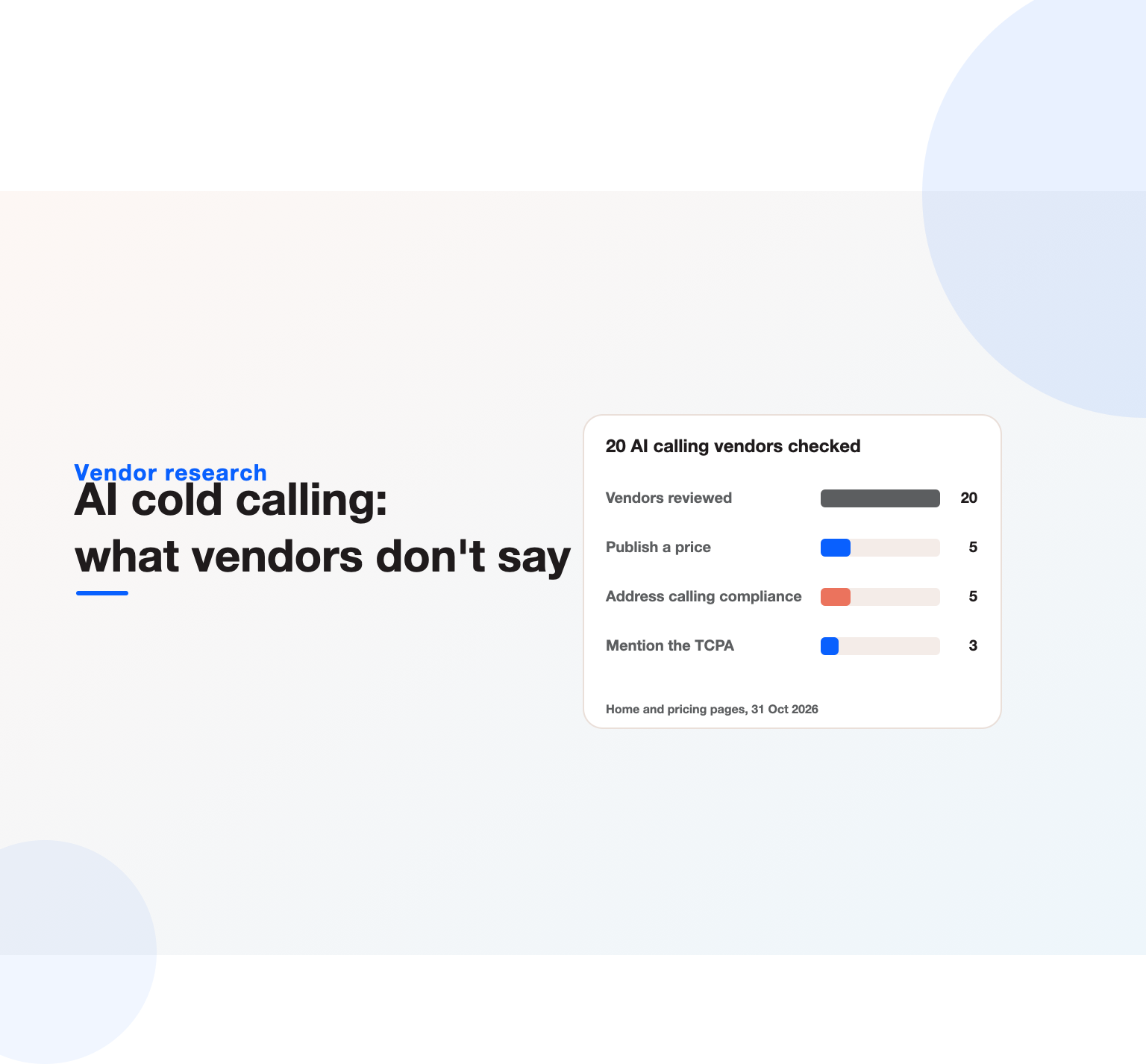
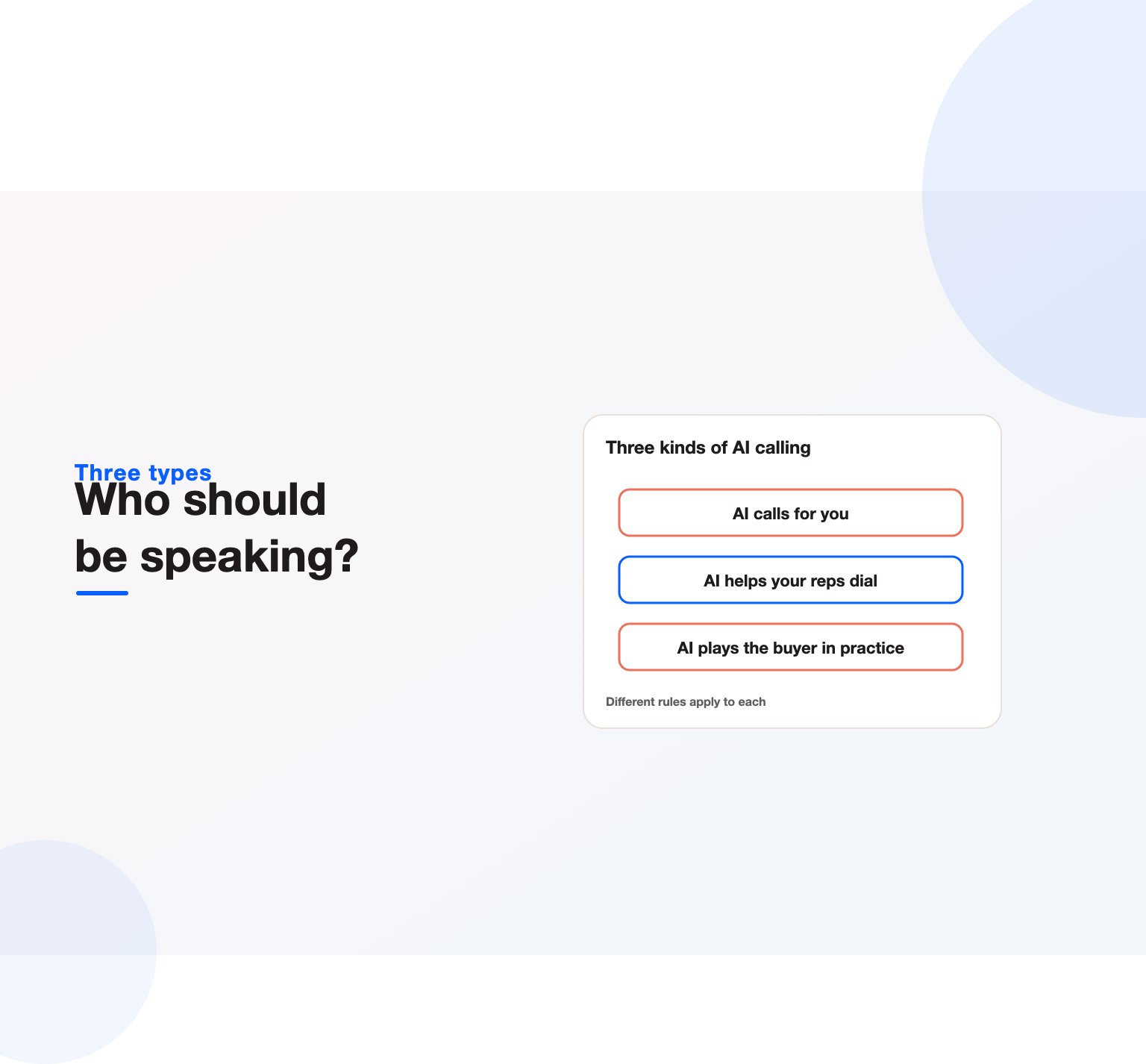
AI cold calling means using artificial intelligence in outbound sales calls, in one of three ways: AI voice agents that place and hold the call themselves, AI-powered dialers that help human reps call faster and smarter, and AI roleplay tools that let reps practise cold calls against a simulated buyer. Each carries different rules. In the US, the FCC confirmed in 2024 that AI-generated voices count as “artificial” voices under the Telephone Consumer Protection Act, so autonomous AI calls to consumers generally need prior express consent. We reviewed the websites of 20 vendors in this space on 31 October 2026: only 3 mention the TCPA on the pages we checked, only 5 address calling compliance at all, and only 5 publish a price.
Key Highlights
- The category covers three types of product: autonomous AI callers, AI-assisted dialers for human reps, and AI practice tools.
- The FCC’s February 2024 declaratory ruling treats AI-generated voices as artificial voices under the TCPA.
- In our review of 20 vendors, only 3 mentioned the TCPA and only 5 addressed consent or do-not-call rules on their home or pricing pages.
- Pricing is scarce: 5 of 20 publish it, and autonomous callers that do charge per minute, from about 7 to 31 cents.
- All four AI practice vendors we reviewed sell through demos, despite strong search demand for “ai cold calling practice”.
- The safest high-return uses today are AI-assisted dialing, call preparation and practice, with autonomous calling limited to consented contacts.
What is AI cold calling?
Cold calling has always been a numbers game: dial many prospects, reach a few, book fewer meetings. AI changes the economics at every step, from choosing who to call and when, to the conversation itself, to coaching afterwards. Interest has surged: “cold calling ai” and “ai cold calling practice” each draw around 900 searches a month in the US, “ai cold calling” around 500, and “conversational ai for cold calling” another 200. Questions such as “is ai cold calling illegal” and “how to use ai for cold calling” show that buyers want both capability and reassurance.
The term covers three very different products.
| Type | What it does | Who talks to the prospect | Examples we reviewed |
|---|---|---|---|
| Autonomous AI callers | An AI voice agent dials, speaks, qualifies and books meetings | The AI | Bland AI, Retell AI, Synthflow, Vapi, Thoughtly, Air AI, 11x, Artisan, Alta |
| AI-assisted dialers | Parallel dialing, voicemail detection, live notes, call summaries, coaching cues | A human rep | Nooks, Orum, Kixie, Aircall, Dialpad, JustCall, Koncert |
| AI practice tools | Simulated buyers for roleplay, scoring and feedback | Nobody external: it is training | Hyperbound, Second Nature, Yoodli, Pitch Monster |
Choosing between them starts with a simple question: who should be speaking to this prospect? If the answer is a person, because the deal is complex, the buyer is senior or trust is everything, then AI belongs around the call: research, dialing, notes and practice. If the contact asked to be called and needs a quick, standard answer or a booking, an AI voice can handle the conversation itself. Most successful AI cold calling programmes use both, deliberately, rather than letting the newest tool dictate the approach. The rest of this guide covers the rules, the evidence from vendors, and a practical plan for each type.
If you are evaluating voice technology more broadly, our comparison of AI voice agents covers per-minute pricing for inbound and outbound use. This guide focuses on outbound sales and the rules that govern it.
Is AI cold calling illegal?
It is not illegal in itself, but it is regulated, and the rules depend on who you call, where they are and how the call is made.
United States
In February 2024 the Federal Communications Commission issued a declaratory ruling confirming that the Telephone Consumer Protection Act’s restrictions on “artificial or prerecorded voice” calls apply to AI technologies that generate human-sounding voices. In practice, that means:
- Autonomous AI calls to residential and mobile numbers generally require the called party’s prior express consent, and prior express written consent for telemarketing.
- Calls must carry required identification and opt-out mechanisms.
- National and internal do-not-call rules still apply; the National Do Not Call Registry is the starting point.
- Several states add their own telemarketing rules, including calling hours and disclosure requirements.
Human reps using an AI-assisted dialer are in a different position: the voice is human, though autodialer, calling-hour and do-not-call rules can still apply depending on the technology and the call.
United Kingdom
The Privacy and Electronic Communications Regulations govern marketing calls. The ICO’s guidance on telephone marketing explains that automated marketing calls need specific prior consent, while live calls must screen against the Telephone Preference Service unless the person has consented.
India and other markets
India’s telecom regulator requires commercial callers to register and follow customer preference rules, and many other countries have do-not-call registries and consent requirements for automated calls. Rules differ widely, so get local advice before calling across borders.
This is general information, not legal advice. Anyone deploying autonomous calling should have counsel review consent capture, scripts, disclosures and call records.
Our research: how vendors handle pricing and compliance
Because the legal stakes are high, we wanted to see how openly vendors address them. On 31 October 2026 we reviewed the home page and, where available, the pricing page of 20 vendors across the three categories, and recorded whether those pages mention the TCPA, do-not-call rules or consent for calling, and whether they publish a price.
| Category | Vendors reviewed | Mention TCPA | Address calling compliance | Publish a price |
|---|---|---|---|---|
| Autonomous AI callers | 9 | 2 | 3 | 3 |
| AI-assisted dialers | 7 | 1 | 2 | 2 |
| AI practice tools | 4 | 0 | 0 | 0 |
| Total | 20 | 3 | 5 | 5 |
What we found
- Compliance is rarely front and centre. Just three vendors, Retell AI, Thoughtly and Koncert, mentioned the TCPA on the pages we reviewed. Retell’s page states plainly that outbound calling requires prior consent under the TCPA. Artisan and Kixie mentioned do-not-call list handling.
- Most autonomous callers say nothing about consent up front. Six of the nine autonomous vendors did not mention TCPA, consent for calls or do-not-call rules on those pages. That does not mean their products ignore compliance, but buyers should ask directly.
- Pricing is mostly behind demos. Five vendors showed prices: Bland AI (14 cents a minute), Retell AI (7 to 31 cents a minute), Vapi (per-component per-minute pricing), Aircall (from 30 dollars per licence a month) and Dialpad (from 89 dollars per user a month).
- Practice tools are demo-only. None of the four AI roleplay vendors showed a price, even though “ai cold calling practice” is one of the most searched terms in the category.
The takeaway for buyers: compliance due diligence falls on you. Ask every vendor the questions later in this guide before a single call goes out.
Autonomous AI callers: where they fit
Fully automated outbound calling is the most hyped and the most constrained category. The technology is impressive: modern voice agents handle interruptions, answer common questions and book meetings into calendars. The constraint is consent. Because consumer calls generally require prior consent, the realistic uses are:
- Speed-to-lead calls to people who have just requested a call or submitted a form with consent.
- Reactivation of existing customers or leads who have agreed to be contacted.
- Appointment confirmation and rescheduling.
- Event and webinar follow-up with registrants who opted in to calls.
- Qualification of inbound enquiries before a human takes over.
Truly cold, unconsented autonomous calls to consumers are where legal risk concentrates. Business-to-business calling rules differ by country, but reputational risk remains: prospects who feel tricked by a bot rarely become customers. Disclosing that the caller is an AI assistant is a sensible default.
AI-assisted dialers: the practical middle ground
For most B2B sales teams, the biggest return from AI in cold calling today comes from helping human reps rather than replacing them. AI-assisted dialers typically offer:
- Parallel or power dialing that skips unanswered calls and voicemail so reps spend more time in conversations.
- Prioritisation of who to call and when, based on engagement and fit.
- Live assistance: talk tracks, objection prompts and competitor notes on screen during the call.
- Automatic notes and CRM logging, with call summaries and next steps.
- Coaching analytics: talk-to-listen ratio, objection patterns and outcome trends.
Because a human is speaking, trust is higher and many of the artificial-voice rules do not apply in the same way, though do-not-call and calling-hour rules still do. This is also where AI fits best with a modern B2B lead generation strategy: humans have better conversations with better-chosen prospects.
AI cold calling practice: training reps with simulated buyers
Search demand for “ai cold calling practice” is as high as for “cold calling ai”, which makes sense: practice has no legal risk and immediate value. Roleplay tools simulate buyer personas, from a busy chief financial officer to a sceptical IT manager, and score reps on openers, discovery questions, objection handling and closing for a next step.
The benefits are practical. New reps can make hundreds of practice calls before touching a real prospect. Managers can assign specific scenarios, such as handling “send me an email” or a competitor objection, and review scores instead of listening to every call. Experienced reps can rehearse before high-stakes calls.
To get value from practice tools:
- Build personas from real calls. Use actual objections, language and situations from your market.
- Define what good looks like. Agree scoring criteria with your best reps.
- Practise little and often. Short daily sessions beat occasional long ones.
- Connect practice to live results. Compare practice scores with connect-to-meeting rates over time.
You can also run simple practice with a general assistant: describe the persona and objections, ask it to play the buyer, and ask for feedback afterwards. Our guide to ChatGPT for marketing includes prompts for sales enablement.
How to use AI for cold calling: a step-by-step plan
- Clean and segment your list. Remove numbers on do-not-call registries and internal suppression lists, and record consent status for every contact.
- Prioritise accounts with AI research. Let AI summarise company news, hiring signals and likely pains, so every call starts with relevance. See our guide to AI agents for marketing for research workflows.
- Write talk tracks with AI, refine with your best rep. Draft openers, value statements and objection responses, then test them on practice calls.
- Train with roleplay. Each rep completes practice scenarios before live calling.
- Dial with AI assistance. Dial through an AI-assisted dialer for connect rates, live prompts and automatic logging.
- Reserve autonomous calling for contacts who gave consent, such as speed-to-lead follow-up and reactivation.
- Review and coach weekly using call summaries and analytics.
- Measure outcomes: connect rate, conversation-to-meeting rate, meetings held and pipeline created.
Writing an AI cold calling script
Whether a human or an AI delivers it, a good cold call has four parts.
- Permission-based opener: “Hi Priya, it’s Sam from [company]. You weren’t expecting my call. Can I take 30 seconds to explain why I rang, and you can tell me if it’s worth continuing?”
- Relevant reason: one specific observation about their situation, such as a new market, a hiring push or a common problem in their role.
- Question, not pitch: “How are you handling [problem] today?”
- Clear next step: a short meeting with a specific benefit, or permission to send something useful.
For autonomous AI calls, add a clear statement that the caller is an AI assistant, the company name, the reason for the call and an easy way to opt out. Keep scripts short and let the AI hand over to a human whenever the prospect asks a complex question or wants to talk to a person.
Building a consent-first calling flow
The single most important design decision is how consent is captured and checked. A consent-first flow makes automated follow-up possible and protects the brand.
- Capture consent explicitly. On forms, include a clear, unticked checkbox stating that the person agrees to be called, including by automated or AI voice, about a specific topic, by your company.
- Store proof. Record the timestamp, page, wording and IP or device details with the contact record.
- Check before every call. Your dialer or voice platform should verify consent status and suppression lists before dialing.
- Honour opt-outs immediately. Any request to stop should update every system within a defined, short window.
- Audit regularly. Sample calls monthly for disclosure, script compliance and correct hand-offs.
This flow also improves results: people who asked for a call answer more often and are more receptive. Our guide to AI lead generation shows how to design forms and offers that earn that consent.
Combining calls with email and LinkedIn
Calling works best as part of a sequence rather than on its own. A typical B2B pattern looks like this: a relevant email, a LinkedIn connection or engagement, a call two or three days later referencing the email, a follow-up email with something useful, and a final call. AI helps at each step: researching the account, personalising the first line of each email, choosing the best time to call and summarising every touch in the CRM.
Coordinating channels also reduces pressure on any one of them. A prospect who has seen your name in their inbox and feed is more likely to pick up. Paid social can warm accounts before outreach; our research on the LinkedIn ads library shows what leading B2B brands promote. For the email side, our collection of email marketing examples is a useful reference, and lead nurturing strategies covers what happens after the first conversation.
A worked example: one week of AI-supported outbound
Here is how a small B2B team selling software to mid-sized manufacturers might run a week with AI support.
- Monday: an AI research workflow summarises 150 target accounts, flagging recent expansions and new operations leaders. Reps review the top 60.
- Tuesday: reps spend 20 minutes on AI roleplay against a “sceptical plant manager” persona, then send personalised emails drafted with AI and edited by hand.
- Wednesday and Thursday: calling blocks in an AI-assisted dialer, with live prompts for the two most common objections and automatic notes.
- Thursday afternoon: a voice agent calls inbound leads who requested a call that week, qualifies them and books meetings, handing complex questions to a rep.
- Friday: the manager reviews call summaries and practice scores, updates the talk track and shares two recordings of good calls.
Nothing in this week involves unconsented automated calls, yet AI touches every step. That is the pattern most teams should start with.
Team roles and ramp time
Introducing AI changes what reps and managers spend time on. Reps spend less time on research and admin and more on conversations. Managers shift from listening to random calls to reviewing analytics and targeted recordings. A sales or revenue operations owner is needed to manage tools, data, consent records and costs. Plan for a ramp of four to eight weeks: two weeks of practice and setup, then gradual live use with weekly reviews. Keep the tool stack lean; our SaaS tech stack study shows how quickly overlapping tools accumulate.
Questions to ask vendors before you buy
- How does your product capture, store and check consent before an automated call?
- Do you scrub against national and internal do-not-call lists automatically?
- Can calls disclose that the caller is an AI, and is that configurable by region?
- How are calling-hour rules enforced across time zones?
- Where are recordings and transcripts stored, and for how long?
- What is the all-in cost per connected minute, including telephony and models?
- How do hand-offs to human reps work, and how fast?
- Can we see examples of call recordings in our industry?
Handling objections with AI support
Objections are where most cold calls are won or lost, and they are also where AI helps most in a practical way. Analysing call transcripts reveals which objections come up most often in your market and which responses lead to meetings. Typical early objections include “send me an email”, “we already have a tool for that”, “not a priority right now” and “how did you get my number”. Each deserves a short, honest response that keeps the conversation open without pressure.
AI helps in three ways here. First, mine your recorded calls for the ten most frequent objections and the responses that preceded booked meetings. Second, turn those into talk-track cards that appear in the dialer when the objection is detected. Third, build practice scenarios around each objection so reps rehearse until the response sounds natural rather than scripted. For “how did you get my number”, the honest answer, including where the data came from and an offer to remove them, matters for compliance as much as for rapport.
Review the objection library quarterly, and retire responses that no longer earn meetings. Markets change, competitors launch new messages, and the objections that matter shift with them.
Data quality: the hidden driver of results
Every form of AI calling depends on contact data. Wrong numbers waste minutes, outdated job titles undermine relevance, and missing consent records create risk. Before investing in any calling tool, check four things: the share of numbers that connect to the right person, how recently records were verified, whether consent and suppression status are stored with each contact, and whether call outcomes flow back into the CRM automatically. Teams that fix data first often see bigger gains than any tool can deliver, because better lists lift connect rates and conversation quality at the same time.
Measuring AI cold calling
| Metric | What it tells you |
|---|---|
| Dials per rep per hour | Efficiency gains from AI dialing |
| Connect rate | List quality and timing |
| Conversation-to-meeting rate | Script and rep effectiveness |
| Meeting show rate | Lead quality and confirmation process |
| Pipeline per 100 conversations | Business impact |
| Opt-out and complaint rate | Compliance and reputation risk |
| Practice score trends | Rep skill development |
Tie calls to opportunities in your CRM so you can see which segments and scripts create pipeline; our guide to marketing attribution covers how to credit outbound properly.
Costs: what to budget
Costs depend on the category. Autonomous callers that publish prices charge per minute, roughly 7 to 31 cents a minute in our review, before telephony extras in some cases. Dialers with AI assistance are usually priced per user per month, with published plans in our review starting from 30 dollars per licence (Aircall) and 89 dollars per user (Dialpad); specialist parallel dialers such as Nooks and Orum quote through sales. Practice tools are sold through demos, typically per seat.
The bigger costs are often list data, rep time and management. A useful rule: model cost per meeting held, not cost per minute or per seat, and compare it with your other channels, such as paid social or content.
B2B vs B2C: different rules, different plays
In B2C, consent rules for automated calls are strict in most markets, so autonomous AI calling is mainly suited to customers and leads who have opted in. In B2B, rules vary by country, and calls to business numbers may be treated differently, but mobile numbers, which many professionals use for work, often carry consumer-style protections. For B2B teams, the highest-return combination is AI research and prioritisation, AI-assisted human dialing, and AI practice, with autonomous follow-up for inbound leads. Pair outbound with inbound demand programmes so reps call warmer prospects; see our guide to B2B demand generation.
AI cold calling in India
India has some of the world’s largest calling operations, and AI is changing them quickly, especially through voice agents that handle Hindi, English and regional languages. Commercial calling is regulated by the telecom regulator, with requirements for registered headers and respect for customer preferences, and data protection obligations apply to call recordings and personal data. For many Indian businesses, WhatsApp is a complementary channel with its own opt-in rules; our guide to WhatsApp marketing in India explains how the two can work together.
Common mistakes with AI cold calling
- Assuming B2B means no rules. Mobile numbers and local laws can bring consumer protections into B2B calling.
- Hiding that the caller is AI. It damages trust and may break disclosure rules.
- Calling stale or unverified lists. Poor data wastes minutes and raises complaint rates.
- Skipping human hand-off. Interested prospects should reach a person quickly.
- Measuring dials instead of meetings. Activity is not outcome.
- Buying before practising. Train reps with roleplay before scaling dialing.
Where AI-powered outbound calling is heading
Expect three developments. Regulators will continue to clarify how AI voices fit consent and disclosure rules, so compliance features will become a buying criterion. Voice agents will get better at natural conversation and at handing over to humans mid-call. And practice and live calling will merge: the same AI that scores practice calls will coach reps in real time on live calls. Teams that build consent-first processes now will be able to adopt each improvement safely.
Want help designing a compliant, AI-assisted outbound programme? Our lead generation team combines list strategy, AI tooling and measurement, or you can talk to us directly.
A final word on expectations. AI will not rescue a weak offer, a poorly defined target market or a list of people who have no reason to talk to you. It amplifies what is already there. Teams with a sharp ideal customer profile, a clear reason to call and disciplined follow-up will see the largest gains, because AI removes the friction around good work rather than replacing the work itself.
Methodology
On 31 October 2026 we reviewed the public home page and, where one existed, the pricing page of 20 vendors marketed for AI-led outbound calls, AI-assisted dialing or AI cold call practice. We classified each vendor by category and recorded whether those pages mentioned the TCPA, do-not-call rules or consent for calls, and whether a price was published. Mentions elsewhere on a vendor’s site, such as help centres or legal pages, were not counted, so the compliance figures reflect what a buyer sees on first visit, not product capabilities. Pricing reflects published list prices on the day. The FCC citation refers to its February 2024 declaratory ruling on AI-generated voices under the TCPA. This article is general information and not legal advice. The dataset is available on request.
Key Takeaways
- AI in outbound calling spans autonomous AI callers, AI-assisted dialers for human reps, and AI practice tools.
- In the US, AI-generated voices are treated as artificial voices under the TCPA, so autonomous calls to consumers generally need prior consent.
- Just 3 of 20 vendors we reviewed mentioned the TCPA, and only 5 addressed calling compliance on their main pages; due diligence falls on the buyer.
- Five of 20 publish prices; autonomous callers that do charge about 7 to 31 cents a minute.
- The safest high-return path is AI research, AI-assisted human dialing and AI practice, with autonomous calls reserved for consented contacts.
Frequently asked questions
Is AI cold calling legal?
It is legal but regulated. In the US, the FCC has confirmed that AI-generated voices fall under TCPA rules on artificial voices, so automated calls to consumers generally require prior consent. Other countries have their own consent and do-not-call rules. Get legal advice before launching.
What is the best AI tool for cold calling?
It depends on the job. Assisted dialers such as Nooks, Orum, Kixie or Dialpad help human reps; voice platforms such as Retell AI, Bland AI or Synthflow power autonomous calls to consented contacts; Hyperbound, Second Nature, Yoodli and Pitch Monster support practice.
How much does AI calling software cost?
Autonomous callers that publish prices charge roughly 7 to 31 cents a minute. AI-assisted dialers are usually priced per user, from about 30 to 89 dollars a month in the published plans we found. Many vendors quote only through sales.
Can AI practise cold calls with my sales reps?
Yes. AI roleplay tools simulate buyer personas and score reps on openers, discovery and objection handling. Practice has no legal risk and is one of the fastest ways to improve call results.
Should an AI caller say it is an AI?
Disclosure is the sensible default and is required by some laws and platforms. It protects trust and reduces complaints.
Can AI replace SDRs for cold calling?
Not fully. AI handles research, dialing, notes, consented follow-up and practice well. Building rapport, handling complex objections and judging fit still benefit from people.
Ready to put this into practice?
Talk to the team that runs SEO, AI search and paid growth programs every day.
Book a Strategy Call →