 Skip to content

How to Generate Leads: A Practical Playbook
How to generate leads with a repeatable engine: content and search to attract, offers and landing pages to capture, paid and social to reach, and fast follow-up, nurture, and scoring to convert, measured to pipeline.
Quick Answer
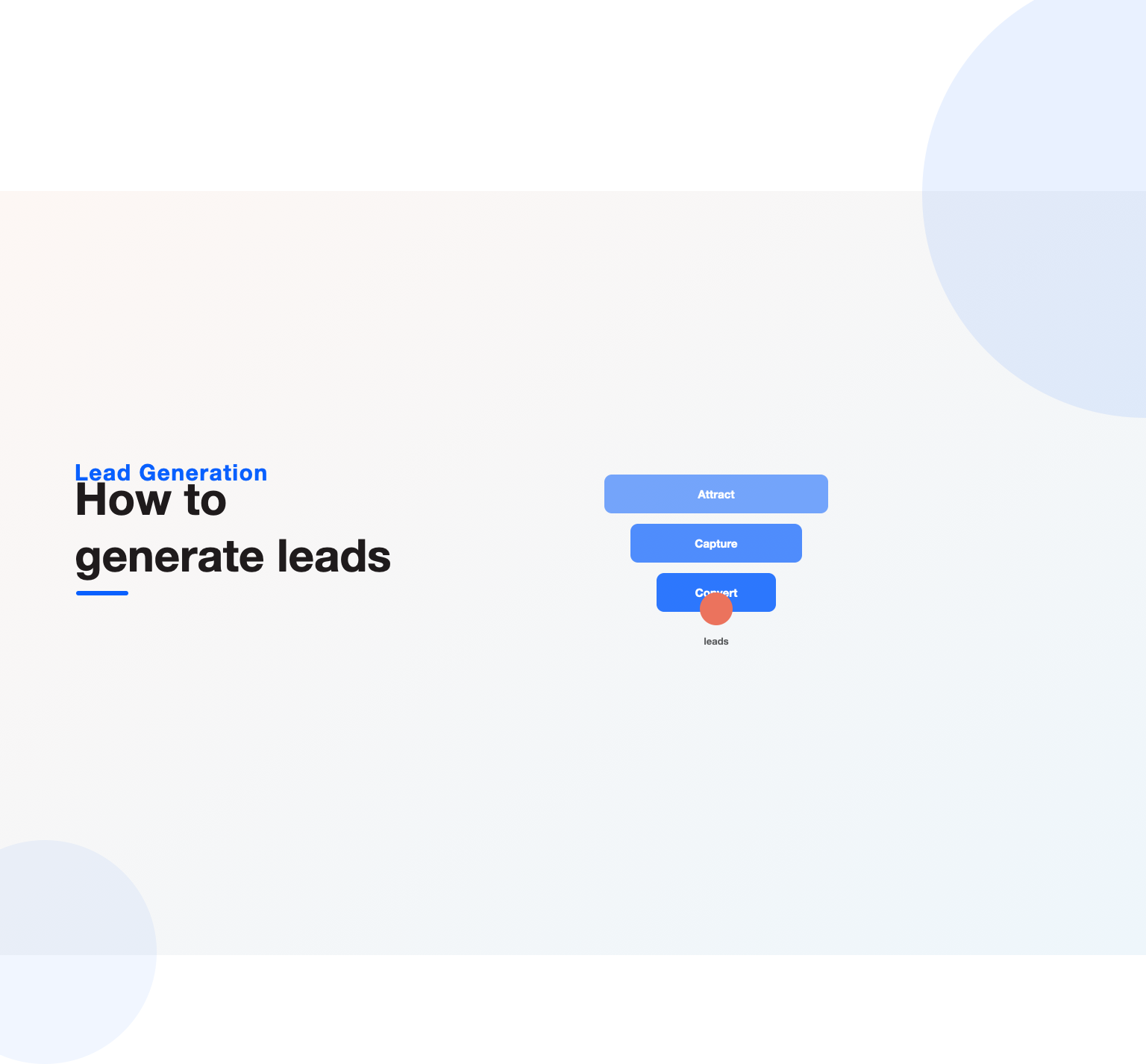
To generate leads, you build a repeatable system that attracts the right people, captures their interest, and hands the ready ones to sales: publish useful content that ranks and earns trust, own the high-intent searches your buyers make, offer something worth exchanging contact details for, convert traffic with focused landing pages, and follow up fast with nurture and scoring. The teams that learn how to generate leads reliably treat it as an engine measured to pipeline and revenue, not a scatter of one-off campaigns, and they pick a focused few channels that fit their business rather than chasing every tactic at once. Understanding how to generate leads at this level is less about any one trick and more about running the whole system deliberately.
Key Highlights
- Generating leads is a system of attract, capture, convert, and follow up, not a single tactic.
- Content and organic search create durable, compounding lead flow over time.
- High-intent search and paid ads capture buyers at the moment they are looking.
- A worthwhile offer and a focused landing page turn visitors into contacts.
- Fast follow-up, nurture, and lead scoring decide how many captured leads convert.
- Every channel is measured to pipeline, and the mix is tuned by what actually produces revenue.
Start with who you are trying to reach
Before any specific method, one foundation decides whether the rest will work: a sharp definition of who your ideal customer is and what problem you solve for them. Every tactic in this guide targets that person, and every one misfires without it. A vague audience produces vague content, loose targeting, and generic offers, which is why programs that skip this step generate volume that never converts. Getting it precise makes the messaging sharper, the targeting tighter, and the offers more compelling, so each method that follows works harder because it is aimed at a clearly defined buyer.
The second foundation is agreement with sales on what a qualified lead actually is. Marketing can generate thousands of contacts, but if sales will not accept them, the effort is activity dressed up as progress. A shared, written definition of a qualified lead, and a clear handoff process, is what turns raw contacts into pipeline. These two foundations are unglamorous, but they are the difference between a program that produces revenue and one that produces reports, so they come first, before a single campaign is planned.
Content that attracts the right buyers
The most durable way to generate leads is to publish genuinely useful content that ranks in search and earns trust over time. This is not blogging for its own sake; it is a deliberate body of educational material and a distinctive point of view that make your company the recognised authority on the problem you solve. It reaches buyers long before they are ready to purchase, planting the interest that later becomes a lead, and it keeps working for years after each piece is published.
As a discipline, lead generation has always rewarded businesses that give value before they ask for it, and content is the purest expression of that principle. Done well, content works across the funnel: educational articles create awareness, comparison and buyer-guide pieces support consideration, and bottom-of-funnel content captures intent. It also builds the organic search presence that quietly compounds, which is why serious lead generation and SEO are inseparable. Building that presence deliberately, the way a disciplined SEO program does, turns content from scattered posts into an engine that earns attention and captures interest at once. When people ask how to generate leads without paying for every click, this is the honest answer: a content engine is the closest thing to compounding lead flow that marketing offers.
Owning high-intent search
The fastest way to generate leads is to capture high-intent search, because it meets buyers at the exact moment they are actively looking for a solution. This means ranking organically and, where it pays, advertising for the commercial queries your buyers type when they are ready to act, then pairing that visibility with pages built to convert rather than merely inform. A person searching a solution category is closer to a decision than one browsing a how-to article, and reaching them is often the quickest route to near-term pipeline.
The discipline is to distinguish informational queries, which serve awareness, from commercial ones, which serve capture, and to build the right page for each, a distinction rooted in how search engine optimization matches pages to intent. A buyer searching a solution wants a clear, convincing commercial page; one searching a question wants a genuinely useful guide that earns trust and a later return. Learning how to generate leads from search means covering both, so the same investment feeds awareness and conversion, and every high-intent click lands somewhere designed to turn it into a contact rather than a bounce, which is where conversion rate optimisation earns its place. Paid search accelerates this where organic is too slow, buying immediate visibility for the highest-intent terms while the organic presence matures.
Offers worth exchanging details for
People do not hand over their contact details for nothing, so a central part of how to generate leads is offering something genuinely valuable in return. A strong lead magnet, a practical guide, a template, a calculator, a benchmark report, a free assessment, gives the visitor real value and gives you permission to follow up. Weak offers, a generic newsletter signup or a thin checklist, produce weak leads, because only people with little intent trade their details for little value.
The best offers are specific to a real problem your buyer has and to the stage they are at. Top-of-funnel offers educate and attract a wide audience; bottom-of-funnel offers, a demo, a consultation, a pricing guide, attract fewer but far more qualified contacts. Matching the offer to the intent is what keeps lead quality high, and it is why the same traffic can produce either a flood of unqualified signups or a smaller stream of genuine buyers depending on what you ask people to exchange their details for. A considered set of offers across the funnel is one of the highest-leverage decisions in the whole program.
Landing pages that convert
Traffic and offers only generate leads if the page where they meet is built to convert. A focused landing page, one offer, one clear benefit, one form, one call to action, consistently outperforms a cluttered page that tries to do several jobs at once. Every extra link, every unnecessary form field, and every moment of confusion costs conversions, so the discipline is to remove everything that does not move the visitor toward the single action you want.
The mechanics matter: a headline that restates the offer’s value, proof in the form of testimonials or results, a form that asks only for what you genuinely need, and a call to action that is specific rather than generic. Small changes here compound, because a landing page that converts at four percent instead of two doubles the leads from the same traffic, which is why disciplined conversion rate optimization and refining these pages is among the highest-return work in learning how to generate leads. This is the point where all the upstream effort either turns into contacts or leaks away, so it deserves disproportionate attention rather than being treated as an afterthought once the traffic is flowing.
Paid channels for faster reach
When organic reach is too slow for the pipeline you need now, paid channels generate leads faster by buying visibility you have not yet earned. Search ads capture high-intent buyers immediately; social and display ads build awareness and retarget people who engaged but did not convert. The trade-off is that paid leads stop the moment the spend does, so paid channels are best treated as an accelerator that funds patience for the compounding organic work, not as the whole strategy.
Used well, paid and organic reinforce each other: paid search covers the high-intent terms while organic rankings mature, and retargeting keeps your brand in front of the audience your content attracted. The mistake is to rely on paid alone, which leaves you renting a stream of leads at a cost that never falls. Channels such as LinkedIn ads reach B2B buyers precisely, and a well-run Google Ads program captures the commercial searches organic cannot yet win. The right balance shifts with stage: heavier on paid early for near-term pipeline, tilting toward organic as the content engine begins to compound.
Social media and community
Social platforms and communities generate leads by building the trust and familiarity that considered purchases depend on. This is rarely about a single viral post; it is about a consistent presence that keeps your point of view in front of the people you want to reach, so that when they are ready to act your company is already familiar. For B2B audiences, LinkedIn is usually the strongest channel, both for organic thought leadership and for precise social media marketing; for broader audiences, the platforms shift but the principle holds.
Communities, a forum, a group, an ongoing conversation, work even more slowly but produce even higher-quality leads, because they rest on genuine relationship rather than a fleeting impression. In markets where buyers research thoroughly and rely on peers, which describes most B2B and much of the Indian market, this engagement-led approach often outperforms louder, more transactional tactics over any serious time horizon. The lead flow it produces is patient rather than immediate, which is exactly why it complements the faster capture channels rather than competing with them.
Referrals and word of mouth
The highest-quality leads most businesses ever see come from referrals, because a recommendation from a trusted peer carries a credibility no advertisement can buy. A deliberate referral system, asking satisfied customers at the right moment, making it easy for them to refer, and sometimes rewarding it, turns this from a happy accident into a repeatable channel. Referred leads convert at higher rates and cost less to acquire, which makes referral one of the most efficient answers to how to generate leads that exists.
The reason referrals are underused is that they require a genuinely good product or service and a bit of process, rather than a media budget. But for any business with happy customers, building a light referral motion is among the highest-return moves available, because it compounds trust that is already earned. Pairing it with case studies and testimonials, which let a prospect’s research surface that same social proof, extends the effect beyond the direct ask, so the trust one customer places in you quietly recruits the next several.
Follow up fast, then nurture
Generating a lead is only half the work; what happens next decides how many convert. Speed matters more than almost anything: a lead followed up within minutes converts far better than one contacted days later, because intent decays fast. The teams that win on lead generation are often simply the ones that respond first, while the interest is still warm and the buyer is still in the moment that prompted them to reach out.
Most leads, though, are not ready to buy immediately, and nurture is what stops that interest from leaking away. Run through lifecycle email marketing, and increasingly through channels like WhatsApp in markets that prefer it, nurture keeps the not-yet-ready warm with relevant, spaced content until their timing is right. Lead scoring adds precision, tracking engagement so sales is alerted only when a lead is genuinely warm, which respects sales time and lifts conversion. Most of this runs on marketing automation, and the return it produces is exactly the kind laid out in our guide to marketing automation benefits. Without this layer, even excellent lead capture quietly wastes the interest the harder work produced.
Choosing which methods to run
You cannot run every method at once, and trying to is the surest way to do none of them well. The right choice depends on your business. A company with high-value target accounts should weight precise, account-focused outreach; a high-volume, self-serve business should weight content, search, and nurture. A business still working out how to generate leads should build the capture foundation, search, offers, and conversion, first for near-term pipeline, then layer in the slower content and community work that compounds.
The principle is to pick a few methods that fit your model and your stage, run them well, and connect them, rather than dabbling in all of them. Start with the foundations, add the capture methods that produce near-term results, then invest in the ones that compound. Let results guide expansion, doubling down on what produces qualified pipeline and cutting what does not. A focused set of well-executed methods beats a broad set of half-run ones every time, which is the single most useful rule in deciding how to generate leads for your particular business rather than copying someone else’s playbook wholesale.
Generating leads in the Indian market
In India, the mix of these methods has some local texture worth planning for. Buyers research thoroughly and place heavy weight on trust and relationships, which rewards content, thought leadership, and referral over aggressive short-term capture. Search and LinkedIn are strong channels for both awareness and capture, and WhatsApp increasingly plays a central role in follow-up and nurture, given how Indian buyers prefer to communicate. A fast WhatsApp response to a fresh enquiry often outperforms a slower email in a market where the channel is woven into daily life.
Sales cycles are frequently long and involve multiple stakeholders, which raises the value of nurture and of methods that keep a buying group engaged over time. The practical implication is that Indian programs skewed entirely to volume capture, buying lists or chasing raw form-fills, tend to underperform ones that invest in genuine trust-building and disciplined follow-up, because the market rewards patience. Pairing content-led attraction with a coordinated demand generation program tuned to these local realities is what turns scattered activity into predictable pipeline here.
Measuring what actually works
Every method must be measured to pipeline and revenue, or you cannot tell which are worth the effort. Track each channel through the funnel: the traffic or attention it creates, the leads it captures, the quality of those leads, and ultimately the pipeline and revenue it influences. The north-star metrics for how to generate leads are pipeline created and revenue influenced, not raw lead counts or activity, which can rise while revenue stays flat. A channel producing a thousand leads that never convert is worse than one producing fifty that do.
This measurement is what lets you tune the mix, shifting investment toward the methods that produce qualified pipeline and away from those that only produce activity. It also depends on sales alignment, because only sales can confirm which leads became real opportunities. Programs measured this way improve steadily; programs measured on activity plateau because nobody can see what truly drives revenue. Treat measurement not as reporting but as the feedback loop that makes the whole program smarter each quarter, and the engine compounds rather than stalling at whatever level it first reached.
Common mistakes when generating leads
- Chasing volume over quality. A flood of unqualified contacts wastes sales time and hides what actually converts.
- Buying lists. Purchased contacts have no intent, convert poorly, and can damage sender reputation and trust.
- Slow follow-up. Interest decays fast; a lead contacted days later converts far worse than one reached in minutes.
- Weak offers. Asking for details in exchange for little value produces few and low-intent leads.
- Neglecting nurture. Capturing interest but not nurturing it leaks the value the harder work produced.
- Running everything at once. Dabbling in every channel does none well; focus beats breadth.
Each mistake is the inverse of a sound principle, which is why studying how strong programs generate leads is also the fastest way to learn what to avoid.
Turning this into a first 90 days
To make it concrete, a realistic first quarter for a team building the engine looks like this. In month one, lock the foundations, a sharp ideal-customer definition and a written, sales-agreed definition of a qualified lead, and stand up demand capture: the highest-intent searches covered with strong pages, a clear offer, and a focused landing page with a clean conversion path. This alone often starts producing leads while everything else is built.
In month two, launch the content engine with a clear point of view and the first genuinely useful pieces, wire up nurture so no captured interest goes cold, and set a hard rule on follow-up speed. In month three, add lead scoring and the reporting that traces the whole funnel to pipeline, and pick one higher-effort channel, a referral motion or a webinar series, to pilot. By ninety days the team has a capture base earning now, a content engine beginning to compound, a nurture layer connecting them, and the measurement to see what works. From there it widens deliberately, doubling down on whatever the pipeline data rewards, which is exactly how a scattered set of tactics becomes a compounding engine rather than a list of things tried once and abandoned.
Qualifying and routing what you capture
Knowing how to generate leads is only worthwhile if the leads you capture reach the right person in a usable state, which is why qualification and routing deserve as much thought as the channels that produce them. Not every contact is a buyer: some are researchers, some are the wrong fit, and some are simply early. A light qualification step, a few form fields, a scoring rule, or a quick discovery touch, sorts genuine prospects from noise before sales invests time, so the pipeline that reaches your team is worth working rather than a pile to be waded through.
Routing is the other half. A qualified lead should reach the right salesperson quickly, with the context of how it was generated and what it engaged with, so the first conversation starts warm rather than cold. Getting this plumbing right usually means a clean CRM and the integrations that connect it to your marketing automation and forms, which is where deliberate revenue operations pays off. A program that generates strong leads but routes them slowly or loses their context wastes much of the work, so treat qualification and routing as part of how you generate leads, not an afterthought bolted on once the traffic arrives.
How the methods fit together
The methods here are not a menu to pick one from; they are parts of a single engine, and their value comes from how they connect. Content and social presence create the awareness that offers and landing pages capture, which follow-up and nurture keep warm, which sales converts to revenue. Paid channels accelerate the parts that are too slow organically, and referrals overlay the whole thing with trust that makes every stage convert better. Seen this way, the question stops being which tactic is best and becomes how well the tactics hand off to one another.
A gap anywhere leaks value: traffic with no offer wastes attention, an offer with no follow-up loses the lead, and everything with no sales alignment stalls at the handoff. This is why the foundations matter, and why a program is best judged as a whole rather than channel by channel. Connecting the funnel end to end, often through disciplined revenue operations, is what makes the leads you generate actually convert to closed revenue rather than piling up in a database nobody works. For the wider strategic picture around this, our guide to what demand generation is is worth reading alongside this one.
Key Takeaways
- Generating leads is a system of attract, capture, convert, and follow up, not a single tactic.
- Content and organic search build durable, compounding lead flow; high-intent and paid search capture buyers now.
- A valuable offer matched to intent, on a focused landing page, is what turns traffic into contacts.
- Fast follow-up, nurture, and lead scoring decide how many captured leads actually convert.
- Referrals produce the highest-quality leads and deserve a deliberate, repeatable motion.
- Choose a few methods that fit your model and stage, run them well, and connect them.
- Measure every channel to pipeline and revenue, and tune the mix by what actually converts.
Frequently asked questions
What is the fastest way to generate leads?
The fastest way to generate leads is to capture high-intent search, through organic rankings where you have them and paid search where you do not, because it meets buyers at the moment they are actively looking and can produce pipeline quickly. Pair it with a strong offer and a focused landing page so the traffic converts rather than bounces. Speed of follow-up then decides how many of those leads become opportunities, so a fast response process matters as much as the channel that produced the lead.
How do I generate leads without a big budget?
Without a big budget, lean on the methods that cost effort rather than media spend: a content engine that ranks in search over time, a deliberate referral motion that turns happy customers into a channel, and a consistent presence on the one social platform where your buyers gather. These compound slowly but lower the cost of acquisition as they mature, unlike paid channels that stop the moment the spend does. Focus on two or three executed well rather than spreading a small budget thin across many.
What is a lead magnet and do I need one?
A lead magnet is something valuable you offer in exchange for contact details, a practical guide, a template, a calculator, an assessment, or a report. You need one because people rarely hand over their details for nothing, and the quality of the magnet largely determines the quality of the leads. Match it to the buyer’s stage: educational magnets attract a wide top-of-funnel audience, while a demo or consultation attracts fewer but far more qualified contacts closer to a decision.
How many leads should I aim to generate?
The right number is the one that produces the pipeline and revenue your goals require, worked backwards from your conversion rates, not a raw target chosen in isolation. Start from the revenue you need, divide by average deal size for the number of customers, then apply your lead-to-opportunity and opportunity-to-close rates to find how many qualified leads that implies. Aiming for a large raw number without regard to quality usually just floods sales with contacts that never convert.
Are bought lead lists worth it?
No. Purchased lists contain contacts with no relationship to you and no intent to buy, so they convert poorly, waste sales time, and can damage your sender reputation and brand if you email them cold. The leads that convert are ones who chose to engage with your content, offer, or brand. It is almost always a better investment to build a modest but genuine lead flow through content, search, and referral than to buy a large list of contacts who never asked to hear from you.
How do I generate B2B leads specifically?
For B2B, weight the methods toward LinkedIn thought leadership and targeting, high-intent search with strong commercial pages, content that speaks to a buying group rather than a single buyer, and disciplined nurture for long, multi-stakeholder cycles. Referrals and case studies carry extra weight because B2B buyers research thoroughly and trust peers. Because these deals are considered and slow, a nurture layer and clean sales alignment matter more than raw volume, and quality of lead almost always beats quantity.
Ready to put this into practice?
Talk to the team that runs SEO, AI search and paid growth programs every day.
Book a Strategy Call →