 Skip to content

Performance Max Campaigns: How They Work and How to Win
Performance Max campaigns run across all Google channels with automation. Learn how they work, when to use them, how to set up asset groups, and how to keep control of spend.
 Performance Max campaign fanning out across Search, Shopping, YouTube, Display and Gmail”/>
Quick Answer
Performance Max campaigns are a Google Ads campaign type that runs across every Google channel, Search, Shopping, Display, YouTube, Gmail, Maps and Discover, from a single campaign, using automation to decide where and when your ads show. Instead of building separate campaigns for each network, you supply assets, text, images, video and product feeds, plus a conversion goal, and the system optimizes placement and bidding across the whole of Google to hit that goal. That reach and automation make Performance Max campaigns powerful for advertisers who want scale and are willing to trust the machine, but the same automation means less manual control and less visibility into where spend goes, which is exactly where inexperienced advertisers get burned. Used well, with strong assets, clean conversion data, sensible feed and audience signals, and careful monitoring, Performance Max can be an efficient engine for conversions and sales. Used carelessly, it can quietly spend budget on low-value placements and branded traffic you would have won anyway. This guide explains how the campaign type works, when to use it, how to set it up properly, and how to keep control of it.
Key Highlights
- Performance Max campaigns serve across all Google channels from one campaign, with automation deciding placement, bidding and targeting toward your goal.
- They trade manual control and placement visibility for reach and automated optimization, so they suit advertisers ready to lean on the machine.
- Success depends on strong, complete asset groups, accurate conversion tracking and clear goals, because the automation optimizes toward whatever you feed it.
- Audience signals and, for retailers, a healthy product feed guide the system faster toward the right customers rather than dictating exact targeting.
- Without guardrails, the campaign can absorb branded and low-value traffic, so account structure and brand exclusions protect the budget.
- Monitoring the limited but growing reporting, and pairing Performance Max with search campaigns, keeps the automation honest and accountable.
What Performance Max campaigns are
Performance Max represents a shift in how Google Ads campaigns are built, moving from advertiser-controlled targeting toward goal-based automation. In a traditional setup, you choose the network, the keywords or placements, and much of the targeting yourself, running separate campaigns for search, shopping and display. Performance Max campaigns collapse that into one goal-driven campaign that spans every Google surface at once, and instead of telling the system exactly where to show ads, you tell it what outcome you want and give it the raw materials to pursue that outcome across all of Google’s inventory.
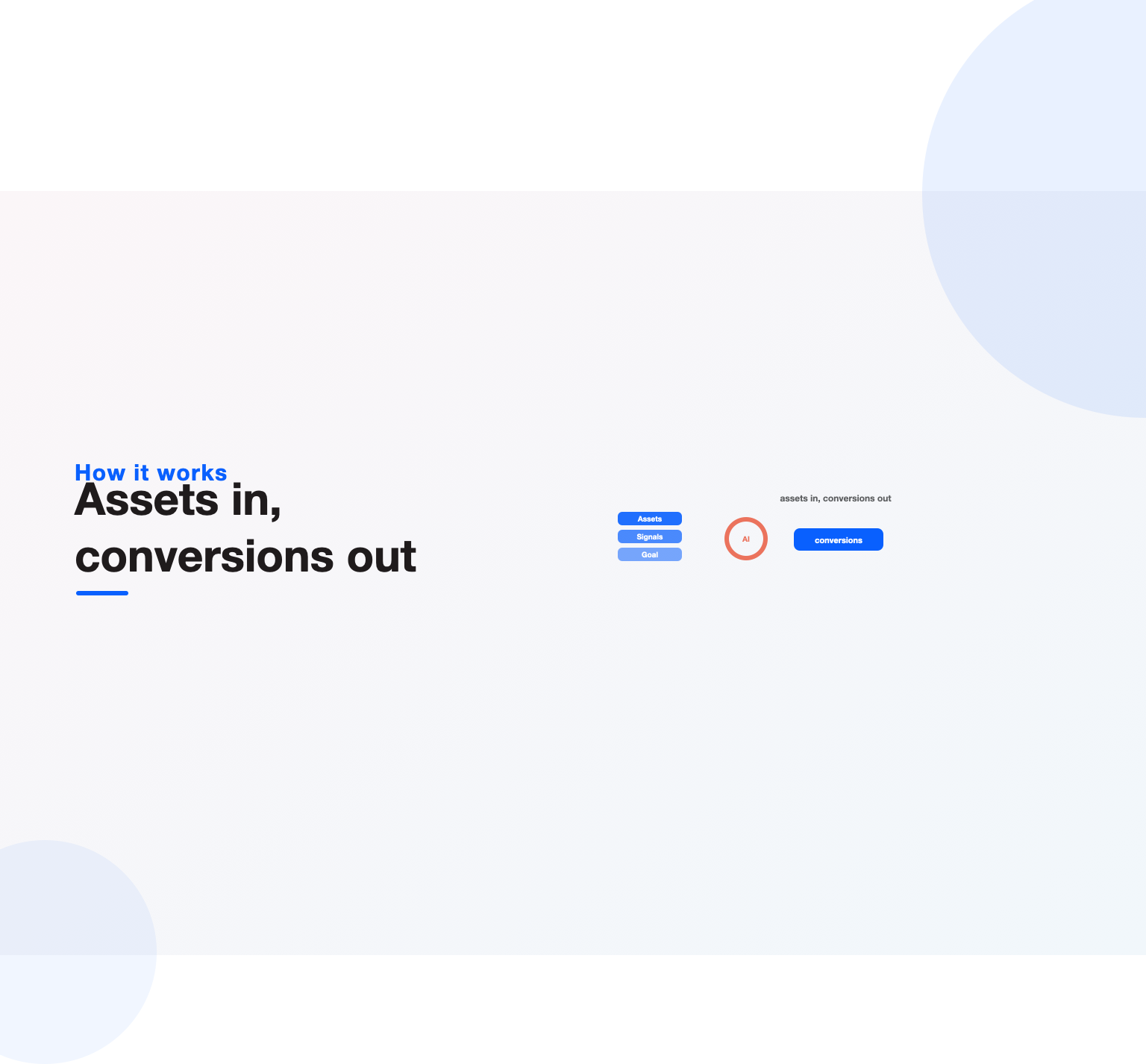
The mechanism is asset-based. You build asset groups containing headlines, descriptions, images, logos and video, and for retailers you connect a product feed, then set a conversion goal and let the automation assemble and place ads across channels to hit it. This is a genuinely different model from keyword-driven search, and understanding that difference is the key to using it well, because the advertiser’s job moves from choosing placements to supplying excellent assets and clean signals and then holding the automation accountable to results. Advertisers who treat Performance Max campaigns like a traditional campaign, expecting the same levers, are the ones most often frustrated by it.
How the automation works
At the heart of the campaign type is machine learning that decides, impression by impression, where to show your ads, which assets to combine, who to target and how much to bid, all in service of the conversion goal you set. The system draws on Google’s signals about user intent and behavior across its surfaces to find the moments most likely to convert, then serves an ad assembled from your assets into whatever channel fits, Search one moment, YouTube the next, Shopping or Display after that. This cross-channel optimization is what lets Performance Max find conversions a single-network campaign would miss.
The trade-off is control and transparency. Since the automation makes the placement and targeting decisions, you cannot dictate exactly where ads run or see the same granular placement reporting a manual campaign offers, and that opacity is the most common complaint advertisers raise. The way to work with it rather than against it is to accept that you influence the automation through the quality of your assets, the accuracy of your conversion data, and the signals you provide, rather than through direct control. Advertisers who master that indirect influence get strong results; those who fight the automation for control it will not give tend to struggle, which is why experienced Google Ads management treats Performance Max as a system to steer, not a dial to set.
When to use Performance Max
Performance Max campaigns are not right for every situation, and knowing when they fit prevents wasted spend. They shine for advertisers with clear conversion goals and enough conversion volume to feed the automation, particularly ecommerce retailers with a product feed, the same audience served by structured B2B accounts, who want to sell across every Google surface, and lead-generation businesses ready to trust automated optimization toward a well-defined goal. When there is real conversion data and the objective is unambiguous, the automation has what it needs to work, and the cross-channel reach of Performance Max campaigns can drive incremental results efficiently.
They are a poorer fit in other cases. An account with too few conversions cannot give the automation enough signal, so a thin-volume advertiser is often better served concentrating budget on search first and adding Performance Max once conversion volume supports it. Businesses that need tight control over messaging, placement or brand safety may find the opacity uncomfortable, and those whose value comes from precise keyword targeting can lose that precision inside the automation. Weighing whether your goals, volume and tolerance for automation fit the campaign type, rather than adopting it because it is heavily promoted, is the first decision, and it is one a considered Google Ads budget plan should account for.
Setting up asset groups
Because the automation builds ads from what you supply, the quality and completeness of your asset groups largely determine how well a Performance Max campaign performs. An asset group is the creative building block: a set of headlines, long headlines, descriptions, images in multiple sizes, logos and ideally video, all themed around a product line, service or audience. The system mixes and matches these to create ads for each placement, so the more strong, varied and relevant assets you provide, the better the combinations it can assemble and the wider the range of surfaces it can serve well.
Completeness matters more than most advertisers expect. Skimping on assets, providing few images or no video, forces the system to work with a thin set and often to auto-generate weak substitutes, which caps performance. Filling every asset slot with genuinely good, on-brand material, and organizing asset groups around distinct themes so each speaks clearly to its audience, gives the automation the raw material it needs to excel. Treating asset creation as the core work of Performance Max campaigns, rather than an afterthought, is what separates campaigns that hit their goals from ones that spend without returning, and it rewards the same creative discipline that strong ad copy demands everywhere in the account.
Conversion tracking is non-negotiable
Every optimization decision Performance Max makes depends on conversion data, so accurate tracking is not a nice-to-have but the foundation the whole campaign rests on. The automation optimizes relentlessly toward the conversions you tell it to value, which means if tracking is broken, double-counting, or pointed at the wrong action, the system will confidently optimize toward the wrong outcome and waste budget doing it efficiently. Before launching, verifying that conversion tracking fires correctly, once per genuine conversion, with sensible values assigned, is the single most important preparatory step.
Conversion values sharpen the automation further. When Performance Max can optimize toward value, not just conversion count, feeding it accurate values, actual revenue for ecommerce, or sensible lead values weighted by quality, lets it chase the most profitable conversions rather than the cheapest, which is a meaningful lever for return. Getting this right connects directly to the broader discipline of a proper Google Ads audit, where conversion accuracy is always the first thing verified. An advertiser who launches Performance Max on shaky tracking is building on sand, so this is the step to get right before any budget is spent.
Audience signals and the product feed
While Performance Max does not use traditional targeting, you can and should guide it with audience signals and, for retailers, a well-built product feed. Audience signals are suggestions, not restrictions: you tell the system about the customers you expect to convert, existing customer lists, website visitors, interest segments, and it uses those as a starting point to find similar high-value users faster, then expands beyond them as it learns. Providing strong, relevant audience signals accelerates the automation’s learning and steers it toward the right people early, which matters most in the first weeks.
For ecommerce, the product feed is central. Performance Max campaigns lean heavily on the feed to serve Shopping-style ads, so a complete, accurate, well-optimized feed, good titles, correct attributes, images and pricing, directly shapes how well the campaign sells, in the same way it does across ecommerce PPC management. A neglected feed caps a retail Performance Max campaign no matter how good the other assets are. Treating audience signals and the feed as the levers that guide the automation, rather than assuming the machine will figure everything out unaided, is how advertisers shorten the learning period and reach profitable performance sooner.
Keeping control and avoiding waste
The biggest risk with Performance Max campaigns is that, left unmanaged, the automation absorbs traffic you should not pay for, most notoriously your own branded searches. Since the campaign spans search among its channels, it can capture people already looking for your brand, taking credit for conversions you would have won for free and inflating its apparent performance while cannibalizing cheaper brand campaigns. Applying brand exclusions, available through the account, so Performance Max does not spend on your brand terms is a critical guardrail that many advertisers miss until the reporting looks suspiciously good.
Structure provides the other protection. Running well-managed search campaigns for your most important high-intent keywords alongside Performance Max keeps control over those valuable queries rather than surrendering them to the automation, and it gives you a clear read on what each is contributing. Watching for the campaign drifting into low-value placements or audiences, and using the account signals and exclusions available to steer it, keeps spend productive. The advertisers who get the most from Performance Max are not the ones who trust it blindly but the ones who set clear guardrails and then hold the automation accountable, a stance that a rigorous ad spend audit reinforces whenever performance looks too good to question.
Reading the reporting
Reporting has been the historic weak point of the campaign type, and while it has improved, reading what is available critically is part of managing it well. Early versions offered almost no visibility into where spend went or which assets and placements drove results, which fueled distrust, and although Google has added asset-group performance, search-term insights, and more placement and audience data over time, it still falls short of the granularity a manual campaign provides. The task is to make the most of what exists rather than assume the black box is unknowable.
The insights that are available repay attention. Asset-group performance shows which creative themes are working, the search-terms and insights reporting reveals what queries and audiences the automation is finding, and comparing Performance Max results against your search and shopping campaigns shows whether it is adding incremental conversions or merely reshuffling existing ones. Pulling these signals regularly, and pairing them with a clear view of how conversions are actually earned through sound marketing attribution, turns the limited reporting into enough of a picture to steer the campaign rather than fly blind. Advertisers who ignore the reporting because it is imperfect miss the signals that would let them improve.
Testing and optimizing over time
A Performance Max campaign is not a launch-and-leave exercise, and the advertisers who win with it treat it as something to test and refine continuously. Once conversion data accumulates, the levers to improve it are the ones you control: refreshing and expanding asset groups so the automation has better and more varied material, sharpening audience signals as you learn who actually converts, improving the product feed for retail, and adjusting the conversion goals and values the system optimizes toward. Each of these feeds better information into the automation, and the campaign responds to better inputs with better output.
Patience during learning is part of the discipline. Like other automated campaigns, Performance Max needs a learning period to gather data and stabilize, and reacting to early volatility by changing everything only resets that learning and prolongs the instability. Letting the campaign gather enough conversions before judging it, then optimizing deliberately through assets, signals and goals rather than constant upheaval, is how performance improves over time. This measured approach, strong inputs, patience through learning, steady refinement, is what turns Performance Max from an unpredictable spend into a reliable channel, and it mirrors the steady-optimization mindset behind effective Google Ads for SaaS.
Lead generation versus ecommerce use
The campaign type behaves differently depending on whether you sell products online or generate leads, and setting it up well means respecting that difference. For ecommerce, the product feed does much of the heavy lifting, serving Shopping-style ads across surfaces and letting the automation optimize toward revenue when you supply conversion values, so the priority is a clean, complete, well-optimized feed alongside strong supporting assets. Retailers often see the fastest, clearest returns here because the feed gives the system rich, structured information about exactly what it is selling and to whom.
Lead generation is more delicate. Without a product feed, the automation leans entirely on your asset groups and conversion signals, and the quality of the conversions you feed it matters enormously, because optimizing toward raw form-fills invites low-quality leads that flatter the reporting while starving sales. The fix is to feed the system your best signal of a genuine lead, values weighted by quality, or conversions defined further down the funnel, so it chases prospects who actually become customers rather than anyone who fills a form. Lead-generation advertisers who define conversions carelessly get volume without value, while those who feed the automation qualified signals get a channel that produces real pipeline, a distinction that matters acutely in accounts like Google Ads for real estate agents where a single good lead is worth many weak ones.
Measuring true incremental value
The hardest and most important question with the campaign type is whether it is adding conversions you would not otherwise have won, or simply claiming credit for ones that were coming anyway. As the automation reaches across channels and can absorb branded and retargeting traffic, its reported conversions can overstate its real contribution, which is why sophisticated advertisers measure incrementality rather than trusting the raw conversion count. Comparing total account performance before and after launch, watching whether other campaigns lose volume as this one gains it, and using brand exclusions to strip out easy branded conversions all help reveal the genuine incremental lift.
This scrutiny changes decisions. A campaign that looks stellar on reported conversions but merely cannibalized existing search and brand traffic is not earning its budget, while one that shows modest reported numbers but clearly grew total conversions is doing exactly what it should. Judging the campaign on incremental business results rather than platform-reported credit keeps budget honest and prevents the automation from being rewarded for work your other channels did. Building this incrementality mindset into how you evaluate spend is one of the most valuable habits an advertiser can develop, and it applies well beyond this one campaign type across the whole account.
Common Performance Max mistakes
Several recurring errors keep advertisers from getting value out of the campaign type. The most damaging is launching on inaccurate conversion tracking, which points the automation at the wrong goal and guarantees wasted spend no matter how good everything else is. Close behind is providing thin asset groups, too few images, no video, weak copy, which starves the system of the material it needs and forces poor auto-generated substitutes. Skipping brand exclusions, a leak any ad spend audit flags immediately, is another frequent and costly mistake, letting the campaign feast on cheap branded traffic and report inflated success.
Other common missteps include using Performance Max on an account with too little conversion volume to feed the automation, abandoning search campaigns for important keywords and losing control of them, reacting impatiently to the learning period, and ignoring the reporting that does exist because it is imperfect. The thread running through these mistakes is either failing to give the automation good inputs or failing to set guardrails around it. Advertisers who supply strong assets, clean data and clear signals, and who fence the campaign in with exclusions and parallel search, find that Performance Max rewards them, while those who launch it loosely and walk away rarely get the results the campaign type is capable of, a gap our Google Ads audit process is designed to expose.
Performance Max alongside your other campaigns
Performance Max works best as part of a considered account, not as a replacement for everything else, and deciding how it fits with your other campaigns is a strategic choice. The common and effective pattern is to run Performance Max for broad, automated reach and incremental conversions across channels, while keeping tightly managed search campaigns for your highest-value keywords where control and precision matter most. This division gives you the automation’s scale where scale helps and manual control where control pays, rather than surrendering the whole account to the machine or refusing its reach entirely.
Coordination between them prevents waste and confusion. Brand exclusions on Performance Max, clear separation of what each campaign is responsible for, and honest comparison of their incremental contribution keep the two working together rather than competing for the same conversions. For many advertisers, especially retailers and lead-generation businesses with solid conversion data, this blended structure, Performance Max for reach, search for precision, delivers the best of both, and building it well is a core part of professional account management that also weighs paid search against organic through a lens like our SEO vs PPC comparison. Vertical accounts such as Google Ads for B2B companies tune this balance to their longer sales cycles.
The practical route for most teams is to pilot the campaign type deliberately rather than betting the whole account on it at once. Launch it with a clear goal, sound tracking and strong assets, fund it enough to gather data without starving your proven search campaigns, and give it a defined window to prove incremental value before deciding whether to expand. Approached as a controlled test with guardrails, it rarely disappoints in the way an all-in, unmanaged launch does. Teams that lack the time to build assets, verify tracking and monitor incrementality often find that folding it into ongoing Google Ads services pays for itself, and retailers in particular benefit from the feed and creative discipline that specialist ecommerce PPC management brings, while considered-purchase brands can borrow the qualified-lead approach used in Google Ads for SaaS.
Key Takeaways
- Performance Max campaigns run across all Google channels from one campaign, trading manual control for automated, goal-based optimization.
- They fit advertisers with clear goals and real conversion volume, especially retailers with a product feed, more than thin-data or control-heavy accounts.
- Strong, complete asset groups and accurate conversion tracking are the foundation, because the automation optimizes toward whatever you feed it.
- Guide the system with audience signals and a healthy product feed to shorten learning and reach the right customers faster.
- Protect the budget with brand exclusions and parallel search campaigns, since unmanaged Performance Max absorbs branded and low-value traffic.
- Read the growing reporting, stay patient through learning, and steer with managed Google Ads discipline rather than trusting the black box blindly.
Frequently asked questions
What are Performance Max campaigns?
Performance Max campaigns are a Google Ads campaign type that serves ads across all of Google’s channels, Search, Shopping, Display, YouTube, Gmail, Maps and Discover, from a single campaign driven by automation. Rather than choosing placements and keywords yourself, you supply asset groups of text, images and video, connect a product feed if you are a retailer, set a conversion goal, and let the system optimize where and when your ads show to hit that goal. The result is broad cross-channel reach with automated bidding and placement, at the cost of the manual control and placement visibility a traditional single-network campaign offers.
Are Performance Max campaigns worth it?
For the right advertiser, yes. They work well for businesses with clear conversion goals and enough conversion volume to feed the automation, particularly ecommerce retailers with a good product feed and lead-generation businesses ready to trust automated optimization. In those cases the cross-channel reach can drive efficient incremental conversions. They are less suitable for accounts with very little conversion data, businesses needing tight control over placement and messaging, or those whose value depends on precise keyword targeting. The honest answer is that Performance Max is worth it when your goals, data and tolerance for automation fit, and frustrating when they do not.
How do I set up a Performance Max campaign?
Start by verifying conversion tracking is accurate, since everything optimizes toward it. Then build complete asset groups, filling every slot with strong headlines, descriptions, images in multiple sizes, logos and video, organized around distinct themes. Connect and optimize your product feed if you sell online, add audience signals describing the customers you expect to convert, and set a clear conversion goal with values where possible. Apply brand exclusions so the campaign does not spend on your own branded searches, and run it alongside managed search campaigns for your most important keywords. Finally, be patient through the learning period and refine assets and signals as data arrives.
Do Performance Max campaigns cannibalize search campaigns?
They can, which is why guardrails matter. Since Performance Max includes search among its channels, it can capture branded and high-intent queries your search campaigns would otherwise win, taking credit for conversions and inflating its apparent performance. The fixes are to apply brand exclusions so it does not spend on your brand terms, and to keep well-managed search campaigns for your highest-value keywords rather than surrendering them to the automation. Comparing incremental results honestly, rather than trusting the campaign’s reported conversions at face value, reveals whether Performance Max is adding new conversions or merely reshuffling ones you already had. Managed carefully, the two complement rather than cannibalize each other.
How long do Performance Max campaigns take to work?
Like other automated campaigns, they need a learning period to gather conversion data and stabilize, typically a few weeks depending on how quickly conversions accumulate. During this time performance can be volatile, and the worst thing to do is react by changing everything, which only resets the learning. Give the campaign enough conversion volume before judging it, then optimize deliberately through better assets, sharper audience signals, an improved feed and refined goals. Accounts with higher conversion volume stabilize faster because the automation gets the data it needs sooner, while thin-volume accounts take longer and may struggle to exit learning at all, which is a sign the campaign type may not fit yet.
What is an asset group in Performance Max?
An asset group is the creative building block of a Performance Max campaign, a themed set of headlines, long headlines, descriptions, images in multiple sizes, logos and video that the system mixes and matches to build ads for each placement. You typically create one asset group per product line, service or audience so each speaks clearly to its intended customer. The completeness and quality of these assets largely determine performance, because the automation can only assemble good ads from good material. Filling every slot with strong, on-brand, varied assets gives the system the range it needs to serve well across channels, while thin asset groups cap what the campaign can achieve.
Ready to put this into practice?
Talk to the team that runs SEO, AI search and paid growth programs every day.
Book a Strategy Call →