 Skip to content

Black Hat SEO: Techniques, Risks and the Safe Alternatives
Black hat SEO explained: the common techniques, the penalties they trigger, how search engines catch them, and the legitimate white hat alternative to reach the same goal without the risk.
Quick Answer
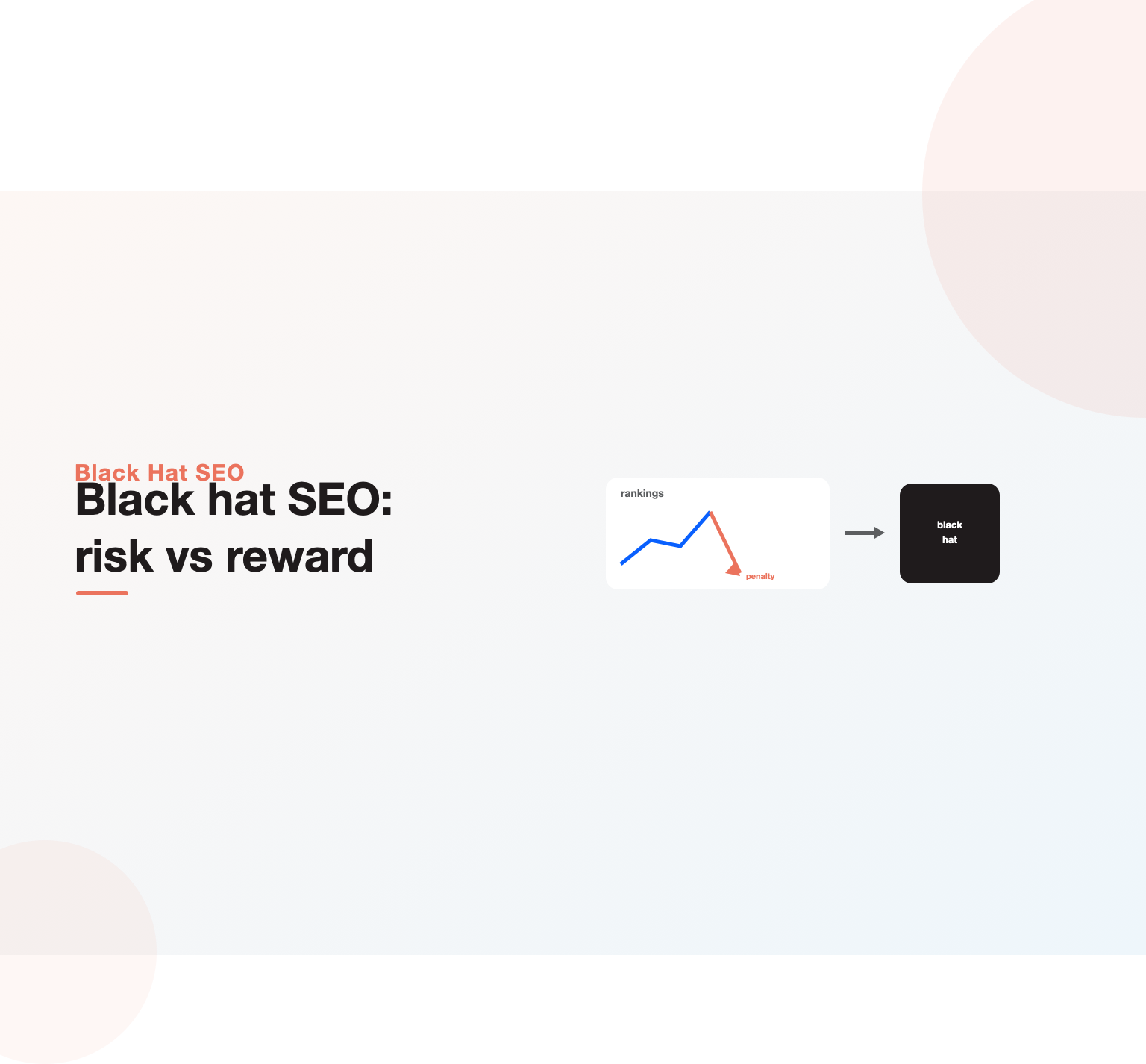
Black hat SEO is the practice of manipulating search rankings with tactics that break the search engines’ guidelines, things like buying links, stuffing keywords, cloaking, hidden text and spun or AI-mass-produced content. It can produce fast, short-lived gains, but it carries real downside: ranking drops, manual penalties, and in bad cases full deindexing, with recovery often taking longer than the shortcut ever saved. Almost every black hat tactic has a legitimate white hat alternative that reaches the same goal without the risk, and in the AI-search era, where engines increasingly reward genuine trust and expertise, manipulation is getting easier to catch and less worth attempting. This guide explains the common techniques, the consequences and penalties they trigger, how search engines detect them, and the legitimate white hat alternative to reach for instead of each one.
Key Highlights
- Black hat means chasing rankings with tactics that violate search-engine guidelines, in exchange for speed and at the cost of durability.
- The common techniques cluster into link schemes, content manipulation, and technical deception like cloaking and hidden text.
- Consequences range from a quiet algorithmic suppression to a manual action or full deindexing, and recovery is slow and uncertain.
- Grey hat sits in the ambiguous middle, tactics that are not clearly banned but carry rising risk as guidelines tighten.
- AI search raises the stakes: engines lean harder on trust and first-hand expertise, so manipulation is easier to detect and worth less.
- Every black hat shortcut has a white hat alternative that reaches the same goal safely, which is where your effort belongs.
What black hat SEO actually is
At its core, black hat is any attempt to game search rankings using methods that deliberately break the guidelines search engines publish. The name borrows from old Western films where the villain wore the black hat, and it is set against white hat SEO, the legitimate practice of earning rankings by making a site genuinely more useful, relevant and trustworthy. The dividing line is not cleverness or aggression; plenty of white hat work is aggressive and clever. The line is whether a tactic tries to deceive the engine or serve the user.
What makes black hat SEO tempting is speed. Legitimate SEO compounds over months, while a link-buying spree or a wave of thin pages can move rankings in weeks, which is exactly why struggling sites and impatient owners reach for it. The trade is real but lopsided: you borrow ranking gains against a debt that comes due when the algorithm updates or a reviewer notices, and the interest, lost traffic, penalties, cleanup, is usually far higher than the shortcut was worth. Understanding black hat matters even if you never intend to use it, because you need to recognize it when an agency proposes it, when a competitor attacks you with it, or when a well-meaning tactic drifts across the line.
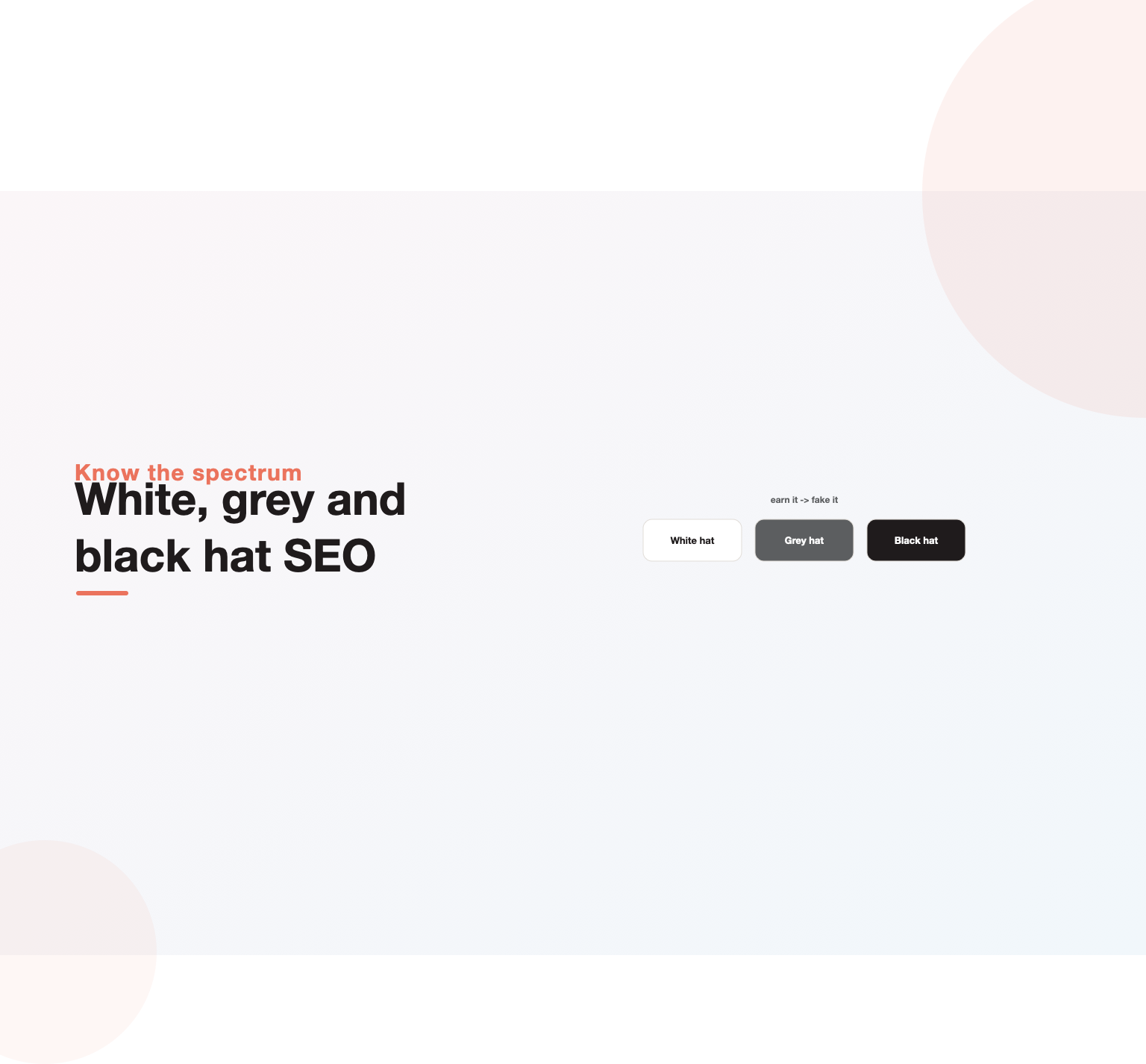
It helps to see the spectrum. White hat earns rankings by deserving them, while black hat fakes the signals of deserving them. It lives in between, using tactics that are not explicitly forbidden but clearly bend the intent of the guidelines, and that grey zone shifts toward black over time as engines close loopholes. Knowing where a tactic sits on that spectrum is the first skill, and it is more useful than any list of tricks, because the tricks change while the principle does not.
Common black hat techniques
These techniques change as search engines adapt, but they fall into a few durable categories. Recognizing them is what lets you avoid using them by accident and spot them when someone else does.
- Link schemes: Buying links, participating in link farms and private blog networks, mass directory and comment spam, and excessive reciprocal linking. The goal is to fake the authority that genuine links signal, and it is one of the most penalized categories.
- Keyword stuffing: Cramming a page with repeated keywords, often unnaturally or in long lists, to try to force relevance. It reads badly to humans and is trivial for engines to detect.
- Cloaking: Showing search engines one version of a page and users a different one, so the engine ranks content the visitor never sees. This is a clear deception and treated harshly.
- Hidden text and links: Placing keywords or links in text colored to match the background, behind images, or via tiny fonts and off-screen positioning, so they count for ranking without being visible.
- Doorway pages: Low-value pages built to rank for specific queries and funnel visitors elsewhere, rather than to serve the searcher directly.
- Spun and mass-produced content: Auto-generated, scraped, or lightly reworded content published at scale, now including AI-generated pages produced purely to manipulate rankings rather than to help readers.
- Sneaky redirects: Sending users to a different URL than the one that ranked, or redirecting based on device or referrer to hide the real destination.
- Negative SEO: Turning these tactics against a competitor, pointing spammy links at their site or scraping and duplicating their content, to try to trigger a penalty on them.
The pattern across all of them is deception: each fakes a signal the engine uses to judge quality, rather than earning it. That is why a single list can never be complete, new tactics appear constantly, but they are all variations on making a page look more deserving than it is. Once you internalize that, you can classify a tactic you have never seen before.
Why black hat is tempting, and what it really costs
The appeal of black hat SEO is easy to understand. Real SEO is slow, competitive and uncertain, and a business watching competitors outrank it can feel that playing fair is losing. These tactics promise to skip the queue, and sometimes they deliver a visible bump that makes the risk feel justified. For a site with nothing to lose, a churn-and-burn affiliate site, a short-lived campaign, the math can even work in narrow cases, which is why the tactics persist.
For any real business, though, the cost calculation runs the other way. The gains are temporary by design, since they rest on signals the engine is actively working to discount, so the traffic evaporates on the next update or review. The downside is durable: a penalized domain can lose most of its organic traffic overnight, and rebuilding trust with the engine takes months of cleanup and waiting, during which the business is worse off than if it had never started. Add the opportunity cost, the same effort spent on legitimate SEO would have built an asset that keeps paying, and the shortcut is almost always the more expensive path once you count the recovery. For a business weighing this honestly, the durable economics of legitimate SEO beat the shortcut on almost every horizon longer than a quarter.
There is also a reputational cost that rarely makes the tactic lists. Customers, partners and investors increasingly notice when a brand is caught manipulating, and the trust a business spends on a ranking trick is harder to rebuild than the ranking itself. The quiet lesson is that black hat is not really a marketing decision but a risk decision, and framed that way, it rarely survives scrutiny for a company that intends to be around next year.
The consequences: penalties and how they work
The consequences of black hat SEO arrive in two forms, and it helps to know the difference. The first is an algorithmic suppression, where an update simply stops rewarding the manipulated signals and your rankings quietly fall. There is no notification, just a drop, and recovery means removing the offending tactics and waiting for the algorithm to reassess, which can take one or more update cycles.
The second is a manual action, where a human reviewer at the search engine confirms a violation and applies a penalty directly. This does come with a notification in Search Console, and it can range from demoting specific pages to removing the entire site from the index. Recovering from a manual action means fixing every flagged issue and submitting a reconsideration request that a reviewer must approve, a process that can take weeks and is not guaranteed to succeed on the first attempt. In the worst cases, a site is fully deindexed and effectively invisible, which for a business that depends on organic traffic is close to an extinction event.
Both outcomes share a hard truth: the cleanup almost always costs more than the shortcut saved. Disavowing bad links, removing manipulative content, rebuilding a legitimate profile and waiting out the reassessment can consume months, and the traffic lost in the meantime is gone for good. If you suspect a drop is a penalty rather than a normal fluctuation, our guide on recovering from a Google traffic drop walks through diagnosing and reversing it.
Black hat versus white hat versus grey hat
The clearest way to hold these categories is by intent. White hat SEO tries to make the site genuinely deserve its rankings, better content, sound technical foundations, real authority, a good experience. Black hat tries to fake those signals. Grey hat sits between, using tactics that are not explicitly banned but clearly lean on manipulation, and the grey zone is where most well-meaning sites accidentally stray.
Examples make the grey zone concrete. Buying a handful of links from a service that calls them sponsored placements, spinning one solid article into ten thin variations, or using AI to mass-produce pages that are technically original but add nothing, none of these is as blatant as cloaking, yet all bend the guidelines and carry rising risk as engines tighten. The safe test is simple: would this tactic still make sense if search engines did not exist, purely as a way to serve your audience better? Legitimate work passes that test; black and grey hat work usually does not. Holding that question in mind keeps you on the right side of a line that no rulebook can fully enumerate, and it ages far better than chasing whatever loophole is currently open.
Does black hat SEO even work against AI search?
This is the question most black hat guides skip, and it is increasingly the important one. As discovery shifts into AI answers from ChatGPT, Perplexity, Gemini and Google’s AI Overviews, the tactics that once fooled a link-counting algorithm face engines built differently. AI systems synthesize answers from sources they judge trustworthy, weighting first-hand expertise, corroboration across the web, and genuine authority, which are precisely the signals manipulation cannot easily fake at scale.
That shift changes the risk calculus. Keyword stuffing and thin AI-spun pages are exactly what modern spam systems and quality models are tuned to catch, and a manipulated page that somehow ranks a blue link may still be ignored by the AI layer that now sits above it, so the manipulated win produces no citation and no visibility where a growing share of buyers actually look. Meanwhile the trust signals that earn AI citations, expertise, accuracy, real reputation, are the opposite of black hat SEO, which means the same effort now has an even higher legitimate ceiling. Building genuine authority is the work behind AI search optimization and answer engine optimization, and it is the direct opposite of gaming the system. The practical takeaway is blunt: black hat was always a poor long-term bet, and the move toward AI-mediated search makes it a worse one.
The white hat alternative to every black hat tactic
The most useful thing to know about black hat SEO is that each tactic exists because it targets a real ranking goal, and each of those goals has a legitimate way to reach it. Map the shortcut to the safe path and the temptation mostly disappears.
- Earn links rather than buying them: create genuinely useful, linkable assets, original data, tools, definitive guides, and do outreach and digital PR that gives real publications a reason to cite you. Slower, but the links last and carry no risk.
- Cover the topic thoroughly rather than stuffing keywords: answer the question and its follow-ups well, and relevance follows without forcing repetition.
- Show users the same page you show engines, and make it good enough to rank on its own, and make it good enough to deserve the ranking on its own.
- Build genuinely distinct, useful pages for each service and location instead of doorway pages, for each service and location you serve, the kind that help the searcher rather than funnel them.
- Publish fewer, better pages with real expertise instead of spun or mass-produced content, with real expertise and first-hand insight, which is also what earns AI citations.
- Let a natural, branded-leaning anchor profile form on its own rather than manipulating it, on its own, which is what a healthy site looks like anyway.
The through-line is that white hat SEO reaches the same destinations, authority, relevance, visibility, by deserving them, so the results survive the next update instead of being erased by it. That durability is the entire argument, and it is why a business planning to last should treat the white hat path not as the cautious option but as the only one with a positive expected value. If earning links is your bottleneck, our breakdown of off-page SEO covers how to build authority the safe way.
How to recover if you have used black hat
Plenty of sites carry black hat SEO from a previous owner, a past agency, or an inherited shortcut, and the good news is that recovery is possible with patience. Start by diagnosing the problem honestly: audit the backlink profile for bought or spammy links, review the content for thin, spun or keyword-stuffed pages, and check Search Console for any manual action notification that names the specific issue.
From there the work is methodical. Remove or disavow the manipulative links you can, rewrite or remove the low-value content, and fix any technical deception like cloaking or sneaky redirects. If a manual action is in place, document the cleanup and submit a reconsideration request that clearly explains what was wrong and what you fixed, because reviewers approve requests that show genuine remediation, not promises. If the damage is purely algorithmic, there is no request to file; you clean up and wait for the next reassessment. Either way, the recovery is slower than the original shortcut, which is the whole lesson of black hat in one experience, and rebuilding on a legitimate footing afterward, the fundamentals in our SEO guide, is what keeps the recovery from becoming a cycle. Set realistic expectations too: legitimate rankings return on the timeline covered in how long SEO takes to work, not overnight, so the fastest real recovery is to stop the manipulation, clean up thoroughly, and let a rebuilt foundation, ideally guided by a proper SEO program, compound from a clean base rather than chasing another shortcut.
Protecting your site from negative SEO
Manipulation is not only something sites do; it is sometimes something done to them. Negative SEO is a competitor turning these tactics against you, pointing spammy links at your domain, scraping and republishing your content to create duplicates, or faking signals to try to trigger a penalty. It is less common and less effective than it once was, since engines have grown better at ignoring unnatural links rather than punishing the target, but it is worth guarding against.
Protection is mostly vigilance. Monitor your backlink profile for sudden spikes of low-quality links and disavow them if a genuinely toxic pattern appears, watch for scraped copies of your content and address them, and keep Search Console alerts on so you learn of a manual action immediately. Most sites never need to act on negative SEO, but knowing what it looks like means you can tell the difference between an attack and a normal fluctuation, and respond calmly rather than overreacting to links the engine was already ignoring. A steady, well-audited site is a hard target, which is one more reason the legitimate fundamentals are the best defense as well as the best offense.
How search engines catch black hat SEO
Understanding how engines detect manipulation explains why the tactics fail so reliably. Modern search engines run automated spam systems that use machine learning to spot unnatural patterns at scale, sudden spikes of low-quality links, pages built around repeated keywords, content that matches known spun or scraped text, and networks of sites linking to each other in tell-tale shapes. These systems improve with every update, so a tactic that slips through today is often caught retroactively later, which is why black hat gains have a habit of evaporating without warning.
Automated detection is backed by human review. Search-quality reviewers assess sites against Google’s published spam policies, and a confirmed violation becomes a manual action applied directly to the site. Engines have also shifted from penalizing manipulative links to simply ignoring them, which quietly removes the benefit a link scheme was bought for while leaving the spend wasted. The same discipline that finds spam also rewards its opposite: sites with clean technical foundations, genuine authority and real expertise. Running a regular SEO audit and keeping the technical foundations sound is how you stay clearly on the right side of these systems, and it doubles as the diagnostic that catches a problem an inherited tactic may have left behind.
The arrival of AI-driven ranking and answer systems adds another detection layer that is even harder to fool. Because these systems weigh corroboration and trust across many sources, a single manipulated page carries little weight, and the whole approach of faking signals runs against how they decide what to surface. That is why building genuine authority through generative engine optimization and honest answer engine optimization is not just safer than manipulation but strictly more effective as search keeps evolving. The detection gap that black hat once exploited is closing from both directions at once.
Grey hat SEO: the risky middle ground
The grey hat zone deserves its own attention because it is where most legitimate sites actually get into trouble, not through blatant cloaking but through tactics that feel defensible until an update reclassifies them. Guest posting purely for links, lightly rewording an article into several near-duplicates, using an AI tool to produce dozens of pages that are technically original but add nothing, buying a review or two, none of these looks as reckless as a link farm, yet all lean on manipulation and all carry rising risk as guidelines tighten and detection improves.
The danger of grey hat is precisely that it works often enough to feel safe. A tactic that has not been penalized yet is easy to mistake for a tactic that is fine, and teams build processes around it until an update wipes out the gains and sometimes more. The honest way to evaluate a grey hat tactic is to ask what happens if the engine decides tomorrow that it counts as manipulation: if that outcome would hurt, the tactic is a liability you have simply not been billed for yet. Treating grey hat as deferred black hat, rather than a safe shortcut, keeps a program durable.
The resolution is the same one that runs through this whole guide. Anchor the work to genuine value, and the grey zone mostly stops being tempting because you no longer need it. Sound fundamentals, useful content, real authority, a good experience, reach the same rankings without the deferred bill, and they compound instead of collapsing. If you are not sure whether a tactic crosses the line, our SEO guide and the question of whether SEO is worth it both come back to the same answer: the legitimate path is slower to start and far cheaper to keep, which is the entire case against the shortcuts.
Key Takeaways
- Treat black hat as a risk decision, not a marketing one: the gains are temporary and the downside, penalties, deindexing, cleanup, is durable and usually costlier than the shortcut saved.
- Learn the categories, link schemes, content manipulation, technical deception, so you can recognize a tactic you have never seen and avoid crossing the line by accident.
- Use the intent test: if a tactic would make no sense in a world without search engines, it is probably black or grey hat and worth avoiding.
- Map every shortcut to its white hat alternative and do that instead; the legitimate path reaches the same goal and survives algorithm updates.
- Assume AI search makes manipulation worth even less, since AI engines reward the trust and expertise that black hat SEO cannot fake, so invest there.
- If you have inherited black hat tactics, audit, clean up, disavow and, where needed, file a reconsideration request, then rebuild on legitimate fundamentals with the right SEO foundation.
Frequently asked questions
What is black hat in simple terms?
Black hat SEO is trying to rank higher by tricking search engines with tactics that break their guidelines, such as buying links, stuffing keywords, hiding text or mass-producing thin content. It is the opposite of white hat SEO, which earns rankings by genuinely making a site more useful and trustworthy. The defining feature is deception: black hat tactics fake the signals of quality rather than earning them, which is why engines work to detect and penalize them.
Is black hat illegal?
Black hat SEO is generally not illegal in the criminal sense, it breaks the search engines’ terms and guidelines rather than the law, though some related activity like hacking a site to place links clearly is illegal. The real consequence is not legal but practical: search engines can suppress, penalize or deindex a site that uses these tactics. So while you will not usually be prosecuted for black hat, you can lose most of your organic traffic, which for many businesses is the more serious penalty.
Does black hat SEO still work in 2026?
Some black hat tactics still produce short-term gains, which is why they persist, but they work less reliably and for less time than they used to, and the risk has grown. Search engines detect manipulation far better than in the past, and the shift toward AI-mediated search adds another layer that rewards genuine trust and expertise over faked signals. For any site that intends to last, the tactics are a poor bet: the gains are temporary and the downside is a penalty that can erase years of progress.
What is the difference between black hat and white hat SEO?
The difference is intent. White hat SEO earns rankings by making a site genuinely deserve them through useful content, sound technical health and real authority, while black hat fakes those signals to trick the engine. White hat results are durable because they rest on real quality; black hat results are fragile because they rest on signals the engine is actively trying to discount. The grey hat middle uses tactics that are not clearly banned but bend the guidelines and grow riskier over time.
How do I recover from a black hat SEO penalty?
Start by identifying the problem: audit your backlinks for spammy or bought links, review content for thin or stuffed pages, and check Search Console for a manual action notice. Remove or disavow the bad links, fix or remove the manipulative content, and correct any technical deception. If there is a manual action, submit a reconsideration request documenting exactly what you fixed; if the issue is algorithmic, clean up and wait for the next reassessment. Recovery is slower than the shortcut was, so rebuild on legitimate fundamentals afterward.
Can competitors hurt my rankings with black hat?
They can try, through negative SEO like pointing spammy links at your site or duplicating your content, but it is harder and less effective than it once was, because engines increasingly ignore unnatural links rather than penalizing the target. Protect yourself by monitoring your backlink profile for sudden spikes of toxic links, watching for scraped copies of your content, and keeping Search Console alerts on. Most sites never need to act, but knowing what an attack looks like lets you respond calmly instead of overreacting to links the engine is already discounting.
Ready to put this into practice?
Talk to the team that runs SEO, AI search and paid growth programs every day.
Book a Strategy Call →