 Skip to content

LLM Optimization: The Technical Guide to Machine-Readable Content
LLM optimization is the technical craft of making content parseable and reproducible by AI models: semantic HTML, structured data, entities, chunking, consistency and llms.txt.
Quick Answer
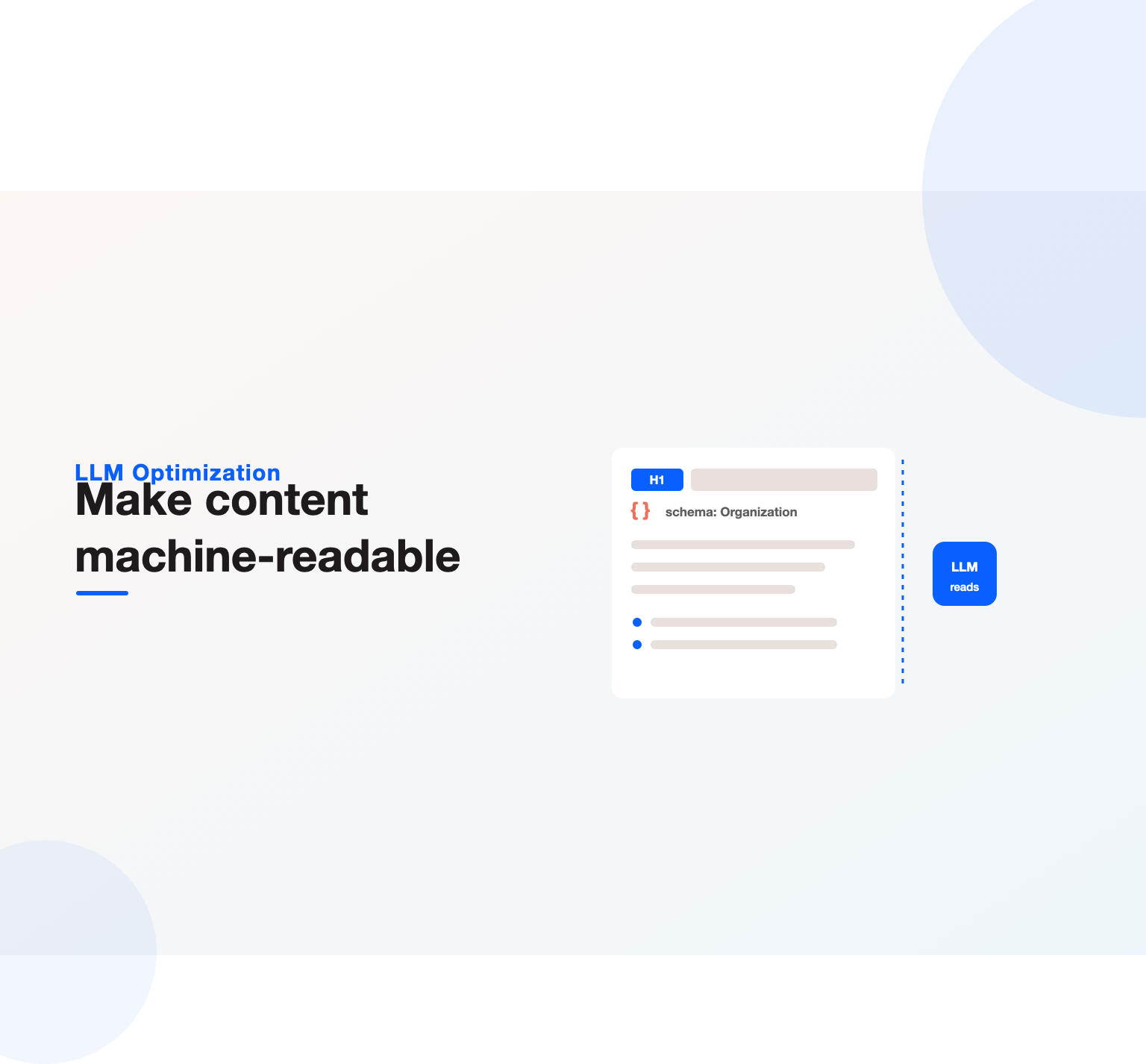
LLM optimization is the technical practice of structuring your content, markup and data so large language models can accurately parse, retrieve and reproduce your information in their answers. It covers clean semantic HTML, structured data that defines your entities, self-contained and well-chunked passages, consistent facts across the web, and machine-readable signals such as an llms.txt file. Unlike pure content strategy, it targets the mechanics of how models ingest a page, and it is what ensures the substance you publish is legible to a machine rather than lost in markup a model cannot interpret.
When a language model answers a question about your category, it is not reading your website the way a person does. It is parsing structure, extracting discrete facts, resolving which entity you are, and deciding whether your information is consistent enough to reproduce. LLM optimization is the technical craft of shaping your content and data so those systems can parse it, retrieve it, and repeat it accurately. Where broader visibility work focuses on authority and demand, this is the hands-on layer beneath it: the schema, the semantic structure, the entity hygiene, and the machine-readable signals that determine whether a model can actually use your pages. This guide walks through the concrete levers, in the order that matters, so an engineer or a technically minded marketer can act on them. Each section is written to be applied directly to a real page rather than admired in the abstract, and the levers build on one another, so working through them in sequence compounds the effect.
Key Highlights
- It is the technical layer that makes your content parseable and reproducible by models, distinct from the authority and demand work above it.
- Clean semantic HTML and structured data are foundational, because a model that cannot identify your entities and structure cannot reliably use your content.
- Self-contained, well-chunked passages are extracted far more accurately than facts buried in long, context-dependent paragraphs.
- Factual consistency across your site and the wider web is a technical discipline that directly affects whether a model trusts and repeats your information.
- Emerging signals like an llms.txt file and clean entity data give models an authoritative, low-friction account of who you are and what you cover.
What LLM optimization is, precisely
Think of it as the engineering-side counterpart to content and authority strategy. It concerns itself with a narrow, concrete question: when a model ingests your page, can it correctly parse the structure, identify the entities, extract clean facts, and trust the data enough to reproduce it. Every lever in this discipline serves that question. It is deliberately mechanical, because the failures it prevents are mechanical: a fact wrapped in markup a model misreads, an entity it cannot disambiguate, a passage it cannot lift without breaking the meaning, a claim that contradicts your own data elsewhere. Fixing those is not glamorous, but it is often the difference between content a model can use and content it silently skips.
This is why LLM optimization is best treated as a technical checklist applied to content that is already good. It does not replace genuine expertise or useful writing; it makes that substance machine-legible. A brilliant analysis buried in a JavaScript-rendered page with no structure and inconsistent entity data is invisible to the systems now mediating search, while the same analysis, cleanly marked up and internally consistent, becomes a reliable source. The work rewards precision and repeatability, which is exactly why it suits an engineering mindset: each lever is testable, each fix is verifiable, and the cumulative effect is content that models can consume without friction.
Semantic HTML and document structure
The first lever of LLM optimization is the structure of the document itself. Models rely on the semantic skeleton of a page, its headings, paragraphs, lists and tables, to understand how information is organized and to locate the passage that answers a given question. A page built with meaningful, hierarchical headings that read like the questions users ask is far easier for a model to navigate than one where structure is faked with styled div elements. Headings should describe the content beneath them accurately, the hierarchy should be logical, and important facts should live in clean paragraphs or lists rather than in captions, images, or scripts a model may never process.
Rendering matters as much as markup here. Content that only appears after heavy client-side execution is a risk, because the system ingesting your page may see an empty shell where your substance should be. Serving the meaningful content in the initial HTML, so it is present without requiring a browser to run scripts, is a core LLM optimization safeguard. The same applies to critical facts locked inside images or interactive widgets: if a number, definition or claim matters, it should exist as real text in the document, not only as a rendered graphic, because text is what a model can read and a picture, for these purposes, usually is not.
Structured data and entities
If document structure tells a model how a page is organized, structured data tells it what the page is about in terms it can resolve unambiguously. Schema markup that describes your organization, articles, products, people and their relationships gives models an explicit, machine-readable account of your entities rather than forcing them to infer everything from prose. This is a high-value lever of LLM optimization because entity resolution, correctly identifying which company, product or person a page refers to, is exactly where models often go wrong, and clear structured data removes that ambiguity. Marking up your organization, authorship and key entities consistently across the site helps a model build an accurate model of who you are.
Entity consistency extends beyond your own domain. Models cross-reference the entities they encounter, so aligning how your brand, people and products are described across your site, your profiles, and the broader web strengthens the model’s confidence in the entity. Contradictory or fragmented entity information, a different company description here, an out-of-date title there, weakens that confidence and invites the model to trust another source instead. Treating your entity data as a maintained, consistent asset, both on-page through structured data and off-page through the profiles and references a model can find, is one of the most durable investments in LLM optimization because it compounds across every question your entities are relevant to.
Chunking and self-contained passages
Models retrieve and reproduce information in pieces, so how you chunk your content strongly affects how well it is used. A passage that makes a complete, self-contained point, a full definition, a clear claim with its reason, a specific statistic with its context, can be lifted cleanly into an answer. A sentence that only makes sense three paragraphs into an argument cannot, because when it is extracted in isolation it loses its meaning or, worse, becomes misleading. A central habit of LLM optimization is writing in coherent, standalone units: each important idea expressed so that it survives being quoted on its own.
This has practical implications for how you format a page. Leading a section with a direct, self-sufficient answer and then elaborating gives a model a clean chunk to extract at the top. Using lists for enumerable items, tables for comparisons, and short definitional sentences for key terms all produce the kind of discrete, extractable units models handle best. The goal of this part of LLM optimization is to minimize the work a model has to do to find and lift a correct, complete piece of information, because the easier that extraction is, the more likely your content is to be the one reproduced rather than a competitor’s cleaner passage.
Factual accuracy and consistency
Because models increasingly cross-check claims, factual accuracy and internal consistency are not just editorial virtues but technical requirements of LLM optimization. A page that states a figure contradicted by another page on your own site gives a model conflicting signals and a reason to distrust both. Numbers, dates, names and claims that drift out of sync across your content quietly erode the reliability a model perceives, and unreliable sources get skipped. Keeping key facts accurate and aligned everywhere they appear is therefore part of the technical maintenance of a site optimized for language models, not an afterthought handled once at publication.
Freshness plays a related role. Models favor information that appears current and maintained, and stale content, visibly out of date or contradicted by more recent sources, is a liability. Building a practice of reviewing and updating your important facts, and signaling clearly when content was last updated, keeps your information in the state models prefer to reproduce. This maintenance mindset is a defining trait of mature LLM optimization: the site is not a set of documents published once and forgotten but a consistent, current, internally aligned body of information that a model can trust to be right whenever it reaches for it.
Machine-readable signals and llms.txt
An emerging layer of LLM optimization involves giving models explicit, low-friction guidance about your site. The most discussed of these is the llms.txt file, a simple, machine-readable document that summarizes what your site covers and points to your most important, authoritative pages, much as a sitemap or robots file guides traditional crawlers. While support for such signals is still evolving, publishing a clear, accurate account of your site’s purpose and key resources is a low-cost step that helps models encounter an authoritative summary of your brand rather than assembling one from scattered fragments. Our examples of how to structure an llms.txt file show what a good one looks like in practice.
These signals work best as a complement to the fundamentals, not a substitute for them. An llms.txt file pointing to thin or inconsistent pages does little; the same file pointing to well-structured, entity-clean, factually consistent content amplifies work that is already sound. The broader principle of this part of the technical layer is to reduce the friction and ambiguity a model faces when it tries to understand your site, whether through structured data, consistent entities, or explicit machine-readable summaries. Every one of these signals is a way of telling the systems that now mediate search, clearly and in their own terms, exactly what you are and what you can be trusted to say.
How LLM optimization fits with the wider discipline
The technical layer is the foundation beneath the broader goal of being visible in AI answers, and it works hand in hand with the strategy layers above it. The authority you build and the demand you create determine whether a model wants to feature you; this work determines whether it technically can. A brand with great authority but poor technical hygiene will be under-represented relative to its reputation, while strong technical work on thin, low-authority content will be legible but rarely chosen. The two layers are complementary, and a complete program addresses both. For the strategic layer that sits on top of this technical work, our guide to AI search optimization frames the wider discipline, and our explainer on LLM SEO covers the authority and content side in depth.
Placing optimizing for models correctly in the stack also prevents wasted effort. Teams sometimes pour resources into content and outreach while leaving basic technical barriers in place, then wonder why models under-cite them; others obsess over markup while publishing content with no depth or authority behind it. The productive sequence is to get the technical foundation right so your good content is fully legible, then invest in the authority and demand that make models want to feature it. Understanding how the layers relate, and where the practice ends and strategy begins, is what lets a team allocate effort where it actually moves the needle rather than optimizing one layer in isolation.
Measuring and maintaining LLM optimization
Because it is technical, much of model-readiness can be measured and monitored directly. You can audit whether your important content renders in the initial HTML, whether your structured data validates and covers your key entities, whether your passages are self-contained, and whether your facts are consistent across the site. These are concrete, testable conditions, and building them into your publishing and QA process turns this technical work from a one-time project into a maintained standard. The advantage of the technical layer is precisely this verifiability: unlike the softer signals of authority, most of these levers can be checked and enforced.
The outcome-side measurement connects back to the wider program: tracking whether the major models retrieve and reproduce your content accurately for your priority questions, and whether errors or omissions decrease as you improve the technical foundation. When a model misstates a fact about you or cites a competitor’s cleaner page, that is often a technical signal pointing to a specific fix, a missing piece of structured data, an inconsistent figure, a passage that did not survive extraction. Treating those observations as a maintenance queue keeps your the discipline current as both your content and the models evolve. If you want a partner to run this technical work alongside the strategy, our answer engine optimization services handle both layers together, and our generative engine optimization services extend the same rigor to generative-answer surfaces. Get the mechanics right, and every other investment in AI visibility works better on top of them.
A practical checklist
It helps to turn the levers above into a concrete checklist a team can run against any important page. Does the meaningful content appear in the initial HTML, without depending on scripts to render. Do the headings form a logical hierarchy and read like the questions the page answers. Does structured data validate and describe the organization, author and key entities on the page. Are the important facts expressed as self-contained passages that survive being quoted alone. Are the numbers, names and claims consistent with what the rest of the site and the wider web say. Is there a clear signal of when the content was last updated. Running this list on your highest-value pages first surfaces the technical gaps that most often keep good content out of AI answers, and fixing them is usually fast because each item is specific and verifiable.
The value of a checklist is that it makes model-readiness a repeatable standard rather than a matter of individual judgment. Once the list is agreed, it can be built into the publishing workflow, so every new page ships in a state models can use rather than being retrofitted later. It also gives non-specialists a way to contribute: a writer can confirm the answer-first structure and self-contained passages, while an engineer handles rendering and structured data. This division of labor, guided by a shared checklist, is how disciplined teams keep a growing site consistently legible to language models. For the content-side habits that pair with these technical checks, our guide to answer-first writing and our overview of how brands win AI search are useful companions.
Common technical mistakes
A handful of technical errors account for most of the cases where good content is under-used by models. The most damaging is hiding substance behind client-side rendering, so the page a model ingests is effectively empty; this single issue can remove an otherwise strong page from consideration entirely. A close second is missing or invalid structured data, which forces models to infer entities they could have been told explicitly, increasing the chance they resolve you incorrectly or trust a clearer source instead. Inconsistent facts across pages are a third, quietly teaching a model that your information cannot be relied upon. None of these are exotic, and all are fixable, but they persist because they are invisible in a normal browser where the page looks perfectly fine.
A subtler mistake is optimizing markup while neglecting the content it wraps. Perfect structured data around a thin, low-authority page produces something legible but rarely worth citing, because the technical layer makes content usable, not valuable. The reverse error, deep content trapped in poor technical delivery, is just as common and just as costly. The productive mindset treats the technical work as necessary but not sufficient: it removes the reasons a model cannot use your content, after which the authority and quality of that content determine whether it wants to. Our roundup of the common mistakes that hurt AI citation covers both the technical and strategic errors together, and our analysis of the most cited websites in AI answers shows what getting both right looks like.
Where to start
For a team beginning this work, sequence beats ambition. Start with rendering and crawlability on your most important pages, because a page a model cannot ingest gains nothing from any other improvement. Next, add and validate structured data for your core entities, since accurate entity resolution has an outsized effect on how models represent you. Then work through your key pages to make their important passages self-contained and their facts consistent, and finally add the machine-readable signals like a clear llms.txt that summarize your site. This order front-loads the fixes with the largest effect on whether models can use your content at all, before the finer refinements.
Approached this way, the technical work becomes a manageable program rather than an overwhelming audit. Each stage is testable, each fix is verifiable, and the improvements compound: a well-rendered, entity-clean, consistent, well-structured page is a reliable source across every question it is relevant to, and a site full of such pages steadily becomes one models reach for by default. The teams that treat model-readiness as an engineering standard, maintained continuously and checked on every release, build a durable technical advantage over competitors who leave these barriers in place. For a comparison of the adjacent disciplines this foundation supports, our explainer on AEO versus GEO puts the technical layer in its wider context.
How it differs by site type
The emphasis within this technical work shifts with the kind of site involved. For a content or media site, the priority is answer-first structure, self-contained passages and clean article markup, because the value is in the text being extracted accurately. For an ecommerce or product site, product and organization structured data and consistent product facts carry more weight, since models increasingly summarize and compare products and need reliable, resolvable data to do it well. For a software or services brand, entity consistency and clear authorship signals matter most, because the goal is to be correctly identified and trusted as a provider in a category. Knowing which levers matter most for your site type lets you sequence the work for the largest return rather than treating every lever as equally urgent.
What stays constant across every site type is the underlying logic: reduce the friction and ambiguity a model faces when it tries to ingest, understand and reproduce your information. Whether the payoff is an extracted answer, a summarized product, or a correctly attributed recommendation, the mechanism is the same, and so is the discipline of testing, fixing and maintaining the technical foundation. This is why the levers generalize even as their priority order changes, and why a team that internalizes the principles can apply them confidently to any property. For the strategy that rides on top of this foundation, our guide to LLM SEO and the broader AI search optimization playbook show where the technical work leads.
Related reading
- AI Search Optimization: The Definitive Guide
- LLM SEO: How to Get Recommended by AI Models
- How to Write Answer-First Content That AI Engines Extract
- How AI Search Engines Choose Which Brands to Cite
- llms.txt Examples and How to Structure One
Key Takeaways
- Ensure your important content renders in the initial HTML, not just after scripts.
- Add and validate structured data for your organization, authors and key entities.
- Rewrite key facts as self-contained, quotable passages models can extract cleanly.
- Build model-readiness into publishing so every new page ships legible by default.
Frequently asked questions
What is LLM optimization?
In practice, it is the technical work of structuring your content, markup and data so large language models can accurately parse, retrieve and reproduce your information. It covers semantic HTML, structured data and entities, self-contained passages, factual consistency, and machine-readable signals like an llms.txt file. It is the mechanical layer that makes good content legible to a model, distinct from the authority and demand work above it.
How is LLM optimization different from LLM SEO?
They are complementary layers. LLM SEO is the broader discipline of earning citations and recommendations, which leans heavily on authority and content strategy. LLM optimization is the technical foundation beneath it: whether a model can actually parse your structure, resolve your entities, extract your facts, and trust your data. One decides whether a model wants to feature you; the other decides whether it technically can.
Does structured data help with LLM optimization?
Yes, significantly. Structured data gives models an explicit, machine-readable account of your entities and their relationships, which removes the ambiguity of inferring everything from prose. Because entity resolution is exactly where models often err, clear schema for your organization, authorship, products and key entities is one of the higher-value technical levers, especially when the same entity information is kept consistent across your site and the wider web.
What is an llms.txt file?
An llms.txt file is a simple, machine-readable document that summarizes what your site covers and points to your most important, authoritative pages, similar in spirit to a sitemap or robots file but aimed at language models. Support is still evolving, but publishing a clear, accurate one is a low-cost way to help models encounter an authoritative summary of your brand rather than assembling one from scattered fragments.
Does content need to render without JavaScript?
Your meaningful content should be present in the initial HTML rather than appearing only after heavy client-side execution, because a system ingesting your page may see an empty shell if the substance depends on scripts running. Serving the important text server-side, and keeping critical facts as real text rather than locked inside images or widgets, is a core safeguard so models can actually read what matters.
How do you measure LLM optimization?
Much of it is directly testable: whether important content renders in the initial HTML, whether structured data validates and covers your entities, whether passages are self-contained, and whether facts are consistent across the site. On the outcome side, track whether models retrieve and reproduce your content accurately for priority questions, and treat any misstatement or competitor citation as a signal pointing to a specific technical fix.
How does chunking affect LLM optimization?
Chunking determines whether a model can lift a correct, complete piece of your content into an answer. Because models retrieve and reproduce information in pieces, a passage that makes a full, self-contained point can be quoted cleanly, while a sentence that depends on three paragraphs of context loses its meaning or misleads when extracted alone. Leading each section with a direct, standalone answer, and using lists and short definitional sentences, produces the discrete units that models handle best and is a core part of LLM optimization.
Does LLM optimization help with traditional SEO too?
Largely yes. Clean semantic structure, valid structured data, fast server-side rendering and consistent, accurate information are all things traditional search engines reward as well, so the technical foundation you build for models tends to strengthen classic rankings at the same time. The two are not identical, but the overlap is high enough that most LLM optimization work pays off across both surfaces rather than forcing a trade-off between them.
Who should own LLM optimization?
It sits naturally between engineering and content, so it works best with shared ownership: engineers handle rendering, structured data and site-wide consistency, while content owners handle answer-first structure and self-contained passages. A shared checklist built into the publishing process keeps both sides accountable, which is what turns model-readiness from an occasional audit into a standard every new page meets before it ships.
Is LLM optimization a one-time task?
No. Content changes, entities drift, facts go stale and the models themselves evolve, so model-readiness works best as a maintained standard built into publishing and QA rather than a single project. Auditing structure, structured data, consistency and rendering on an ongoing basis, and treating model errors about you as a maintenance queue, keeps the technical foundation sound as both your site and the systems reading it change.
Ready to put this into practice?
Talk to the team that runs SEO, AI search and paid growth programs every day.
Book a Strategy Call →