 Skip to content

The MarTech Audit: How to Find the 30-40% Your Stack Wastes
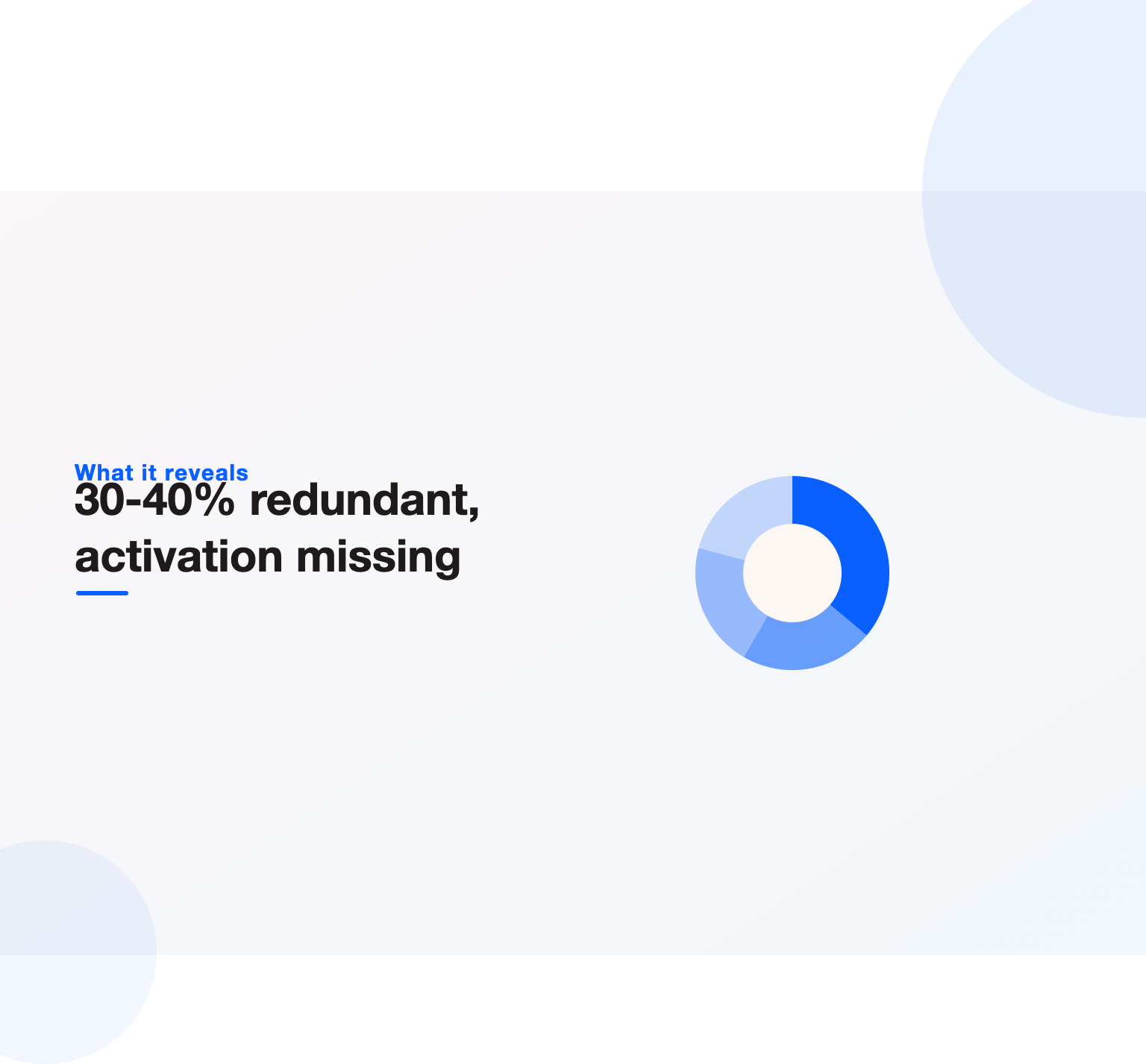
A martech audit maps your stack to the value chain and reveals the 30-40% that is redundant plus the missing activation layer. How to run one, and what it always finds.

Quick Answer
A review is a structured review of your marketing technology stack that maps every tool to the value chain, measures how much of each is actually used, and identifies redundancy, gaps and integration failures. It exists because most stacks grew by accretion rather than design, so companies own far more technology than they orchestrate. A good audit reveals the 30 to 40 percent of tools that are redundant, the activation layer that is usually missing, and the sequence of fixes that will lift performance fastest. It is the cheapest high-return move in marketing technology, because it costs nothing to run and prevents the most expensive mistake: buying more tools to solve a problem better orchestration would fix.
A review is the fastest way to find out why your marketing technology is underperforming, and for most enterprises the answer is uncomfortable. In our State of Enterprise MarTech 2027 report, where we audited the observable stacks of 190 enterprise SaaS companies, the average scored just 43 out of 100 on the Unified MarTech Efficiency Index, and stacks were typically 30 to 40 percent redundant. A review turns that vague sense of bloat and underperformance into a specific, actionable picture: what you own, how much of it you use, where the gaps are, and what to fix first. This guide explains what an audit is, how to run one, and what it almost always reveals.
Key Highlights
- A review maps every tool to the value chain, measures real usage, and surfaces redundancy, gaps and broken integrations, turning a vague sense of underperformance into a specific plan.
- Our benchmark, effectively an audit of 190 enterprise stacks, found the average scored 43 out of 100 and stacks were typically 30 to 40 percent redundant.
- A review almost always reveals a stack strong at measurement and weak at activation, with the customer data platform and experimentation layers missing.
- The audit is the cheapest high-return move available, because it costs nothing to run and prevents expensive purchases that better orchestration would make unnecessary.
- Run an audit as a recurring discipline, not a one-time project, because stacks drift, tools change and redundancy creeps back in without ongoing review.
What an audit is
A review is a systematic assessment of your marketing technology: what you own, how it is configured, how much of it is actually used, and how well it works together. It is not a vendor pitch or a feature comparison; it is an honest inventory and evaluation of your existing stack against what it is supposed to achieve. The best way to think about an audit is as reading your stack as a value chain, from collecting data through unifying it, acting on it and governing it, and judging how well each stage performs rather than simply counting tools.
The reason an audit matters is that most stacks are impossible to reason about without one. Marketing technology accretes over years, one tool and one vendor at a time, until nobody has a complete picture of what the organisation owns, how it connects, or how much of it is switched on. A review rebuilds that picture, which is the precondition for improving anything, because you cannot fix a stack you cannot see. It replaces anecdote and assumption with a clear map, and that map is where every good decision about the stack begins.
A review differs from a simple tool inventory in that it judges capability, not just presence. Owning an analytics platform is not the same as using it well, and owning a customer data platform is worthless if it was never properly implemented, so a real audit scores how much of each tool is genuinely delivering value. This is the discipline behind our benchmark, which scored 190 stacks on real capability across seven dimensions rather than on logos, and it is why a proper audit produces insight that a spreadsheet of subscriptions never could.
Why you need an audit
The case for an audit is strongest precisely when a stack feels bloated but nobody can say exactly why. If your marketing technology spend keeps rising while results do not, if different tools report different numbers, if campaigns need heroics to ship, or if you suspect you are paying for capability you never use, an audit turns those suspicions into facts. It is the diagnostic step that should precede any decision to buy, consolidate or rebuild, because acting without it means guessing.
A review also protects budget in a way little else does. Our benchmark found stacks are typically 30 to 40 percent redundant, which means a large slice of the marketing technology budget is being spent on tools that duplicate a capability or sit unused. A martech audit finds that waste and turns it into reclaimable budget, often paying for itself many times over before a single new tool is bought. In budget season, walking in with an audit that shows exactly what can be cut and what must be kept is far stronger than defending a stack nobody fully understands.
Finally, an audit is the foundation for a credible roadmap. Once you know what you own, how much you use, and where the gaps are, you can sequence improvements deliberately rather than reacting to vendor pressure. This is why an audit is the natural first step in any serious marketing technology programme, and why our martech stack and marketing operations guidance both begin from it. Without an audit, every subsequent decision rests on assumption; with one, it rests on evidence.
The seven dimensions an audit measures
A thorough audit scores the stack across the same seven dimensions we used to benchmark 190 companies, because a stack is only as strong as its weakest one. The first three are the foundation: content and experience tooling, which 71 percent of companies run; measurement and analytics, at 65 percent; and data plumbing through tag management, at 59 percent. A martech audit typically finds these in good shape, because they are mature, well-understood categories that almost every enterprise has handled.
The governance dimension is where an audit often finds a surprise. Consent and privacy tooling now appears on 47 percent of stacks, more than marketing automation at 42 percent, which means compliance has outpaced activation. A martech audit that surfaces this shows where budget and attention have flowed, toward avoiding fines rather than toward converting customers, and it prompts the question of whether the balance is right. Governance matters, but a stack that is fully compliant and still cannot convert has misallocated its effort.
The last three dimensions are where an audit usually finds the real problems. Demand intelligence sits at 42 percent, activation through marketing automation at 42 percent, optimisation through experimentation at 31 percent, unification through a customer data platform at 28 percent, and real-time engagement at just 20 percent. A martech audit almost always reveals that these activation dimensions are the weak point, which is why the average stack scores only 43 out of 100. Scoring each dimension turns the audit from an opinion into a diagnosis, showing exactly where the next investment should go, and it is rarely another analytics tool.
How to run an audit step by step
Running an audit follows a clear sequence, and the first step is a complete inventory. List every marketing tool the organisation owns, including the shadow tools individual teams bought without central oversight, and record what each is for, what it costs, and who owns it. This alone is revealing, because most enterprises discover tools nobody remembered buying and subscriptions nobody uses. A martech audit cannot judge a stack it has not fully catalogued, so completeness matters more than speed at this stage.
The second step is to map each tool to the value chain and assess integration. Place every tool in its stage, collect, unify, act, govern, and record whether it is fully integrated, half-connected or isolated, because an audit is as much about the connections as the tools. This mapping exposes the shape of the stack, whether it is balanced or the inverted pyramid most enterprises run, and it reveals the integration failures that leave data trapped and tools working in silos. The connections are where much of the hidden cost and lost value live.
The third step is to measure real usage and capability. For each tool, judge how much of it is actually switched on and delivering value, from the flagship features down to the ones nobody configured, and score each of the seven dimensions accordingly. The fourth step is to synthesise: identify the redundancy to remove, the gaps to fill, and the integration to fix, then sequence those into a prioritised plan. A martech audit that ends in a scored, sequenced plan is one an organisation can act on, which is the whole point of running it.
What an audit almost always reveals
Across the stacks we have audited, an audit tends to reveal the same pattern, and recognising it in advance helps you know what to look for. The first finding is redundancy: 30 to 40 percent of the stack duplicates a capability, with multiple tools solving the same job and none fully integrated. This is immediate reclaimable budget, and an audit that surfaces it usually pays for itself before any other change is made, simply by identifying what can be retired.
The second finding is the measurement-versus-activation imbalance. A martech audit almost always shows a stack strong at the front of the value chain, where analytics and tag management are near universal, and weak at the back, where the customer data platform, experimentation and engagement layers are missing. This imbalance is the single best explanation for why the average stack scores only 43 out of 100, and an audit makes it concrete, showing exactly which activation capabilities are absent and what they would unlock.
The third finding is broken integration. A martech audit typically reveals that even the tools a company owns are not fully connected, so data is trapped, numbers conflict, and the stack behaves as a set of silos rather than a system. Half-connected tools produce contradictory data that erodes trust, and an audit surfaces exactly where those connections are missing. Together these three findings, redundancy, the activation gap, and broken integration, are what an audit almost always uncovers, and they are the reason so much marketing technology spend produces so little.
Red flags an audit surfaces
Beyond the structural findings, an audit surfaces specific red flags worth acting on quickly. The clearest is shadow IT: tools bought by individual teams outside any central process, which fragment the data further and duplicate capability the organisation already owns. A martech audit brings these into the light, and consolidating them is often an easy early win. Another red flag is tools with near-zero usage, the subscriptions nobody logs into, which an audit turns into obvious cuts.
Conflicting data across tools is a subtler but more damaging red flag. When an audit finds that analytics, the CRM and the advertising platforms all report different numbers, it signals broken integration and, worse, a stack whose own team no longer trusts its data. Once trust in the numbers is gone, decisions revert to gut feel, and the whole measurement investment is wasted, which is why an audit treats data consistency as a priority finding rather than a technicality. Restoring one trustworthy view is often the highest-value fix an audit recommends.
The last red flag an audit surfaces is the absence of ownership. When no one clearly owns the stack, tools proliferate, integrations decay and nobody is accountable for whether the technology delivers, which is a governance failure as much as a technical one. A martech audit that finds no clear owner will usually recommend establishing one as the first structural fix, because without ownership the other fixes will not hold, and the stack will drift back toward the state the audit found. Naming an owner is what makes an audit’s recommendations stick.
Should you run an audit yourself or with a partner?
A martech audit can be run internally, and for a small stack a capable team with the right framework can do it well. The advantage of an internal martech audit is knowledge of the business context, and the discipline of doing it builds internal understanding of the stack that pays off long after. For organisations with the expertise and a manageable stack, a self-run martech audit against a clear seven-dimension framework is entirely feasible and worth doing regularly.
A partner earns its place when the stack is large, the internal expertise is thin, or objectivity matters. An experienced team runs an audit faster, benchmarks the results against many other stacks, and brings the honesty an internal review sometimes lacks, because it has no attachment to the tools someone chose or the decisions someone defends. This external perspective is often what an audit needs to reach uncomfortable but accurate conclusions, and it is the work our digital marketing consulting and growth marketing teams deliver, benchmarked against the 190 stacks in our report.
Either way, the value of an audit lies in acting on it, not merely producing it. A martech audit that ends in a report nobody implements is the same waste as a dashboard nobody reads, so the real question is not only who runs it but who owns the follow-through. Whether internal or external, an audit should produce a scored, sequenced plan with an owner accountable for delivery, because that is what turns a diagnosis into the performance improvement the report shows is available to almost every enterprise stack.
How often should you run an audit?
A martech audit is not a one-time event, because the conditions that create bloat never stop operating. New tools get bought, teams change, integrations decay, and redundancy creeps back in, so a stack audited once and neglected drifts back toward the state it started in. The right cadence treats the audit as a recurring discipline, with a light continuous review of the signals that break silently and a deeper full audit on a regular schedule.
A practical rhythm runs a comprehensive martech audit annually, with lighter quarterly checks on new tools, high-value templates and the health of key integrations. The annual audit re-scores the seven dimensions and re-sequences the roadmap; the quarterly checks catch drift before it compounds. This cadence keeps the stack lean and the roadmap current, and it prevents the slow accretion that turns a clean stack into a bloated one over a couple of years. Treating the audit as maintenance rather than a rescue mission is what keeps a stack high-performing.
The discipline of a recurring martech audit also changes buying behaviour. When every purchase must survive the next audit, teams think harder before adding tools, and the reflex to buy in budget season gives way to the discipline of consolidating first. This is the deeper value of a regular martech audit: it does not just clean up the stack once but installs the habit that keeps it clean, which is exactly the operating discipline our benchmark found separating the high performers from everyone else. The audit becomes a governance rhythm rather than a one-off event.
What an audit typically costs
A martech audit can range from a free internal exercise to a paid engagement, and the right choice depends on the size of the stack and the honesty required. An internal martech audit costs only the team’s time, which is well spent because the discipline builds lasting understanding of the stack, and for a manageable estate a capable team with a clear framework can do it thoroughly. The trade-off is objectivity, since an internal review can struggle to reach uncomfortable conclusions about tools the team chose or decisions it defends.
A partner-led martech audit carries a fee, but it usually pays for itself many times over through the redundancy it uncovers. Our benchmark found stacks typically 30 to 40 percent redundant, so an audit that identifies even part of that waste reclaims budget far exceeding its cost, before any performance improvement is counted. The real question is not the price of the audit but the cost of not running one, which is a bloated stack quietly wasting a third of its budget and underdelivering on the rest. Framed that way, an audit is among the cheapest high-return investments in marketing technology, whichever way you run it.
Turning an audit into action
The value of an audit lies entirely in what happens after it, because a diagnosis nobody acts on changes nothing. The most common failure is producing a thorough audit report that then sits unimplemented while the stack drifts on unchanged, which wastes the effort and, worse, tells the organisation that audits do not lead anywhere. To avoid this, an audit should end not in a document but in a sequenced plan with owners, deadlines and clear first moves, so the findings translate directly into work.
Sequencing the fixes is what turns an audit into results, and the order follows the report’s logic: consolidate the redundancy first for immediate budget and simplicity, fix the integrations that leave data trapped, then build the activation layer the audit found missing, guided by our customer data platform and conversion optimisation work. Assign each fix an owner and a date, review progress against the plan, and re-audit on a schedule to catch drift. Done this way, an audit becomes the engine of continuous improvement rather than a one-off report, and it is the practical starting point our demand generation and consulting engagements build from, because you cannot improve a stack you have not first honestly seen.
The martech audit checklist
A practical audit works through a consistent checklist so nothing is missed. Start with the inventory: every tool, its owner, its cost, its renewal date, and whether anyone actually uses it, including the shadow tools bought outside central oversight. Then the integration map: which tools are connected, which share data cleanly, and where information is trapped in silos that produce conflicting numbers. Then usage: for each tool, how much of its capability is switched on versus paid for but idle, because an unused feature is indistinguishable from one you do not own.
From there the checklist moves to the seven dimensions, scoring content, measurement, data plumbing, governance, demand intelligence, activation and engagement against what a high-performing stack should achieve. It then flags the red items: the redundant tools to retire, the broken integrations to repair, the activation gaps to fill, and the absence of clear ownership if no one is accountable for the stack. Finally it sequences the findings into a plan, ordered for impact, so the review ends in action rather than observation. Worked this way, the checklist turns an intimidating estate into a clear, prioritised set of moves any team can begin the next week.
How audit findings differ by company size
The pattern a review uncovers shifts with company size, and knowing what to expect sharpens the work. In a smaller company, the findings usually centre on gaps rather than bloat: a missing data layer, no experimentation practice, and a foundation that measures but cannot act, so the priority is building the activation layer rather than cutting. The stack is small enough to reason about, and the fastest gains come from adding the one or two capabilities that unlock the rest.
In a mid-sized company, redundancy starts to dominate the findings, because the stack has grown past what anyone fully tracks, and duplicate tools and half-finished integrations proliferate. Here the priority is consolidation and integration, reclaiming budget and restoring a clean data flow. In a large enterprise, the review typically finds all of it at once: significant redundancy, serious integration debt, a thin activation layer despite heavy spend, and shadow tools scattered across business units. At this scale the review is less about any single fix and more about installing the ongoing discipline that keeps a sprawling estate coherent, which is exactly the operating rhythm our benchmark found among the high performers and the gap it found among everyone else.
From audit to a high-performing stack
A martech audit is the beginning of a programme, not the end of one, and its findings map directly onto the work of building a better stack. The redundancy it flags becomes a consolidation plan; the missing activation layer becomes a roadmap to a customer data platform and experimentation practice; the broken integrations become a connection project; and the absence of ownership becomes the case for a real marketing operations function. Each finding is a step on the path from a stack that measures to one that converts.
This is why the audit is the natural first move in any serious marketing technology effort. It replaces guesswork with evidence, turns a vague sense of underperformance into a sequenced plan, and gives leadership a defensible basis for every subsequent decision about the stack. The report shows the destination, a balanced, orchestrated stack in the top tier, and the audit is how a company finds out how far it currently sits from that destination and exactly which moves close the gap. Run it honestly, act on it deliberately, and repeat it on a schedule, and the same stack that scored 43 out of 100 can steadily climb toward the performance the leaders already enjoy.
Related reading
- The State of Enterprise MarTech 2027
- The Modern MarTech Stack: Built to Measure, Not Convert
- Customer Data Platforms: The Missing Activation Layer
- Marketing Operations: The Discipline That Turns a Stack Into Revenue
- How to Build a High-Performance MarTech Stack
Key Takeaways
- Inventory every tool, including shadow purchases, and map each to the value chain.
- Measure real usage and score the seven dimensions honestly.
- Turn findings into a prioritised plan: consolidate, integrate, and fill the activation gap.
- Repeat the audit on a schedule so redundancy cannot creep back.
Frequently asked questions
What is an audit?
A martech audit is a structured review of your marketing technology stack that maps every tool to the value chain, measures how much of each is actually used, and identifies redundancy, gaps and broken integrations. Unlike a simple tool inventory, an audit scores real capability across the stack, so it produces a diagnosis and a prioritised plan rather than just a list of subscriptions.
Why is an audit important?
Because most stacks grew by accretion and nobody has a complete picture of what is owned, used or connected. A martech audit rebuilds that picture, which is the precondition for improving anything, and it typically finds 30 to 40 percent redundancy that becomes reclaimable budget. It is the diagnostic step that should precede any decision to buy, consolidate or rebuild, because acting without it means guessing.
How do you run an audit?
Inventory every tool including shadow IT, map each to the value chain and assess integration, measure real usage and score the seven dimensions, then synthesise the findings into a prioritised plan. A martech audit that ends in a scored, sequenced roadmap with a clear owner is one an organisation can act on, which is the whole point of running it.
What does an audit reveal?
Almost always three things: redundancy of 30 to 40 percent, a stack strong at measurement and weak at activation with the customer data platform and experimentation layers missing, and broken integration that leaves data trapped and numbers conflicting. A martech audit turns these from vague suspicions into specific, actionable findings, and they are the reason most marketing technology underperforms.
How often should you run an audit?
Run a comprehensive martech audit annually, with lighter quarterly checks on new tools and key integrations, because the conditions that create bloat never stop. A stack audited once and neglected drifts back toward its original state, so treating the audit as a recurring discipline rather than a one-time project is what keeps a stack lean and high-performing over time.
Should you run an audit internally or with a partner?
A capable internal team can run an audit on a manageable stack with the right framework, and doing so builds valuable understanding. A partner earns its place when the stack is large, expertise is thin, or objectivity matters, because an external team benchmarks against many stacks and brings honesty an internal review can lack. Either way, the value lies in acting on the audit, so it should end in a plan with an accountable owner.
Ready to put this into practice?
Talk to the team that runs SEO, AI search and paid growth programs every day.
Book a Strategy Call →