 Skip to content

AI Citation Readiness Audit: How to Audit Your Website
Run an AI citation readiness audit on your website: a five-part check covering crawlability, answer-first content, structure and schema, authority and prompt tests.
Quick Answer
An AI citation-readiness audit checks whether engines can retrieve your pages, extract clean answers, and trust your content, then prioritises the fixes that most improve your odds of being cited. It maps each weakness to a specific, actionable remedy.
An AI citation readiness audit checks whether answer engines can find, understand, trust and quote your website, so you know exactly what to fix to start earning citations. Run it in five parts: technical retrievability, answer-first content, structure and schema, authority and trust signals, and live prompt testing against the engines themselves. This guide walks through each part step by step, with what to look for and how to score it, so you finish with a prioritised list of fixes rather than a vague sense that you should be doing more.
Key Highlights
- An AI citation readiness audit checks whether engines can find, understand, trust and quote your site.
- Run it in five parts: technical retrievability, answer-first content, structure and schema, authority and trust, and live prompt testing.
- Live prompt testing, asking the engines your real questions, reveals where you are cited or missing.
- Score each part so you know exactly what to fix first.
- The most common findings are buried answers, thin authority signals and no citation measurement at all.
What an AI citation readiness audit checks
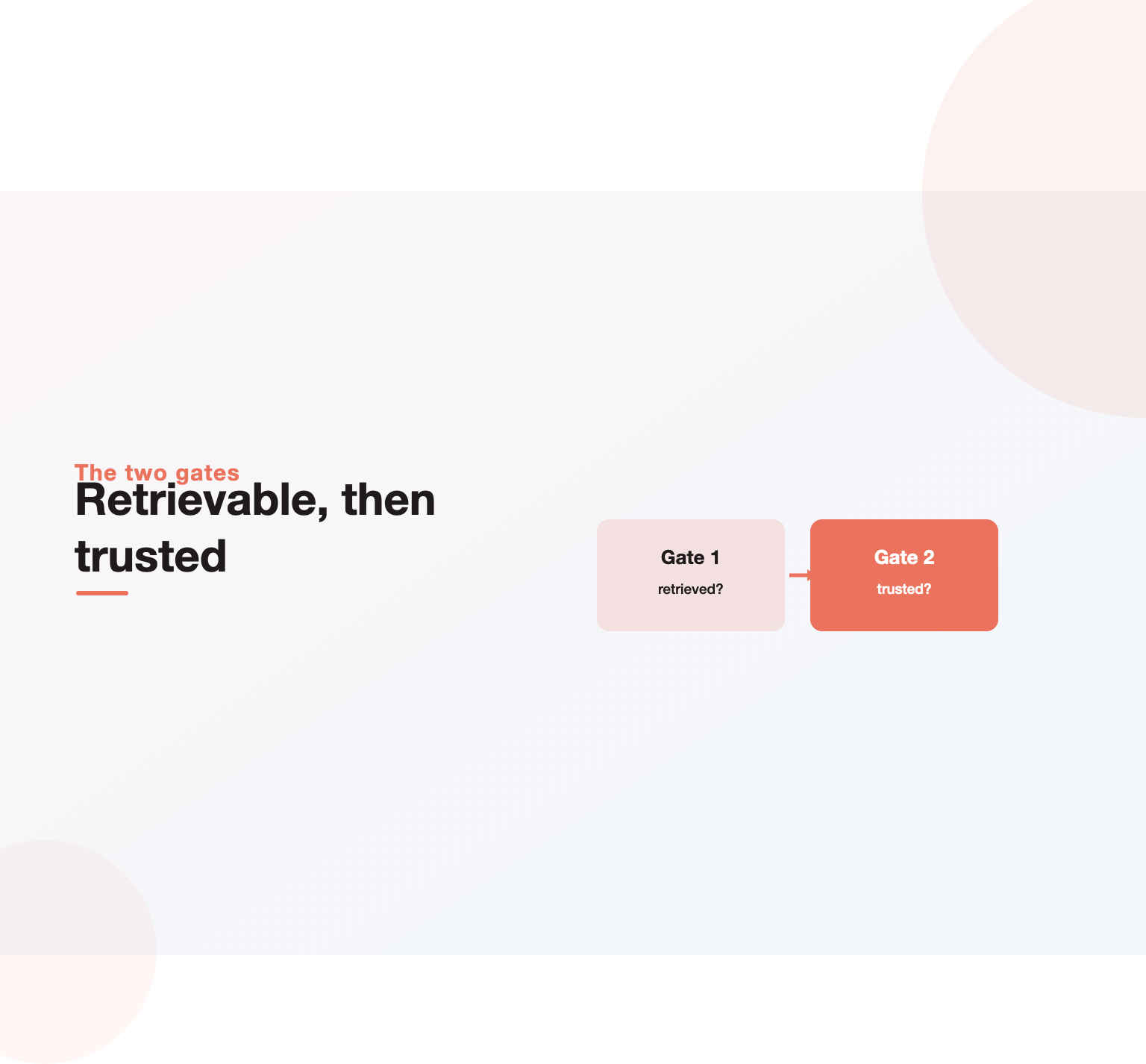
An AI citation readiness audit answers one question: when someone asks an answer engine about your category, is your site in a state to be retrieved, understood, trusted and quoted? Getting cited depends on clearing two gates in order. First, the engine has to be able to retrieve your content at all. Second, it has to trust and understand it enough to quote it. The audit works through both gates in five parts, and each part produces concrete fixes. Score each area, weight the gaps, and you have a roadmap.
Part 1: Technical retrievability
If an engine cannot access your content, nothing else matters, so start here. Confirm that your important pages are crawlable and not blocked in robots.txt, that content renders in HTML rather than hiding behind JavaScript that bots may not execute, and that pages load fast and render cleanly on mobile. Check that you are not accidentally blocking the AI crawlers you want to reach you. Make sure your XML sitemap is current and your key answers live in real text, not trapped inside images or embeds. A page an engine cannot read is a page it can never cite. This part also hides the most common nasty surprise: teams are sure their content is accessible, then find on inspection that a redesign, a migration or a well-meaning performance tweak quietly moved key answers behind a script or into an image months ago. Check it directly rather than assuming, because everything downstream depends on it.
Part 2: Answer-first content
Next, audit whether your content actually answers questions in a form an engine can lift. For your most important topics, check that each key question has a page or section that leads with a clear, self-contained answer in the first two sentences, before the supporting detail. Look for buried answers, where the reader has to wade through preamble, and for pages that dance around a question without ever stating the answer plainly. Rewrite those answer-first. This single habit does more for citation readiness than almost anything else, and our guide to what makes content citable details how.
Part 3: Structure and schema
Now check how easy your content is to parse. Audit your heading structure: are headings phrased as the questions people ask, in a logical hierarchy, or are they vague labels? Review your structured data for the relevant schema types, Article, FAQPage, Organization, Product, and confirm it validates. Check that content is broken into clean, self-contained sections an engine can extract independently rather than one undifferentiated wall of text. Well-structured content is not a nicety here; it is the difference between an engine confidently quoting you and skipping to a clearer source.
In practice, part 4: Authority and trust
Retrievable and clear gets you considered; trusted gets you quoted. Audit your E-E-A-T signals. Do your articles have named authors with real credentials and bios? Does your site demonstrate first-hand experience, original data or genuine expertise, or does it read like a summary of everyone else? How strong are your brand mentions and citations across the wider web, since engines lean on external corroboration to decide who to trust? Our guide to E-E-A-T for AEO covers how to strengthen each signal. Weakness here is the most common reason a technically perfect page still is not cited.
In many cases, part 5: Live prompt testing
Finally, test reality. Take the questions your buyers actually ask and run them through ChatGPT, Perplexity, Gemini and Google AI Overviews. Note when you are cited, when a competitor is cited instead, and what the cited sources do that you do not. This is the most direct signal you have: it shows your current share of answer and reveals the gap between where you are and where the cited sources sit. Repeat it regularly, because it is also how you will measure whether your fixes are working.
How to score each part of the AI citation readiness audit
An audit is only useful if it ends in a number you can act on, so score each of the five parts rather than leaving a vague impression. A simple approach works well: rate each part from zero to five, where zero means a blocker that stops citations outright and five means best-in-class. For retrievability, a single blocked or unreadable key page drags the score down hard, because it caps everything else. For content, sample your top ten priority pages and score how many lead with a clean, liftable answer. For structure, count how many have valid schema and question-shaped headings. For authority, judge named authorship, evidence of first-hand experience and external mentions. For prompt testing, use your measured share of answer directly as the score. Write the five numbers down; the lowest one is almost always where your next sprint should go.
Tools that help with the audit
You do not need exotic tooling. For retrievability, a standard crawler plus Google Search Console tells you what is indexed and readable, and fetching a page as plain text reveals whether your answers survive without JavaScript. A schema validator confirms your structured data parses. For content and structure, a careful manual read of your priority pages beats any automated score, because citation readiness is about clarity a human editor can judge. And for prompt testing, the tools are the engines themselves: ChatGPT, Perplexity, Gemini and Google. The discipline that matters more than any tool is consistency, running the same checks and the same prompt set each time so your scores are comparable across audits.
The most common audit findings
Across most first audits, the same handful of issues show up. Answers are buried under throat-clearing introductions instead of stated up front. Headings describe topics vaguely rather than posing the question a user asks. Schema is missing or invalid on exactly the pages that would benefit most. Content reads as a competent summary of what everyone else already says, with no first-hand experience or original data to make it worth citing. And authors are anonymous or unattributed, giving engines no person to trust. None of these is hard to fix individually; the value of the audit is seeing which ones are actually holding you back so you fix the ones that move your citation rate rather than polishing things that were already fine. These findings show up in almost every AI citation readiness audit.
Who owns the audit and how often
Citation readiness sits across teams, so decide ownership explicitly or it falls through the cracks. Technical retrievability belongs with whoever owns SEO or the site’s engineering. Answer-first content and structure belong with content and editorial. Authority building spans content, PR and leadership. One person should own the overall scorecard and the quarterly cadence, even if the fixes are distributed. On frequency, run live prompt tests monthly, because they are quick and show movement, and run the full five-part audit quarterly, or sooner after a major site change or a shift in how the engines behave. Regular beats occasional: a light quarterly rhythm keeps you ahead, while a heroic annual audit lets problems accumulate for months.
Retrievability deep dive: what blocks AI crawlers
Because retrievability caps everything, it is worth knowing the specific ways sites lock engines out. The obvious one is a robots.txt rule or meta tag that disallows crawling, sometimes added years ago and forgotten. The subtler one is content that only appears after JavaScript runs, so a bot that does not fully render the page sees an empty shell where your answer should be. Answers baked into images, PDFs or embedded widgets are invisible to text retrieval. Slow, heavy pages can be crawled shallowly or abandoned. And some sites now face a deliberate choice about whether to allow the specific AI crawlers the engines use, which is a strategy decision, not just a technical toggle. Work through each of these on your priority pages, because a single one can quietly keep an otherwise excellent page out of every answer.
A worked example of an AI citation readiness audit
Picture a mid-sized software company that ranks well but rarely appears in AI answers. For most teams, part one finds its key docs render fine, but its best explainer content sits behind a JavaScript tab that bots do not expand, so the answers are effectively invisible. In short, part two finds those explainers bury their answers under long introductions. In practice, part three finds no FAQ or Article schema on the guides. In many cases, part four finds strong backlinks but anonymous, unattributed posts with no visible expertise. For most teams, part five confirms it: competitors are cited for the category’s core questions, and the company is not. The plan writes itself, surface the tabbed content, rewrite the explainers answer-first, add schema, attribute the posts to named experts, then re-test. That is answer engine optimization in miniature: find the specific gate you are failing, and fix it in priority order. Note how ordinary the fixes are; none of them is exotic, and every one of them is something a capable team can ship in a normal sprint once the audit has shown them exactly where to look.
From audit to citations: what to expect
Set expectations honestly, because the timeline is not instant. Retrievability fixes can show up fast; once an engine can finally read a strong page, it may start being cited within weeks. Answer-first and structure improvements tend to compound over one to three months as the engines re-crawl and re-evaluate. Authority is the slowest, building over months as mentions, attributed expertise and recognition accumulate, but it is also the most durable, because it is the hardest for competitors to copy. The right mindset is a steady loop rather than a launch: audit, fix, re-test, and watch your share of answer climb question by question. Sites that treat it this way pull steadily ahead of those waiting for a single dramatic result.
How this connects to the rest of AEO
An audit tells you where you stand; the rest of this series tells you how to improve each part. For the foundations, the complete answer engine optimization guide and the beginner guide set the context, and how AEO works explains the retrieve-then-trust flow the two audit gates map onto. For the content and structure parts, how engines choose which brands to cite shows what a strong candidate looks like. For the authority part, the E-E-A-T guide and the topical authority guide are the playbooks, and the ASE framework organises the whole effort. Run the audit first, then use the guide that matches your lowest-scoring part.
For the fixes each part points to, how to write answer-first content and what makes content citable handle the content gaps, the common AEO mistakes guide covers what to stop doing, how often to update content keeps you fresh, and turning your site into an AI-citable knowledge base is the longer-term build the audit works toward.
Think of the audit as the diagnostic and the rest of the series as the treatment plan. The audit is deliberately engine-agnostic, because the same readiness that earns a Google AI Overview citation earns one in ChatGPT, Perplexity or Gemini. Fix the gates once, and you improve across every answer engine at the same time, which is what makes answer engine optimization such a high-leverage investment.
Making the AI citation readiness audit a repeatable process
The first audit is the hardest; after that, the value is in repetition. Document the exact checks you ran, the prompt set you tested, and the scores you gave each part, so the next audit is a comparison rather than a fresh start. Store the results somewhere the whole team can see, and attach each finding to an owner and a due date so the audit produces action, not just a report that gets admired and forgotten. Over a few cycles you build something more valuable than any single audit: a trend line showing your citation readiness and share of answer climbing quarter on quarter. That trend line is what turns a one-off health check into a genuine program, and it is what lets you prove the work is paying off when someone asks whether the investment is worth it.
Turning the audit into a plan
Score each of the five parts, then prioritise by impact and effort. Retrievability blockers come first, because they cap everything else; a page no engine can read cannot be cited no matter how good it is. Answer-first rewrites and structure fixes are usually high impact for the effort. Authority building is slower but decisive, so start it early even though it pays off over months. Re-run the prompt tests after each round of fixes to confirm your citation rate is moving. The audit is not a one-off; it is the loop that turns citation readiness into actual citations. Scoring makes the AI citation readiness audit comparable over time.
One caution on prioritisation: do not let the easy, satisfying fixes crowd out the decisive one. Adding schema and tidying headings feels productive and can be done in an afternoon, so teams often do those and stop, then wonder why citations barely move. If your audit shows the real gap is authority, a genuine lack of named expertise, first-hand evidence or outside recognition, then that is where the next quarter should go, however much slower and less tidy it feels. Fix the part that is actually holding you back, not the part that is quickest to close.
We run full AI citation readiness audits and turn them into a prioritised roadmap, then execute the fixes and track your share of answer across every major engine.
Running an AI citation readiness audit by page type
Different pages fail for different reasons, so the audit works best when you check each page type against the questions that matter for it.
Homepage and about page
These pages define your entity. In practice, check that they state, in plain text near the top, what the company does, who it serves and where it operates. Compare the wording with your Google Business Profile, LinkedIn page, Crunchbase entry and major review sites. Inconsistent descriptions confuse AI systems about who you are, and confused systems rarely cite. Confirm that Organization structured data is present and that its sameAs links point to your official profiles.
Service and product pages
Commercial pages are cited when buyers ask comparison and “best option for” questions. In many cases, check that each page states clearly what the product or service is, who it is for, what it costs or how pricing works, and how it differs from alternatives. Vague marketing copy such as “innovative solutions for modern businesses” gives an engine nothing to extract. Specific statements about features, limits and typical customers do.
Blog posts and guides
Informational content is where most citations happen. For each guide, check that the main question is answered in the first two or three sentences, that each subheading is a question or a clear statement, and that at least one specific fact or number is included with a source. For most teams, check the visible date and whether the content is still accurate.
Documentation and help centre
Help content is often overlooked, yet AI assistants frequently cite it when users ask how to do something with a product. In short, check that help articles are indexable rather than hidden behind a login, that they use descriptive titles, and that steps are written as numbered lists in plain HTML.
A simple scoring template
Score each page from 0 to 2 on six criteria: crawler access, answer placement, structure, specificity of facts, freshness and entity consistency. A score of 0 means the criterion fails, 1 means it partly passes and 2 means it fully passes. The maximum is 12.
Pages scoring 10 or more are ready and need only monitoring. Pages scoring between 6 and 9 need targeted fixes, usually a rewritten opening and a fresher date. Pages scoring 5 or less need a substantial rewrite or should be merged into a stronger page on the same topic. Keeping the scores in a spreadsheet lets you track progress over successive audits and show improvement to stakeholders in a single number.
Weight the scores by business value. A product page that scores 6 matters more than a minor blog post that scores 4, so sort the fix list by value first and score second.
Auditing for multiple markets and languages
If you operate in several countries, run the live prompt testing in each market. AI engines often cite local sources for local questions, and a brand that is well cited in the United States may be invisible in the United Kingdom or India. Equally, check that localised pages exist for each market, that hreflang tags are correct as described in Google’s guidance on localized versions, and that local prices, regulations and examples are used rather than copies of the main market page.
Local directories and review platforms also differ by country. A business that is well reviewed on one platform at home may have no presence on the platform buyers use elsewhere. Including those platforms in the authority section of the audit closes a gap that most teams never notice.
Red flags in third-party audit reports
If you buy an audit from an agency or tool vendor, watch for a few warning signs. A report that lists only technical SEO issues with “AI” added to the title has not tested AI engines at all. A report without live prompt results, showing which engines cite which sources for your questions, cannot tell you where you stand. Recommendations that rely on hidden text, mass-produced FAQ pages or schema for content that does not appear on the page break Google’s structured data policies and can cause harm.
A good report connects each finding to a specific page, explains why it matters for citations, and ranks fixes by impact and effort. It should also include a baseline of current citations so you can measure improvement after the work is done.
Presenting audit results to leadership
Executives rarely need the full spreadsheet. Summarise the AI citation readiness audit in three parts. First, where you stand: the share of priority questions where your brand is cited today, compared with your two strongest competitors. Second, why: the three or four issues that explain most of the gap, such as buried answers, inconsistent entity information or a lack of original data. Third, the plan: the fixes, their cost and the expected timeline for the first measurable results.
Repeat the same summary each quarter. Over time the trend line becomes the clearest evidence that the investment is working, and it keeps AI visibility on the agenda alongside rankings and paid search. If you would rather have the audit run for you, our AEO services team delivers it with a prioritised fix list and a citation baseline.
What to fix first after the audit
Start with anything that stops engines reading your pages. Blocked crawlers, pages accidentally set to noindex and content that only appears after scripts run can make every other improvement pointless, and these fixes are usually quick for a developer.
Next, rewrite the openings of your highest-value pages. Moving a clear answer into the first two or three sentences is cheap and often produces the fastest change in citations, especially in engines that search the live web.
Then correct entity information. Update the company description on your main directory and review profiles so it matches the homepage, and fix any outdated addresses, phone numbers or product names.
After that, add specific facts and sources to pages that rely on general claims, refresh statistics and dates, and strengthen internal links between related guides.
Leave the slowest work, such as original research and earning mentions on other sites, as an ongoing program rather than a one-off fix. It takes longer to pay off but builds the authority that keeps citations stable once you have them. Track each fix with its date so the next audit can show which changes moved the score.
Share the before and after scores with the people who made the fixes. Writers and developers rarely see the results of their changes, and showing them which edits raised the score and which questions now cite the site builds the habits that keep future pages ready from the day they are published.
Finally, schedule the next audit before closing this one. A fixed date three months out keeps the process alive, and comparing two audits side by side is far more convincing than any single snapshot. Over a year, four audits give you a clear trend that shows exactly how your readiness, and your citations, have improved as a result of the work.
Key Takeaways
- In practice, check retrievability: crawlability, rendering and technical health.
- Assess answer-first structure and quotable evidence on key pages.
- Evaluate authority and entity consistency across the web.
- Prioritise fixes by impact and re-audit on a schedule.
Frequently asked questions
What is an AI citation readiness audit?
An audit that checks whether answer engines can retrieve, understand, trust and quote your website. It covers technical retrievability, answer-first content, structure and schema, authority signals, and live prompt testing.
How do I audit my site for AI citations?
Work through five parts in order: confirm engines can crawl and read your pages, make key answers answer-first, fix headings and schema, strengthen E-E-A-T signals, then test real questions in ChatGPT, Perplexity, Gemini and AI Overviews.
What is the first thing to check?
Technical retrievability. If an engine cannot crawl or read your content, because it is blocked, hidden behind JavaScript or trapped in images, nothing else you do can earn a citation, so fix access first.
How do I know if I am being cited?
Run the questions your buyers ask through the major answer engines and note where you, or a competitor, appear as a source. This live prompt testing shows your current share of answer and the gap to close.
How often should I run the audit?
Treat it as a loop, not a one-off. Re-run live prompt tests after each round of fixes to confirm your citation rate is improving, and do a full audit periodically as engines and your content change.
Why is my page not getting cited even though it ranks?
Usually a trust or clarity gap. The page may be retrievable and rank well but lack answer-first phrasing, clean structure or the E-E-A-T signals an engine needs to confidently quote it over a clearer, more authoritative source.
Ready to put this into practice?
Talk to the team that runs SEO, AI search and paid growth programs every day.
Book a Strategy Call →