 Skip to content
Unified Platforms
Generative Engine Optimization Services
Unified Platforms delivers generative engine optimization services for brands that want to be part of the answer when ChatGPT, Perplexity, Gemini, Claude, and Google's AI Overviews compose one. GEO is the craft of making your content the material generative engines select, quote, and weave into their responses, and it is growing at the speed search shifts. We practice it with evidence, editorial discipline, and measurement.
- Content engineered for generation
- Passage-level, not just page-level
- Share of answer tracked over time
Our Clients
Brands that have worked with us
From global giants to fast growing startups, teams trust Unified Platforms with their growth.










What Generative Engine Optimization Services Covers
- Prompt-space research
- Answer capture and share-of-answer scoring
- Passage-level content engineering
- Information gain content
- Evidence and citation architecture
- Corroboration and off-site GEO
Overview
Generative Engine Optimization, Practiced as a Craft
When a generative engine answers a question, it performs an act of selection: from everything it has read and retrieved, it chooses a handful of passages to trust, compresses them, and weaves them into a response. Generative engine optimization is the discipline of winning that selection, shaping your content, your evidence, and your brand's footprint so the engines pick your material as raw material. Where classic SEO competed for position on a page of links, GEO competes for presence inside the answer itself, and the share of buyer attention it decides is growing every quarter.
The research on how generative engines select sources is young but surprisingly actionable. Passages with concrete statistics, quotable definitions, cited sources, and clear structure get selected measurably more often than fluent generalities; content that adds information the engines have not already seen outperforms content that paraphrases the consensus; and freshness, consistency, and corroboration all weight the choice. None of this is exotic: it is evidence-forward writing, applied deliberately at passage level, and most brands have never done it because nobody was measuring what the engines chose until now.
Our generative engine optimization services operate on exactly that playbook. We map the prompts your buyers actually ask, capture how each engine currently answers, and score your share of those answers against competitors. Then we go to work at passage level: rewriting priority content so every section makes a selectable claim, adding the statistics, definitions, and comparisons engines quote, publishing genuinely new information worth selecting, and building the corroborating footprint that makes your claims safe to repeat. The measurement panel closes the loop, so improvement is a trendline rather than an anecdote.
GEO sits inside a family of disciplines, and honesty about the boundaries helps buyers more than acronym marketing does. Our AI search optimization practice covers the full umbrella, entity engineering, technical readiness, and cross-surface measurement; our answer engine optimization work grew from featured snippets and structured answers; GEO is the content-side specialisation, the craft of writing and evidencing material that generation selects. Run together they compound, and we scope engagements around what your situation needs rather than what the trend cycle is selling this month.
It helps to picture what winning looks like in practice, because it is quieter than a ranking. A procurement head asks an engine to compare approaches in your category, and the answer's second paragraph carries your framework, named. A founder asks which vendors handle their edge case, and you are one of three mentioned, described accurately, with your differentiator intact. A journalist drafting a piece asks for market context and quotes your statistic, sourced. None of these moments show up in a rank tracker, and all of them move pipeline, which is why the discipline needs its own measurement and why we built one.
The demand curve says this is the moment: searches for generative engine optimization services have grown roughly ninefold year over year, while the number of brands doing the work rigorously remains tiny. That gap is the opportunity. Our results band shows confirmed outcomes from the discipline, a deep-tech client cited across three LLM platforms on fourteen commercial queries, and the same passage-level, evidence-first programme that earned those citations is what this page describes.
Prompt-space research. Keyword research maps what people type into search boxes; prompt research maps what they ask engines, longer, more conversational, more comparative. We build your prompt panel from buyer interviews, sales questions, community discussions, and query data, then segment it by intent and commercial value. This panel becomes both the optimization target and the measurement instrument, because in GEO you optimise for questions, not keywords.
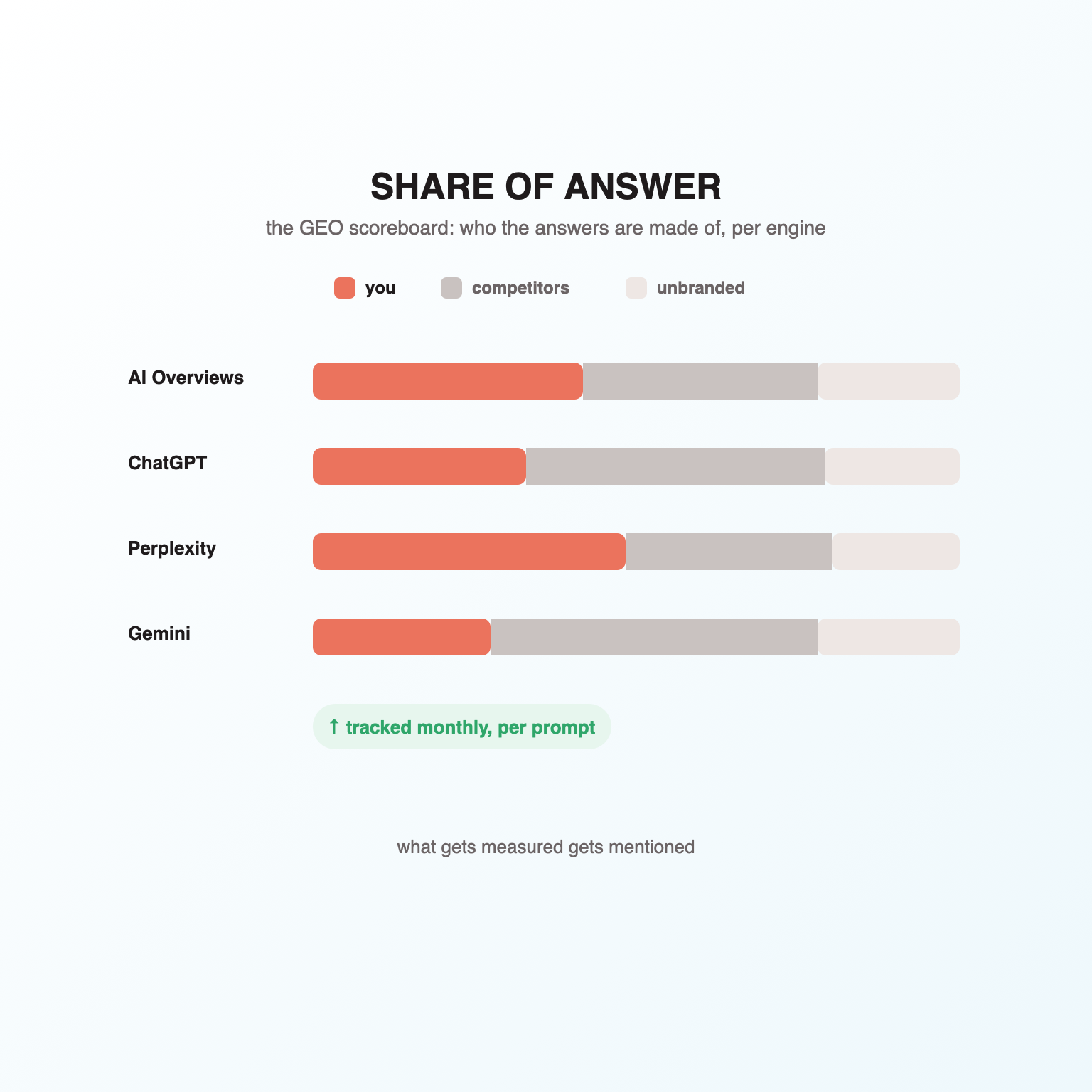
Answer capture and share-of-answer scoring. For every prompt in the panel we capture how ChatGPT, Perplexity, Gemini, Claude, and AI Overviews respond: which brands get named, which sources get cited, what claims get repeated, and how you are described when you appear. Scored over time, this produces your share of answer, the GEO equivalent of rankings, and it turns an invisible competition into a dashboard your team can act against.
Passage-level content engineering. Engines select passages, not pages, so we optimise at that granularity: every priority section rebuilt to lead with a selectable claim, carry a statistic or definition worth quoting, and stand alone if lifted out of context. Structure gets the same treatment, headings that mirror prompt phrasing, comparisons in liftable form, summaries that compress accurately. It reads better to humans too, which is not a coincidence: engines learned their taste from us.
Information gain content. Generative engines have already read the consensus; repeating it gives them no reason to choose you. We create content with genuine information gain: original data from your operations, named frameworks, firsthand teardowns, expert positions that advance the conversation. This is the hardest part of GEO and the most defensible, because a unique fact can only be cited from its source, and that source becomes you.
Evidence and citation architecture. Claims that carry numbers, sources, and attribution get selected more and repeated more safely. We wire that architecture through your content: statistics cited to their origin, quotes attributed to named experts, claims phrased so they survive compression without distorting, and author entities built so expertise is machine-attributable. The same work that wins engine selection reads as credibility to every human who checks.
Corroboration and off-site GEO. Engines repeat what multiple sources agree on, so your claims need a footprint beyond your own domain: industry publications carrying your data, expert commentary in roundups, community presence where your category gets discussed, and consistent brand facts everywhere they appear. We run this as earned placement with substance, and it doubles as classic authority building, one investment, both search eras, and a bill you would have paid anyway for the authority alone.
The Difference
Write the Material the Answer Is Made From
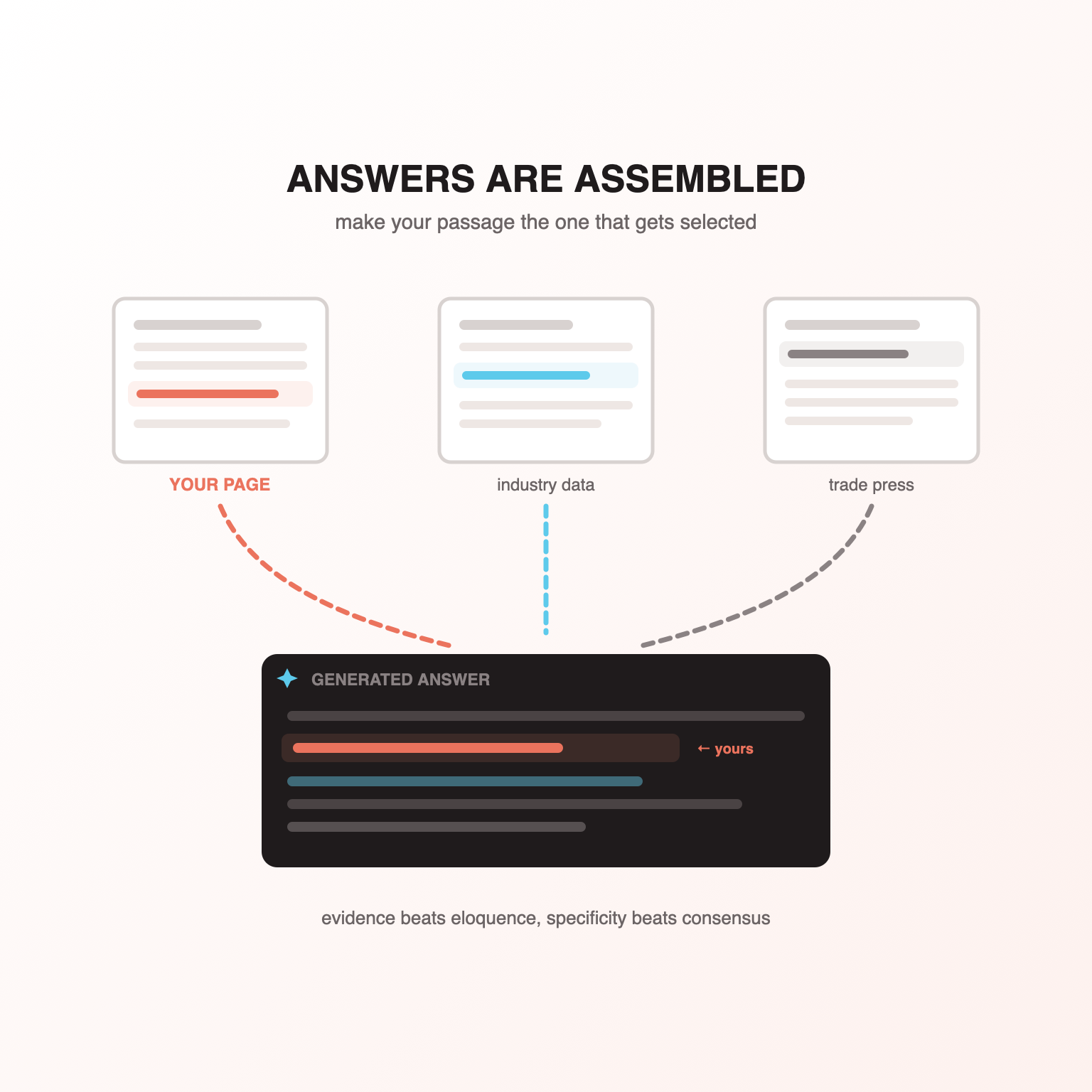
Every generated answer is assembled from selected passages, and selection has rules: evidence beats eloquence, specificity beats consensus, corroborated beats claimed, and new information beats a better paraphrase. GEO is the discipline of writing to those rules on purpose. Do it well and your sentences become the answer's building blocks, carrying your brand into conversations no rank tracker can see.
Book a Strategy CallOur Process
How We Build Your Share of Answer
A disciplined sequence, adapted to your competitive landscape. Open each step.
01Prompt panel and baseline
02Selection gap analysis
03Passage engineering sprint
04Information gain production
05Corroboration rollout
06Panel rhythm and expansion
Why Unified Platforms
Why Brands Choose Us for GEO
The working habits behind every engagement.
We practice GEO as craft, not acronym
Much of what sells as generative engine optimization is last year's SEO deck with new letters. Ours is passage-level editorial engineering grounded in how selection actually works, statistics, quotability, information gain, corroboration, run by a team that writes and measures rather than rebrands. Ask to see the passage briefs and the panel data; the method survives inspection.
Confirmed citations, not projections
The results band shows outcomes we can walk you through: a deep-tech brand established as a cited source across three LLM platforms on fourteen commercial queries, from a standing start with limited consumer recognition. Early proof in a young discipline is rare, and ours came from the exact programme described on this page.
Editorial gates that AI slop cannot pass
The irony of the GEO gold rush is that most of its content is machine-written filler engines have no reason to select. Every passage we ship carries a claim, a number, or a definition worth lifting, enforced by the same hard editorial gates our twenty-million-word content practice runs. Being worth quoting is the entire game, and filler is disqualified by definition.
One family of disciplines, honestly scoped
GEO, AEO, AI search optimization, and classic SEO share a substrate, and we operate all of them, which lets us scope by your situation instead of upselling overlap: entity or technical gaps route to the AI search programme, snippet and structured answer work to AEO, content selection to GEO. You buy the work you need, and the practices reinforce each other instead of billing twice for the same substrate.
Measurement that survives scrutiny
Share of answer is easy to fake with cherry-picked screenshots and easy to prove with a disciplined panel: fixed prompts, scheduled runs, logged responses, competitor scoring, trendlines. We run the disciplined version and report the misses alongside the wins, because a measurement you cannot trust is worse than no measurement at all.
The window logic is on your side
Ninefold growth in demand for this work, a handful of rigorous practitioners, and engines still forming their preferences about who to trust in each category: first movers are setting defaults their competitors will have to dislodge. We were early enough to have receipts, and the programme is built to bank that advantage while the window is open.
Industries
Industries We Work With
Category specific strategy, not one template applied to every business.
Get a Free Share-of-Answer Snapshot
Send us five prompts your buyers would ask an AI about your category, and we will send back a share-of-answer snapshot: how ChatGPT, Perplexity, Gemini, and AI Overviews answer them today, which competitors get selected, and where your fastest openings are. Free, specific, and usually surprising, most brands discover the answers have already chosen a favourite, and it is rarely who they expected. If the snapshot shows you are already well represented, we will say so and tell you what to protect, because defending a won position is cheaper than recapturing a lost one.
Book a Strategy CallQuestions
Frequently Asked Questions
Straight answers before you ever get on a call.
GEO Basics
What is generative engine optimization?
How is GEO different from AEO and AI search optimization?
Does GEO replace SEO?
Method
What actually makes a passage more likely to be selected?
What is information gain and why does it matter so much?
How do you research prompts instead of keywords?
Working With Us
We publish constantly already. Why is our share of answer still low?
What does a GEO engagement include?
How long before share of answer moves?
Can our team learn to do this internally?
Scope and Situations
Which engines matter most for GEO right now?
Can GEO fix wrong or outdated claims engines make about us?
Does GEO work for local and multi-location businesses?
Is there a risk engines stop citing sources altogether?
Measurement and Proof
How does GEO reporting fit into our existing marketing dashboards?
How do you measure GEO results?
The engines change constantly. Does the work keep its value?
What results can you show from real GEO work?
Be the Source the Answers Are Built From
Categories are being described to buyers right now in words some company supplied, and in most markets that company was simply the first one to take the discipline seriously. The engines are still forming their preferences; the defaults are still being set. Somewhere right now, a generative engine is answering a question that used to bring buyers to your website, and it is building that answer from whoever gave it the best material. The brands investing in generative engine optimization services this year are supplying that material and becoming the default their categories get described by; everyone else is negotiating with a conclusion after it is written. Book a free strategy call, bring five prompts your buyers would ask, and we will show you what the answers currently say, and exactly what it would take to be in them.
Book a Strategy CallExplore more
Generative engine optimization by location and industry
Generative engine optimization by industry
GEO tailored to your field: getting your business named and cited inside the recommendations AI engines write for the buyers you want, measured in real outcomes.
As a generative engine optimization agency, we get your brand named and cited inside the answers ChatGPT, Perplexity, Gemini and Google AI Overviews write, measured in real pipeline, not visibility scores.