 Skip to content

Demand Generation vs Lead Generation: The Difference
Demand generation vs lead generation: one creates interest and grows the market, the other captures ready buyers into contacts. How they differ, how to measure each, and how to balance and connect them.
Quick Answer
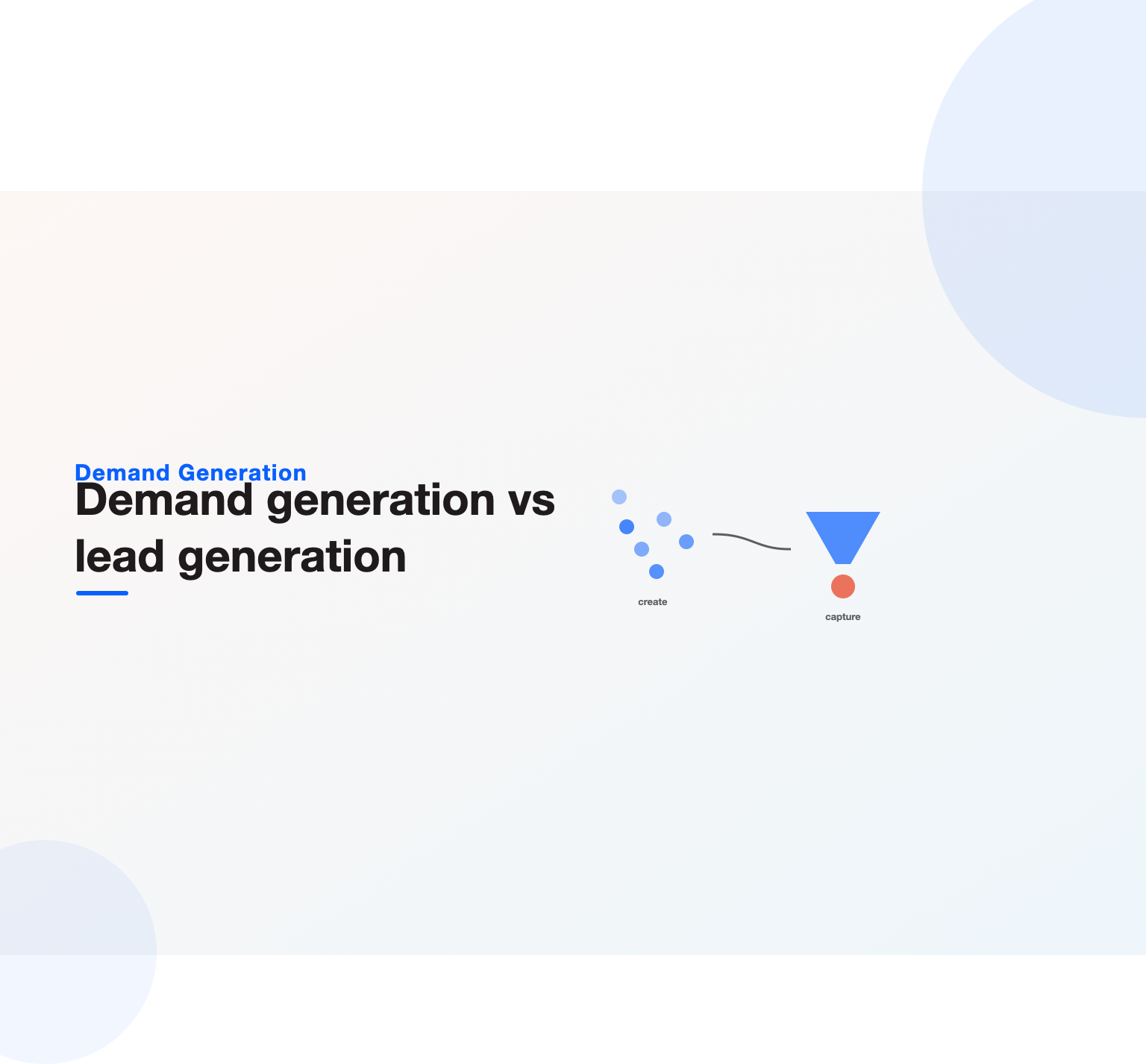
Demand generation vs lead generation is not a choice between two competing tactics; it is the difference between creating interest and capturing it. Demand generation builds awareness and shapes how a market thinks about a problem, so that more people eventually want what you sell. Lead generation captures the details of people who are ready to act now, so that sales has someone to talk to. The two are sequential and complementary: one grows the pool of future buyers, the other converts the ready ones into contacts. The useful question is rarely an either-or between them, but how to balance and connect the two so that created interest is actually captured rather than left to leak away, sequenced sensibly for the stage your business is at.
Key Highlights
- Creating interest and capturing it are different jobs; the two disciplines are complementary, not rival.
- Each has its own honest metric: influenced pipeline and brand for one, captured contacts and conversion for the other.
- Lead-only programs plateau because they compete for a small in-market pool without growing it.
- Creation-only programs build interest that leaks away without a capture layer to convert it.
- Stage of business changes the balance: early teams weight capture, scaling teams invest in creation.
- The two work best wired into one funnel measured end to end to pipeline and revenue.
What demand generation actually is
The first discipline is the work of creating awareness of and interest in the problem you solve, among people who may not yet be looking for a solution. It shapes how a market understands a problem so that, over time, more people recognise they have it and come to associate your company with solving it. As a practice, demand generation works through content, thought leadership, webinars, community, and brand-building, all aimed at growing the total pool of people who will eventually become buyers rather than at harvesting the few who are shopping today.
Its key feature is that it plays a longer game. It rarely produces an immediate lead; instead it plants interest that becomes pipeline months later, which makes it harder to measure and easier to underfund. But it is what expands the market of people who might buy, rather than merely competing for the small number already in-market. A business that only ever captures existing interest is fishing in a fixed pond; creating demand is what stocks the pond. That is why serious growth programs invest in it despite the patience it requires and the genuine difficulty of attributing its payoff to any single campaign, because the alternative is a pipeline that can only ever shrink relative to a market you never helped grow.
What lead generation actually is
The second discipline is the work of capturing the contact details of people who have shown enough interest to be worth following up, so that sales has identified prospects to pursue. It converts interest, whether you created it or it already existed, into a named contact you can nurture and sell to. As a practice, lead generation works through offers and lead magnets, high-intent search, landing pages, forms, and the follow-up that turns a captured contact into a live conversation.
Its defining feature is that it produces something immediate and countable: a contact, a form-fill, a demo request. This makes it easier to measure and to justify, which is precisely why many programs over-invest in it relative to creating demand. But capture can only ever convert the interest that exists; it cannot manufacture more of it. A capture program with nothing feeding it eventually exhausts the in-market pool and plateaus, which is the classic symptom of a business that has learned to harvest demand but never to create it. Recognising that limit is the moment most teams first feel the demand generation vs lead generation tension in their own numbers, usually as a rising cost per lead nobody can explain.
The core difference in one view
The cleanest way to hold the contrast in mind is this: one grows the number of people who want what you sell, and the other identifies which of them are ready to buy now. One expands the market; the other harvests it. Creating demand is a top-of-funnel, long-horizon investment in interest and trust; capturing it is a mid-funnel, near-term conversion of that interest into contacts sales can work immediately.
This single difference explains almost every other contrast between them. One is measured in awareness, engagement, and influenced pipeline over quarters; the other in captured contacts, cost per lead, and conversion this month. One is patient and compounding; the other is immediate and countable. Neither is superior, because they answer different questions. The mistake is to treat demand generation vs lead generation as a contest and then fund only the one that is easier to measure, which is almost always capture, at the cost of the creation work that would keep it supplied with fresh interest in the first place. Held side by side honestly, the two look less like rivals and more like the two ends of a single rope you have to pull together.
How they are measured differently
Because they do different jobs, the two are measured differently, and applying the wrong yardstick to either is a frequent and costly error. Judging creation work by immediate leads makes it look like a failure, because its payoff is delayed and diffuse; judging capture work by brand awareness misses its whole point. The distinction therefore extends into how you evaluate each, not merely how you run it, and getting the evaluation wrong quietly undermines the funding of whichever half is harder to credit.
Creating demand is fairly judged by leading indicators of interest, content engagement, branded search growth, direct traffic, community participation, and by its influence on pipeline over time, which requires attribution patient enough to credit a touch months before the deal. Capturing demand is fairly judged by captured contacts, their quality, cost per lead, and the rate at which they convert to opportunities. Holding each to its own honest metric is what prevents the common death spiral where the creation work is cut for showing no immediate leads, after which the capture engine slowly starves for lack of fresh interest and the whole program plateaus while everyone wonders why the numbers stopped moving.
Why you need both
The strongest programs refuse the either-or entirely, because for any business that wants durable growth this is a false choice. Creation without capture builds interest that has nowhere to go, so the awareness you paid for dissipates before it becomes revenue. Capture without creation harvests a shrinking pool of existing intent, competing ever harder for the same in-market buyers while doing nothing to grow their number, until the returns quietly collapse.
Run together, they compound: the creation side grows the pool of future buyers and warms the market, the capture side converts the ready ones and hands them to sales, and the created interest that is not yet ready is kept warm by nurture until it is. This is why the mature view treats them as one funnel rather than two departments. A coordinated demand generation program that also owns the capture and hand-off is what turns created interest into pipeline rather than letting it evaporate, and it is the practical resolution of the whole demand generation vs lead generation question, which turns out to have been a question about balance all along.
How stage of business changes the balance
The right weighting between the two is not fixed; it shifts with the stage and goals of the business. A young company with little brand and an urgent need for pipeline should weight capture first, harvesting the existing demand it can reach to produce near-term revenue, because it cannot yet afford the patience that pure creation requires. Early on, survival rewards capture, and there is no shame in leaning on it while the business finds its feet.
As the company matures and can afford to invest ahead of return, the balance should tilt toward creating demand, because the in-market pool it has been harvesting is finite and generating new interest is what keeps growth from plateauing. A scaling business that keeps pouring everything into capture eventually finds cost per lead rising and volume flattening, the unmistakable signature of a market it has fully harvested but never grown. Reading your stage honestly, and shifting the demand generation vs lead generation balance as you grow, is what keeps the program matched to the business rather than frozen in the shape it took when near-term pipeline was the only thing that mattered.
Where the two overlap
The distinction is useful, but in practice the two blur at the edges, and pretending they are cleanly separate causes its own mistakes. A single piece of content can both create interest, by educating a market, and capture it, by carrying an offer that converts a ready reader into a lead. High-intent search sits right on the seam: it captures existing demand, yet the content that ranks for it also builds the authority that creates demand in the first place.
The practical implication is to design assets and channels to do both jobs where they naturally can, rather than forcing every activity into one category. A strong content marketing engine is the clearest example, creating awareness at the top and capturing intent at the bottom from the same body of work, while a disciplined SEO program earns the rankings that do both at once. Recognising the overlap stops you from building artificial walls between two functions that are really one system, and it is why the most effective teams organise around the whole funnel rather than around the line the comparison draws.
The tactics that belong to each
It helps to make the two concrete by naming the tactics that typically belong to each, while remembering the overlap above. On the creation side sit thought-leadership content, original research and reports, webinars and events, podcasts, community-building, organic social presence, and brand advertising, all of which grow awareness and trust without asking for much in return. Their job is to make a market think differently and to make your company the name it associates with the problem, which is slow work that pays off in a warmer, larger pool of eventual buyers. Much of this creation work also earns the organic visibility that a disciplined SEO program compounds over time, so the same investment builds both awareness now and discoverability later, which is part of why the creation side is so easy to undervalue on a single month’s numbers.
On the capture side sit lead magnets and gated content, high-intent search and paid search, conversion-focused landing pages sharpened by conversion rate optimisation, forms and calls to action, retargeting through LinkedIn ads, and outbound outreach, all of which turn interest into a named, contactable prospect. Their job is to identify who is ready and to get their details in front of sales while the intent is warm. The reason it helps to list them is that most teams already run several from both columns without realising which job each is doing, and simply labelling them clarifies whether the program is genuinely balanced or quietly skewed toward capture because those tactics are the ones that report a number this month. Once the tactics are sorted this way, the gaps in a program usually become obvious at a glance.
Demand generation vs lead generation in India
In the Indian market, the balance between the two has some local texture worth planning for. Buyers research thoroughly and place heavy weight on trust and relationships, which rewards the creation side, content, thought leadership, and community, more than in markets where a quick transactional capture can work. A business that leans entirely on capture here often finds its leads convert poorly, because trust was never built before the ask, and a cold form-fill from an unfamiliar brand carries little weight with a cautious buyer.
At the same time, the immediacy of channels like WhatsApp gives capture and fast follow-up real power in India, provided the interest has been created first. Long, multi-stakeholder cycles raise the value of patient creation and nurture, because a buying group needs to be warmed over time rather than converted in a single touch. The practical implication is that Indian programs skewed entirely to capture tend to underperform ones that invest in genuine demand creation and then capture with disciplined follow-up. Pairing the two, tuned to how business marketing actually works locally, is what turns scattered activity into pipeline here rather than a stream of leads that never close.
Common mistakes in balancing the two
- Funding only what is measurable. Cutting creation work because it shows no immediate leads starves capture of interest to convert.
- Capture with no creation. Competing for a fixed in-market pool without growing it, so cost per lead rises and volume plateaus.
- Creation with no capture. Building awareness with no offer or follow-up, so interest leaks away before it converts.
- Wrong metric for each. Judging creation by leads or capture by brand misreads both disciplines.
- Ignoring stage. A startup running pure creation, or a scale-up running pure capture, both misallocate their budgets.
- Treating them as rival departments. Walling the two off breaks the single funnel they should share.
Each mistake is the inverse of a sound principle, which is why understanding the balance between the two is also the fastest way to learn what to avoid.
Turning the distinction into a plan
To make it concrete, a sensible way to act on the comparison is to sequence rather than choose. Begin by building the capture foundation, the high-intent search, offers, landing pages, and follow-up, because it produces the near-term pipeline that funds patience for the rest and proves the funnel actually converts. This is the capture side doing its proper job of harvesting the demand that already exists, and it buys you the credibility and cash flow to invest in the slower work.
With that base earning, invest deliberately in the creation side, the content engine, thought leadership, and community that grow the pool of future buyers, and connect it to the capture layer so created interest flows into it rather than dissipating. Add a nurture layer, usually on marketing automation, to keep the not-yet-ready warm in the gap between creation and capture, a discipline covered in depth in our guide to lead nurturing strategies. Measure each half to its own honest metric and the whole to pipeline, and shift the balance toward creation as the business matures. Sequenced this way, the demand generation vs lead generation question stops being a debate and becomes a plan that produces revenue now while building the larger market that produces it later.
A worked example of the balance
An example makes the balance concrete. Picture a B2B software company selling to mid-sized firms. Its capture engine, high-intent search, a strong demo offer, and fast follow-up through a well-run paid search program, reliably converts the buyers already shopping for its category, and in the early days that is enough to hit its numbers. Cost per lead is reasonable, sales has enough to work, and the temptation is to conclude that capture is all the marketing the business needs.
Then growth flattens. The category’s in-market pool is finite, competitors are bidding up the same keywords, and cost per lead climbs while volume stalls. Nothing about the capture engine has broken; it has simply run out of new demand to harvest. The fix is not more capture but the creation side the company never built: a content and thought-leadership engine, a presence on the channels its buyers use, and the social media and community work that make a wider market aware of the problem before they start shopping. Months later, that created demand flows into the same capture engine, which now converts a larger pool at a lower cost. The lesson of the example is that the demand generation vs lead generation balance is not a one-time decision but a dial you turn as the business and its market change, and the plateau is usually the signal that the dial needs turning toward creation.
Budgeting across the two
A practical question the comparison always raises is how to split budget between the two, and the honest answer is that it shifts with stage and goal rather than sitting at a fixed ratio. Early on, weight spend toward capture, because it produces the near-term pipeline that proves the program and funds the rest; a common early split leans heavily to capture with a smaller, growing investment in creation. As the creation work starts compounding, the balance tilts toward it, because its returns keep growing while capture competes for a fixed pool whose cost only rises.
The mistake to avoid is funding only what shows an immediate return, which starves the creation work that builds future pipeline and then leaves everyone puzzled when growth plateaus. Treat a portion of the budget as an investment in demand that will convert next quarter and beyond, not this month, and protect it from being raided whenever a short-term number wobbles. Measured to pipeline rather than to leads alone, that patience is straightforward to defend, because the trend line rather than the single month tells the real story. Underpinning both halves with clean data and a coordinated revenue operations foundation is what lets you see that story clearly enough to hold the discipline.
How the two fit into one funnel
Seen whole, the two are not separate strategies but two stages of one funnel, and their value comes from how they connect. The creation side fills the top by building awareness and interest; the capture side turns the ready ones into contacts; nurture keeps the not-yet-ready warm; and sales converts the qualified ones to revenue. A gap anywhere leaks value: creation with no capture wastes interest, capture with no nurture loses the early ones, and everything with no sales alignment stalls at the handoff between marketing and sales.
This is why the framing, useful as it is for understanding the difference, should never harden into an organisational wall. The teams that grow fastest organise around the whole funnel, measure it end to end, and move investment between creation and capture as the data and the business stage dictate. For the deeper mechanics of the creation side, our guide to what demand generation is is worth reading alongside this one, and for the capture side, our guide to how to generate leads covers the tactics in depth, so the pair together map the whole funnel this comparison divides.
Key Takeaways
- Creating interest grows the market; capturing it turns ready buyers into contacts. Different jobs, not rivals.
- They are complementary stages of one funnel, so the useful question is balance, not either-or.
- Each has its own honest metric: influenced pipeline and brand for one, captured contacts and conversion for the other.
- Capture-only programs plateau; creation-only programs leak. Durable growth needs both, connected.
- Stage of business sets the balance: weight capture early, invest in creation as you scale.
- In India, trust-building creation matters more, paired with fast capture on channels like WhatsApp.
- Sequence rather than choose: build the capture base, then invest in creation, connected by nurture and measured to pipeline.
Frequently asked questions
What is the difference between demand generation and lead generation?
Creating demand builds awareness and interest in the problem you solve among people who may not yet be looking, growing the total pool of future buyers. Capturing it takes the contact details of people who have shown enough interest to be worth following up, turning interest into named contacts sales can work. In short, one grows the market and the other harvests it. They are sequential and complementary rather than competing, and the strongest programs run both, connected into a single funnel measured to pipeline and revenue rather than to either metric alone.
Is demand generation better than lead generation?
Neither is better; they do different jobs and answer different questions, so framing it as a contest misses the point. Creating demand grows the number of people who want what you sell over the long term; capturing it converts the ready ones now. A program with only one eventually fails: capture alone exhausts the in-market pool and plateaus, while creation alone builds interest that leaks away without a way to convert it. The right approach balances and connects the two rather than choosing a winner between them.
Which should a startup focus on first?
A startup with little brand and an urgent need for pipeline should usually weight capture first, harvesting the existing demand it can reach to produce near-term revenue, because it cannot yet afford the patience that pure creation requires. As the business matures and can invest ahead of return, the balance should tilt toward creating demand to grow the pool of future buyers and avoid plateauing. The honest rule is to read your stage: capture funds survival early, creation drives durable growth later, and most businesses need to move deliberately from one emphasis to the other.
How do I measure each of them?
Measure each to its own honest metric. Creation is judged by leading indicators of interest, content engagement, branded search growth, direct traffic, community participation, and by its influence on pipeline over time, which needs attribution patient enough to credit a touch months before the deal. Capture is judged by captured contacts, their quality, cost per lead, and conversion to opportunities. Applying the wrong yardstick, leads to creation or brand to capture, makes each look like it is failing at a job it was never meant to do, which is how good programs get cut for the wrong reasons.
Can one piece of content do both?
Yes, and the best often does. A strong educational article can create demand by shaping how a market understands a problem, and capture it by carrying a relevant offer that converts a ready reader into a lead. High-intent search sits right on the seam, capturing existing demand while the content that ranks for it builds the authority that creates demand. Designing assets to do both jobs where they naturally can, rather than forcing each into one category, is what makes a content engine efficient and blurs the line the comparison draws in day-to-day practice.
How do the two work together in a funnel?
They are two stages of one funnel: creation fills the top by building awareness and interest, capture turns the ready ones into contacts, nurture keeps the not-yet-ready warm, and sales converts the qualified ones to revenue. Their value comes from how cleanly they hand off to one another, so a gap anywhere leaks value. The teams that grow fastest organise around the whole funnel rather than walling the two functions apart, measure it end to end, and shift investment between creation and capture as the business stage and the data dictate.
Ready to put this into practice?
Talk to the team that runs SEO, AI search and paid growth programs every day.
Book a Strategy Call →