 Skip to content

Google Ads Quality Score: How to Raise It and Cut Costs
Google Ads Quality Score rates the relevance of your keywords, ads and pages and directly lowers cost per click. Learn the three components and how to improve each one.
 Quality Score gauge at 8 out of 10 lowering the cost per click”/>
Quick Answer
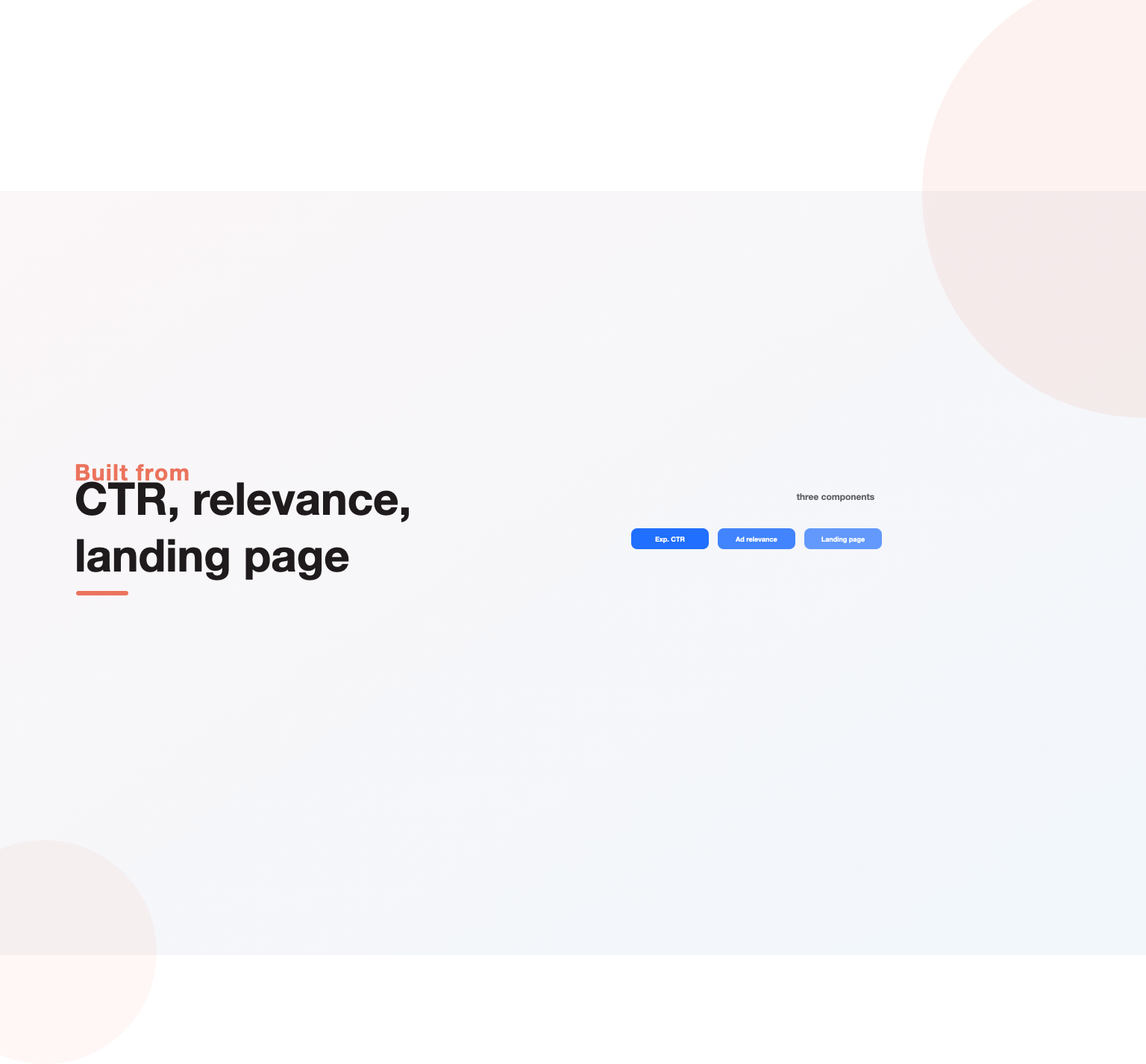
Quality Score is Google’s rating, from one to ten, of how relevant and useful your keywords, ads and landing pages are to the people searching, and it directly affects both what you pay per click and how prominently your ads show. It is built from three components: expected click-through rate, how likely your ad is to be clicked; ad relevance, how closely your ad matches the search intent; and landing-page experience, how relevant and useful your page is to the visitor. A higher score lowers your cost per click and improves your ad rank, so two advertisers bidding the same amount can pay very different prices and hold very different positions depending on relevance, which makes it one of the most powerful levers over the efficiency of an account. Improving it is essentially earning a discount on every click by being more relevant. This guide explains what it is, how each component works, why it matters so much for cost, and the practical steps, tighter ad groups, better ad copy, stronger landing pages, that raise it and steadily lower what you pay for every click.
Key Highlights
- Quality Score is Google’s one-to-ten rating of how relevant your keywords, ads and landing pages are to searchers.
- It is built from expected click-through rate, ad relevance and landing-page experience, each of which you can improve.
- A higher Quality Score lowers cost per click and improves ad rank, so relevance is effectively a discount on every click.
- Tighter ad groups let ads speak directly to their keywords, lifting ad relevance and expected click-through rate together.
- Strong, relevant landing pages that match the ad improve the third component and conversion rate at once.
- Treat it as a diagnostic to guide improvement, not a vanity metric to obsess over, so use it to find weak spots.
Why Quality Score matters
The reason the score deserves attention is money: it directly determines how much you pay for each click and how well your ads rank, so improving it makes an account both cheaper and more visible. Since ad rank is calculated from your bid and your score together, a higher score lets you achieve the same position for a lower bid, or a better position for the same bid, which means two advertisers can bid identically and yet pay very different amounts and appear in very different places depending on their relevance. Over months and thousands of clicks, that gap is the difference between an account that stretches its budget and one that quietly overpays for every visitor, which is why the relevance-minded advertiser wins on economics that a higher bidder cannot simply buy their way past. That is why relevance is not a soft, nice-to-have quality but a hard financial lever that shows up directly in what you pay.
The effect compounds across an account. A few points of improvement on high-volume keywords can meaningfully lower the overall cost per click and free budget to buy more clicks, so working on it is one of the highest-return activities available, especially since it costs nothing but effort to be more relevant. This is why raising it sits near the center of any serious cost-reduction effort and is a constant focus of professional Google Ads management: it is the mechanism by which being genuinely useful to searchers is rewarded with lower costs and better positions, aligning what is good for the searcher with what is good for the advertiser. That alignment is unusual in advertising, where the platform’s interests and the buyer’s often diverge, and it means the effort you put into relevance is never wasted: it improves results for the person clicking and lowers costs for you at the same time, a rare win that pays off across every kind of account, from a lean local one to a considered-purchase Google Ads for B2B companies program.
The three components explained
The score rests on three components, and understanding each is the key to improving the whole. Expected click-through rate is Google’s prediction of how likely your ad is to be clicked when it shows for a keyword, based largely on the historical performance of your ad for that term, so it rewards ads that searchers actually find compelling. Ad relevance measures how closely your ad matches the intent behind the search, so an ad that speaks directly to what the keyword means scores well while a generic ad loosely connected to it scores poorly.
Landing-page experience, the third component, assesses how relevant, useful, fast and trustworthy the page your ad points to is for the person who clicks, so it extends the judgment of relevance past the ad into the destination. Each component is rated as above average, average or below average, which tells you exactly where a keyword’s score is weak and therefore what to fix first. Since the three components correspond to the ad-group structure, the ad copy, and the landing page, the diagnosis points straight at the work, which is why treating the score as a set of three fixable signals rather than a single mysterious number is the right way to approach it, a diagnostic mindset any thorough Google Ads audit applies.
Lifting expected click-through rate
Expected click-through rate improves when your ads genuinely appeal to the people searching, so the work here is writing ads that searchers want to click. Compelling, specific copy that speaks to the searcher’s need, leads with a clear benefit, and includes a strong call to action earns more clicks than generic text, which over time lifts the expected click-through rate for the keyword. Given that the component is based on how your ad has actually performed, improving the ad itself is the most direct way to raise it, and testing stronger variations against each other keeps pushing it up.
Relevance to the specific keyword also drives clicks. Copy that reflects the exact search, ideally including the keyword or its intent in the headline, feels more relevant to the searcher and earns more clicks than a broad ad covering many terms at once, which is why tightly themed ad groups help this component as much as the next one. Using ad assets and extensions to expand the ad and give more reasons to click further lifts click-through rate, so a complete, relevant, compelling ad is the foundation of a strong expected click-through rate, the same craft that underpins effective responsive search ads and rewards the same attention to what the searcher actually wants.
Raising ad relevance
Ad relevance measures how well your ad matches the meaning of the search, and the most powerful lever over it is account structure, specifically how tightly your ad groups are themed. When an ad group contains a tight cluster of closely related keywords, the ad can speak directly to all of them, so it is highly relevant to each search, but when an ad group mixes many different intents, the single ad cannot be relevant to all of them and relevance suffers. This is why the classic advice to build tightly themed ad groups is really advice about relevance.
The practical fix for weak ad relevance is usually to break broad ad groups into tighter ones, each with its own ad written specifically for its cluster of keywords, so every ad closely matches the searches it serves. Including the keyword theme in the ad copy reinforces the match a searcher and the system both recognize. As ad relevance connects structure and copy, improving it often means restructuring the account so ads and keywords align, which lifts not just this component but expected click-through rate too, since a more relevant ad also gets clicked more. Getting this structure right is foundational work that pays off across the whole account, a cornerstone of steady Google Ads optimization.
Strengthening landing-page experience
Landing-page experience extends the judgment of relevance to the page a click lands on, so improving it means making that page genuinely relevant, useful and easy for the visitor who arrives. A page that matches the promise the ad made, loads quickly, works well on mobile, and makes the desired action clear scores well, while a slow, generic, or mismatched page, sending ad traffic to a homepage instead of a relevant page, drags the score down and wastes the click. Aligning each ad with a focused, relevant landing page is the core of this component, and it is often the piece advertisers neglect most, pouring effort into keywords and ads while sending the resulting clicks to a page that was never built to receive them.
The work rewards you twice. As a better landing page improves both Quality Score, lowering cost per click, and conversion rate, turning more of those clicks into customers, investing in landing pages is one of the most valuable things you can do, improving the economics of an account on two fronts at once. Speed, mobile-friendliness, message match between ad and page, and a clear path to action are the levers, and improving them lifts landing-page experience while making the whole paid journey more effective. This is why landing pages deserve as much attention as keywords and ads, and why they are a shared concern of paid and conversion teams alike, as our dedicated guide to Google Ads landing pages explores.
How Quality Score affects your costs
The financial mechanics of The metric are worth understanding precisely, because they explain why relevance saves money. Ad rank, which determines whether and where your ad shows, is calculated from your bid multiplied by your Quality Score along with other factors, so a higher score lifts your ad rank without raising your bid, and the actual price you pay per click is influenced by the The score of you and the advertisers around you. The upshot is that a higher score both improves your position and lowers the price you pay to hold it.
This is why two advertisers bidding the same amount can have very different experiences: the one with the higher score pays less per click and ranks better, effectively earning a relevance discount, while the one with a low score pays a premium and struggles to show well. Over an account spending real money, those differences compound into large gaps in efficiency, which is why improving It is a genuine cost-reduction strategy rather than a cosmetic exercise. Understanding this mechanism turns Quality Score from an abstract number into a clear reason to invest in relevance, and it connects directly to how you manage your Google Ads budget, since lower costs stretch the same spend further.
Using Quality Score as a diagnostic
The most useful way to treat The score is as a diagnostic tool that points to weak spots, rather than a target to obsess over for its own sake. By showing the three component ratings for each keyword, above average, average or below average, it tells you exactly where a keyword is underperforming, a below-average ad relevance points to structure and copy, a below-average landing-page experience points to the page, a below-average expected click-through rate points to the ad, so you know what to fix without guessing, which turns a vague sense that a keyword is expensive into a specific, actionable to-do. This diagnostic value is where the score earns its keep.
The caution is not to chase the number itself in isolation. It is a means to lower costs and better performance, not the end, so obsessing over raising a score on a low-volume keyword that barely spends is a poor use of time, while improving the components on high-volume keywords that drive real cost delivers meaningful savings. Using the component ratings to prioritize where relevance improvements will actually move the account, focusing effort where the spend is, the same prioritization a good Google Ads budget plan applies, is what makes the score genuinely useful, and it keeps the work pointed at cost and results rather than a vanity figure, the same practical discipline that governs sensible account management everywhere, including specialized accounts like Google Ads for SaaS.
Quality Score and account structure
Since ad relevance and expected click-through rate both improve when ads closely match their keywords, account structure turns out to be one of the biggest determinants of The metric across an account. A tightly organized account, built from well-themed ad groups, each with ads written specifically for its keywords, gives every ad the chance to be highly relevant, which lifts the scores of the keywords within it. A sprawling account whose ad groups mix many intents forces generic ads that cannot be relevant to everything, which suppresses scores account-wide no matter how good the individual pieces are.
This makes structural work one of the highest-leverage ways to raise the score at scale, since restructuring an account into coherent, tightly themed ad groups improves relevance for many keywords at once rather than one at a time. It is slower than tweaking a single ad but far more powerful, because it addresses the root cause of poor relevance across the account. Building and maintaining a clean, well-themed structure is therefore not just tidiness but a direct investment in lower costs, which is why experienced managers treat account architecture as foundational to The score, and why fixing a messy structure is often the single biggest lever on an inefficient account, a fix that a rigorous Google Ads audit frequently identifies first.
How Quality Score is reported and updated
It helps to know where the number lives and how it moves, so you neither over-read a single figure nor miss a real trend. The keyword-level score, from one to ten, is visible in your account alongside the three component ratings, and it updates as the system gathers more data on how your ads and pages actually perform, so a newly launched keyword starts with a provisional estimate that firms up as real clicks and conversions accumulate. This means a fresh keyword with a low score is not necessarily a problem; it may simply need time and data before the number reflects reality.
The score you see is also a snapshot rather than the exact figure used in every auction, since the real-time calculation considers the specific context of each search. That is why chasing tiny movements in the reported number is a poor use of energy, while acting on the component ratings, which point clearly at what to fix, is productive. Reading the reported score as a directional guide, watching the components on your high-spend keywords, and giving new keywords time to settle is the balanced way to use the metric, rather than reacting to every small change, the same measured approach that a disciplined Google Ads audit brings to every metric in the account.
Relevance beyond the number
Stepping back, the deepest lesson here is that Google has built a financial incentive around being genuinely useful to searchers, so the work of raising it is really the work of serving people better. Every lever that improves the score, ads that match the search, tight structure so the message fits, pages that deliver what the ad promised, also makes the experience better for the person clicking, which is why relevance rewards you with both lower costs and higher conversion rates at the same time. The advertiser and the searcher want the same thing.
That alignment is worth holding onto, because it reframes the whole exercise from gaming a metric to earning its reward. Built to be relevant from structure to copy to landing pages, an account, tends to have strong scores as a natural consequence rather than a target chased for its own sake, and it performs well because it genuinely helps the people it reaches. Keeping that principle in view, serve the searcher and the score follows, keeps the work honest and productive, and it connects to the same customer-first thinking that underpins a strong Google Ads landing pages strategy and effective ecommerce PPC management alike.
Common Quality Score mistakes
Several recurring errors keep advertisers from raising it effectively. The most common is running sprawling ad groups that mix many different intents, so ads cannot be relevant to their keywords and relevance scores stay low, which is a structural problem no amount of ad tweaking fully fixes. Close behind is sending all ad traffic to a generic homepage rather than relevant landing pages, which drags down landing-page experience and wastes clicks. Writing generic ads that do not speak to the specific keyword suppresses expected click-through rate and ad relevance together.
Other frequent mistakes include obsessing over the It number on low-spend keywords while ignoring the components on the high-volume keywords that actually drive cost, treating Quality Score as a vanity metric rather than a diagnostic, and neglecting landing pages as though they were outside the advertiser’s job. The thread through these errors is either failing to align ads, keywords and pages, or misusing The score as a target instead of a guide. Advertisers who build tight structure, write relevant ads, align strong landing pages, and use the component ratings to prioritize where spend is highest get the lower costs and better positions relevance rewards, while those who neglect relevance pay a premium on every click, a gap our Google Ads audit reliably surfaces.
When to get help with Quality Score
Improving It is within reach of a capable marketer who understands its three components, and for a smaller account, tightening ad groups, writing relevant ads, and improving landing pages is a realistic, high-return project. The core ideas, align ads and keywords with tight structure, match ads to pages, focus effort where spend is highest, are more about disciplined structure and relevance than technical difficulty, and a diligent owner can meaningfully lower their costs this way.
Expert help pays off as accounts grow large and the structural work becomes substantial, when restructuring many campaigns for relevance is a big undertaking, when landing-page improvement needs coordination with other teams, or when the account spends enough that small efficiency gains are worth real money. An experienced practitioner restructures accounts for relevance, writes ads that lift click-through rate, aligns landing pages, and uses Quality Score diagnostically to prioritize, so folding this into ongoing Google Ads services often lowers costs by more than the cost of the help. Whichever route you take, the essentials of The metric stay the same: build tight, relevant structure, write ads that match their keywords, align strong landing pages, and use the component ratings to focus effort where it saves the most.
None of this is complicated, which is the encouraging part. Raising the number is not a matter of secret tricks but of doing the obvious things well: grouping keywords tightly, writing ads that match them, and pointing each ad at a page that delivers. Do that consistently across the keywords that carry your spend, and the reward arrives quietly as a lower cost per click and a better position, month after month, without any change to your bids, which is why this is among the most durable efficiencies an advertiser can build into an account.
Key Takeaways
- Quality Score rates the relevance of your keywords, ads and landing pages and directly lowers cost per click while improving ad rank.
- Its three components, expected click-through rate, ad relevance and landing-page experience, each point to specific work you can do.
- Tight, well-themed ad groups are the biggest structural lever, letting ads match their keywords and lifting relevance across the account.
- Relevant, fast, matching landing pages improve the third component and conversion rate at the same time.
- Treat Quality Score as a diagnostic to prioritize fixes on high-spend keywords, not a vanity number to chase everywhere.
- Being genuinely relevant earns a discount on every click, so improving it is a core part of any Google Ads optimization effort.
Frequently asked questions
What is Quality Score in Google Ads?
Quality Score is Google’s rating, from one to ten, of how relevant and useful your keywords, ads and landing pages are to the people searching. It is built from three components: expected click-through rate, how likely your ad is to be clicked; ad relevance, how closely your ad matches the search intent; and landing-page experience, how relevant and useful your page is to the visitor. The score directly affects both what you pay per click and how prominently your ads show, because ad rank is calculated from your bid and your Quality Score together. A higher score lowers your cost per click and improves your position, so improving relevance is effectively earning a discount on every click.
How do I improve my Quality Score?
Work on the three components. To lift expected click-through rate, write compelling, specific ads that searchers want to click and test stronger variations. To lift ad relevance, build tight, tightly themed ad groups so each ad speaks directly to its keywords, including the keyword theme in the copy. To lift landing-page experience, send each ad to a relevant, fast, mobile-friendly page that matches the ad’s promise rather than a generic homepage. Because ad relevance and click-through rate both depend on structure, tightening sprawling ad groups is often the highest-leverage fix. Focus your effort on high-volume keywords where improvements actually lower meaningful cost.
Why does Quality Score affect my cost?
Because ad rank, which determines whether and where your ad shows, is calculated from your bid multiplied by your It along with other factors, and the price you pay per click is influenced by these scores. A higher Quality Score lifts your ad rank without raising your bid, so you can hold the same position for a lower bid, or a better position for the same bid, and you tend to pay less per click. This is why two advertisers bidding the same amount can pay very different prices and rank very differently depending on relevance. Over an account spending real money, those differences compound, making The score a genuine cost-reduction lever rather than a cosmetic metric.
What is a good Quality Score?
Scores of seven and above are generally considered good, indicating strong relevance across the components, while scores below five signal real problems worth fixing. However, the exact number matters less than the component ratings and where the keyword sits in your account. A slightly lower score on a low-spend keyword barely matters, while improving the components on a high-volume keyword that drives significant cost delivers real savings. Rather than chasing a perfect ten everywhere, treat Quality Score as a diagnostic: use the above-average, average and below-average component ratings to find what to fix, and prioritize the high-spend keywords where relevance improvements will actually lower your costs meaningfully.
Do landing pages affect Quality Score?
Yes, landing-page experience is one of the three components of It. Google assesses how relevant, useful, fast and trustworthy the page your ad points to is for the person who clicks, so a page that matches the ad’s promise, loads quickly, works on mobile and makes the desired action clear, the hallmarks of good Google Ads landing pages, scores well, while a slow, generic or mismatched page drags the score down. Sending ad traffic to a homepage instead of a relevant, focused page is a common way to hurt this component. Improving landing pages helps twice, raising Quality Score to lower cost per click and improving conversion rate to turn more clicks into customers, which is why they deserve real attention.
Is Quality Score a ranking factor?
Yes, in the sense that it is a direct input into ad rank, which determines whether your ad shows and in what position. Ad rank is calculated from your bid and your The metric together with other factors, so a higher Quality Score improves your ad rank and can win you a better position without a higher bid. This means relevance, as measured by The score, competes alongside bidding to decide placement, which is why a highly relevant advertiser can outrank a higher-bidding but less relevant one. Improving Quality Score therefore both lowers your costs and lifts your positions, making it one of the most valuable things to work on in an account.
Ready to put this into practice?
Talk to the team that runs SEO, AI search and paid growth programs every day.
Book a Strategy Call →