 Skip to content

Best Enterprise SEO Software: An Honest 2026 Comparison
The best enterprise SEO software compared honestly: BrightEdge, Conductor, seoClarity, Semrush, Ahrefs, Botify, Lumar and more, the criteria that matter, and when to hire a team instead.
Quick Answer
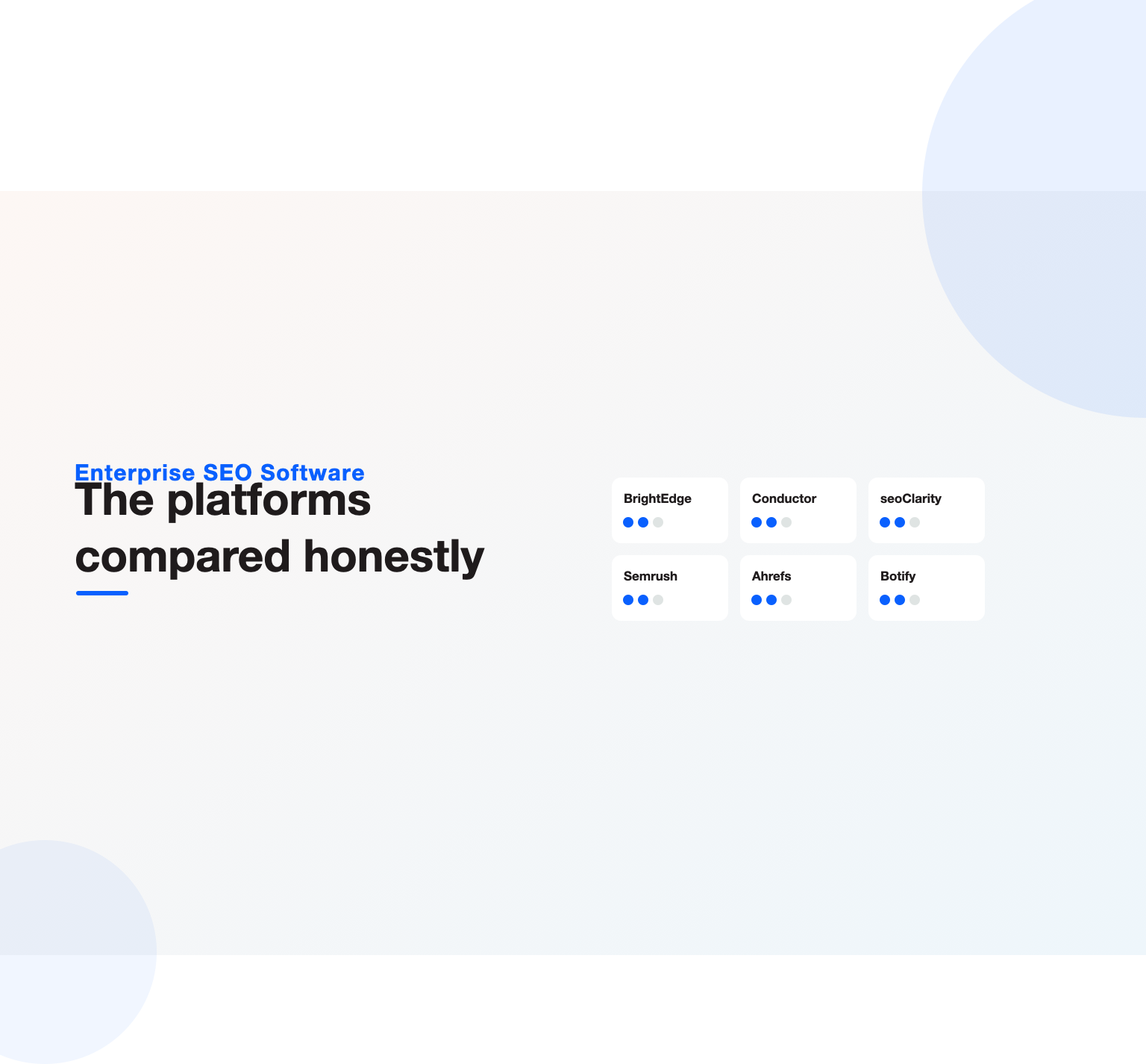
Enterprise SEO software is the category of platforms built to manage search optimization across very large websites, with the scale, automation, and reporting that solo tools cannot provide. The established leaders are enterprise suites like BrightEdge, Conductor, and seoClarity, alongside powerful all-in-one platforms such as Semrush and Ahrefs used at enterprise scale, specialist technical crawlers like Botify and Lumar, and dependable point tools including Screaming Frog and Moz. The right enterprise SEO software depends on what you need most: content and workflow at scale, deep technical crawling of millions of URLs, competitive intelligence, or reporting for many stakeholders. This guide compares the leading options, the criteria that separate them, and how to decide between buying software and hiring a managed team to run it, so the money goes where it actually moves the needle.
Key Highlights
- Enterprise SEO software exists to handle scale, automating analysis, crawling, and reporting across sites with thousands or millions of pages that manual tools cannot manage.
- The dedicated enterprise suites, BrightEdge, Conductor, and seoClarity, lead on content workflow, recommendations, and multi-stakeholder reporting, at enterprise pricing.
- All-in-one platforms like Semrush and Ahrefs deliver enormous capability at more accessible pricing and scale well for many large teams.
- Technical specialists such as Botify and Lumar focus on crawling and log analysis at massive scale, which is where the largest sites win or lose.
- Software is only half the equation: the platform surfaces the work, but a skilled team is what turns its data into results, which is why many enterprises pair tools with expertise.
What enterprise SEO software is, and who needs it
Enterprise SEO software is a class of platform designed for the scale and complexity of large organizations, offering the automation, integrations, and reporting that big sites and teams require. The defining features are scale, handling huge numbers of pages and keywords, workflow, coordinating multiple users and teams, and reporting, giving stakeholders across an organization visibility into performance. These platforms typically carry enterprise pricing to match, which is why they are aimed at organizations where search is a significant channel worth serious investment.
Not every large company needs the most expensive enterprise SEO software, and the honest question is whether your scale and complexity justify it. A site with millions of pages, several teams touching SEO, and executives who need regular reporting is a clear fit. A smaller operation may get everything it needs from a capable all-in-one platform at a fraction of the cost. The point of enterprise SEO software is to make large-scale, multi-team SEO manageable, so the right choice depends on genuinely having that scale rather than buying enterprise tooling for its own sake, and much of what these platforms automate still rests on the fundamentals in our guide to how SEO works.
How we compared the options
The tools below are grouped and described by what they do best rather than ranked one to ten, because the best enterprise SEO software genuinely depends on your priorities. We weighed each on the criteria that matter at scale: how well it crawls and analyzes large sites, the depth and usefulness of its recommendations, its keyword and rank tracking, its competitive intelligence, its reporting and workflow for multiple stakeholders, and how it fits into an enterprise’s other systems. Pricing and the learning curve matter too, since a powerful platform nobody adopts delivers nothing.
A note on honesty: this is a comparison of real platforms with genuine strengths and trade-offs, not a ranking engineered to sell one product. Unified Platforms is an SEO services provider rather than a software vendor, so we have no tool of our own to push here, which lets us describe each option straight. Where a platform excels we say so, and where the real decision is whether you need software at all or need a team to run it, we say that too. Use the criteria to match a tool to your situation rather than looking for a single winner that does not exist.
BrightEdge
BrightEdge is one of the most established names in enterprise SEO software, known for its content optimization and recommendation engine aimed at large content operations. Its strength is helping big teams decide what to create and how to optimize it, with data-driven recommendations, content performance tracking, and share-of-voice measurement against competitors. It also emphasizes tying SEO to business outcomes, which suits organizations that need to justify the channel to executives. As a mature enterprise platform, BrightEdge carries enterprise pricing and is best suited to large content-driven sites with the budget and team to use its breadth fully. For a company whose SEO revolves around producing and optimizing content at scale, it remains a leading choice, though smaller operations will find it more platform than they need.
Conductor
Conductor is another long-standing enterprise SEO software platform, with a strong emphasis on content intelligence, workflow, and a customer-focused approach that many large teams value. It helps organizations research topics, guide content creation, monitor technical health, and report on performance, positioning itself as a partner to marketing teams rather than just a data tool. Conductor is often praised for usability and support, which matters when rolling a platform out across a large organization where adoption is half the battle. Like its peers it sits at the enterprise price point and is aimed at sizable teams, making it a strong option for content-led enterprises that want a platform their marketers will actually adopt and use, backed by hands-on support through implementation and beyond.
seoClarity
seoClarity is a comprehensive enterprise SEO platform that competes with the other suites on breadth while emphasizing data scale and an included research data set. It offers keyword research, rank tracking, technical auditing, content optimization, and reporting in one place, with an emphasis on handling very large data volumes and providing AI-assisted features. seoClarity appeals to enterprises that want an all-in-one platform with deep data and the ability to slice performance across large sites and many segments. It positions itself as a full-stack option for teams that would rather consolidate into a single platform than assemble several tools, and it is a credible choice for large organizations weighing it directly against BrightEdge and Conductor on capability and data depth.
Semrush
Semrush is an all-in-one SEO and marketing platform that, while not exclusively an enterprise tool, scales to serve large teams and offers enterprise plans and features. Its enormous breadth, keyword research, rank tracking, site auditing, competitive analysis, content tools, and more, makes it a workhorse for organizations that want wide capability without the top-tier enterprise price tag. Semrush is particularly strong on competitive and keyword intelligence, and its familiarity means teams often ramp quickly. For many large but not massive operations, it delivers most of what dedicated these platforms provides at more accessible pricing, which is why it is a common choice for growing enterprises and a benchmark others are measured against, especially where competitive research is a priority.
Ahrefs
Ahrefs is a powerful all-in-one platform renowned for the quality of its backlink and keyword data, widely used from small businesses to large enterprises. Its strengths are its link index, keyword research, rank tracking, and site auditing, backed by data many practitioners consider best in class. Ahrefs is less explicitly positioned as enterprise software than the dedicated suites, but its capability and data depth make it a staple in enterprise toolkits, often used alongside a workflow-focused platform. For organizations that prioritize research quality, competitive analysis, and technical auditing over enterprise workflow and stakeholder reporting, it is an outstanding and cost-effective choice, and it pairs well with a dedicated enterprise platform when both breadth and depth are needed.
Botify
Botify is specialist enterprise SEO tools focused on technical SEO and crawling at massive scale, built for the largest and most complex sites. Its distinctive strength is combining crawl data with log-file analysis and analytics to show how search engines actually crawl and render a huge site, which is exactly where enterprise sites with millions of URLs win or lose visibility. Botify is aimed at organizations where technical SEO at scale is the core challenge, ecommerce marketplaces, large publishers, and similar, and it provides the deep crawl and indexation intelligence those sites need. It is less a content-marketing platform than a technical powerhouse, so it often complements a content-focused suite rather than replacing it, serving the engineering-heavy side of enterprise SEO.
Lumar
Lumar, formerly known as Deepcrawl, is another technical-SEO specialist offering website crawling and monitoring built for large, complex sites. It focuses on helping teams find and fix technical issues at scale, monitor site health continuously, and integrate technical SEO into development workflows so problems are caught before they ship. Lumar suits enterprises that treat technical health as an ongoing engineering concern rather than a periodic audit, with automation to track thousands of pages and flag regressions. Like Botify, it occupies the technical end of the software and frequently sits alongside a content or all-in-one platform, giving large organizations the deep, continuous crawling and monitoring that keeps a sprawling site crawlable, indexable, and healthy as it constantly changes.
Screaming Frog
Screaming Frog is not enterprise software in the platform sense, but its SEO Spider is such a standard technical-auditing tool that it appears in nearly every serious SEO toolkit, enterprise included. It is a desktop crawler that inspects a site’s technical details, broken links, redirects, metadata, structured data, and more, with speed and precision practitioners rely on. Screaming Frog is inexpensive and powerful for hands-on technical work, though it is a practitioner tool rather than a stakeholder-reporting platform, and very large sites push the limits of a desktop crawler. Enterprises typically use it alongside a scaled platform for spot audits and detailed technical investigation, where its granularity and control make it indispensable for the people actually doing the work.
Moz Pro
Moz Pro is a well-known all-in-one SEO platform that, while positioned more for small and mid-sized businesses than pure enterprise, offers capable keyword research, rank tracking, site auditing, and link analysis with a gentle learning curve. Moz is valued for accessibility and its educational resources, which lower the barrier for teams building SEO capability. It is generally less suited to the largest, most complex enterprise needs than the dedicated suites, but for a large organization with more moderate requirements, or a team that values usability and support, it is a solid, established option. It also serves well as a dependable core platform that a growing team can adopt before graduating to heavier an enterprise platform if scale demands it.
Sitebulb and other technical tools
Beyond the big names, several focused tools earn a place in enterprise toolkits. Sitebulb is a technical auditing crawler praised for clear, prioritized recommendations that make complex technical issues understandable, useful for teams that want guidance alongside raw data. Sitebulb complements the larger platforms for detailed technical audits. Google’s own free tools, especially Search Console, remain essential at any scale as the source of truth for how Google sees your site, and no enterprise stack is complete without them. The lesson is that enterprise SEO is rarely run on a single tool: organizations assemble a stack, typically a scaled platform for workflow and reporting, a technical specialist for crawling, and focused tools for specific jobs, matched to their particular priorities.
MarketMuse and content optimization tools
A distinct category of tools focuses specifically on content planning and optimization, which large content operations increasingly rely on. MarketMuse uses AI to analyze topic coverage and guide teams on what to write and how comprehensively to cover a subject, helping enterprises build genuine topical authority rather than scattered posts. MarketMuse and similar content-intelligence tools like Clearscope are often used alongside a broader platform, adding depth on the content side where the dedicated suites and all-in-one tools are strong but not always specialized. For an enterprise whose growth depends on content at scale, a focused content-optimization tool can be a valuable complement to its core stack, sharpening the quality and coverage of what the larger platforms help plan and measure.
Similarweb and competitive intelligence
Understanding the competitive landscape at scale is its own need, and tools built for market and competitive intelligence serve it. Similarweb provides traffic and market-share data across websites and channels, helping enterprises benchmark against competitors, spot opportunities, and understand where their organic performance sits in the wider market. Similarweb is less an SEO execution tool than a strategic intelligence platform, useful for the planning and benchmarking that inform an enterprise SEO strategy. Large organizations often layer this kind of competitive intelligence on top of their execution platforms, because seeing the whole market clearly is what turns tactical SEO work into a strategy aimed at the gaps and opportunities competitors have left open.
Rank tracking at enterprise scale
Tracking rankings reliably across thousands of keywords and many locations is a specialized need that dedicated rank trackers serve well. Tools like AccuRanker focus on fast, accurate, large-scale position tracking with the granularity, by location, device, and segment, that enterprises need to monitor performance meaningfully. AccuRanker and similar specialists are often used alongside a broader platform when precise, high-volume rank tracking matters more than the tracking bundled into all-in-one suites. For an enterprise measuring performance across a huge keyword set, a dedicated tracker provides the reliability and detail that turn rankings into a trustworthy signal, feeding the reporting that stakeholders depend on.
How to choose enterprise SEO software
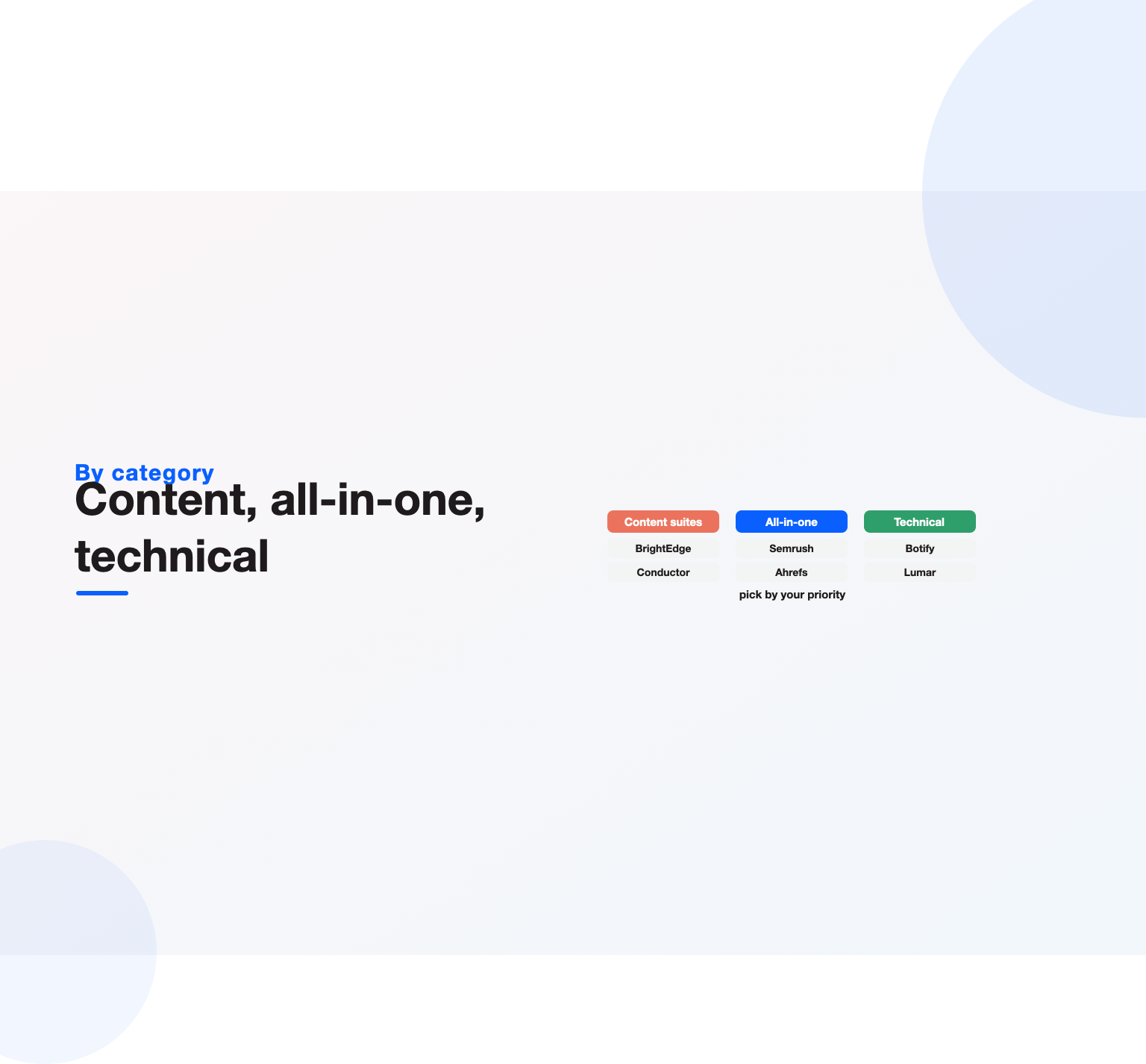
Choosing well starts with your actual needs rather than a feature list. Identify your primary challenge: if it is producing and optimizing content across large teams, the content-led suites like BrightEdge and Conductor fit; if it is technical health on a massive site, the specialists like Botify and Lumar lead; if it is broad capability at reasonable cost, the all-in-one platforms like Semrush and Ahrefs deliver. Match the tool to the problem you most need to solve, and be honest about whether your scale genuinely requires enterprise tooling or whether a capable platform will do.
Then weigh the practical factors that determine whether a platform succeeds in your organization: pricing against budget and expected return, the learning curve and how much support comes with it, how it integrates with your analytics and other systems, and how well it reports to the stakeholders who need to see results. Trials and demos are worth the time, since the right fit depends on how a platform works for your team and data, not on a specification sheet. The best enterprise search platforms is the one your team will actually adopt and use to drive results, which is often a question of fit and usability as much as raw capability.
Software versus a managed enterprise SEO team
The most important decision is often not which enterprise SEO platforms to buy but whether software alone is what you need, because a platform surfaces the work without doing it. These tools identify opportunities, flag technical issues, and track performance, but someone still has to interpret the data, set strategy, and execute the changes across a large organization, which is where many enterprises find the real bottleneck. Buying a powerful platform and lacking the team to act on it is a common and expensive mistake, since the software is only as valuable as the expertise applying it.
For that reason many enterprises pair software with a skilled in-house team, an expert agency, or both, so the platform’s data becomes action. If your challenge is capacity or expertise rather than tooling, a managed enterprise SEO service can provide the strategy and execution that turn any platform into results, and it connects to the broader SEO services that keep the whole channel aligned. The strongest setups combine the right software with the right people, because the enterprises that win at scale are the ones that turn their tools’ insights into shipped changes and measurable growth, not the ones with the most expensive license sitting unused. The takeaway for a buyer is to start from the problem, map the candidates to it, run real trials with your own data, and budget for the people who will operate whatever you choose. A platform is a force multiplier for a capable team and an expensive shelf ornament without one, so the tooling decision and the talent decision are really the same decision, made together. Handled that way, enterprise SEO software becomes what it should be: leverage that turns a large, unwieldy site into a compounding source of organic growth.
How the tools are adapting to AI search
As AI Overviews and answer engines reshape search, the these platforms category is racing to add AI-search capabilities, and it is worth understanding where the platforms are heading. Most of the major tools have added or are adding features to track visibility in AI answers, monitor AI Overview presence, and help optimize content for citation by AI systems, since enterprises need to see this new surface alongside traditional rankings. The platforms that report AI visibility clearly will have an edge as that visibility becomes a standard part of how large organizations measure the channel.
The practical takeaway is to factor AI-search coverage into a platform decision now, asking how a tool tracks and supports AI visibility rather than treating it as a future concern. That said, the underlying work of winning AI citations, creating authoritative, well-structured content, is the same regardless of which platform measures it, so tooling should inform strategy rather than dictate it. Folding AI-visibility metrics into your SEO reporting keeps stakeholders informed about a real shift, and the platforms that make that easy save enterprise teams meaningful effort as the measurement matures.
Free tools every enterprise stack needs
No matter how much enterprise SEO tools an organization buys, a few free tools remain essential and belong in every stack. Google Search Console is the source of truth for how Google sees and ranks your site, providing query, page, and coverage data no third-party tool can fully replicate, and it is indispensable at any scale. Google Analytics supplies the traffic and conversion data that ties SEO to business outcomes, and Google’s performance tools help monitor the site speed that affects both rankings and users.
These free tools do not replace enterprise platforms, but they complement them and often provide the ground truth against which the paid tools are checked. A disciplined enterprise stack pairs the scale and workflow of paid software with the authoritative, direct data of Google’s own tools, and runs both against a solid technical SEO checklist so nothing important is missed. The most effective enterprises are not the ones with the most expensive licenses but the ones that combine the right paid platforms with the free essentials and the expertise to use all of it well.
Key Takeaways
- The software handles the scale, automation, and reporting that large sites and multi-team organizations need, and is worth it only when you genuinely have that scale.
- The dedicated suites, BrightEdge, Conductor, and seoClarity, lead on content workflow and stakeholder reporting; all-in-one platforms like Semrush and Ahrefs offer huge capability at more accessible pricing.
- Technical specialists like Botify and Lumar own crawling and log analysis at massive scale, while tools like Screaming Frog and Sitebulb serve detailed hands-on audits.
- Choose by your primary challenge, content, technical, or breadth, and by fit and adoption, not by a single overall ranking that does not exist.
- Software is only half the answer: the platform surfaces the work, but a skilled team is what turns its data into results, which is why many enterprises pair tools with expertise.
Frequently asked questions
What is enterprise SEO software?
An enterprise platform is a category of platform built to manage search optimization across very large, complex websites and organizations, providing the scale, automation, integrations, and reporting that single-purpose or small-business tools cannot. These platforms crawl and analyze huge numbers of pages, track thousands of keywords, automate recommendations, and report performance to stakeholders across an organization, which is why they carry enterprise pricing and are aimed at companies where search is a major channel.
What is the best enterprise SEO software?
There is no single best option, because the right enterprise search platforms depends on your priorities. For content workflow and stakeholder reporting, the dedicated suites BrightEdge, Conductor, and seoClarity lead; for broad capability at more accessible pricing, Semrush and Ahrefs are excellent; for technical SEO at massive scale, Botify and Lumar specialize. The best choice is the one that matches your primary challenge and that your team will actually adopt and use to drive results.
How much does enterprise SEO software cost?
Dedicated enterprise platforms typically cost from several thousand dollars a month up to much more, with pricing based on scale, features, and usage, and usually quoted rather than published. All-in-one platforms like Semrush and Ahrefs are far more affordable, often a few hundred dollars a month for capable plans, which is part of why many large teams use them. The right question is the return: enterprise software should be judged against the value of the organic growth it helps drive.
Do I need enterprise SEO software or a regular tool?
It depends on your scale and complexity. If you have a very large site, multiple teams touching SEO, and stakeholders who need reporting, dedicated enterprise SEO platforms earns its cost. If your needs are more moderate, a capable all-in-one platform like Semrush, Ahrefs, or Moz will likely provide everything you need at a fraction of the price. Buying enterprise tooling you do not have the scale to use is a common and avoidable waste.
Is software enough, or do I need an SEO team?
Software alone is rarely enough, because these platforms surface opportunities and issues but do not interpret the data, set strategy, or execute changes across a large organization. That work requires skilled people, whether an in-house team, an agency, or both. Many enterprises find their real bottleneck is capacity and expertise rather than tooling, so pairing the right software with the right team, or a managed enterprise SEO service, is what turns a platform into actual results.
Which enterprise SEO software is best for technical SEO?
For technical SEO at enterprise scale, the specialists Botify and Lumar lead, because they focus on crawling, log-file analysis, and continuous monitoring of very large sites where technical health determines visibility. For detailed hands-on technical audits, Screaming Frog and Sitebulb are standards used across the industry. Many enterprises combine a technical specialist for scaled crawling with a broader platform for content and reporting, since technical and content needs are best served by different strengths.
Can all-in-one tools work for enterprises?
Yes, all-in-one platforms like Semrush and Ahrefs work well for many large organizations, offering broad capability, strong data, and reasonable pricing that scales to sizable teams. They may lack some of the workflow, stakeholder reporting, and massive-scale technical features of dedicated enterprise suites, so the largest and most complex operations sometimes need more, but for many enterprises they deliver most of the value at a much lower cost and are a sensible default before committing to top-tier these platforms.
Ready to put this into practice?
Talk to the team that runs SEO, AI search and paid growth programs every day.
Book a Strategy Call →