 Skip to content
Generative Engine Optimization
Generative Engine Optimization for Accountants
Generative engine optimization for accountants gets your firm named and cited when business owners ask ChatGPT, Perplexity, Gemini and Google AI Overviews which accountant to hire, whether they need a CPA, or how to handle a tax problem. We build the proof, reviews and clarity the models trust, and we measure it in booked consultations, not vanity scores.
- Cited when businesses ask AI
- Built on real proof and reviews
- Measured in booked consultations
Our Clients
Brands that have worked with us
From global giants to fast growing startups, teams trust Unified Platforms with their growth.










What Generative Engine Optimization for Accountants Covers
- Question mapping across every service line
- Credential-forward entity work
- Earning the client sentiment models trust
- Answerable service, scope and pricing pages
- Specialisation as the competitive wedge
- Season-aware measurement to booked work
Overview
What Generative Engine Optimization for Accountants Covers
A founder crosses the threshold from freelancer to real business, incorporates, hires two people, and suddenly the questions pile up faster than the revenue: do I need a CPA or will a bookkeeper do, how much should this cost, can someone who understands my industry handle it. In 2026 that founder does not open ten browser tabs; they ask an assistant, read the paragraph it writes back, and note the one or two firms it names. Making your firm the one that gets named there is what generative engine optimization for accountants is for.
Accounting is unlike the local trades in one decisive way: the work travels. A cloud-based practice in Denver can serve a Shopify seller in Tampa as easily as a neighbour, so the questions the engines field are less about who is nearby and more about who is right, which specialisation, which credential, which price band, which industry fluency. That shifts the whole optimisation problem away from map pins and toward proof of fit, and it is why a plan copied from a dentist or a law firm quietly fails for a CPA practice.
There is also a clock on it. The demand for accountants is violently seasonal, spiking through the run into April and again around extension and year-end deadlines, and the assistants get a surge of do-I-need-help and which-firm questions in exactly those windows. We build so that your firm is already the cited answer before the season arrives, rather than scrambling for visibility in the weeks when every competitor is bidding for the same attention and no amount of spend buys a citation quickly.
What Unified Platforms does is reverse-engineer how the engines currently answer your prospects. We map the real questions across your service lines, tax planning, bookkeeping, fractional-CFO advisory, IRS resolution, and record who gets named, which review sites and professional directories get quoted, and where a competitor is winning the recommendation you should own. That evidence, specific to your niches and your market, is the foundation of the engagement, not a generic checklist of best practices.
Trust, for an accountant, is a particular animal. Prospects are handing over their money and their exposure to the IRS, so the models weigh credentials, an active CPA or EA designation, clean professional listings, genuine client reviews and clear scope of service, more heavily than they would for a lower-stakes purchase. A firm with a vague listing or thin sentiment is skipped even when the accounting is excellent, because a model will not put its name behind advice about someone's finances on a source it cannot verify.
It is worth separating three things firms muddle together. Classic accounting SEO competes for the map pack and the ranked links; answer engine optimization competes for the single featured answer above them; the generative layer makes your firm the source a model quotes inside its own recommendation, often with no link shown at all. We run all three as one programme, but generative engine optimization for accountants has its own mechanics, entity clarity, review depth and niche authority, and it is the layer nearly every firm has left untouched.
The scoreboard we hold ourselves to is booked consultations and signed engagements, never a visibility index. This fits CPA firms, tax practices, bookkeeping services and fractional-CFO shops, and it fits the niche-focused practices, e-commerce, real estate, medical, expat, that win precisely because a model rewards specificity. If prospects arrive already naming a competitor they found through an assistant, the engines are answering your market and recommending someone else, and this work is how you take that recommendation back.
The questions have also grown genuinely complex, which plays to a specialist's advantage if the engines can find them. A remote seller now has economic-nexus obligations in states they have never visited; a content creator is unsure whether an LLC or an S-corp saves more; a family with a small rental is guessing at depreciation. An assistant will attempt an answer, then, increasingly, suggest talking to a firm that handles exactly this, and generative engine optimization for accountants is how yours becomes the firm it points to, because you have published the clear, correct explanation the model chose to trust.
Finally, the profession is shifting from compliance toward advisory, and the AI-search behaviour is shifting with it. Prospects are no longer only asking who will file my return; they are asking who will help me plan, who understands my industry, who will pick up the phone in September when a deal closes. These are higher-value, stickier engagements, and they are exactly the ones researched carefully inside an assistant before a call. We build generative engine optimization for accountants around that advisory intent, so your firm is cited not just for the commodity filing but for the relationship that lasts years and refers others.
Question mapping across every service line. A Shopify seller worried about sales-tax nexus, a landlord asking about depreciation and a six-figure earner facing an IRS notice ask assistants very different things, so we map the question set for each service line you run, tax, bookkeeping, advisory, resolution, and record how the engines answer them now: who is named, which review and directory sources are quoted, and where a rival is taking the recommendation. That map is specific to your niches, not a template.
Credential-forward entity work. The engines weigh professional standing heavily for financial advice, so we make your CPA or EA credentials, firm registration, service scope and industries served unambiguous across your Google Business Profile, professional directories and your own site. Because accounting work is largely remote, we lean the entity toward specialisation and credibility signals rather than a single location, which is what actually moves a recommendation for a practice that serves clients nationwide.
Earning the client sentiment models trust. Answers about accountants lean on independent reviews as objective proof of reliability with someone's money, and we build a genuine review programme timed around the moments clients are happiest, a clean filing, a resolved notice, a smooth close. That earned sentiment is frequently what tips an engine toward your firm over an equally credentialed competitor with a quieter profile.
Answerable service, scope and pricing pages. Prospects ask an assistant what an engagement costs and whether a firm fits their situation before they book, so we publish honest pages on CPA-versus-bookkeeper, packaged pricing bands, what a fractional-CFO engagement includes and how a specific niche is handled. Clear scope and price is exactly the material a model can quote, so your firm becomes the source rather than a directory.
Specialisation as the competitive wedge. Accounting rewards depth, and so do the engines: a practice known for e-commerce, real estate or expat returns can out-cite a far larger generalist on those questions. We sharpen the positioning and authority signals around the niches whose engagements you actually want, so the visibility lands on the clients worth having rather than on low-value one-off queries.
Season-aware measurement to booked work. You see which questions now cite your firm and how many consultations and signed engagements those citations produced, tracked with the seasonality of the profession in mind so a quiet summer is not misread as failure. If a question wins citations but never a client, we say so and redirect the work toward the service lines that fill the calendar.
The Difference
Be the accountant AI recommends
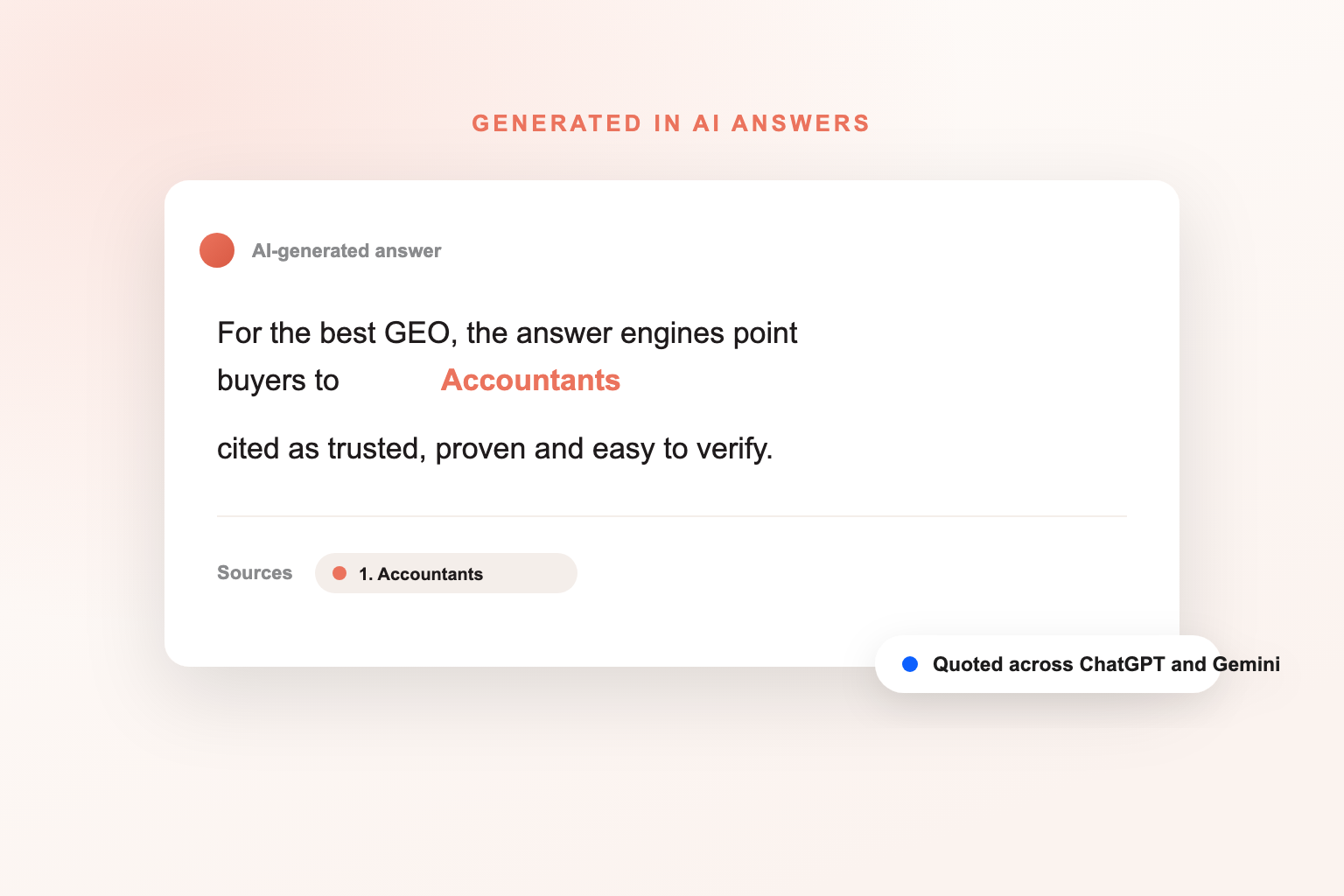
When a business owner asks ChatGPT or Google AI Overviews which accountant to hire or whether they need a CPA, the engine names a few firms and skips the rest. Generative engine optimization for accountants is how you become one of the named, cited few, by making your firm the source the models can identify, trust and quote, through clean listings, genuine reviews, sharp niche positioning and clear service information. We build the proof that earns the citation and measure the result where it counts, in booked consultations. And because accounting demand swings hard with the calendar, we get you established as that cited answer before the season peaks, when a citation is worth the most and hardest for a competitor to buy their way past.
Book a Strategy CallOur Process
How We Make Your Firm the Cited Answer
A disciplined sequence, adapted to your competitive landscape. Open each step.
01Baseline every service line in the engines
02Diagnose why a rival gets the nod
03Fix credibility, then publish the answers
04Launch ahead of the season and watch
05Report on citations and signed engagements
Why Unified Platforms
Why Accounting Firms Choose Us for GEO
The working habits behind every engagement.
Judged on signed engagements
We measure the work by booked consultations and engagements that closed, not by a visibility score, and retire any effort that earns citations without clients. For a firm paying monthly, that is the only honest test, and it keeps every hour we bill pointed at engagements rather than at a chart that looks impressive but never rings the phone.
We know how businesses buy accounting
The do-I-need-a-CPA, what-does-it-cost and who-understands-my-industry questions are where engagements begin now, and we build straight for them. A generic AI-marketing approach optimises for questions that never put a signed client on your books.
Depth beats a bigger generalist
Specificity is what the engines reward, so a practice with genuine depth in a niche can out-cite a much larger generalist for those engagements, and we build that focused authority rather than spreading you thin across every service a firm could theoretically offer.
Standards-respecting review work
We help you earn the independent client sentiment the engines weigh most, through programmes built around professional conduct standards, never through fabricated reviews or anything that could put your standing or a client relationship at risk.
Specialists who track the engines
AI search shifts month to month, and your account is run by people who follow how each engine chooses and cites firms and adjust the plan as it moves, so the programme keeps producing engagements instead of coasting on a playbook that worked last quarter.
Straight about what earns a citation
No tactic makes a model recommend a firm it cannot verify. We will tell you plainly where your credentials, reviews or service pages are too thin to be cited yet, fix the substance, and build the kind of proof that holds up as the engines grow stricter about financial advice.
Industries
Industries We Work With
Deep experience across the sectors we serve, with strategy tailored to each.
Ready to be the firm AI recommends?
Book a free GEO audit for your firm. We will show you what the AI engines already tell business owners in your area and niche, which firms they recommend instead of you, and the fastest path to becoming the cited answer for the questions that bring qualified clients. You will see the actual answers ChatGPT and Google's AI surfaces return for your key service lines today, the specific credential, review or content gap holding each one back, and an honest estimate of how quickly a citation there could turn into booked consultations, so you can judge the opportunity on real evidence rather than a pitch before you commit a single dollar.
Book a Strategy CallQuestions
Frequently Asked Questions
Straight answers before you ever get on a call.
Generative Engine Optimization for Accountants Essentials
What is generative engine optimization for accountants?
How is GEO different from accounting SEO and AEO?
How do AI engines decide which accountants to recommend?
Does this actually bring in clients?
Which AI engines do you optimize for?
How important are reviews and niche positioning?
More on the Service
Do you also handle service and pricing pages?
Will GEO replace our SEO?
How long before we see results?
How much does GEO for accountants cost?
Do you work with niche and multi-partner firms?
Is any of this against professional or advertising rules?
How do we get started?
Working With Unified Platforms
How do you price generative engine optimization for accountants?
How do we get started with generative engine optimization for accountants at Unified Platforms?
Do you work with our in-house team, or fully manage it?
How do you report on progress?
Why choose Unified Platforms for generative engine optimization?
Do you work with companies outside India?
What size of company do you work best with?
Can we start small and scale the engagement later?
How do you stay accountable for results?
What makes Unified Platforms different from a large consultancy?
How involved will our team need to be?
Do you offer a pilot or discovery engagement to start?
Let's get your firm into the answer
Tell us about your firm, your services and the clients you want more of. We will map a generative engine optimization plan that makes your firm the one the AI engines name when a business owner asks, measured in booked consultations rather than a visibility number. We will start with the niche where your engagements are most valuable and your fit is strongest, prove the citations and booked consultations there before the next filing season arrives, and expand from that base into your other service lines. That way the programme earns its keep on real client work rather than on a chart, and you enter your busy months already established as the firm the assistants recommend, instead of buying visibility at the exact moment it is most expensive and slowest to move.
Book a Strategy CallExplore more