...

Generative Engine Optimization for SaaS

Generative Engine Optimization

Generative Engine Optimization for SaaS

Generative engine optimization for SaaS gets your product named and cited when ChatGPT, Perplexity, Gemini and Google AI Overviews answer your buyers' questions. We do the entity, evidence and content work that makes you the source the model quotes, and we measure it in trials and pipeline, not vanity scores.

  • Cited in answers, not just ranked in links
  • SaaS-native, buyer-question led
  • Measured in trials and pipeline
Generative Engine Optimization for SaaS
Measured in trials and pipeline
Bangalore based, global reach
75M+Organic traffic driven
150K+Organic leads generated
110M+Social-driven topline
40+ yrsCollective team experience

Our Clients

Brands that have worked with us

From global giants to fast growing startups, teams trust Unified Platforms with their growth.
myntra logo
nextagile logo
getwidget logo
great-learning logo
designcafe logo
upgrad logo
vemicaindia logo
sacredkosmetics logo
metro logo
knowledgehut logo

What Generative Engine Optimization for SaaS Covers

  • Category answer research
  • Entity and evidence engineering
  • Comparison and alternative content
  • Third-party proof the engines trust
  • Structured data and product clarity
  • Citation tracking and pipeline measurement

Overview

What Generative Engine Optimization for SaaS Covers

Generative engine optimization for SaaS is the work of getting your product named and cited when ChatGPT, Perplexity, Gemini and Google AI Overviews answer the questions your buyers ask. It is not classic SEO, and it is not the scramble for the featured answer box. These engines do not simply rank links; they generate an answer and attribute a handful of sources, and generative engine optimization is how a software brand becomes one of those sources. For SaaS, whose buyers now open an AI assistant before they open Google, that citation is often the first impression you get, and sometimes the only one.

Unified Platforms runs generative engine optimization for SaaS companies from research through to results. We study how the models actually answer your category, do the entity and evidence work that makes your product citable, and tie the whole thing to trials, pipeline and MRR rather than to a score on a dashboard. We treat generative engine optimization as a revenue channel a SaaS team can hold accountable, not a science project, because a citation that never turns into a signup is just a nicer kind of vanity metric.

SaaS is where this discipline matters most, and where it behaves differently from any other category. Your buyers ask the engines comparison questions, the endless X versus Y, alternative questions such as the best tool for a specific job, and detailed use-case questions, and the models answer them by synthesizing review sites, documentation, community threads and comparison content. A SaaS product that is missing from those sources is missing from the answer, however good the software is, because the model can only cite what it can find and trust.

A generative engine optimization for SaaS engagement with us covers the full picture: researching the questions and the current answers in your category, engineering your entity presence so the models understand exactly what you do and who you serve, building the comparison, alternative and use-case content the engines pull from, earning third-party proof on the review sites and communities they trust, and marking up your product so it is machine-readable. Then we track which answers cite you, and tie those citations back to trials and pipeline.

It helps to be precise about the difference, because these terms get blurred. Answer engine optimization fights for the single featured answer; traditional SEO fights for the blue link; generative engine optimization makes you the source a model quotes when it writes its own answer from scratch. For a SaaS company the three are strongest together, and we run them as one AI search system, but the generative-citation work is its own discipline with its own tactics, and it is the one most SaaS teams are still completely absent from.

Our generative engine optimization for SaaS suits B2B SaaS platforms, vertical SaaS, developer tools, fintech and martech companies whose buyers do most of their research inside an AI assistant long before they reach a demo form. If prospects arrive already knowing your competitors by name but not you, that is the tell: the engines are answering your category's questions and citing someone else, and closing that gap is exactly what this work does.

We work primarily with United States and North American SaaS companies, alongside teams across the UK and wider markets, and we bring the same discipline to an early-stage product fighting for its first mentions as to an established platform defending its category. Wherever you are, the promise of our generative engine optimization for SaaS is the same: your product cited in the answers your buyers actually trust, and the result measured in trials and pipeline, not applause.

Category answer research. We start by asking the engines the questions your buyers ask, across ChatGPT, Perplexity, Gemini and Google AI Overviews, and recording exactly how your category is answered today: who gets named, which sources are cited, and where you are absent. That map of the real answers, not assumptions, is the foundation every later decision in your generative engine optimization program is built on.

Entity and evidence engineering. Models cite sources they can identify and trust. We build your product's entity presence so the engines understand precisely what your SaaS does, who it is for and how it differs, and we assemble the evidence, the specifics, the numbers, the proof, that makes a claim about you safe to repeat. This is the core of getting cited rather than merely mentioned.

Comparison and alternative content. The questions that bring SaaS trials are comparisons and alternatives: this tool versus that one, the best option for a particular use case. These are exactly the prompts the engines answer from comparison and alternative pages, so we build honest, specific ones that make your product the obvious cited choice for the buyers you actually want, and skip the ones you do not.

Third-party proof the engines trust. AI-generated answers lean heavily on sources outside your own site, review platforms like G2, community threads, and independent write-ups. We map which third-party sources the models pull from in your category and help you earn a genuine, credible presence there, because for a SaaS brand a citation from a source the engine already trusts often matters more than anything on your own domain.

Structured data and product clarity. An engine can only cite what it can parse. We mark up your product, pricing, features and FAQs with clean structured data and rewrite the fuzzy product explanations that leave a model guessing, so your SaaS is machine-readable and unambiguous. Clarity is a ranking factor when the reader is a language model deciding whether it understands you well enough to quote you.

Citation tracking and pipeline measurement. We track which questions cite your SaaS, on which engines, and how that share of voice moves over time, then we connect it to what a SaaS team actually cares about: trials, demos and pipeline. You get a clear read on whether your generative engine optimization is producing revenue, not just a prettier visibility chart, and we reprioritise the work around what converts.
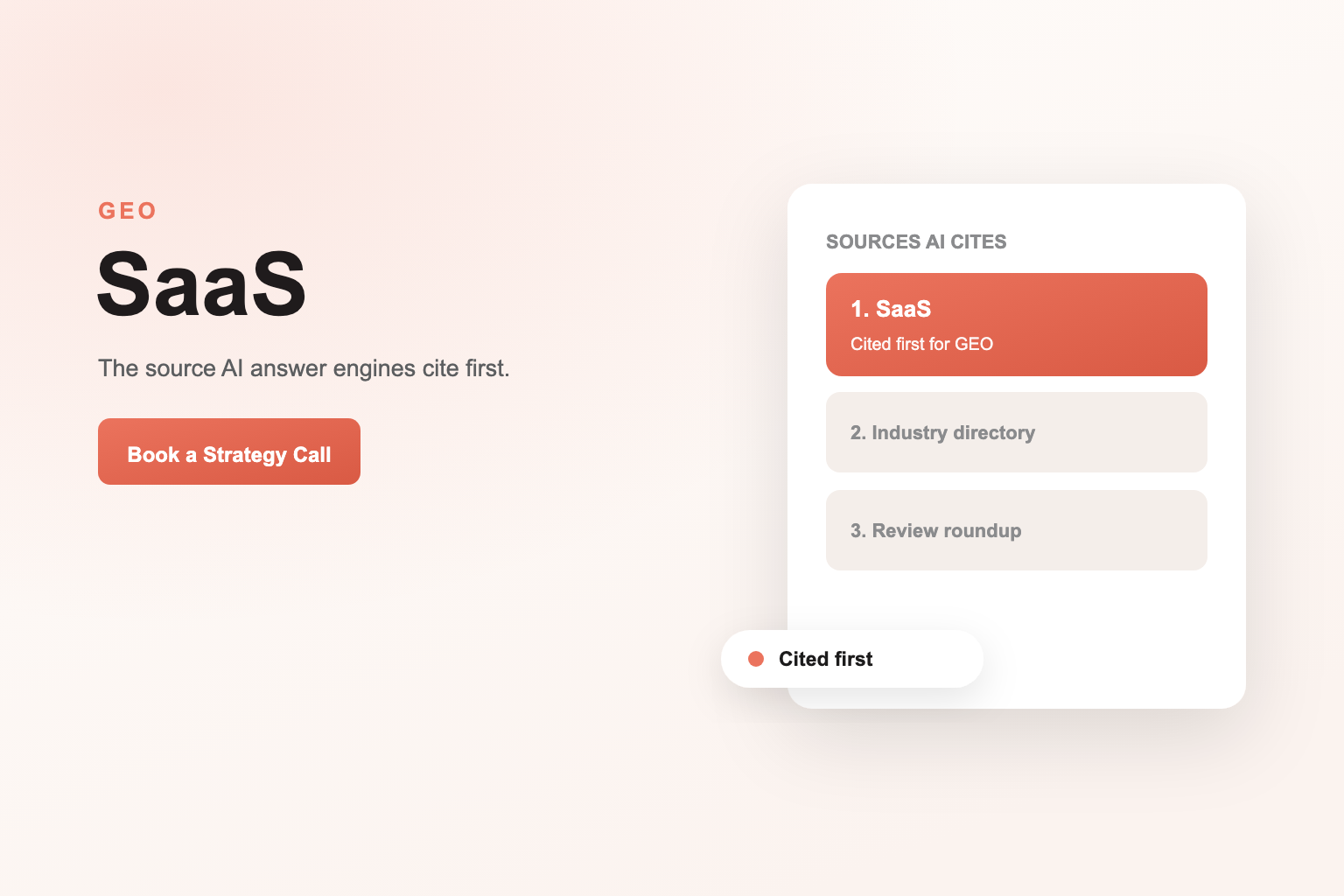
Be the SaaS the AI names

The Difference

Be the SaaS the AI names

When a buyer asks ChatGPT or Perplexity which tool to use, the engine names a few products and ignores the rest. Generative engine optimization for SaaS is how you become one of the named, cited few, by making your product the source the model can understand, trust and quote for the questions that lead to trials. We build the entity, evidence and third-party proof that earn the citation, and we measure the result where it counts, in signups and pipeline, so AI visibility stops being a guess and becomes a channel you can grow.

Book a Strategy Call

Our Process

How We Make Your SaaS a Cited Source

A disciplined sequence, adapted to your competitive landscape. Open each step.

01Audit the AI answers in your category
We run your category's real buyer questions through the major engines and document how each is answered today, who is cited, and where your SaaS is missing. You get an honest baseline of your generative visibility before we change anything, and a ranked list of the questions worth winning because they lead to trials.
02Map the citable gaps
For each question that matters, we work out why you are not the cited source: a missing comparison page, thin third-party proof, an unclear product explanation, or a weak entity footprint. That gap analysis becomes a concrete plan rather than a vague push to be more visible in AI.
03Build the entity, evidence and content
We execute the plan: entity work, structured data, the comparison, alternative and use-case content the engines pull from, and the specific evidence that makes your claims citable. Everything is built to be quoted by a model, not just read by a person, which is a different bar and we design for it.
04Earn the third-party citations
We help you earn genuine presence on the review sites, communities and independent sources the engines trust in your category, because much of a SaaS answer is assembled from outside your own site. This is slower, earned work, and it is usually the difference between being mentioned and being cited.
05Track citations and tie them to pipeline
Once the work is live we monitor which answers cite you across the engines, watch your share of voice against competitors, and connect it to trials and pipeline. We report in plain numbers a SaaS team can act on, and we keep shifting effort toward the questions that actually produce signups.

Why Unified Platforms

Why SaaS Teams Choose Us for GEO

The working habits behind every engagement.

GEO as a revenue channel, not a vanity score

We hold your generative engine optimization to trials, demos and pipeline, and we will drop work that produces citations but no signups. For a SaaS team that is the only test that matters, and it is the one most GEO providers quietly avoid.

SaaS-native, not a generic playbook

We understand how software gets bought now, the comparison and alternative questions, the role of G2 and communities, the trial-to-paid journey, and we build for it. A generic GEO approach misses the specific questions that actually move a SaaS pipeline.

One system: GEO, AEO and SEO together

Generative citation, the featured answer and the classic search ranking reinforce each other, and we run them as one program rather than three disconnected efforts, alongside the wider generative engine optimization work. That is how your SaaS gets named by the model, ranked in the results and clicked by the buyer, instead of winning one and losing the rest.

Senior people who know the models

Your account is run by specialists who study how ChatGPT, Perplexity, Gemini and AI Overviews actually choose and cite sources, and who update as the engines change. This field moves monthly, and a stale playbook stops working fast.

Honest about what earns a citation

There is no trick that makes a model cite a product it cannot verify. We will tell you plainly where your evidence, proof or clarity is too thin to be cited yet, and fix the substance, because that is the only thing that holds up as the engines get stricter.

You own the work

The entity assets, content and third-party presence we build are yours and keep paying off, on your own accounts and properties, with transparent reporting and no long lock-in. We would rather re-earn the engagement each quarter with results you can see in your trial numbers.

Industries

Industries We Work With

Category specific strategy, not one template applied to every business.

B2B SaaS platformsVertical SaaSDeveloper tools and APIsFintech SaaSMartech and sales techHR and people techCybersecurity SaaSAI and data platforms

Ready to be the SaaS the AI names?

Book a free GEO audit for your SaaS. We will show you which buyer questions the AI engines already answer in your category, who they cite instead of you, and the fastest path to becoming a cited source for the questions that bring trials.

Book a Strategy Call

Questions

Frequently Asked Questions

Straight answers before you ever get on a call.

Generative Engine Optimization for SaaS Essentials

What is generative engine optimization for SaaS?
It is the practice of getting your software product cited when generative AI engines like ChatGPT, Perplexity, Gemini and Google AI Overviews answer your buyers' questions. Rather than ranking a link, these engines write an answer and attribute a few sources, and generative engine optimization for SaaS makes your product one of those trusted sources through entity work, evidence, comparison content and third-party proof, all tied to trials and pipeline rather than a vanity visibility score.
How is GEO different from AEO and SEO?
Traditional SEO competes for the ranked blue link; answer engine optimization competes for the single featured answer or snippet; generative engine optimization makes you the source a model quotes when it generates its own answer from many inputs. They overlap and work best together, but the generative-citation work has its own tactics: entity authority, evidence the model can verify, and presence across the review sites and communities the engines synthesize from. For SaaS, being absent from that last layer is the most common and most costly gap.
How do AI engines decide which SaaS products to cite?
They favour products they can clearly identify and safely trust. That means a well-defined entity the model understands, specific verifiable claims rather than vague marketing, structured and machine-readable information, and corroboration from third-party sources like G2 and community discussions. A product with thin proof or a fuzzy description gets skipped, even if it is genuinely good, because the model will not stake an answer on a source it cannot verify.
Does GEO for SaaS actually drive trials and pipeline?
It can, when it is built and measured for it. Buyers increasingly form their shortlist inside AI assistants, so a citation at that moment is high-intent and often precedes a trial. We weight the work toward the comparison, alternative and use-case questions that lead to signups, track which answers cite you, and tie that to trial and pipeline numbers, the same way we report across our client programs. If citations are not producing signups, we change the plan rather than celebrate the chart.
Which AI engines do you optimize for?
The ones your buyers actually use: ChatGPT, Perplexity, Google AI Overviews and AI Mode, and Gemini, with an eye on Copilot and others as they grow. Each sources and weights information differently, so we track and optimize for them separately rather than assuming strength in one carries to the rest. For most B2B SaaS categories, ChatGPT and Perplexity carry the most buyer-research weight today, and we manage them together as one AI search optimization program.
Do comparison and alternative pages really matter for this?
Enormously, for SaaS specifically. The highest-intent buyer questions are comparisons and alternatives, and the engines answer them largely from comparison and alternative content. Honest, specific pages that lay out where your product fits and where it does not are some of the most citable assets you can own, because they give the model exactly the structured, comparative information it needs to name you in an answer.
How important is G2 and third-party proof?
Very. AI answers about SaaS lean heavily on independent sources, review platforms, community threads and third-party write-ups, because the model treats them as more objective than your own site. We map which of these the engines cite in your category and help you earn a genuine presence there. A strong, credible third-party footprint is frequently the single biggest lever on whether your SaaS gets cited.
Will GEO replace our SEO?
No, and anyone who says so is overselling. Classic search still sends real traffic, and the same authority and SEO work that helps you rank, including for SaaS SEO specifically, also helps the models trust and cite you. Generative engine optimization is an additional layer for the growing share of buyer research happening inside AI, not a replacement. We run GEO, AEO and SEO as one program precisely so you are not forced to choose.

More on the Service

How long before we see results?
You can often see citation changes within weeks on the questions where the gap was a missing page or unclear product information. The earned third-party proof and entity authority build over a few months, and that is where the durable citations come from. It is faster than classic SEO for the quick-win questions, but the compounding results reward patience and consistency.
How much does GEO for SaaS cost?
It depends on your category's competitiveness and how much entity, content and third-party work is needed, so we price each engagement to the plan rather than a fixed number. What matters more is the return: the work should pay for itself in trials and pipeline from buyers who found you through AI. We are transparent about scope and the outcome each level targets, so you invest against a result, not an hourly rate.
Do you work with early-stage SaaS with little authority?
Yes, and early is often a good time, because the AI answers in many software categories are still forming and the cited set is not yet locked in. An early-stage product will not out-muscle an incumbent everywhere, so we focus on the specific, winnable questions where clear positioning and genuine proof can earn you a citation now, and build from there as authority grows.
Can you handle developer tools and technical products?
Yes. Developer tools and APIs are a strong fit, because their buyers ask precise, technical questions and the engines reward clear documentation, real code examples and specificity. We work with your technical content and docs to make them both genuinely useful to developers and highly citable to the models, which for technical SaaS tends to go hand in hand.
How do you measure GEO success?
By whether your SaaS is cited for the questions that matter, how your share of voice moves against competitors across the engines, and, above all, whether that translates into trials, demos and pipeline. We track citations on a fixed set of buyer questions over time and connect them to your funnel, and we report in plain terms you can act on rather than a single opaque visibility score.
How is this different from just publishing more blog content?
Publishing more posts does little if they are not the sources the engines cite. Generative engine optimization is about the right assets, entity clarity, comparison and use-case content, verifiable evidence and trusted third-party proof, built specifically to be quoted in an answer. It is a targeted, citation-first approach, not a volume play, which is why a handful of the right assets can outperform a content calendar full of the wrong ones.
Can you work alongside our in-house SaaS marketing team?
Absolutely. Most of our SaaS clients have capable marketers who simply do not have the specialist time to track how the AI engines answer their category and to build for citation. We slot in as the dedicated generative engine optimization function, own the research, the citable assets and the measurement, and coordinate with your team on positioning and content so everything stays consistent with your brand.
How do we get started?
Start with a free GEO audit. We will run your category's key buyer questions through the major engines, show you where you are cited and where a competitor is cited instead, and map the fastest path to becoming a cited source for the questions that bring trials. From there we scope the engagement and begin. The first step is just a clear look at how the AI answers your market today.

Working With Unified Platforms

How do you price generative engine optimization for saas?
We scope after an initial consultation rather than quoting a generic package, because the right investment depends on your goals, scale and how much you want us to run versus your in-house team. We start with the highest-impact work so early results help justify and fund the wider engagement, and we are transparent about scope and fees before you commit.
How do we get started with generative engine optimization for saas at Unified Platforms?
It starts with a short consultation to understand your goals and situation, followed by a focused audit or discovery step. From there we agree priorities and a plan, then move into execution with a clear cadence of delivery and reporting. You always know what we are doing, why, and what it is producing.
Do you work with our in-house team, or fully manage it?
Both models work. We can run the function end to end, or operate as a strategic partner that sets direction, builds the systems and equips your in-house team to execute. Many clients start with us leading and shift more in-house over time. We are honest about where we add the most value versus where your team is better placed.
How do you report on progress?
With a transparent cadence tied to outcomes, not activity. You get a live view you can check any time and a regular review where we look at what is working, what is not, and what to do next. We report against the metrics that map to your business goals, so the investment is always accountable.
Why choose Unified Platforms for generative engine optimization?
Because we combine senior, experienced practitioners with an integrated growth, marketing and talent practice, so your generative engine optimization work connects to everything else driving your business rather than sitting in a silo. We focus on outcomes you can measure, we are honest about what will and will not move the needle, and we have 15+ years and 40+ years of collective experience behind the work.
Do you work with companies outside India?
Yes. We are based in Bangalore and work with clients across India and globally. Our engagements are delivered through strategy, systems and content that work regardless of location, and we adapt to the markets, norms and time zones your business operates in.
What size of company do you work best with?
We work with everyone from funded startups and scaleups to established mid-market and enterprise businesses. What matters more than size is that you have a real growth or people challenge worth solving and the intent to act on it. We scope the depth and pace of the engagement to your stage, so a lean team gets focused, high-leverage work and a larger organisation gets the breadth it needs.
Can we start small and scale the engagement later?
Yes, and we often recommend it. Starting with a focused, high-impact scope lets you see real results and build trust before committing to a broader engagement. As the work proves out, we expand into adjacent areas at a pace you are comfortable with, so the investment always tracks the value being created.
How do you stay accountable for results?
Through transparent, outcome-based reporting and a regular review cadence. We agree the metrics that matter at the outset, baseline them, and report progress against them openly, including what is not working. You are never left guessing whether the engagement is delivering, and we adjust the plan based on real results rather than defending activity for its own sake.
What makes Unified Platforms different from a large consultancy?
Large consultancies often sell strategy decks and staff junior teams to deliver them. We are senior, hands-on operators who build and run the work, and we sit inside an integrated growth, marketing and talent practice, so the pieces connect rather than arriving as disconnected recommendations. You get practical execution and measurable outcomes, not a binder that sits on a shelf.
How involved will our team need to be?
Enough to give us context and make decisions, but we do the heavy lifting. Early on we need time from the people who know your business, goals and data. Once the engagement is running, we minimise the load on your team, handling execution and bringing you clear options and reporting rather than adding to your workload. We flex to how hands-on or hands-off you want to be.
Do you offer a pilot or discovery engagement to start?
Yes. Many clients begin with a focused audit or discovery step, or a defined pilot, before a broader engagement. It lets you see how we work and get early value while we build a clear, evidence-based plan for the wider program. It is a low-risk way to start and usually pays for itself in the clarity it creates.

Let's get your product into the answer

Tell us your product, your category and the questions your buyers ask before they buy. We will map a generative engine optimization plan that makes your SaaS the brand the AI engines name and cite, and we will hold it to trials and pipeline, not to a visibility number nobody can bank.

Book a Strategy Call
+91 95909 45916business@unifiedplatforms.comBangalore, India · serving clients globally
Ready to be the SaaS the AI names?
Scroll to Top