 Skip to content
AI Search Optimization
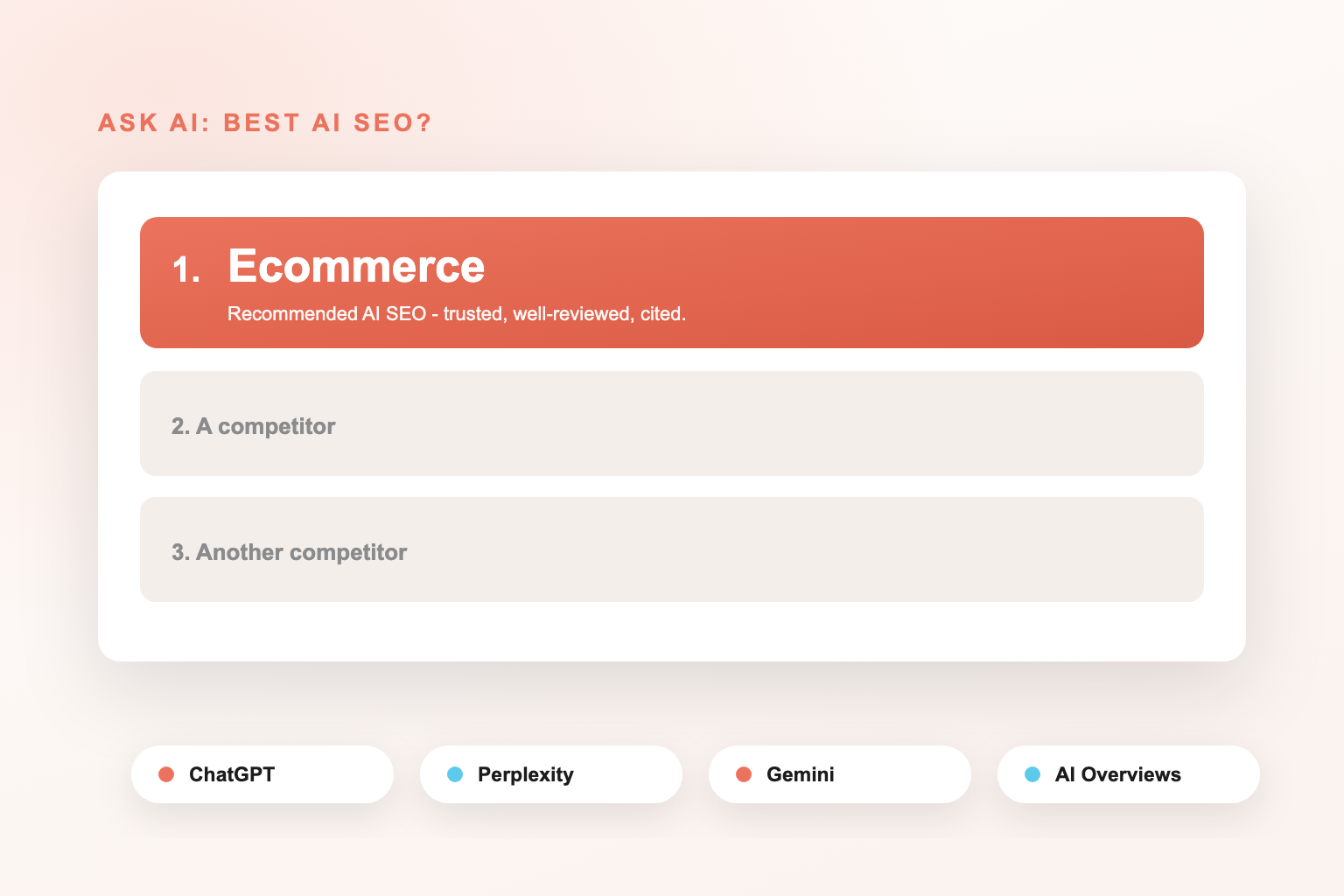
AI SEO Services for Ecommerce
AI SEO for ecommerce gets your products and category pages found across the AI surfaces, Google AI Overviews and AI Mode, ChatGPT shopping, Perplexity and Gemini, when shoppers ask AI what to buy. We fix the feeds, schema, content and reviews the models read, and measure it in AI-driven sessions and revenue, not vanity scores.
- Products surfaced in AI answers
- Built on feeds, schema and reviews
- Measured in AI-driven revenue
Our Clients
Brands that have worked with us
From global giants to fast growing startups, teams trust Unified Platforms with their growth.







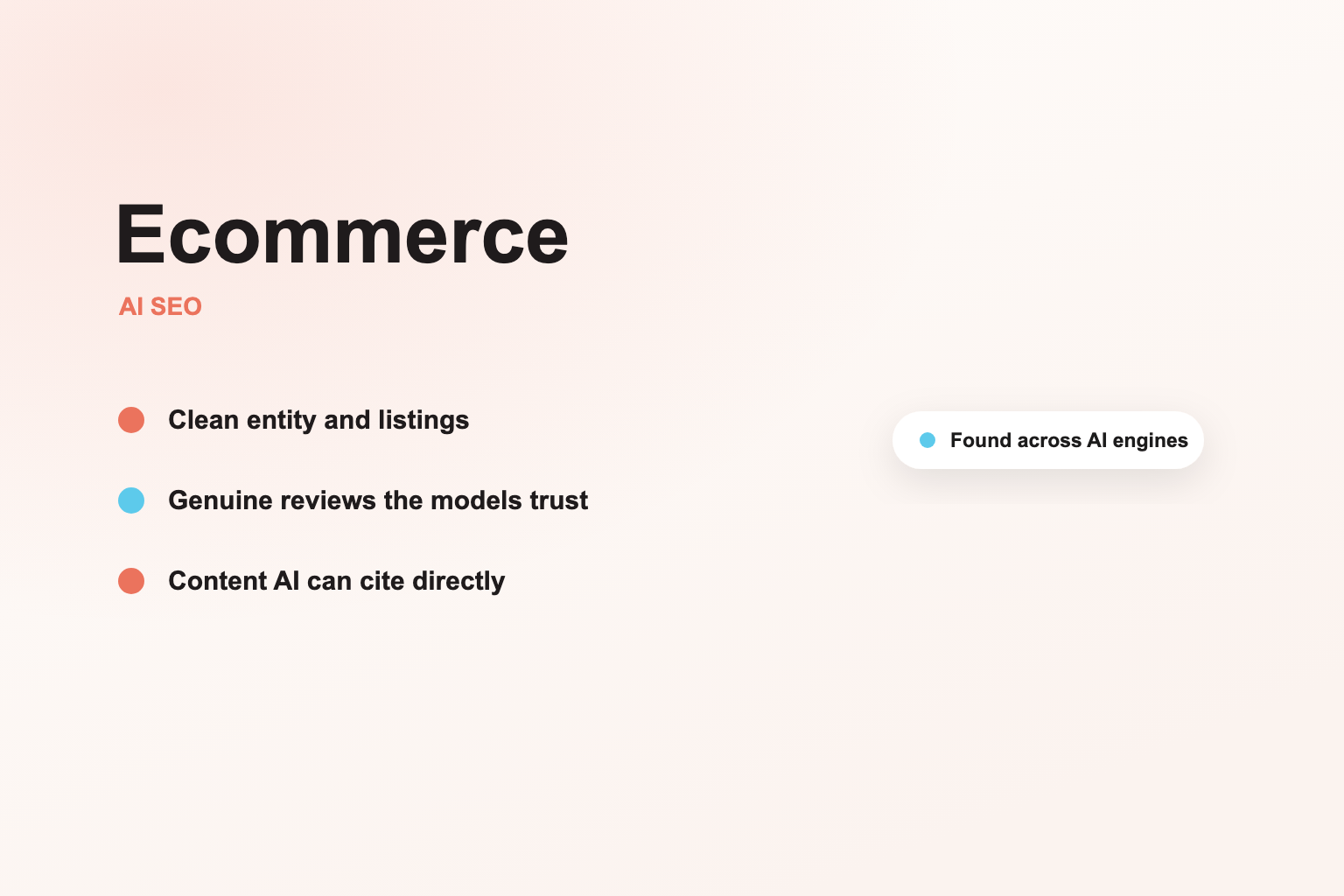
What AI SEO Services for Ecommerce Covers
- Buying-question and AI-answer research
- Product feed and catalogue data
- Product and review schema
- Content shoppers and models both use
- Reviews and product proof
- Revenue tracking, not impressions
Overview
What AI SEO for Ecommerce Covers
Ecommerce is where the shift to AI search is most visible and most brutal. A shopper who once typed best running shoes for flat feet into Google and compared a page of results now asks ChatGPT or Google's AI Overviews and gets back a short, opinionated list of specific products, often with a buy path attached. If your product is not in that answer, the sale was lost before your product page ever had a chance, and AI SEO for ecommerce exists to make sure your products are the ones the AI names.
This is a different problem from ranking a category page in classic search. When an AI answers what should I buy, it is not returning ten links; it is reading product data, reviews, specs, structured markup and editorial coverage, then synthesising a recommendation. AI SEO for ecommerce is the work of making every one of those inputs, your feed, your schema, your reviews, your content, legible and trustworthy enough that the models pick your product over a competitor's.
Unified Platforms runs AI SEO for ecommerce end to end, from research to revenue. We study how the AI surfaces answer the buying questions in your categories, fix the product data, structured markup, content and review signals the models depend on, and tie the work to AI-driven sessions and sales rather than a dashboard score. In a channel measured in return on ad spend, a product cited by AI that never converts is just an expensive vanity metric.
Ecommerce has a technical layer no other vertical carries, and the plan reflects it. Product feeds, variant data, price and availability, Product and Offer schema, review markup, canonicalisation across thousands of SKUs, all feed the models, and a gap in any of them quietly drops your products out of AI answers. We treat the catalogue as the core asset it is, because the AI surfaces read it as structured data long before they read your brand story.
It is worth being precise about the service, because the disciplines blur. Classic ecommerce SEO chases category and product rankings; answer engine optimization chases the featured answer; generative engine optimization chases the citation inside a written recommendation. AI SEO for ecommerce is the umbrella that runs all of them together, so your products show up across every AI surface a shopper might use, not just on one.
The scoreboard we hold ourselves to is AI-driven sessions and revenue, never impressions. Each month you see which buying questions now surface your products, how your share of the AI answer compares to the competitors you actually lose sales to, and how much revenue traced back to an AI referral, so the investment is judged the way an ecommerce operator judges any channel, by what it returns.
This fits ecommerce brands across the spectrum, direct-to-consumer brands, marketplaces and multi-brand retailers, subscription and replenishment models, and considered-purchase categories where shoppers research hard before buying. If customers arrive already naming a competitor's product an AI recommended, the surfaces are answering your category and steering the sale elsewhere, and AI SEO for ecommerce is how you take that recommendation back, category by category and product by product.
We work with stores from a focused single-category brand to a catalogue of tens of thousands of SKUs, on Shopify, custom stacks and everything between. The promise holds at any size: your products surfaced in the AI answers shoppers now trust, and the outcome measured in revenue rather than a chart that looks good in a board deck but never moves the top line.
One reality shapes how we sequence the work: with a large catalogue you cannot optimize everything at once, and you should not try. We start with the categories and hero products where margin and demand are highest, prove the AI visibility and revenue there, and use that momentum, the data, the reviews, the sales, to widen across the catalogue, which compounds far faster than a thin pass over every SKU.
The AI shopping surfaces are also multiplying, and each reads products its own way. Google's AI Overviews and AI Mode increasingly render product tiles with price, rating and availability pulled straight from your feed and schema; ChatGPT surfaces products through its shopping features and connected sources; Perplexity and Gemini fold product picks into their answers. Optimizing for one and ignoring the rest leaves demand on the table, so we work the full set rather than betting the catalogue on a single surface that could change its rules next quarter.
There is a reason this channel is worth the effort beyond traffic volume. A shopper who reaches your product through an AI recommendation has already been pre-qualified by the model, matched to their stated need, budget and constraints, so they tend to arrive further down the funnel and convert at a higher rate than a cold click from a crowded results page. Winning the AI answer is not just more sessions; it is better sessions, which is exactly what moves contribution margin rather than vanity traffic.
Finally, ecommerce AI visibility is not a set-and-forget project, because your catalogue and the surfaces both move constantly. Prices change, products sell out, new SKUs launch, seasons turn, and the models re-read your feed and re-rank products on their own cadence. We treat the programme as ongoing operations, keeping the feed, schema and reviews current and watching how the AI answers shift for your priority categories, so a product you won in the answer this month is still there next month rather than quietly dropping out when a competitor updates their data.
Images matter more here than in any other vertical, because shopping is visual and the AI surfaces are increasingly multimodal. Clean, well-tagged product imagery with descriptive alt text and correct image structured data helps the models understand what a product actually is, match it to a shopper's described need, and render it in a visual answer or product tile. We treat image optimization as part of the feed and schema work, not a nice-to-have, because a product the model cannot see clearly is a product it is reluctant to recommend.
If you sell across regions or run multiple stores, the plan accounts for that too. Currency, language, shipping and availability all change how and whether a product is surfaced for a given shopper, and the models read those signals from your feed and markup. We make sure the right catalogue is eligible for the right market, so an AI answering a shopper in one country recommends products they can actually buy, rather than surfacing an out-of-stock or wrong-region listing that wastes the click and erodes trust in your brand.
Buying-question and AI-answer research. We put the real buying questions in your categories to Google's AI Overviews, ChatGPT, Perplexity and Gemini, best product for a use case, is it worth it, what to buy under a budget, and record which products the models recommend, which sources they pull, and where yours are absent. That map of how AI answers shopping questions is the foundation of the engagement.
Product feed and catalogue data. The AI surfaces read your catalogue as structured data, so we clean and enrich the product feed, titles, attributes, variants, price and availability, so the models can understand and trust what you sell. In ecommerce, feed quality is often the single biggest lever on whether a product is eligible to be surfaced at all.
Product and review schema. We implement and validate Product, Offer, AggregateRating and Review structured data across your product and category pages, the machine-readable signals the models lean on to compare products. Clean schema is what lets an AI quote your price, rating and specs directly into an answer instead of a competitor's.
Content shoppers and models both use. Shoppers ask AI which product fits, and the models answer from clear buying content, so we build the comparison guides, use-case pages, sizing and spec explainers and honest FAQs that help a shopper decide and give the models something citable, so your store becomes the source the answer draws from rather than a marketplace listing.
Reviews and product proof. AI recommendations about products lean hard on ratings and reviews as objective proof, so we help you earn and structure genuine review signals across your product pages and the third-party sources the models read. Strong, well-marked-up reviews are frequently what tips an AI answer toward your product over an equally good competitor's.
Revenue tracking, not impressions. You get reporting that ties AI visibility to sessions, assisted conversions and revenue, not vanity counts. We track which buying questions now surface your products and connect them to the carts and orders they drive, so you can see whether the AI SEO is producing sales, and we shift effort toward the categories that convert.
The Difference
Be the product AI recommends
When a shopper asks ChatGPT or Google AI Overviews what to buy, the model answers with a few specific products and skips the rest. Being one of the products it names is the aim of AI SEO for ecommerce, achieved by making your catalogue legible and trustworthy to the models, through a clean feed, valid Product and review schema, genuine ratings and clear buying content. We build the signals that earn the recommendation and measure the result where it counts, in AI-driven revenue.
Book a Strategy CallOur Process
How We Get Your Products Surfaced by AI
A disciplined sequence, adapted to your competitive landscape. Open each step.
01Audit how AI answers your categories
02Diagnose the feed, schema and content gaps
03Fix the data, then the content
04Prioritise categories and launch
05Track AI visibility and revenue
Why Unified Platforms
Why Ecommerce Brands Choose Us for AI SEO
The working habits behind every engagement.
Measured in revenue, not impressions
We hold the AI-SEO work to AI-driven sessions and revenue and drop anything that earns visibility without sales. In a channel that lives on return on spend, that is the only test that counts.
We understand the catalogue as data
We treat your feed and schema as the core assets the models read, not an afterthought, because in ecommerce the AI surfaces judge products on structured data long before brand story, and most stores leave that layer half-built.
Category focus beats a thin catalogue pass
A large catalogue cannot be optimized evenly, so we win the categories where margin and demand are highest first, where a focused brand can out-surface a giant marketplace for the specific products that matter, then compound outward.
Reviews and proof done right
Genuine, well-structured reviews move AI product recommendations, and we help you earn and mark them up correctly on your product pages and the sources the models read, never through fake ratings that risk your store and get detected.
Specialists who track the shopping surfaces
AI shopping shifts fast across Overviews, ChatGPT and Gemini, and your account is run by people who follow how each surfaces and compares products and adjust as it changes, so the programme keeps producing sales rather than coasting.
Honest about what earns a citation
No trick makes a model recommend a product it cannot parse and trust. We tell you plainly where your feed, schema, reviews or content fall short, fix the substance, and build visibility that survives the next update to how AI ranks products, because durable visibility only ever comes from a catalogue the models can genuinely read, compare and trust.
Industries
Industries We Work With
Deep experience across the sectors we serve, with strategy tailored to each.
Ready to be the product AI recommends?
Book a free AI-SEO audit for your store. We will show you what the AI surfaces already tell shoppers in your categories, which competing products they recommend instead of yours, and the fastest path to being the product AI names when someone asks what to buy, tied to sessions and revenue rather than a visibility score you cannot bank against next quarter's targets.
Book a Strategy CallQuestions
Frequently Asked Questions
Straight answers before you ever get on a call.
AI SEO Services for Ecommerce Essentials
What is AI SEO for ecommerce?
How is it different from regular ecommerce SEO?
How do AI models decide which products to recommend?
Does this actually drive sales, not just visibility?
Which AI surfaces do you optimize for?
Do you fix our product feed and schema, or just advise?
More on the Service
Do you write the buying content too?
Will AI SEO replace our existing ecommerce SEO?
How soon should we expect results?
What does AI SEO for ecommerce cost?
Do you work with large catalogues and marketplaces?
Is any of this against the platforms' rules?
How do we get started?
Working With Unified Platforms
How do you price ai seo services for ecommerce?
How do we get started with ai seo services for ecommerce at Unified Platforms?
Do you work with our in-house team, or fully manage it?
How do you report on progress?
Why choose Unified Platforms for ai search optimization?
Do you work with companies outside India?
What size of company do you work best with?
Can we start small and scale the engagement later?
How do you stay accountable for results?
What makes Unified Platforms different from a large consultancy?
How involved will our team need to be?
Do you offer a pilot or discovery engagement to start?
Let's get your products into the AI answers
Tell us about your store, your categories and the margins you want to grow. We will map an AI search optimization plan that gets your products surfaced when shoppers ask AI what to buy, starting with your highest-margin categories and expanding across the catalogue, measured in AI-driven sessions and revenue rather than a visibility score. We will also show you, before any commitment, exactly which of your products the AI surfaces recommend today and which competitors they name instead, so you can see the size of the opportunity in your own categories and decide with evidence rather than on the strength of a pitch.
Book a Strategy CallExplore more