 Skip to content

AI Visibility Tools: 27 Tools Compared on Price and Engine Coverage (2026)
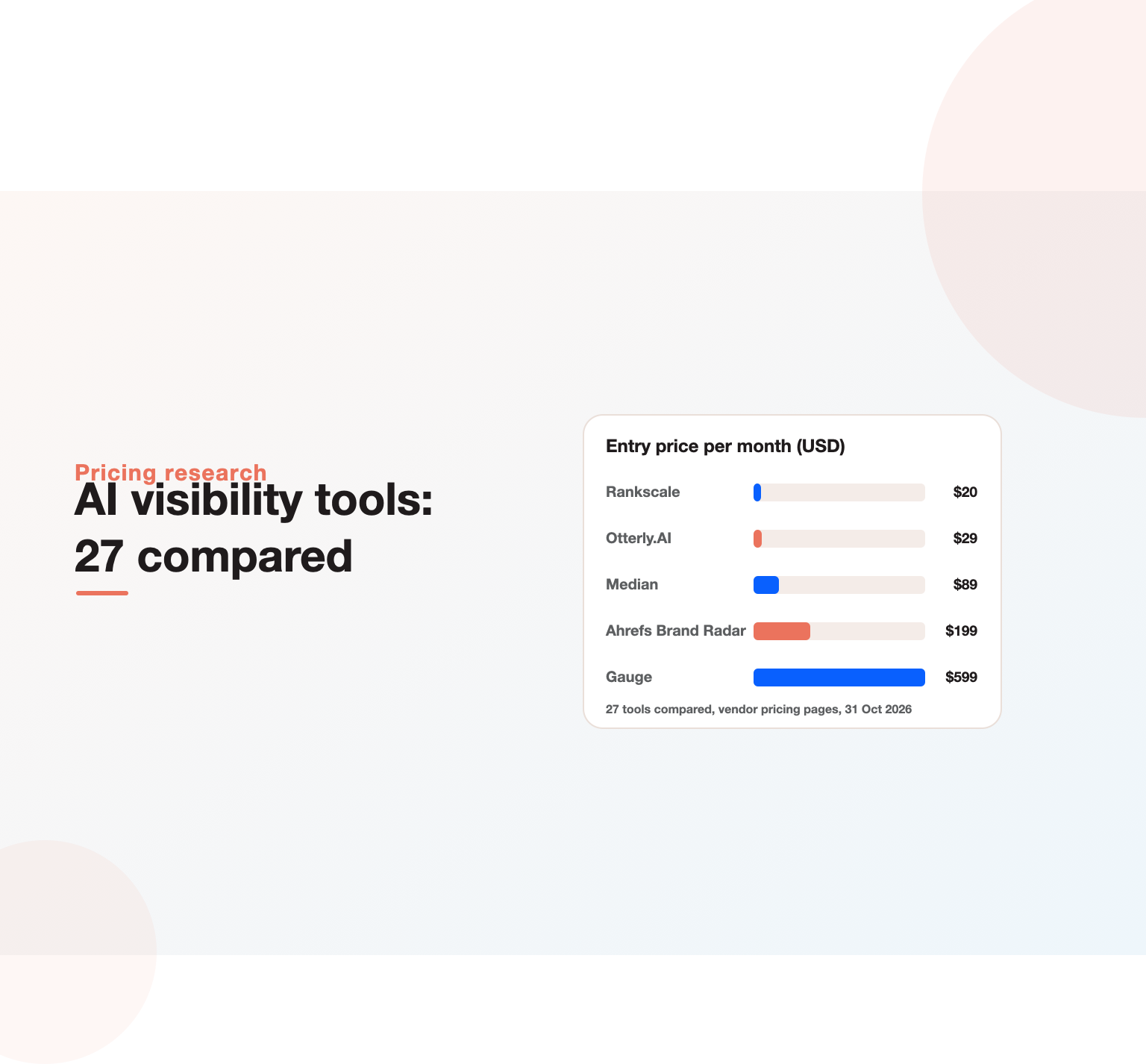
AI visibility tools compared: we read the pricing pages of 27 tools. Entry plans run from $20 to $599 a month (median $89). See which engines each covers and how to choose.
Quick Answer
AI visibility tools track whether, how often and how favourably AI assistants such as ChatGPT, Perplexity, Gemini, Claude and Google AI Overviews mention your brand when people ask questions in your category. They run a set of prompts on a schedule, record which brands and sources each answer cites, and report your share of voice against competitors. We compared the pricing pages of 27 tools on 31 October 2026: 21 publish a price, entry plans range from 20 to 599 US dollars a month, and the median entry plan costs 89 dollars a month. Six enterprise platforms, including Profound, Conductor and BrightEdge, publish no price at all.
Key Highlights
- We reviewed the published pricing of 27 AI visibility tools on their own websites on 31 October 2026.
- 21 of the 27 list a price; the cheapest entry plan is 20 dollars a month (Rankscale) and the most expensive is 599 dollars (Gauge), a 30-fold spread.
- The median entry plan costs 89 dollars a month, and 14 tools start below 100 dollars.
- 18 of the 27 offer a free trial or free tier; six enterprise platforms require a sales call.
- ChatGPT is covered by every tool; coverage of Claude, Copilot, Grok, DeepSeek and Meta AI varies widely.
- Prompt limits, not features, are what separates cheap plans from expensive ones.
What are AI visibility tools?
When a buyer asks ChatGPT “what is the best CRM for a small agency” or asks Perplexity for the top payroll providers in India, the answer names a handful of brands and cites a few sources. AI visibility tools measure that moment. They are the AI-search equivalent of a rank tracker: instead of tracking where a page ranks for a keyword, they track whether a brand is named, recommended or cited for a prompt.
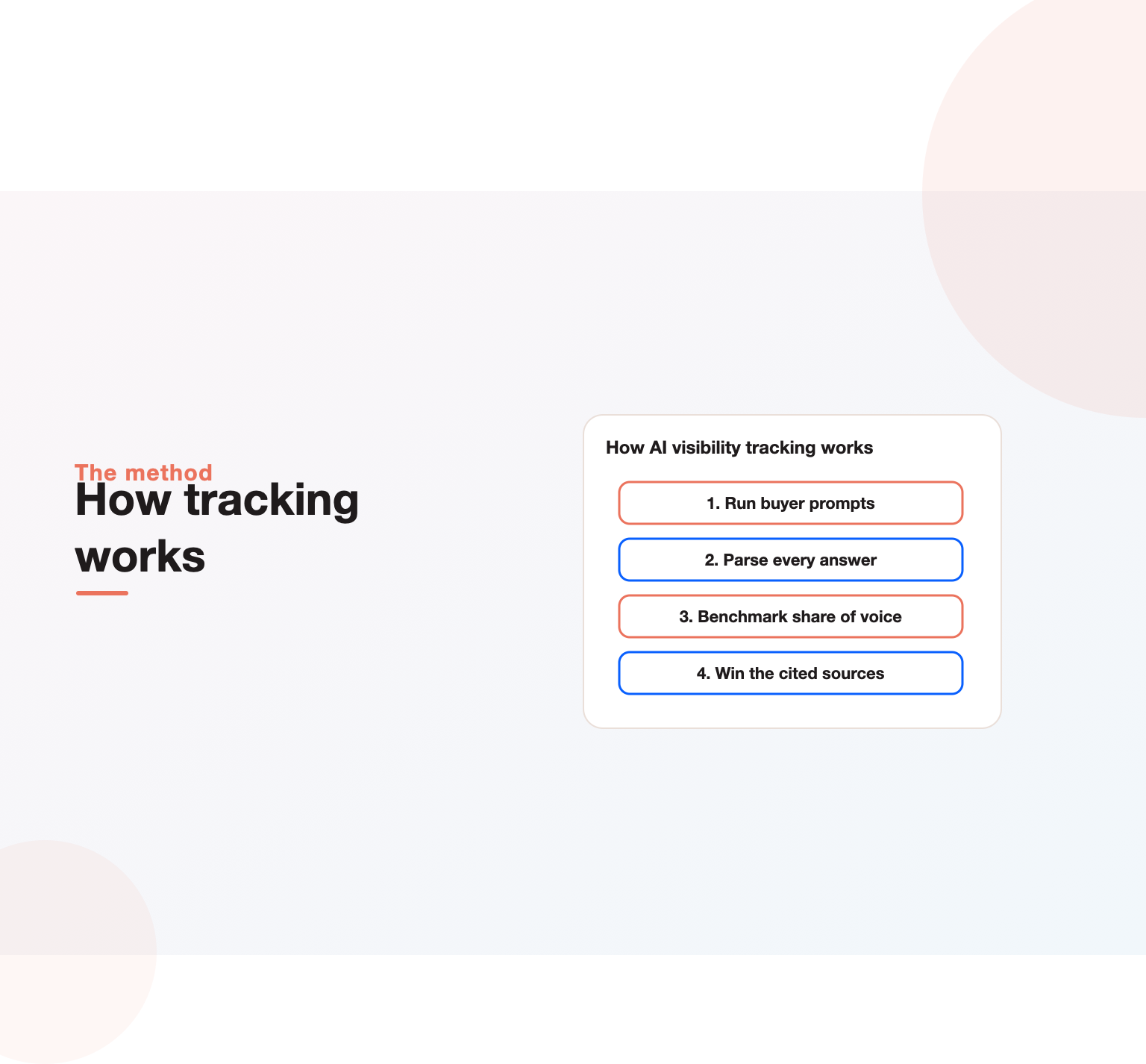
Most AI visibility tools do four things:
- Run prompts. You choose questions your buyers ask, and the tool sends them to several AI engines every day or week.
- Parse answers. The tool records which brands appear, in what order, with what sentiment, and which web pages are cited as sources.
- Benchmark competitors. It calculates share of voice, the percentage of answers that mention you versus rivals.
- Point to fixes. Better tools show which sources the engines trust, so you know which pages, publishers and listings to influence.
The category barely existed two years ago. Search interest shows how fast it grew: “ai visibility tools” now draws around 1,700 searches a month in the US, “best ai visibility tools” around 2,000, and “ai search visibility tracking tools” another 1,600, all with very low keyword difficulty because the market is so new.
Why AI visibility matters now
AI assistants have become a research step in buying decisions. Our own study of the most cited websites in AI answers found that a small set of publishers supplies most of the sources engines quote, and our AI marketing agency research showed that two engines asked the same question agreed on only 3.6 of 10 recommendations. Visibility in one engine says little about another, which is why measurement matters.
Google has also folded AI answers into the results page. Its guidance on AI features in Search confirms that AI Overviews and AI Mode draw on pages in its index, so traditional SEO still feeds AI visibility. What changes is the measurement: a page can rank fifth and still be the source an AI answer quotes, or rank first and be ignored.
How AI engines decide which brands to mention
Understanding the mechanism makes the data easier to read. When an assistant answers a buying question, two things shape the result. The first is what the model learned in training: brands that appear often and consistently across the web, in reviews, comparisons, documentation and news, are more likely to be named from memory. The second is retrieval: assistants with web search run live queries, read a handful of pages and summarise them, so the pages they retrieve heavily influence which brands appear.
That second step is where most teams can act. OpenAI explains in its ChatGPT search documentation that answers with search include links to the sources used. Perplexity shows numbered citations for every answer. Google’s AI Overviews link to supporting pages. Each of those links is a clue to why a brand was or was not included, and collecting them at scale is exactly what tracking software does.
Three patterns show up again and again in the data these products collect:
- Listicles and comparison pages carry outsized weight. “Best X” and “X vs Y” pages from established publishers are among the most cited sources for buying questions.
- Community content matters. Reddit threads, forums and Q&A sites are cited often, especially by Perplexity and Google.
- Freshness helps. Engines with search favour recently updated pages for fast-moving categories, so a comparison updated this quarter tends to beat one from two years ago.
When a tracker shows a competitor winning a prompt, open the cited sources for that prompt. Usually the answer is a page that names them and not you. That is a solvable problem: a correction request, a better product listing, a contribution to the comparison, or a stronger page of your own. Our guide to tracking your brand’s AI citations walks through the manual version of this process if you want to start before buying software.
AI visibility tools pricing: our comparison
Most “best tools” lists rank products on opinion. We wanted a factual baseline, so we read the pricing page of every AI visibility tool we could find with a public website and recorded the cheapest paid plan, whether a free trial exists, and which AI engines the page names.
| Tool | Entry price (USD/month) | Entry plan | Free trial or plan |
|---|---|---|---|
| Rankscale | 20 | Essentials | Yes |
| Otterly.AI | 29 | Lite | Yes |
| Promptmonitor | 39 | Starter | Yes |
| Geoptie | 49 | Starter | No |
| HubSpot AEO | 50 | AEO | Free grader |
| Knowatoa | 59 | Starter | Yes |
| AIclicks | 59 | Starter | Yes |
| Writesonic | 79 | Starter (annual) | No |
| LLMrefs | 79 | All in One | Yes |
| Nightwatch | about 85 (EUR 79) | Starter | Yes |
| SE Visible (SE Ranking) | 89 | Basic | Yes |
| Peec AI | 95 | Starter | Yes |
| Semrush AI Visibility Toolkit | 99 | Toolkit | No |
| Sight AI | 99 | Starter | Yes |
| Trakkr | 100 | Growth | Yes |
| Am I On AI | 100 | Starter | Yes |
| Ahrefs Brand Radar | 199 | Custom prompts | No |
| Scrunch | 250 | Core | Yes |
| AthenaHQ | 295 | Starter | Yes |
| Goodie | 295 | Core | Yes |
| Gauge | 599 | Growth | No |
| Profound | Custom | Enterprise | 7-day trial |
| Evertune | Custom | Enterprise | No |
| Conductor | Custom | Enterprise | No |
| BrightEdge | Custom | Enterprise | No |
| Bluefish | Custom | Enterprise | No |
| Meltwater | Custom | Enterprise | Yes |
Prices are the lowest monthly list price shown on each vendor’s site; several offer 15 to 20 percent off for annual billing. Writesonic’s entry price is shown billed annually, and Nightwatch prices in euros.
What the numbers show
- A 30-fold spread. The cheapest published entry plan costs 20 dollars a month, the most expensive 599. Both track brand mentions in AI answers.
- A low median. Half the tools with public prices start at 89 dollars a month or less. For a small team, the barrier to measuring AI visibility is now lower than a single rank tracker seat was a few years ago.
- Prompts are the real unit of price. Otterly sells 100 extra prompts for 99 dollars; Semrush sells 50 extra prompts for 60 dollars; Geoptie sells 100 more for 99 dollars; Gauge’s 599-dollar plan includes 600 prompts run daily. Compare cost per tracked prompt, not headline price.
- Enterprise platforms hide prices. Profound, Evertune, Conductor, BrightEdge, Bluefish and Meltwater all ask for a demo. Expect annual contracts in the thousands of dollars.
- Trials are common. 18 of 27 tools offer a free trial or free tier, so there is no reason to buy before testing with your own prompts.
Is your brand missing from ChatGPT, Gemini and Perplexity answers?
Our team reviews your current setup and shows you where the opportunities are. See how our AEO services work.
Engine coverage: which AI assistants each tool tracks
An AI visibility tool is only as useful as the engines it queries. Every tool in our comparison covers ChatGPT. Most also cover Perplexity and Gemini, and the majority track Google AI Overviews or AI Mode. Coverage drops off for Claude, Microsoft Copilot, Grok, DeepSeek and Meta AI. Tools such as AthenaHQ and LLMrefs name ten engines on their pricing pages; Semrush’s toolkit page names three, and HubSpot’s AEO product names three.
Two practical points matter more than the headline count:
- Some plans limit how many engines you can choose. AIclicks, for example, lets its Starter plan pick three models and its Pro plan four. Geoptie’s plans let you choose four of seven engines.
- Collection method differs. Some tools query engines through APIs, others capture what a logged-out user sees in the interface. Interface capture is closer to what buyers see, especially for ChatGPT with web search, so ask vendors which method they use.
If Google is your main channel, check AI Overview and AI Mode coverage first; our guide to the best AI Overview tracking tools covers that slice in depth.
The best AI visibility tools by need
There is no single winner; the right choice depends on budget, team and how many prompts you need. Based on published pricing and stated features, here is how the market sorts.
Lowest cost to start: Rankscale, Otterly.AI, Promptmonitor
All three start under 40 dollars a month and offer trials. They suit founders and small marketing teams who want a baseline before committing budget. Expect lower prompt limits and less frequent checks on entry plans.
Best fit for existing SEO suites: Semrush, Ahrefs Brand Radar, SE Visible, Nightwatch
If you already pay for an SEO platform, its AI visibility module keeps data in one place. Semrush’s AI Visibility Toolkit costs 99 dollars a month per domain. Ahrefs’ Brand Radar combines a large pre-built prompt index with custom prompt tracking from 199 dollars a month. SE Ranking sells SE Visible from 89 dollars, and Nightwatch adds AI tracking to its rank tracker.
Best dedicated mid-market trackers: Peec AI, Trakkr, Knowatoa, LLMrefs, AIclicks
These tools were built for AI search from day one. Peec AI starts at 95 dollars with plans up to 495; Trakkr’s Growth plan runs 50 prompts across eight models daily for 100 dollars. They balance price, engine coverage and competitor benchmarking well for a growing team.
Best for content action: Sight AI, Writesonic, Goodie, AthenaHQ
Some tools pair tracking with content creation or optimisation agents. They suit teams that want the tool to suggest or draft fixes, not just report numbers. Check whether the content features are useful to you before paying the higher price.
Best for large brands: Profound, Evertune, Conductor, BrightEdge, Scrunch, Gauge
Enterprise platforms offer broader engine coverage, more prompts, SSO, dedicated support and integrations. Profound offers a free seven-day trial on ChatGPT, Gemini and Google AI Overviews before a sales conversation. Gauge publishes its price: 599 dollars a month for 600 daily prompts.
Free options: HubSpot AEO Grader and trials
For a one-off snapshot, HubSpot’s free AEO Grader shows how AI describes your brand, with ongoing monitoring at 50 dollars a month. Our own AI visibility calculator scores your readiness and gives you a 30-day plan for free.
Tool profiles: what each plan includes
Below are short notes on the tools in our comparison, based on what each vendor states on its pricing page. Treat them as a starting shortlist, then test with your own prompts.
Rankscale
The cheapest paid entry point we found, at 20 dollars a month. Plans are credit based, with a Pro tier at 99 dollars that includes 1,200 monthly credits and a higher tier with REST API access. It suits solo marketers who want to test the idea cheaply.
Otterly.AI
Lite starts at 29 dollars a month for solo marketers, Standard costs 189 dollars and Premium 489 dollars for mid-sized companies and agencies. Extra prompts are sold in blocks of 100 for 99 dollars. It is one of the most widely mentioned trackers among small teams.
Promptmonitor
Starter costs 39 dollars a month with 25 prompts tracked twice a week; Growth costs 79 dollars and Pro 149 dollars with daily tracking and unlimited seats. Its pricing page also compares itself directly against several rivals, which is useful context when shortlisting.
Geoptie
Starter costs 49 dollars for 15 monitoring prompts and two brands, Professional 99 dollars for 100 prompts and Agency 249 dollars for 300 prompts. Each plan picks four of seven engines.
Knowatoa, AIclicks and LLMrefs
All three sit between 59 and 79 dollars at entry. Knowatoa’s Growth tier costs 199 dollars; AIclicks scales from 59 to 499 dollars and limits model choice on lower tiers; LLMrefs offers an all-in-one plan with a seven-day trial and names the widest engine list in our sample.
SE Visible, Semrush and Ahrefs
The big SEO suites now sell AI tracking as add-ons. SE Visible runs from 89 to 399 dollars a month on monthly billing. Semrush charges 99 dollars per domain per month and sells extra prompts at 60 dollars per 50. Ahrefs offers a pre-built AI index from an add-on price and custom prompt tracking from 199 dollars, with an all-models bundle at 699 dollars.
Peec AI and Trakkr
Peec’s plans run 95, 245 and 495 dollars a month, with an enterprise tier above. Trakkr charges 100 dollars for one brand with 50 prompts across eight models daily, and 500 dollars for its agency plan. Both are pure-play trackers designed around share of voice and competitor views.
Scrunch, AthenaHQ and Goodie
These start between 250 and 295 dollars and aim at teams that want monitoring plus optimisation workflows. Goodie’s Pro plan costs 999 dollars a month. AthenaHQ uses a credit model with a free tier that includes a small credit allowance.
Gauge
The most expensive published entry plan at 599 dollars, but also one of the most transparent: 600 prompts run daily across the major engines. Divide the price by prompts and it is competitive with cheaper tools at scale.
Profound, Evertune, Conductor, BrightEdge, Bluefish and Meltwater
None publish prices. Profound offers a free seven-day trial on three engines before an enterprise plan; the others route buyers to sales. These platforms bundle AI tracking with wider SEO, content or media intelligence suites and suit large organisations with procurement processes.
Questions to ask vendors before you buy
- How do you collect answers: through model APIs, or by capturing what a real user sees in the interface?
- Do you run prompts with web search turned on, and from which countries?
- How many times is each prompt run per check, and how do you handle answer variability?
- Do you store the full answer text and the cited links, and can we export them?
- How are brand mentions matched: exact name, aliases, products, misspellings?
- Can we track sentiment and factual accuracy, not only presence?
- What happens to our data and prompts, and can we delete them?
- What will we pay at double the prompt volume in a year’s time?
Building the business case
Leadership will ask what a tracker is worth. Three arguments work. First, risk: if AI assistants describe your product wrongly or recommend competitors for your core use case, you want to know before sales does. Second, efficiency: content and PR teams can prioritise the sources engines actually cite instead of guessing. Third, attribution: once AI referrers are tagged in analytics, you can show visits and leads that start in an assistant. A plan under 100 dollars a month only needs to influence one deal a year to pay back many times over.
Keep the first report simple: share of voice for 30 prompts against four competitors, the ten most cited sources, and three actions for next month. That is enough to secure budget for a second quarter.
How to choose AI visibility tools
Use these questions to narrow the list to two or three, then trial them side by side.
- Which engines matter to your buyers? B2B software buyers lean on ChatGPT and Perplexity; consumer and local searches lean on Google AI Overviews. Pay for coverage of the engines your buyers use.
- How many prompts do you need? Start with 25 to 50 prompts that map to real buying questions. Multiply by brands and markets. That number sets your plan.
- How often should prompts run? AI answers vary from run to run. Daily runs smooth out noise; weekly runs are cheaper but noisier.
- Does it show sources? Citation data, the pages engines quote, is what you can act on. A tool that only reports mentions tells you the score but not how to change it.
- Can it segment by country and language? Answers differ by market. If you sell in India and the US, check both.
- Can you export the data? CSV exports or an API let you combine AI visibility with analytics and CRM data.
- What does an extra prompt cost? Growth gets expensive fast if add-on prompts are priced high.
AI visibility tracking tools vs traditional rank trackers
| Question | Rank tracker | AI visibility tracking tools |
|---|---|---|
| Unit tracked | Keyword | Prompt (a natural-language question) |
| Result | Position 1 to 100 | Mentioned or not, rank in answer, sentiment |
| Stability | Fairly stable day to day | Varies run to run; needs repeated sampling |
| Competitor view | Who ranks above you | Share of voice across answers |
| Actionable data | Ranking pages | Cited sources and how you are described |
You need both. Rankings still drive most traffic, and our rank tracking tools guide covers that side. AI search visibility tools add the layer that rank trackers cannot see.
Want AI answer engines to cite your brand?
Book a free 30-minute strategy call and leave with a clear next step for your business.
How to set up AI search visibility tools in a week
- Day 1: write prompts. List 30 questions buyers ask before buying: “best X for Y”, “X vs Y”, “is X worth it”, “alternatives to X”. Our list of prompts B2B buyers use to shortlist vendors is a good starting point.
- Day 2: add competitors. Pick four to six rivals, including the category leader.
- Day 3: start two trials. Load the same prompts into two tools so you can compare results.
- Day 4 to 6: let prompts run. Collect at least three runs per prompt before reading too much into the numbers.
- Day 7: read sources, not just scores. List the ten domains cited most often for your prompts. Those are the publishers, review sites and communities to win.
Metrics that matter in AI visibility
- Mention rate: the share of answers that name your brand.
- Share of voice: your mentions divided by all brand mentions across tracked prompts.
- Position in answer: first-named brands get more attention than fifth-named ones.
- Sentiment and accuracy: whether the description is positive and correct.
- Citation share: how often your own pages are cited as a source.
- Referral traffic and leads: visits from chatgpt.com, perplexity.ai and similar referrers in analytics.
Our guide to AEO metrics that prove it works shows how to report these to leadership.
How to improve what the tools measure
Measurement only pays if it leads to change. The tools tell you where you are missing; these moves fix it:
- Win the cited sources. If engines quote a review site, listicle or community thread for your category, get included there. Our guide on how to get cited by AI covers the playbook.
- Publish answer-first pages. Clear definitions, comparisons and data that an engine can lift in one sentence.
- Publish original data. Engines and journalists both quote numbers they cannot find elsewhere.
- Fix entity consistency. Use the same company description, categories and facts across your site, LinkedIn, review profiles and directories.
- Optimise for each engine. Perplexity, ChatGPT and Google weigh sources differently; see our notes on Perplexity optimization and winning citations in Google AI Mode.
If you would rather have a team run this end to end, our answer engine optimization services combine tracking, content and source outreach.
AI visibility tools vs GEO tools vs AEO tools
The labels overlap. “AI visibility” describes the outcome being measured; “GEO tools” (generative engine optimization) and “AEO tools” (answer engine optimization) describe the discipline. In practice most products in this market do both: measure visibility and suggest optimisation. Our best GEO tools review ranks products on their optimisation features, while this guide focuses on measurement cost and coverage. For a short list across both, see our AEO and GEO tools ranking.
Common mistakes with AI visibility tracking
- Tracking vanity prompts. “What is [your brand]” will always mention you. Track the category questions buyers ask before they know you.
- Reading one run. Answers change between runs. Judge trends over weeks.
- Ignoring sources. The score is the symptom; cited sources are the cause.
- Buying the biggest plan first. Start with a trial and 30 prompts. Scale once you know which prompts matter.
- Tracking only ChatGPT. Engines disagree. Cover at least two.
- Not tying it to revenue. Add AI referrers to your analytics and CRM source fields so you can see leads, not only mentions.
AI visibility tools for agencies
Agencies need multi-brand workspaces, white-label reports and lower cost per client. Several vendors sell agency plans: Otterly’s Premium plan is aimed at agencies, SE Visible’s top tier targets multi-client management, Trakkr’s Scale plan is built for agencies and multi-brand teams at 500 dollars a month, and Scrunch and Geoptie offer agency or multi-brand options. Calculate cost per client per month before choosing.
AI visibility tools in India
India is the second-largest market for searches about these tools after the US. Most vendors price in US dollars and few segment results by Indian cities, so check whether a tool can run prompts with an Indian location and in Hindi or other Indian languages if your buyers search that way. For many Indian B2B brands, one affordable tracker plus a disciplined source-building plan beats an expensive enterprise contract.
Methodology
On 31 October 2026 we visited the public pricing page (or home page, where no pricing page exists) of 30 AI visibility and AI search monitoring products. Three were excluded because the page could not be read or showed no plan information, leaving 27. For each tool we recorded the lowest monthly list price for a paid plan, the name of that plan, whether a free trial or free tier was offered, and which AI engines were named on the page. Where a vendor quoted only an annual monthly equivalent, we noted it. Euro prices were converted at the approximate rate on the day. Engine counts reflect what each vendor names on its page and may understate coverage. Prices change often; check vendor sites before buying. The dataset is available on request.
Key Takeaways
- AI visibility tools measure how often AI assistants mention and cite your brand for the prompts your buyers ask.
- In our comparison of 27 tools, entry prices ranged from 20 to 599 dollars a month, with a median of 89 dollars.
- Six enterprise platforms publish no price; 18 of 27 tools offer a free trial or tier.
- Compare cost per tracked prompt and engine coverage, not headline price.
- Scores matter less than cited sources: use the data to decide which publishers and pages to win.
Want to know where you stand before buying anything? Try our free AI visibility scorecard or talk to our AEO team.
Frequently asked questions
What are AI visibility tools?
They are software that sends your buyers’ questions to AI assistants such as ChatGPT, Perplexity, Gemini and Google AI Overviews, then reports how often your brand is mentioned, how it is described and which sources are cited, compared with competitors.
How much do AI visibility tools cost?
In our comparison of 27 tools, published entry plans ranged from 20 dollars a month (Rankscale) to 599 dollars a month (Gauge), with a median of 89 dollars. Enterprise platforms such as Profound, Conductor and BrightEdge quote custom prices.
What are the best AI visibility tools?
It depends on budget and team. Rankscale, Otterly.AI and Promptmonitor are the cheapest to start; Semrush, Ahrefs Brand Radar and SE Visible suit teams already using those SEO suites; Peec AI and Trakkr are strong dedicated trackers; Profound and Conductor serve large enterprises.
Are there free AI visibility tools?
HubSpot offers a free AEO Grader, and 18 of the 27 tools we reviewed offer a free trial or free tier. Free options are good for a snapshot; ongoing tracking usually needs a paid plan.
Which AI engines should I track?
At minimum ChatGPT and Google AI Overviews, plus Perplexity and Gemini if your buyers use them. Engines often disagree, so tracking only one gives a misleading picture.
How many prompts should I track?
Start with 25 to 50 prompts that reflect real buying questions in your category, then expand by market and product line once you know which prompts matter.
Ready to put this into practice?
Talk to the team that runs SEO, AI search and paid growth programs every day.
Book a Strategy Call →