 Skip to content

SEO for Business: A Practical Guide to Growth
SEO for business explained: how search grows a company, the three pillars, choosing winnable keywords, measuring ROI, in-house vs agency, and how long it takes.
Quick Answer
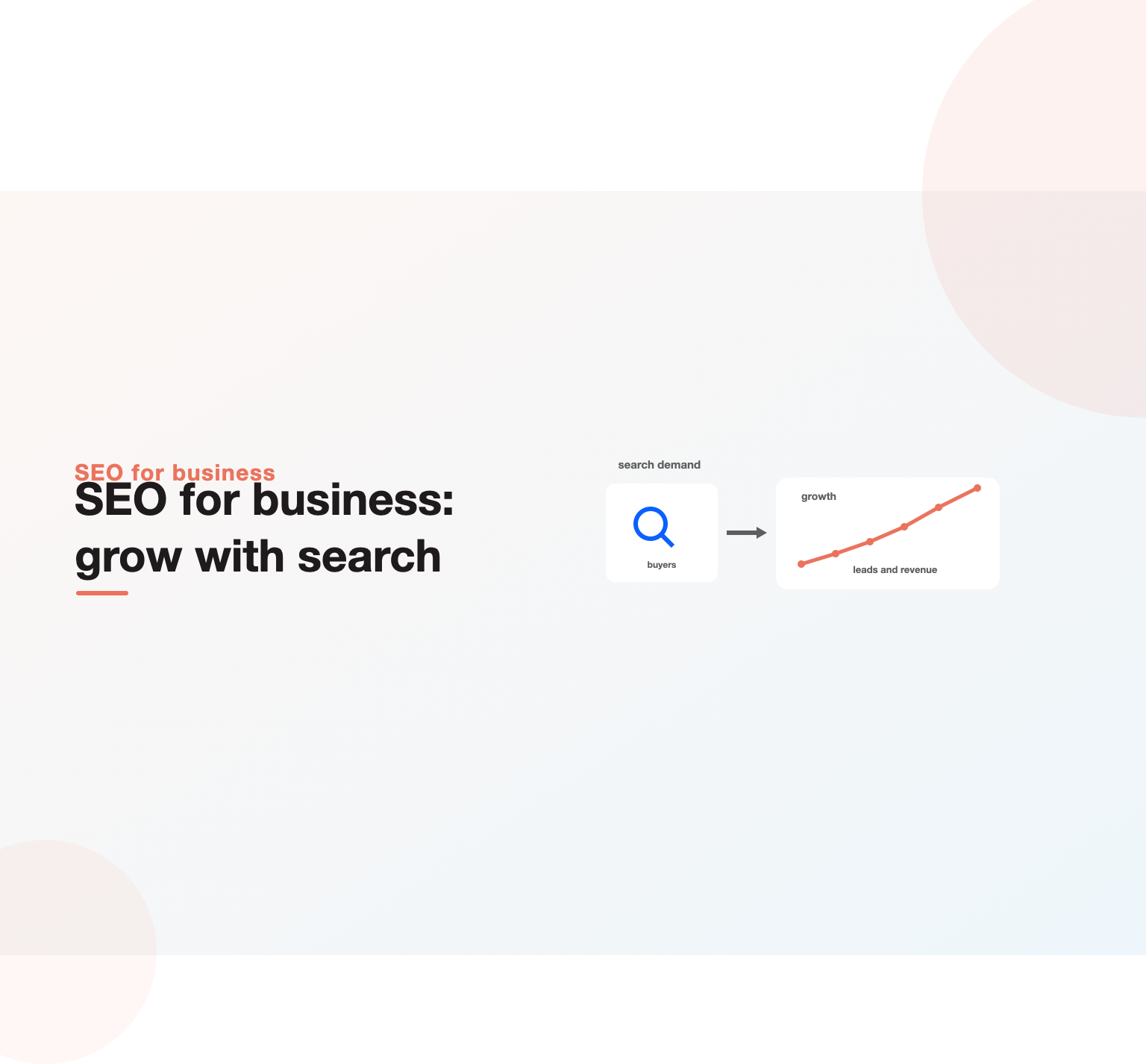
SEO for business is the practice of using search optimization to grow a company, turning the searches your customers already run into a steady flow of visitors, leads and sales. It works by making your website easy for search engines to understand and trust, building pages around the terms buyers use, and earning the authority that lifts you above competitors. Unlike advertising, which stops the moment you stop paying, SEO for business builds a compounding asset that keeps working. The businesses that win treat it as a long-term investment tied to revenue, not a one-off task, and they measure success in customers rather than rankings.
Key Highlights
- SEO for business is a growth channel, not a technical chore: it turns existing search demand into leads and revenue.
- Three pillars carry it, on-page relevance, off-page authority, and technical health, and a strong program balances all three.
- It compounds, so a page that ranks keeps earning traffic for free, unlike advertising that stops when the budget does.
- Success is measured in customers and revenue, not vanity rankings on terms that never convert.
- It rewards patience and focus, since authority builds over months and a few winnable terms beat many unwinnable ones.
What SEO for business really means
Behind the acronym sits a simple commercial idea. Your customers are already searching, for what you sell, for answers to their problems, for a provider they can trust, and every one of those searches is a chance to be found. SEO for business is the deliberate work of capturing those chances: understanding what your buyers type, building pages that genuinely serve those searches, and convincing search engines that your company is the credible answer. It is marketing that meets demand where it already exists, rather than interrupting people who were not looking.
What separates it from other channels is the shape of the return. A paid ad delivers a click and then vanishes when the invoice ends, but a page that earns its ranking keeps delivering clicks month after month at no additional cost. That compounding quality is why search is often the highest-return channel a business can build, and why the companies that invest early tend to widen their lead over time. Understood properly, SEO for business is not a line item to trim but an asset to accumulate, one that grows more valuable the longer it is tended.
It also increasingly spans more than the classic results page. As buyers research through maps, comparison tools and AI assistants, the same clean, authoritative pages that rank also feed those surfaces, so a well-run program earns visibility wherever customers look. Framing search as one connected effort, rather than a narrow tactic, is what turns it into a genuine engine of growth.
The three pillars that make it work
Effective search work rests on three foundations, and a program that neglects any one of them underperforms. Understanding the pillars helps a business judge where its effort, or a provider’s, is actually going.
On-page relevance. This is the work of making each page clearly about what buyers search for: the right terms in the right places, content that fully answers the query, a logical structure, and a helpful experience. On-page work is where you signal, to both readers and search engines, that your page deserves to rank for a given search. It is the most controllable pillar and often the first place a smart program invests.
Off-page authority. Search engines treat links, mentions and reviews from credible sources as votes of confidence, so the reputation your business earns across the wider web strongly influences how high it ranks. Building that authority is patient, relationship-driven work, and it is frequently what separates two otherwise similar companies on the results page. A business that only ever touches its own site, and never earns outside trust, tends to stall.
Technical health. None of the above matters if search engines cannot reach and read your site. A fast, secure, crawlable, mobile-friendly foundation lets everything else count, while a slow or broken site quietly caps your results no matter how good the content. Technical work is unglamorous, but a capable SEO services partner treats it as the base everything else stands on.
Choosing the right keywords
Strategy begins with the searches you choose to pursue, because chasing the wrong terms wastes even excellent work. The instinct is to target the biggest, most obvious phrases, but those are usually the most contested, and a business that fights for a term it cannot win spends months stranded on the second or third page where almost no one clicks. The smarter move is to find the sweet spot: searches with genuine buyer intent and real volume, but a level of competition you can realistically beat from where you stand today.
That balance shifts with your authority. A newer or smaller company wins by concentrating on specific, high-intent and often longer searches that larger rivals overlook, then expanding as its authority grows. An established brand can pursue broader terms. Either way, the discipline is the same: pick searches that convert and that you can win, map one clear intent to each page, and avoid having your own pages compete with one another. This keyword-first thinking is the difference between SEO for business that produces customers and effort that produces only activity, a discipline our small business SEO guide explores for leaner operators.
Content: the engine of growth
Once the targets are chosen, content is what actually earns the rankings and the trust. Every important product, service and question deserves a page that genuinely serves the searcher, answering completely, reflecting real expertise, and making the next step easy. Beyond those core pages, helpful articles that address the questions buyers ask on the way to a decision attract them earlier in the journey and build the topical authority that lifts the whole site. This is the compounding heart of SEO for business: a growing library of genuinely useful pages that keeps pulling in qualified visitors long after it is published.
Quality decides the outcome. A single thorough, genuinely helpful page that ranks and earns links is worth more than a dozen shallow ones that sit unseen, and modern search actively discounts thin, mass-produced content. If writing is not a strength in-house, a focused SEO consulting partner can turn a company’s expertise into pages that rank, but the substance must be real, because both readers and search engines reward depth and quietly ignore filler. Over time, that content becomes a durable competitive moat that rivals cannot quickly copy.
Measuring the return on search
Because it is an investment, search should be judged like one, on the customers and revenue it produces rather than on rankings alone. A position on a chart is only useful if it leads to a call, a form fill or a sale, so the businesses that get the most from SEO for business track those outcomes and tie them back to the pages and searches that drove them. That turns the work into a clear feedback loop: invest more in what generates customers, and stop paying for effort that never converts. It also protects a company from a provider who reports impressive-looking positions on terms that have nothing to do with revenue.
Sensible measurement need not be complex. A solid analytics setup, goal tracking for leads and sales, and a monthly review against the work done cover most of what a business needs to see whether the investment is compounding. The one non-negotiable is that reporting connects to money, because search that cannot be tied to customers is impossible to justify and easy to waste. A partner comfortable being measured this way, on outcomes rather than vanity metrics, is one worth keeping.
In-house, agency, or a blend
Every business faces the question of who does the work, and the right answer depends on resources and stage. Building the capability in-house gives the most control and can suit a company with the time and appetite to learn a fast-moving field, though the learning curve is real and search rewards consistency that a busy team can struggle to maintain. Hiring an agency buys expertise and focus, letting specialists avoid the mistakes that waste months while the business does what it does best, at the cost of a fee and the need to choose a partner well.
Many companies settle on a blend, keeping some work close, publishing, simple updates, review management, while a partner handles technical work, strategy and the heavier content and authority building. Whatever the split, the decision should rest on total value: the results produced against the total cost in money and time, not the smallest invoice. A short conversation with a prospective partner should clarify what genuinely needs a specialist and what a business can sensibly own, and the evaluation approach in our guide on how to choose an SEO agency applies directly.
How long it takes and why patience pays
One expectation trips up more businesses than any other: the belief that search should work overnight. It does not, because authority and trust build gradually, and search engines take time to recognize that a page and a company deserve to rank. Most programs show early movement on lower-competition terms within a few months, with broader, more valuable gains following as authority accumulates. A provider promising page one in weeks is either misinformed or willing to mislead, and treating the timeline honestly is part of investing wisely.
The patience pays precisely because the returns compound. Unlike advertising, where cost per customer stays flat or rises, SEO for business tends to get cheaper per customer over time as ranked pages keep earning free visits and authority makes new rankings easier to win. A company that starts now and stays consistent is building an asset that competitors who wait will struggle to catch, which is why the best time to begin is usually earlier than it feels comfortable to.
Common mistakes businesses make
A handful of errors reliably undermine otherwise good intentions. Chasing head terms that are impossible to win burns budget on rankings that never arrive, while ignoring winnable, high-intent searches leaves easy customers on the table. Publishing thin, mass-produced content in the hope of volume backfires as search discounts it, and neglecting the technical foundation caps everything else. Measuring success by rankings instead of revenue lets a program drift toward vanity, and expecting instant results leads businesses to abandon the work just before it would have paid off. Perhaps the most costly mistake is treating search as a one-time project rather than an ongoing investment, since the compounding only happens for those who keep tending it. Avoiding these traps, more than any clever tactic, is what makes SEO for business reliably pay.
Search, AI answers, and what comes next
The surfaces where customers find businesses are multiplying, and a company that understands the shift early gains an advantage. Buyers now turn to AI assistants and answer tools that summarize options and cite sources, and those systems draw on the same authoritative, well-structured content that ranks in traditional search. So the foundational work a business does to rank also positions it to be recommended by an answer engine or surfaced in generative engine results, without a separate budget. A company with accurate information, genuinely helpful pages and real authority is already prepared for this, while one relying on thin content and tricks is exposed. Investing in a clean, authoritative presence is therefore a bet on where discovery is heading, and it strengthens visibility across every surface, including the emerging AI search layer, at once.
How search compares to your other channels
To value search properly, it helps to set it beside the alternatives a business already uses. Paid advertising delivers instant, controllable traffic, which makes it ideal for launches, promotions and testing, but its cost per customer stays flat or climbs as competition rises, and the traffic ends the moment spending stops. Social media builds relationships and awareness yet rarely captures buyers at the moment of high intent the way a search result does. Email nurtures an audience you already have. Each channel has a role, but none shares the defining trait of SEO for business: a page that ranks becomes an owned asset, working around the clock without a per-click charge and growing more valuable as authority accumulates.
The practical implication is that these channels work best together rather than in competition. Ads can capture urgent demand and fund early growth while organic visibility builds underneath, social can amplify the content that also earns rankings, and email can convert the visitors search brings in. A business that treats SEO for business as the compounding foundation, with the faster channels layered on top, gets the best of both worlds, immediate reach now and a lower cost of acquisition later. Seen this way, search is not one option among many but the durable base the rest of the marketing mix is built on.
Local, national and ecommerce businesses differ
The right emphasis in a search program depends on the kind of business, so a sensible plan starts by matching effort to model. A local business that serves customers in a place wins first through its map presence, consistent listings and reviews, because most of its buyers search with local intent and want a provider nearby. The highest-leverage work sits in the local layer, supported by a strong local SEO foundation, before broader content matters. For this kind of company, SEO for business is largely about owning its immediate area.
A national business competing across a wider market leans harder on content and authority, since it must win contested terms against well-resourced rivals and cannot rely on proximity. An online store adds another dimension, where product and category pages become the money pages and technical scale matters, which is why a dedicated ecommerce SEO approach earns its keep. Recognizing which model you fit prevents a common waste, pouring effort into work that suits a different type of company, and it keeps SEO for business pointed at the growth that actually applies to you.
Getting started: a first plan that works
A company new to search does best with a focused, staged start rather than an ambitious program bought on faith. Begin by fixing anything on the technical foundation that holds the site back, then identify the handful of searches closest to revenue and build or sharpen a strong page for each. Add a simple habit of publishing genuinely helpful content and, where it applies, earning the reviews and citations that build trust. Set up basic tracking from day one so results are visible. This measured beginning keeps risk low, proves the return, and earns the confidence to scale, which is exactly how SEO for business should grow, from evidence rather than optimism.
Expectations matter as much as actions at this stage. Search compounds over months, so a first plan should fund enough runway for the work to show rather than judging it after a single month. A partner who scopes a realistic timeline, ties the plan to leads rather than rankings, and starts with the highest-intent work is setting a business up to judge the investment fairly. If the early signals are good, scaling is straightforward; if they are not, a focused start means little was risked while much was learned, and the questions in our guide on how to work with an SEO consultant help pressure-test any proposal.
Tools, tracking and staying honest
You cannot improve what you do not measure, and fortunately the essential tooling for SEO for business is modest. A solid web analytics setup shows where visitors come from and what they do; goal tracking records the leads, calls and sales that actually matter; and simple rank and visibility tracking indicates whether the work is moving the terms you care about. For a local business, call tracking and the insights inside the business profile add the missing piece. None of this requires an expensive enterprise stack to begin, and the discipline of tying activity to outcomes is worth more than any single tool.
The point of the tooling is accountability, not vanity. Numbers that look impressive but connect to nothing, a ranking on a term no one buys from, an increase in traffic that never converts, are distractions that a disciplined business ignores. What matters is the line from search effort to customers, and reporting that draws that line clearly. When a program is measured honestly this way, SEO for business stops being a leap of faith and becomes a manageable investment whose return you can see and defend, which is precisely the footing every marketing decision should stand on.
Building authority the right way
Of the three pillars, authority is where businesses most often fall short, yet it frequently decides the outcome between similar competitors. Genuine authority comes from being worth referencing: publishing content that others cite, earning mentions from credible publications and local organizations, gathering real reviews, and building a legitimate presence in your industry and community. It cannot be rushed honestly, and the shortcuts that promise to, bought links and manipulative schemes, invite penalties that can erase visibility overnight. Patient, earned authority is the version that lasts, and it compounds, since each credible mention makes the next ranking easier to win.
This work also pays off beyond classic rankings. The same trusted mentions and reviews that lift your search position increasingly influence whether AI assistants and answer tools recommend your business, so authority built the right way strengthens visibility across the newer surfaces too. A company that invests in being genuinely reputable is therefore future-proofing its discovery, not just its rankings, and that durable trust is the deepest moat SEO for business can build around a growing company.
Where AI search fits a growing company
A shift is under way in how people discover companies, and understanding it early is an advantage rather than a distraction. Increasingly, buyers pose their question to an assistant and act on the short, cited answer it returns, never scrolling a traditional results page. Those assistants assemble their recommendations from sources they judge accurate, well organized and trustworthy, which is exactly the material a disciplined program already creates. So the effort a company puts into clear pages, correct information and genuine authority quietly earns it a place in this new channel as well. Getting ready for AI search and answer engines is, for most businesses, less a new project than a reason to do the fundamentals with unusual care, and the same clean foundations feed the generative engine results reshaping product research.
The reassuring implication is that a company does not need to chase every trend to stay found. A business with accurate listings, genuinely helpful content and real reputation is already positioned to be surfaced whether a customer searches the old way or asks an assistant, while a rival relying on thin content and shortcuts is exposed as the surfaces multiply. Investing in a clean, credible presence is therefore a durable bet, and it mirrors the disciplined approach our small business and SEO cost guides describe.
Frequently asked questions, continued
How much should a business budget for SEO?
It varies with competition, goals and the state of the site, so there is no universal figure, only a fair one for your situation. The sensible approach is to start from return, working out what a customer is worth and how many extra leads would justify the fee, then scope a transparent program to match. Judge the spend by the customers it produces rather than by the lowest quote.
Does SEO work for both products and services?
Yes, though the emphasis differs. A service business focuses on service and location pages plus content that answers client questions, while a product business leans on category and product pages and technical scale. In both cases the fundamentals hold: serve real searches, earn authority, keep the site healthy, and measure the customers the work produces.
Can I pause SEO once I rank well?
You can ease effort, but stopping entirely is risky, because competitors keep improving and search results keep shifting, so rankings erode without maintenance. A lighter ongoing rhythm, refreshing key pages, earning new links and publishing occasionally, protects and extends the position you worked to earn, which is why the strongest results come from consistency rather than a single push, and why the compounding logic behind a strong SEO program rewards the businesses that keep tending it long after the first rankings arrive.
Key Takeaways
- SEO for business is a compounding growth channel that turns existing search demand into leads and revenue.
- Balance the three pillars, on-page relevance, off-page authority and technical health, rather than over-investing in one.
- Choose winnable, high-intent keywords over contested head terms, and map one clear intent to each page.
- Measure success in customers and revenue, and insist on reporting that ties the work to money.
- Be patient and consistent, since authority compounds and the businesses that start early widen their lead.
Frequently asked questions
Direct answers to the questions companies ask most about using search to grow.
Is SEO worth it for my business?
For almost any business whose customers search online, yes, because it captures demand that already exists and compounds over time. The return depends on choosing winnable, high-intent searches and committing for long enough to let authority build. Judged against the lasting asset it creates, SEO for business is usually one of the highest-return marketing investments available.
How is SEO different from paid advertising?
Paid ads charge for every click and stop delivering the moment you pause them, while SEO builds a durable asset that keeps earning free visits once pages rank. Ads are excellent for instant, controllable traffic and testing; search is the compounding channel underneath. Most businesses use both, with ads capturing urgent demand while organic visibility grows.
How long before SEO helps my business?
Typically a few months for early movement, with larger gains following as authority accumulates. Lower-competition, high-intent terms tend to move first. Because the returns compound while the core investment holds steady, the payback improves over time, which is why patience and consistency matter more than a fast start.
What are the three pillars of SEO?
On-page relevance, making each page clearly serve a search; off-page authority, earning trust through links, mentions and reviews; and technical health, ensuring search engines can reach and read your site quickly. A strong program balances all three, since neglecting any one caps the results of the others.
Should I hire an agency or do SEO in-house?
It depends on your time, expertise and budget. In-house offers control but demands a real learning curve and consistency; an agency buys expertise and focus for a fee. Many businesses blend the two, keeping simple work in-house while a partner handles technical, strategic and heavier content work. Judge the choice on total value, not the smallest invoice.
How do I measure whether SEO is working?
Track leads, calls and sales from organic search, tie them to the pages and terms that produced them, and review monthly against the work done. Rankings alone are not enough; the real test is customers and revenue. A provider who reports on outcomes rather than vanity positions is demonstrating exactly the accountability worth paying for.
Can a small business compete with larger companies in search?
Yes, by concentrating on specific, high-intent searches that larger rivals overlook rather than fighting for the broadest terms. A focused business that owns its niche, earns genuine authority and publishes genuinely helpful content can out-rank bigger competitors where it matters, then expand as its authority grows.
What is the biggest SEO mistake businesses make?
Treating it as a one-time project instead of an ongoing investment, and measuring rankings instead of revenue. The compounding return only accrues to businesses that keep tending the work and judge it by customers. Chasing unwinnable head terms and publishing thin content are close behind, since both waste effort that focus would have rewarded.
Ready to put this into practice?
Talk to the team that runs SEO, AI search and paid growth programs every day.
Book a Strategy Call →