...

Marketing Automation Services

Unified Platforms

Marketing Automation Services

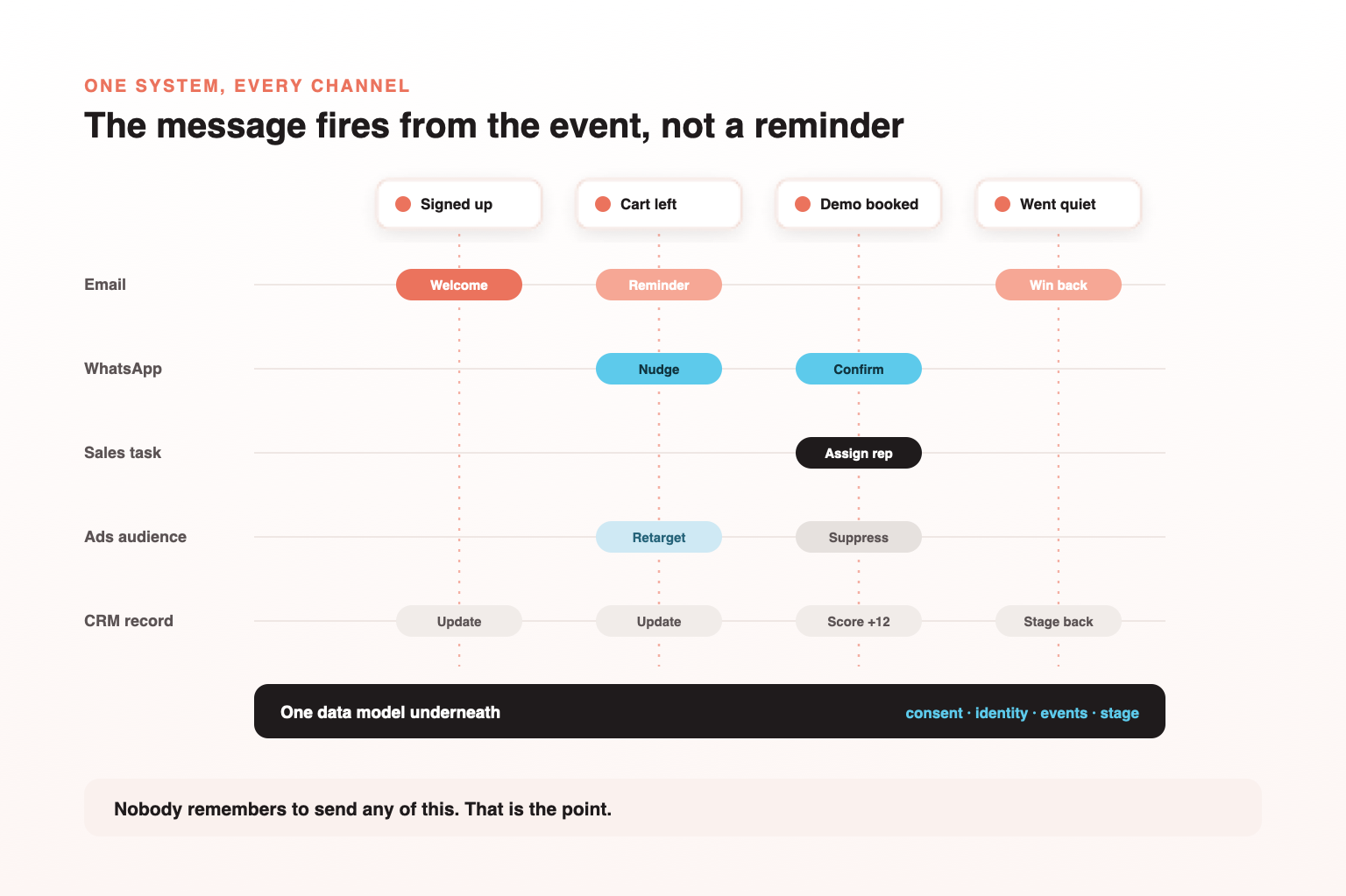
Marketing automation services that connect your platform, your data, and your customer journeys into one system, so the right message fires from a real event instead of somebody remembering to send it.

  • Platform agnostic recommendations
  • Data model built first
  • Journeys tied to real events
Marketing Automation Services
Measured on pipeline contribution
Bangalore based, global reach
14 hrs/wkmanual data entry eliminated by workflow integration (Envigaurd)
4 hoursinvoice generation, down from 2 days, triggered by stage change (Envigaurd)
4.2xemail-attributed GMV from lifecycle flows (Dunzo)
100%booking automation across the tenant platform (RentMyStay)

Our Clients

Brands that have worked with us

From global giants to fast growing startups, teams trust Unified Platforms with their growth.

getwidget logo
vemicaindia logo
myntra logo
designcafe logo
metro logo
sacredkosmetics logo
great-learning logo
google logo
dunzo logo
ikea logo

What Marketing Automation Services Covers

  • Platform audit and selection
  • Data model and event architecture
  • Lifecycle journey design
  • Lead scoring and routing
  • Systems integration
  • Data quality and database health
  • Reporting and attribution setup

Overview

Marketing Automation Services Built on the Layer Underneath

Most companies do not buy marketing automation because they lack ideas. They buy it because the work has outgrown the number of hours available to do it by hand, and because the handoffs between marketing, sales, and support have started dropping people. The platform arrives, a few welcome emails get built, and then the project stalls somewhere between the trial data and the real customer records. Licence renews, usage does not grow, and the tool becomes an expensive way to send newsletters.

The gap is almost never the software. It is the layer underneath: a data model that reflects how your business actually works, events that fire reliably from your product or storefront, definitions everyone agrees on, and journey logic that handles the awkward cases rather than only the happy path. Our marketing automation services concentrate on that layer. We treat the platform as plumbing to be engineered properly, not a canvas to decorate, because the decorating only works once the plumbing does.

Practically, that means auditing what you already own before recommending anything new, designing the lifecycle stages and scoring rules with the people who will act on them, building integrations so records stay consistent across systems, and instrumenting the whole thing so you can see which journeys contribute and which quietly do nothing. Channel execution stays with the channels: our email marketing services and WhatsApp work own what the messages say. Automation owns whether the right person receives them at the right moment with the right data attached.

Platform audit and selection. Choosing a platform before understanding the requirement is how companies end up paying enterprise licence fees for newsletter functionality. Selection work starts with your actual volumes, sales motion, integration needs, and the technical capacity of the team who will run it day to day. Where you already own a platform, the honest answer is usually to make it work rather than migrate, and we will say so. Where a migration genuinely is warranted, the case gets made with costs and timelines attached rather than vendor enthusiasm.

Data model and event architecture. Automation is only as reliable as the records it reads. This work defines the objects, fields, and relationships the platform needs, reconciles them with the sources of truth in your CRM and product, and specifies the events that trigger journeys. Duplicate handling, field validation, and consent flags are designed in rather than patched later. The output is documentation your team can maintain, because an architecture only one agency understands becomes a liability the moment the relationship ends.

Lifecycle journey design. Journeys get mapped against the stages your customers genuinely move through, not a generic funnel diagram. Onboarding, activation, nurture, expansion, renewal, and recovery each get entry criteria, exit conditions, suppression rules, and a defined owner. Edge cases receive as much attention as the main path, since the damage in automation comes from the customer who somehow lands in two journeys at once or keeps receiving a nurture sequence after they have already bought.

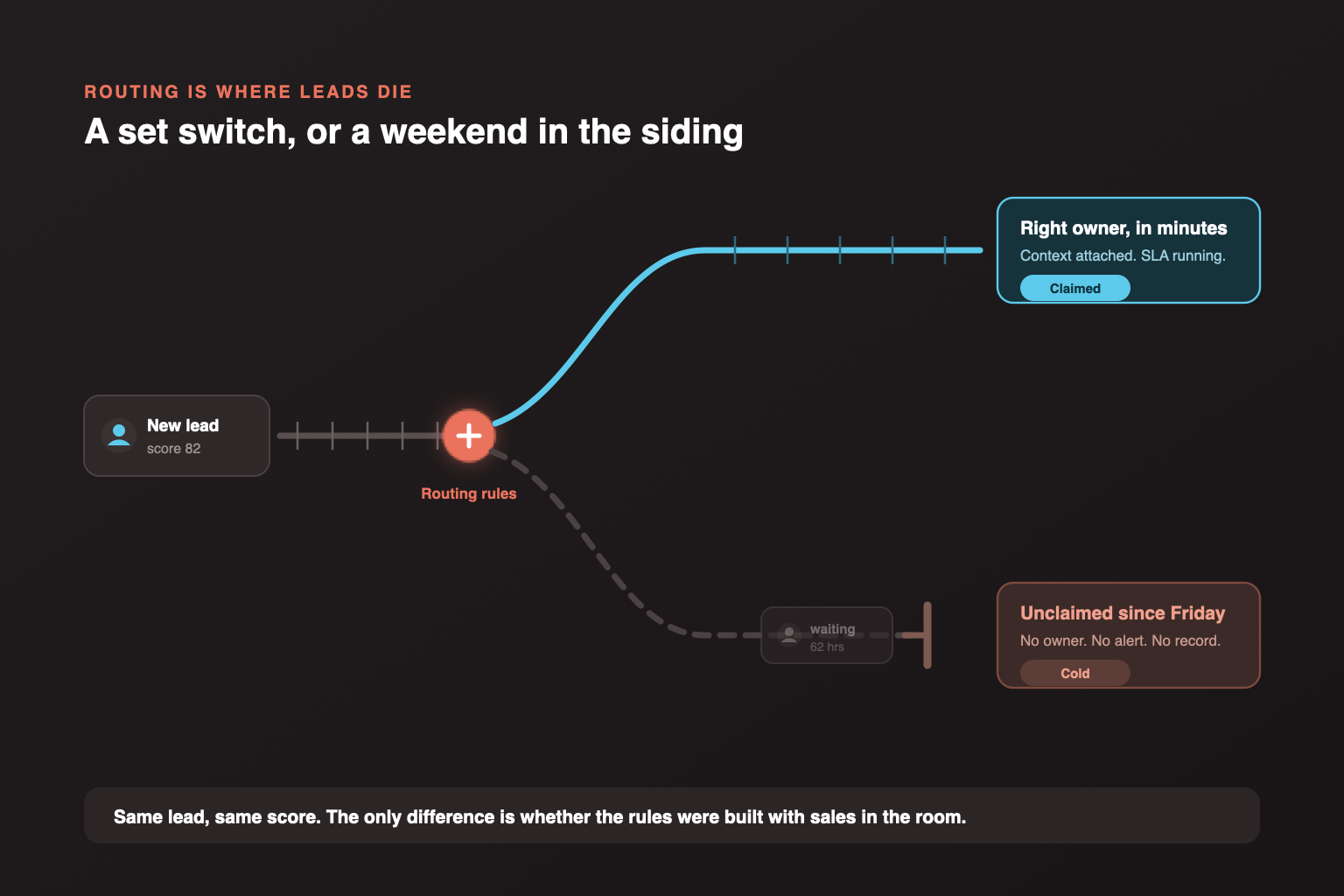
Lead scoring and routing. Scoring models translate behaviour and firmographic fit into a number sales will actually trust, which requires building them with sales rather than presenting them to sales. Thresholds, decay rules, and disqualification criteria are defined explicitly. Routing sends records to the right owner with context attached and service level expectations agreed, so a hot lead does not sit unclaimed over a weekend. Models get reviewed against closed won data, because a score nobody recalibrates drifts into fiction within two quarters.

Systems integration. The value shows up when the automation platform, CRM, product, storefront, support desk, and analytics all agree about who a customer is and what they did. Integration work spans HubSpot, Salesforce, Zoho, and the customer engagement platforms alongside Shopify, WooCommerce, and custom applications. Where a native connector exists and is adequate, we use it. Where it is not, our development team builds against the API directly, including the sync logic and error handling that off the shelf connectors typically leave out.

Data quality and database health. Automation applied to a poor database industrialises the damage, sending the wrong message to the wrong person faster than any human could. This work covers deduplication rules that run continuously rather than as a one off cleanup, validation on the fields journeys depend on, decay handling for contacts who have gone quiet, and suppression logic that holds across every channel at once. Database health gets reported alongside performance, since list size flatters a dashboard while engaged contacts pay the bills.

Reporting and attribution setup. Automation generates enormous amounts of activity data and comparatively little clarity unless reporting is designed deliberately. Dashboards get built around journey level contribution, stage conversion and velocity, list health, and pipeline influenced rather than emails delivered. Attribution is configured with its limitations stated plainly, because a model presented as more certain than it is will eventually be used to justify a bad decision. Reviews focus on which journeys to fix, expand, or switch off.
Routing Is Where Leads Die

The Difference

Routing Is Where Leads Die

The journey can be well written and the scoring model sound, and the programme still fails at the handoff. A lead arrives on Friday evening, the rule sends it to a queue nobody owns, and by Monday the buying moment has passed. Routing built with sales in the room, with context attached and a response time everyone agreed to, is unglamorous work that decides whether the rest of the system was worth building.

Book Free Strategy Call

Our Process

How We Implement Marketing Automation

A disciplined sequence, adapted to your competitive landscape. Open each step.

01Discovery and systems audit
Work begins with what you already have, which is usually more than anyone realises. Existing platforms, licences, integrations, journeys, lists, and reporting get inventoried, along with the manual processes people have built around the gaps. Interviews cover marketing, sales, and whoever handles support, because the handoffs between them are where automation either pays off or breaks. The output is a candid picture of what works, what is dormant, and what is quietly costing money without contributing anything.
02Requirements and platform decision
Requirements get written down before tools are discussed, covering volumes, journeys, integration needs, compliance obligations, and who will operate the system once it is live. That last point decides more projects than feature comparisons do. If your existing platform meets the requirement, the recommendation is to stay and configure it properly. If it does not, options are presented with total cost, migration effort, and the risks of moving stated openly rather than buried in an appendix.
03Data model and integration build
The foundation gets built before any journey is switched on. Objects, fields, and sync rules are configured, integrations connected, and historical data cleaned and migrated where required. Deduplication, validation, and consent handling are implemented here rather than retrofitted. Test records run through every integration path including the failure cases, because the integration that silently returns nothing is considerably more dangerous than the one that throws a visible error.
04Journey and scoring configuration
Lifecycle stages, journeys, scoring models, and routing rules get configured against the design agreed in discovery. Content and messaging are supplied by the channel teams and assembled into the flows with personalisation mapped to real fields. Suppression and frequency rules are applied across journeys rather than within each one separately, which is the only way to prevent a customer receiving four unrelated sequences in the same week.
05Testing and controlled launch
Everything runs against seed records and a limited live audience before full release. Testing covers journey logic, data flowing correctly in both directions, routing reaching the right owners, and reporting matching what the platform actually did. Launch is staged by journey rather than switched on at once, so a problem affects one flow instead of the entire programme. Rollback steps are documented before launch, not improvised during it.
06Enablement and handover
The team who will run the system get trained on it, with documentation covering the data model, the journeys, the naming conventions, and the reasoning behind the decisions. This step is where automation projects usually fail quietly, because a system nobody internally understands stops being maintained the moment priorities shift. Access, ownership, and admin rights sit with you throughout, so continuity never depends on our involvement continuing.
07Optimisation and expansion
Once the foundation is stable, work moves to improving what runs and adding what is missing. Journey performance is reviewed against contribution, underperforming flows are rebuilt or retired, scoring models are recalibrated against closed won data, and new journeys are added where the evidence supports them. Automation debt gets cleaned up deliberately, since every unused workflow and stale list makes the next change harder and slower to make safely.
08Ongoing governance
Systems drift. Fields get added ad hoc, journeys accumulate, definitions quietly diverge between teams, and consent records fall out of date. Governance covers regular audits of workflows and data quality, change control on the model, and a review cadence where the numbers are examined alongside what is being built next. The goal is a system that is still trustworthy in two years, which is a different objective from one that launches impressively.

Why Unified Platforms

Why Teams Bring Us In

The working habits behind every engagement.

Architecture before automation

Journeys built on a shaky data model fail in ways that are difficult to diagnose and embarrassing in front of customers. The data model, events, and integrations get built first, every time. That makes early progress look slower than agencies who demo a welcome series in week one, and it is the reason the programme is still working in month eighteen.

Platform agnostic advice

We hold no reseller margin that depends on recommending a particular platform, so the recommendation can be to keep what you have and configure it properly. That is frequently the honest answer and rarely the profitable one. Where a migration is genuinely justified, the case includes the disruption and cost rather than only the upside.

Engineers on the integration work

Most automation projects stall at the integration nobody could build, which is why so many end up running on manual list uploads. Our development team handles the connections that native connectors do not cover, including sync logic, error handling, and the awkward legacy systems that off the shelf tooling ignores. The same team builds the AI applications and web platforms behind our other work.

Built for your team to own

Documentation, naming conventions, training, and admin access sit with you from the start. Agencies that make themselves structurally difficult to replace produce systems that decay the moment the relationship ends, and we would rather be kept because the work is good. Everything we build is designed to be handed over cleanly, whether or not that ever happens.

Connected to channel execution

Automation only matters if the messages moving through it are worth receiving. Because we also run email, WhatsApp, paid, and content programmes, the journey design and the messaging get planned together rather than thrown over a wall. Where you run channels with other partners, we build to that boundary and document the interface clearly.

Honest about what automation cannot fix

Automation multiplies whatever process you already have, including a broken one. If the underlying problem is an unclear offer, a sales team without capacity, or a product that churns for reasons no email will address, we say so during discovery rather than after implementation. That conversation costs us projects occasionally and saves clients considerably more.

Industries

Industries We Work With

Category specific strategy, not one template applied to every business.

B2B software and SaaSProfessional servicesEducation and edtechFinancial services and insuranceHealthcare and diagnosticsDirect to consumer ecommerceManufacturing and industrialReal estateTravel and hospitalityLogistics and supply chainSubscription and membership businessesMarketplaces and platforms

Worth a Look at Your Stack?

Talk to a senior strategist about what your current stack could do properly before anyone suggests replacing it.

Book Free Strategy Call

Questions

Frequently Asked Questions

Straight answers before you ever get on a call.

Scope and approach

What do marketing automation services include?
The work covers auditing what you already run, selecting or confirming the platform, building the data model and integrations underneath it, designing lifecycle journeys and scoring, configuring routing into sales, and setting up reporting that shows contribution rather than activity. Ongoing engagements add optimisation, new journeys, governance, and recalibration as the business changes. Message content itself usually comes from the channel programmes, either ours or yours, with automation owning the orchestration around it.
Do we need to replace our current platform?
Usually not. Most underperforming automation setups are configuration and data problems wearing a platform costume, and the same tool works well once the model underneath it is sound. Migration gets recommended when there is a concrete blocker, such as a platform that genuinely cannot support your volume, integrate with a system you depend on, or meet a compliance requirement. When that is the case the recommendation comes with migration cost, timeline, and disruption stated up front.
How is this different from your email marketing services?
Email marketing owns what gets sent on that channel: the strategy, the copy, the deliverability, the testing. Marketing automation owns the layer beneath every channel, deciding who enters a journey, what data travels with them, when the trigger fires, where the record goes afterwards, and how it all reports. Smaller programmes running one channel often need only the email engagement. Automation becomes the right entry point once several channels, a CRM, and a sales team all have to stay in agreement.

Platforms and integration

Which platforms do you work with?
Commonly HubSpot, Salesforce and its marketing tools, Zoho, and the customer engagement platforms that suit consumer volumes, alongside the ecommerce native options for Shopify and WooCommerce businesses. The technical work is broadly transferable across them because the hard parts are the data model, the event design, and the integrations rather than the interface. If you run something outside that list, the audit establishes quickly whether it meets your requirement.
Can you integrate with our existing systems?
In most cases yes. Native connectors handle the common combinations and we use them where they are adequate. Where the connector does not expose the events or fields the journeys need, or where the system is bespoke or legacy, our development team builds the integration against the API directly and handles the sync logic and error paths. Identifying which category you fall into happens during discovery, because a plan built on an integration that never gets built quietly becomes manual list uploads.
What happens to our existing data?
It gets audited before anything moves. Duplicates, incomplete records, invalid addresses, stale contacts, and unclear consent status all get identified and a remediation approach agreed with you, since some of those decisions are commercial rather than technical. Migration runs to a staging environment first and gets validated before touching production. Historical data that cannot be cleaned reliably is quarantined rather than imported, because bad records in an automated system cause more damage than absent ones.

Timeline and cost

How long does implementation take?
A focused implementation on an existing platform with reasonable data typically runs six to ten weeks from discovery to first journeys live. Complex integrations, poor data quality, or a platform migration extend that considerably, sometimes to four or five months. Discovery is what makes the estimate real, so we scope that first and quote the build afterwards rather than guessing at both. Journeys go live progressively, so value starts before the full programme is finished.
What does it cost to run?
Three separate costs are worth separating. Platform licensing is paid to the vendor and scales with contacts or volume. Implementation is a project cost driven by integration complexity and data condition. Ongoing optimisation is a retainer scaled to how much is being built and maintained. Companies are most often caught out by licence costs escalating as the contact database grows, which is why database growth assumptions get modelled during selection rather than discovered at renewal.
When should we expect results?
Operational gains appear first, usually within weeks of the initial journeys going live, because work that consumed hours manually stops doing so. Lead quality and routing improvements follow as scoring gets calibrated against real outcomes, typically a quarter in. Revenue contribution takes longer to read honestly, particularly with long B2B sales cycles where a journey influencing a deal today may not show in closed won for months. Reporting is set up to distinguish those horizons rather than blur them.

When it goes wrong

Why do so many marketing automation projects underdeliver?
Three failure patterns account for most of it. The platform gets bought before the requirement is understood, so the tool is either far larger than needed or missing something essential. The data model is skipped in favour of building visible journeys quickly, and those journeys then break in ways nobody can trace. And nobody internally is given ownership, so the system stops being maintained the moment the champion changes role. All three are organisational rather than technical, which is why buying better software rarely fixes a stalled programme.
We bought a platform and barely use it. What now?
This is the most common situation we are called into, and it usually does not require starting again. The audit establishes what the platform can actually do against what you need, what the data underneath it looks like, and which of the existing journeys are worth keeping. Frequently the licence already covers everything required and the blocker is an integration that was never finished or a data model that was never designed. Recovering an underused platform is generally faster and considerably cheaper than migrating to a new one and repeating the same mistakes.
Our sales team ignores the leads automation sends them. Why?
Almost always because the scoring model was built without them and does not match what they experience on calls. A score that repeatedly marks unqualified leads as hot gets ignored within weeks, and once trust is lost it is difficult to rebuild. The fix is to rebuild the model with sales in the room, calibrate it against deals that actually closed rather than assumptions about intent, agree what disqualifies a lead as explicitly as what qualifies one, and recalibrate on a schedule. Routing speed and the context attached to each record matter as much as the score itself.

Measurement and governance

How do you measure whether automation is working?
Activity metrics like emails sent and workflows executed confirm the system is running and say nothing about whether it earns its cost. Reporting centres on journey level contribution, stage to stage conversion and velocity, routing response times against the agreed service level, database and list health, and pipeline influenced or created. Each journey is judged individually, because programmes almost always contain a small number of flows carrying the return and a long tail running quietly at no benefit. Those get retired rather than left in place.
How do you stop the system decaying over time?
Deliberate governance, because drift is the normal state of any automation platform. Fields get added ad hoc for one campaign and never removed, workflows accumulate until nobody is certain which are live, and definitions diverge quietly between marketing and sales. Governance means scheduled audits of active workflows and data quality, change control on the data model, naming conventions applied consistently, and a documented owner for each journey. It is unglamorous work and it is the difference between a system still trusted in year three and one everyone has started routing around.
How does automation handle consent and privacy obligations?
Consent status is treated as part of the data model rather than a setting inside one channel. Records capture what was consented to, when, and through which entry point, and that status propagates across every journey and system in scope. Withdrawal has to work immediately and everywhere, which is precisely the case that fragmented setups fail. India's data protection framework and, where you operate internationally, regimes such as GDPR shape how those fields are designed and retained. Getting this right at the model level is considerably cheaper than retrofitting it across a dozen live journeys later.

Working with us

Who owns the system afterwards?
You do, throughout. Licences sit in your name, admin access stays with your team, and documentation covering the data model, journeys, naming conventions, and decisions is maintained as part of the work rather than assembled at the end. Agencies sometimes structure automation engagements so the client cannot operate the system without them. That produces dependency rather than results, and it is the first thing worth checking with anyone you are evaluating, including us.
Can you work with our in-house marketing team?
That is the usual arrangement. Most engagements pair our technical and architectural work with an internal team who knows the customers and owns the messaging. We handle the build, the integrations, and the governance framework, then train your team to operate and extend it. Where internal capacity is thin, we run more of the day to day and hand over progressively. Either way the split of responsibilities gets agreed explicitly at the start.
What if our processes are not ready for automation?
Discovery will surface that, and we will tell you. Automating an undefined process produces a faster undefined process, and companies with unclear lifecycle definitions or no agreement between marketing and sales about what a qualified lead is should fix that first. Sometimes the useful engagement is a shorter piece of work defining those things, with implementation following once they are settled. Selling a full build into an organisation not ready for it serves nobody.

Start With What You Already Own

Good automation is unglamorous. It is a sound data model, events that fire when they should, journeys that handle the awkward cases, and reporting that tells the truth about what contributed. Tell us what you are running today and we will show you what it could do properly before anyone suggests replacing it.

Book Free Strategy Call
+91 95909 45916business@unifiedplatforms.comBangalore, India · serving clients globally
Worth a Look at Your Stack?
Scroll to Top