...

WhatsApp Marketing Services

Unified Platforms

WhatsApp Marketing Services

WhatsApp marketing services built on the official WhatsApp Business Platform, where every message goes to someone who opted in and every conversation is measured against revenue rather than delivery counts.

  • Official WhatsApp Business Platform
  • Opt-in and consent led
  • Template approval handled
WhatsApp Marketing Services
Measured against revenue
Bangalore based, global reach
2.4xhigher follow-up engagement from WhatsApp-integrated leads (METRO)
+60%client response rate via WhatsApp Business API notifications (Envigaurd)
8,400+qualified B2B registrations in 90 days on the programme (METRO)
40+years of collective marketing experience across channels

Our Clients

Brands that have worked with us

From global giants to fast growing startups, teams trust Unified Platforms with their growth.

simpliaxis logo
metro logo
great-learning logo
upgrad logo
bentotss logo
sacredkosmetics logo
dunzo logo
google logo
myntra logo
knowledgehut logo

What WhatsApp Marketing Services Covers

  • WhatsApp Business Platform setup and verification
  • Opt-in architecture and list building
  • Message template design and approval
  • Lifecycle flows and automation
  • Commerce and CRM integration
  • Measurement, quality and cost control

Overview

WhatsApp Marketing Services That Respect the Inbox

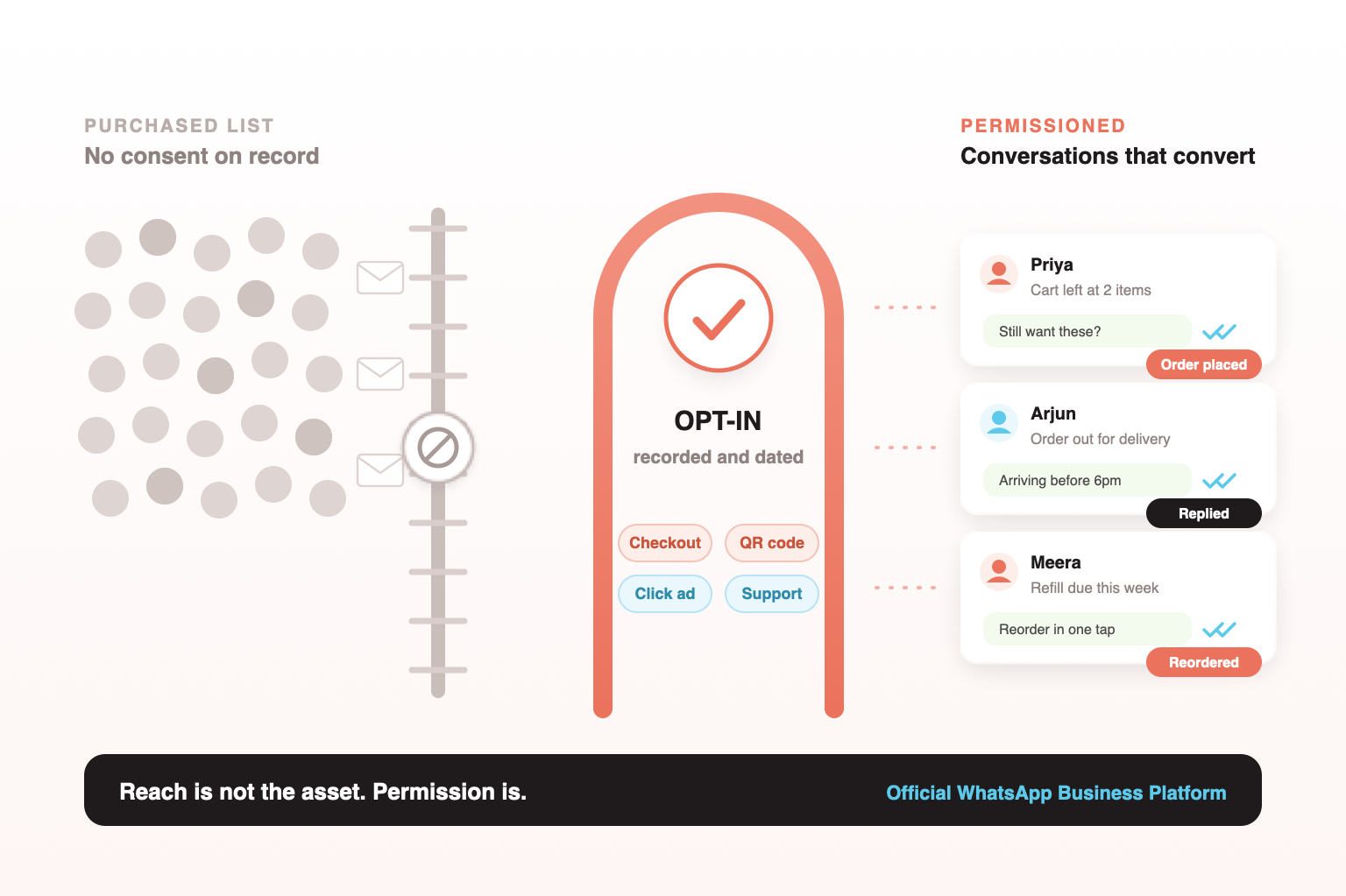
WhatsApp reaches more Indian phones than any other messaging surface, and that reach has attracted an entire industry of bulk sending tools promising to blast thousands of numbers for a flat monthly fee. Those tools run on unofficial connections that Meta actively bans, and the accounts built on them tend to disappear without warning, taking the audience with them. Our WhatsApp marketing services take the opposite route. Everything runs on the official WhatsApp Business Platform, through verified business accounts, message templates submitted for approval, and contact lists assembled from people who asked to hear from you.

That constraint is not a limitation to work around. It is the reason the channel performs. A message arriving in a thread alongside family and colleagues carries an implicit promise of relevance, and audiences punish brands that break it faster on WhatsApp than anywhere else. Opt-in discipline, sensible frequency, and genuinely useful content are what keep block rates low and quality ratings high, which in turn decides whether your messages are delivered at all. Compliance and performance point in the same direction here.

Programmes we run tend to look less like campaigns and more like plumbing. Order updates, delivery notifications, abandoned cart recovery, appointment reminders, payment nudges, and re-engagement sequences fire from your commerce or CRM data, in the customer's language, at moments where a reply is genuinely useful. Broadcast promotions have a place in the mix, though they are rarely where the revenue sits. Reporting ties conversation costs to orders and qualified leads, so the channel is judged on contribution rather than on how many messages left the building.

WhatsApp Business Platform setup and verification. Getting onto the official platform properly is the foundation everything else rests on. Setup covers Meta Business verification, phone number provisioning, display name approval, and connection through the Cloud API or a business solution provider suited to your volume and stack. Green tick application is prepared and submitted where your brand qualifies. Existing accounts get audited instead of replaced, because migrating a number that already holds conversation history and a healthy quality rating is usually better than starting cold. Sandbox testing runs before a single customer message goes out.

Opt-in architecture and list building. A WhatsApp list is only as durable as the permission behind it. Opt-in capture gets designed into the places customers already are: checkout, order confirmation, website widgets, click-to-WhatsApp ads, QR codes on packaging and in store, and IVR deflection from your support line. Each entry point records what was consented to and when, which matters both for compliance and for segmenting later. Preference and frequency controls are built in from the start, so subscribers can dial down rather than block, and the list stays healthy as it grows.

Message template design and approval. Templates are the vocabulary of the channel, and Meta reviews every one before it can send. Drafting covers utility, marketing, and authentication categories, written to pass review the first time and to read like a person rather than a system notification. Variables are mapped to your data so personalisation goes beyond a first name. Buttons, quick replies, and call to action links are specified where they shorten the path to a reply. Rejected templates get diagnosed and resubmitted, and an approved library is maintained as categories and policies shift.

Lifecycle flows and automation. Most of the value in this channel comes from triggered flows rather than broadcasts. Sequences get built for cart abandonment, order and delivery status, post purchase follow up, replenishment reminders, appointment confirmation, renewal prompts, and win back of lapsed customers. Each flow is wired to real events in your commerce platform or CRM, with timing, suppression rules, and exit conditions defined so a customer never receives contradictory messages from two flows at once. Handover to a human agent is built into any flow where a reply deserves one.

Commerce and CRM integration. WhatsApp earns its keep when it is connected to the systems that hold your customer and order data. Integration work spans Shopify, WooCommerce, and custom storefronts, alongside CRM platforms including Zoho, HubSpot, and Salesforce, plus the customer engagement stacks many brands already run. Catalogue and product messages let people browse and enquire without leaving the thread. Payment links and order status sync close the loop. Agent inboxes are configured so sales and support teams can pick up conversations with full context rather than asking customers to repeat themselves.

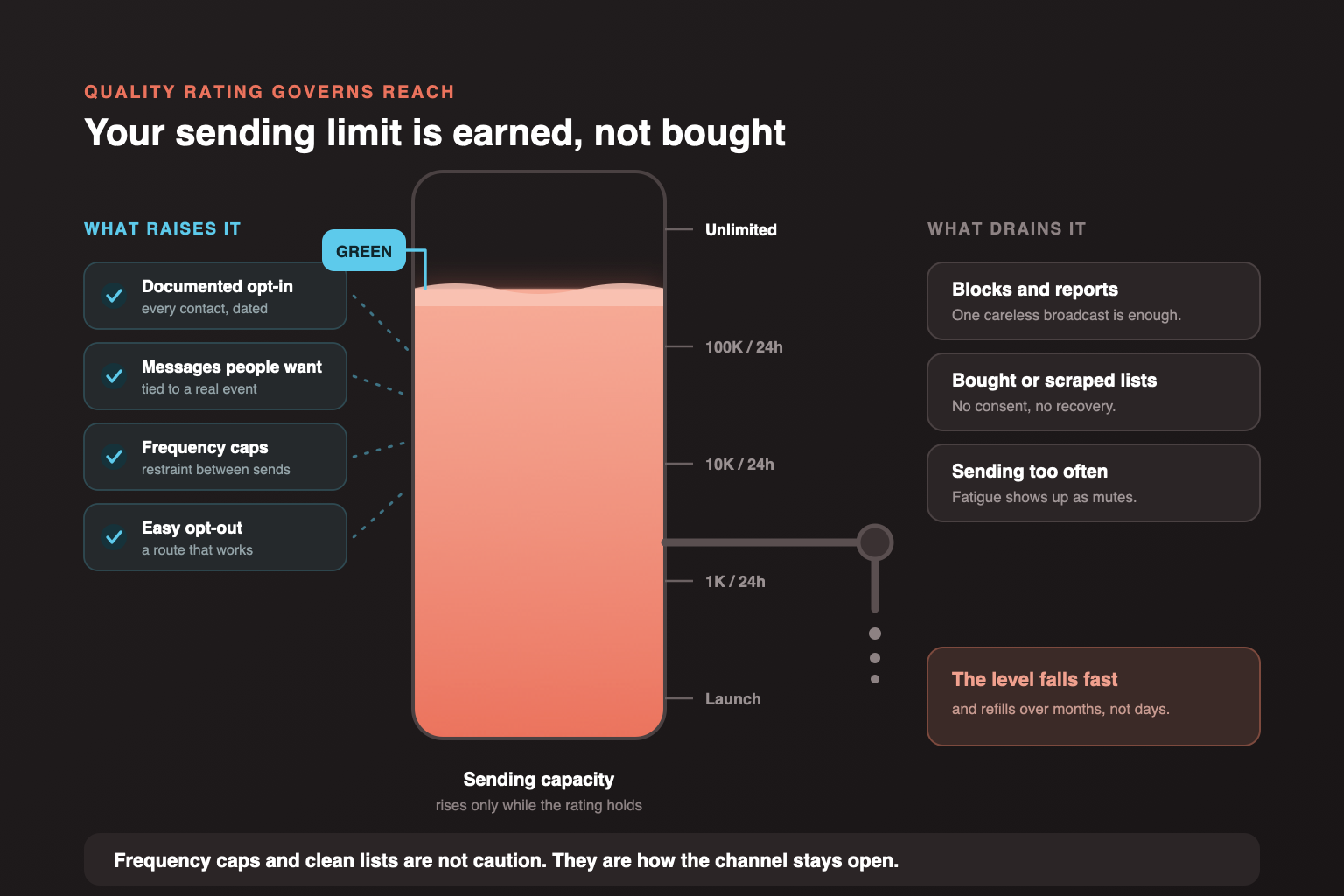
Measurement, quality and cost control. Conversation based pricing means every template category carries a different cost, and a programme that ignores this can quietly become expensive. Reporting tracks conversations initiated, cost per conversation, reply and read rates, block and report rates, quality rating by number, and revenue attributed to the channel. Frequency caps and audience suppression protect the quality rating that governs your sending limits. Where marketing conversations underperform, the fix is often moving the message into a utility template that costs less and gets read more.
The Channel That Punishes Shortcuts

The Difference

The Channel That Punishes Shortcuts

WhatsApp gives you a thread beside a customer's family and colleagues, and it withdraws that access the moment you abuse it. Sending limits rise with your quality rating and collapse with it, so the discipline that feels slow at launch is exactly what lets the programme scale later. Build on documented consent, send messages tied to something the customer is already waiting for, and the channel stays open and keeps compounding. Buy a list and blast it, and you lose the number along with the audience behind it.

Book Free Strategy Call

Our Process

How We Build a WhatsApp Programme

A disciplined sequence, adapted to your competitive landscape. Open each step.

01Channel audit and opportunity sizing
Work starts by looking at what already exists. Any current WhatsApp presence gets reviewed for account health, quality rating, template inventory, and whether unofficial tooling is in play that needs unwinding. Customer journey stages are mapped against moments where a message would genuinely help, and those moments are sized using your order volumes and support ticket patterns. Output is a ranked view of which flows to build first, with an honest estimate of conversation costs at your volume so budget conversations happen before build rather than after.
02Platform setup and compliance groundwork
Business verification, number provisioning, and display name approval are completed, with the Cloud API or a solution provider selected to match your volume, region, and existing stack. Consent records and data handling get reviewed against applicable privacy rules, including India's data protection framework where relevant. Escalation and opt-out handling are defined before launch, because a subscriber who wants out needs a route that works instantly. Documentation covers who owns the account, which matters more than it sounds when agency relationships change.
03Opt-in capture design
Entry points get built across the touchpoints your customers already pass through, with consent language written to be clear rather than buried. Checkout toggles, click-to-WhatsApp ad destinations, website widgets, packaging QR codes, and post purchase confirmations each get configured and tested. Capture is instrumented so you can see which sources produce subscribers who actually engage, since a large list assembled from a single weak source usually underperforms a smaller one built across several. Growth targets are set against engaged subscribers, not raw count.
04Template library and creative development
Templates are drafted across the categories your flows require, submitted for Meta review, and iterated until approved. Copy is written for the medium, which means shorter than email and more direct than a landing page, with the useful information in the first line because that is what shows in the notification. Media, buttons, and quick replies are specified where they reduce friction. Language variants are produced for the markets you serve, since regional language messages consistently outperform English in much of India.
05Flow build and integration
Automation gets built and connected to the systems holding your data, so triggers fire on real events rather than on manual uploads. Cart abandonment, order status, delivery updates, and reactivation sequences are configured with timing and suppression logic that prevents overlap. Agent handover rules route replies to the right team with conversation context attached. Everything is tested against seed numbers across devices and languages before any customer sees it, including the failure paths where an integration returns nothing.
06Controlled launch
Sending begins on a limited audience rather than the full list, which protects the quality rating that governs how much you can send later. Volume ramps as delivery, read, reply, and block rates confirm the programme is landing well. Early cohorts are watched closely for signals that copy or frequency need adjusting, and the ramp pauses rather than pushes through if quality dips. Meta rewards accounts that build sending reputation gradually, so patience in the first fortnight pays for months.
07Optimisation and expansion
Once baseline flows are stable, testing moves to the variables that shift outcomes: timing relative to the trigger event, template category and cost, copy angle, language, and the number of touches before a sequence exits. Underperforming flows get rebuilt or retired rather than left running. New journeys are added where data shows demand, and broadcast campaigns are layered in against segments that have earned the frequency. Cost per conversation is managed alongside revenue so scale does not erode margin.
08Reporting and review
Reporting arrives on a fixed cadence and covers what the channel contributed, not just what it sent. Conversations, costs by category, reply rates, quality rating, and attributed revenue are shown against the previous period with commentary on what changed and why. Review sessions cover what is being tested next and what is being stopped. Where the honest answer is that a flow is not working, that gets said plainly, because a retainer that only reports good news is not worth paying for.

Why Unified Platforms

Why Brands Choose Us for WhatsApp

The working habits behind every engagement.

Official platform only

Unofficial bulk senders are cheaper on day one and catastrophic on the day Meta bans the number. Everything we build runs on the official WhatsApp Business Platform, which means the account, the audience, and the conversation history belong to you and survive. That position costs us deals against blast tool vendors and we are comfortable with it.

Retention thinking, not campaign thinking

Messaging is treated as lifecycle infrastructure rather than a series of sends. Flows tied to real customer events compound over months without anyone touching them, whereas broadcasts need reinventing every week and wear the audience down. The same discipline underpins our email marketing services, and the two channels get planned together rather than competing for the same subscriber.

Built into your data

A messaging programme disconnected from your commerce and CRM data can only send the same thing to everyone. Integration is treated as core scope, not an add on, so triggers, personalisation, and suppression run off live records. Our development team handles the connections that off the shelf tools cannot, which is often what separates a working programme from a stalled one.

Compliance as a performance lever

Consent records, opt-out handling, frequency caps, and template discipline are treated as things that make the channel work rather than paperwork slowing it down. Quality rating directly governs sending limits, so protecting it protects reach. Brands that treat WhatsApp carelessly lose the channel, and recovering a damaged number is considerably harder than protecting a healthy one.

Honest cost modelling

Conversation based pricing catches many brands out, because a programme that looks cheap in a pilot can scale into a meaningful line item. Costs are modelled by template category at your projected volumes before build starts, and reporting keeps cost per conversation visible alongside revenue. Where a cheaper utility template will do the job of a marketing one, that swap gets made.

Proof you can check

Numbers on this page come from client programmes we ran, and the case studies behind them are published with the context attached. Nothing here is invented, rounded up, or borrowed from an industry benchmark report. Where a claim cannot be supported by work we actually did, it does not appear, which is a lower bar than most agencies set and a more useful one.

Industries

Industries We Work With

Category specific strategy, not one template applied to every business.

Direct to consumer ecommerceRetail and omnichannelHealthcare and diagnosticsEducation and edtechReal estateTravel and hospitalityFinancial services and lendingLogistics and deliveryAutomotive dealershipsBeauty and wellness servicesB2B wholesale and distributionSubscription and membership businesses

Worth a Conversation?

Talk to a senior strategist about whether WhatsApp fits your customer journey, and what it would realistically cost at your volumes.

Book Free Strategy Call

Questions

Frequently Asked Questions

Straight answers before you ever get on a call.

Getting started

What do WhatsApp marketing services actually include?
Scope covers getting you onto the official WhatsApp Business Platform, building the opt-in capture that grows a permissioned list, designing and getting approval for message templates, building automated lifecycle flows connected to your commerce or CRM data, and reporting that ties conversation costs to revenue. Most engagements also involve integration work, because the flows only perform when they fire off live order and customer records. Ongoing work covers testing, new journeys, template maintenance as Meta policy shifts, and protecting the account quality rating that governs how much you can send.
Is WhatsApp marketing legal in India?
Yes, when it runs on the official WhatsApp Business Platform with proper consent. Meta requires documented opt-in before you message someone, and templates must be approved before use. India's data protection framework adds obligations around how consent is recorded and how people withdraw it. What is not legal, or at minimum violates Meta's terms and gets numbers banned, is bulk sending through unofficial tools to purchased or scraped lists. That is the model most cheap bulk WhatsApp services sell. We do not build on it, and we would advise unwinding it if you currently are.
How long before the channel produces results?
Platform setup and verification typically take one to three weeks depending on how quickly Meta processes business verification and display name approval. Template approval adds days rather than weeks once drafts are right. First flows usually go live in weeks four to six, and because they fire on transactional triggers they start contributing almost immediately rather than needing an audience to build. List growth is the slower variable, since opt-in capture compounds over months. Programmes generally reach a stable, meaningful contribution somewhere around the three to four month mark.

Cost and pricing

What does WhatsApp marketing cost?
Two costs sit side by side. Meta charges per conversation, priced by category and country, with marketing conversations costing more than utility ones and authentication cheaper still. That is a direct pass through and scales with volume. Separately there is the work of building and running the programme, which is a retainer scaled to how many flows are live and how much testing and integration is involved. Before any build starts we model conversation costs at your projected volumes, because the platform cost often surprises brands more than the agency fee does.
Why is WhatsApp more expensive than SMS per message?
Per unit it often is, and comparing them that way misses the point. WhatsApp delivers rich media, buttons, two way conversation, and read receipts, and it lands in a thread people actually open rather than one they have trained themselves to ignore. Reply rates and read rates run far ahead of SMS in most categories, so cost per outcome frequently lands lower even when cost per message is higher. Utility templates for order and delivery updates are also cheaper than marketing ones, which is where a lot of transactional SMS volume can profitably move.
Can we reduce conversation costs?
Usually, yes, and it is a standard part of optimisation. The largest lever is template category, since a message framed as a genuine utility update costs less than a marketing conversation and typically gets better engagement anyway. Beyond that, tightening audience selection so messages go to people likely to act, capping frequency, suppressing recent recipients, and consolidating several planned touches into one well built flow all reduce spend. Free entry point conversations, where the customer messages you first, are worth designing for deliberately since they carry no charge for a window.

How it works in practice

Do you send bulk WhatsApp messages or blasts?
No. Bulk blasting to unsegmented or purchased lists is what gets business numbers banned, and it is the single fastest way to lose the channel permanently. Broadcasts do have a role, sent to segments that opted in and at a frequency they tolerate, and we build those where they make sense. The bulk of results though comes from triggered flows firing on individual customer events, which is a different mechanism entirely. If bulk sending volume is what you are shopping for, the tool vendors selling it are a better fit than we are.
What happens when a customer replies?
Replies are the point, so handling them is designed rather than left to chance. Flows are built with quick reply options that resolve common questions automatically, and clear handover rules that route anything else to a human with the full conversation context attached. Agent inboxes get configured for your sales and support teams, including routing by topic, language, or region where that matters. Response time targets are agreed up front, because a customer who replies and hears nothing for a day is worse off than one who was never messaged.
Can WhatsApp connect to our existing systems?
In almost all cases, yes. Standard integrations exist for Shopify, WooCommerce, and the major CRM and customer engagement platforms, and those cover a lot of ground without custom work. Where your stack is bespoke or the off the shelf connector does not expose the events your flows need, our development team builds the integration directly against the API. Deciding that early matters, because a programme designed around integrations that were never built ends up as manual list uploads, which is where most stalled WhatsApp projects end up.

Measurement and results

How do you measure WhatsApp marketing performance?
Delivery and read counts are the vanity layer, useful for diagnosing problems and useless for judging value. Reporting centres on conversations initiated by category, cost per conversation, reply rate, and revenue or qualified leads attributed to the channel, tracked against the previous period. Account health sits alongside those numbers, since quality rating and block rate predict whether the programme still works next quarter. Flow level reporting shows which sequences carry the contribution, which matters because in most accounts a small number of triggered journeys produce the majority of the return.
What reply and read rates are realistic?
Read rates on WhatsApp run high across almost every category, frequently well above what the same audience gives email, which is precisely why the channel gets oversold. Reply rates vary enormously by message type. A relevant order or delivery update tied to something the customer is actively waiting for generates far more engagement than a promotional broadcast to a general segment. Rather than quoting benchmark figures that mean little outside their original context, we establish your baseline during the controlled launch and set targets against it.
Can WhatsApp revenue be attributed properly?
Reasonably well, with the usual caveats that apply to any channel where the purchase can happen somewhere else. Links carry tracking parameters, click to WhatsApp entry points are tagged, and where the flow is transactional the order identifier ties the conversation directly to the order. Attribution gets harder for broadcast messages that prompt a purchase days later through another route, and holdout groups are the honest tool for measuring that. Reporting distinguishes between directly tracked revenue and modelled contribution rather than presenting one as the other.

Working with us

Who owns the WhatsApp Business account?
You do. Business verification is completed under your Meta Business account, the number is yours, and the subscriber list and conversation history stay with you if the relationship ends. Access is granted to us as a partner rather than the other way round. This sounds obvious and frequently is not how these arrangements are structured, particularly with vendors who provision numbers under their own accounts. Anyone currently running your programme should be able to answer this question clearly, and if they cannot, that is worth investigating.
Do you work alongside our existing email and SMS programmes?
Yes, and planning them together produces better results than running them separately. Channels compete for the same attention, so suppression logic across them prevents a customer receiving the same prompt three ways in one afternoon. Typically the split settles with WhatsApp carrying time sensitive and transactional communication where reply rates matter, email doing the longer form and higher volume work, and SMS reserved for genuine urgency. Where you already run email with another partner, we work to that boundary rather than around it.
What if WhatsApp turns out not to suit our business?
That answer comes out of the audit rather than after six months of retainer. Some businesses lack the transactional event frequency to justify the channel, and others have audiences that simply do not want brand contact in that space. Where the sizing work suggests the economics do not hold at your volumes, we say so and point you at whichever channel the same budget would serve better. A programme sold into a business it does not fit produces a short engagement and no reference, which serves nobody.

Start With the Journey, Not the Blast

WhatsApp works when the people receiving your messages asked for them and the messages turn out to be useful. Everything else about the channel, from template approval to conversation pricing, follows from that. Tell us about your customer journey and we will map where messaging genuinely helps and what it would cost to run properly.

Book Free Strategy Call
+91 95909 45916business@unifiedplatforms.comBangalore, India · serving clients globally
Worth a Conversation?
Scroll to Top