 Skip to content
Unified Platforms
Search Experience Optimization (SXO) Services
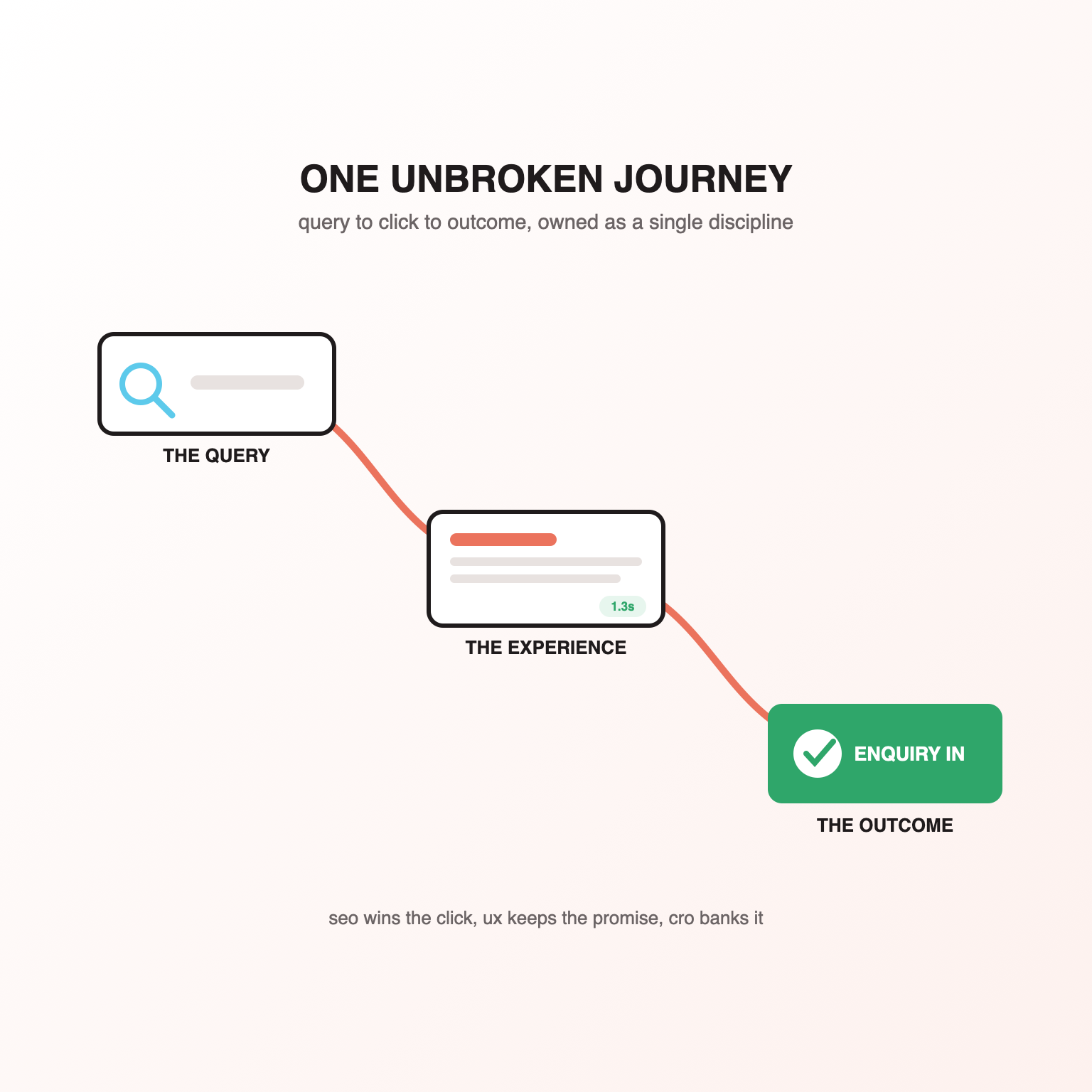
Unified Platforms offers search experience optimization services for brands that have learned the hard lesson: rankings are only half the trade. SXO unifies SEO, user experience, and conversion into one discipline, winning the click, honouring the intent behind it, and walking the visitor to the outcome, so search traffic stops being a vanity metric and starts being a revenue system.
- SEO, UX, and CRO as one discipline
- Intent honoured from query to outcome
- Ranked pages that actually convert
Our Clients
Brands that have worked with us
From global giants to fast growing startups, teams trust Unified Platforms with their growth.










What Search Experience Optimization (SXO) Services Covers
- Intent research and journey mapping
- Content that deserves the click
- Core Web Vitals and performance engineering
- Landing experience and message match
- Conversion paths and friction removal
- Unified measurement
Overview
Search Experience Optimization Across the Whole Journey
Search experience optimization exists because two teams have been optimising halves of the same journey without talking. The SEO team wins rankings and celebrates traffic; the UX team polishes flows for whoever arrives; and between them the actual journey, a person with a question clicking a result and deciding within seconds whether this page deserves their trust, falls through the gap. SXO closes it: one discipline responsible for the whole arc from query to outcome, measured on what the business banks rather than what the rank tracker shows.
The search engines themselves forced this merger. Google's systems increasingly judge pages the way users do, speed, stability, clarity, satisfied intent, and a ranking won by a page that visitors bounce from is a ranking on borrowed time. Core Web Vitals made experience a measurable input; AI-era search made satisfying intent the whole game, because an engine deciding which page to cite reads for usefulness, not keyword density. The brands compounding in organic now are the ones treating experience as a ranking asset and rankings as an experience promise.
Our search experience optimization services run the full arc. On the search side: intent research that maps what each query actually wants, content built to deserve the click, and the technical health that keeps pages fast and crawlable. On the experience side: landing paths that pay off the promise the snippet made, Core Web Vitals treated as conversion features, and layouts that answer first and elaborate second. On the outcome side: conversion paths, measurement, and the testing discipline of our CRO practice, because the point of the visit is what happens at the end of it.
This is not a bundle of three retainers wearing one invoice. The leverage of SXO is in the joints: the intent research that briefs the content also briefs the layout; the page speed work that lifts rankings also lifts conversion; the copy that earns the snippet also frames the offer. Run separately, these disciplines duplicate research and occasionally undo each other; run as one, every improvement pays twice. Our SEO, CRO, and development practices already sit in one room, which is why we can sell the joined-up version honestly.
A worked example makes the discipline concrete. Take a manufacturer ranking third for its category's comparison query. The SEO-only reading says push for position one; the SXO reading starts earlier: the query says the buyer is comparing, so the page must compare honestly, and it must do it within two seconds on a mid-range phone, above an enquiry path that asks for a conversation rather than a commitment. Fix those and two things happen: the existing traffic converts at a multiple, and the engagement signals strengthen the very ranking you wanted pushed. The position chart eventually moves, but the revenue moved first, which is the correct order to want things in.
The results band shows what the joined-up version produces: a manufacturer's site rebuilt to load in 1.3 seconds on mobile, hold bounce to 37 percent, and convert demo requests at 3.2 times the old rate, the same traffic, a transformed outcome. That is the SXO thesis in one engagement: the ranking was never the asset; the experience behind it was, and improving it multiplied everything the rankings were already delivering.
Intent research and journey mapping. Every query is a task in disguise, and SXO starts by naming it: what the searcher wants to know, compare, or do, what they need to see to trust the answer, and what a satisfied end of the journey looks like. We map priority queries to intent, intent to page experience, and experience to outcome, so every later decision, content, layout, speed, CTA, serves a journey rather than a keyword.
Content that deserves the click. Pages get built to pay off the promise the search result makes: direct answers up front, evidence where doubt peaks, structure that lets scanners and readers both succeed, and the citation-ready clarity that AI-era search rewards. The same editorial gates as our content practice apply, because a page that satisfies intent completely is simultaneously the best SEO, the best UX, and the best sales asset a query can have.
Core Web Vitals and performance engineering. Speed is the first experience every visitor has, and it is measurable to the millisecond: LCP, INP, CLS, tuned properly on real devices and real connections. We profile, fix, and verify, images, scripts, fonts, rendering paths, hosting behaviour, and we treat the results as conversion features with ranking side effects. The 1.3 second mobile LCP in our results band was engineered, not inherited.
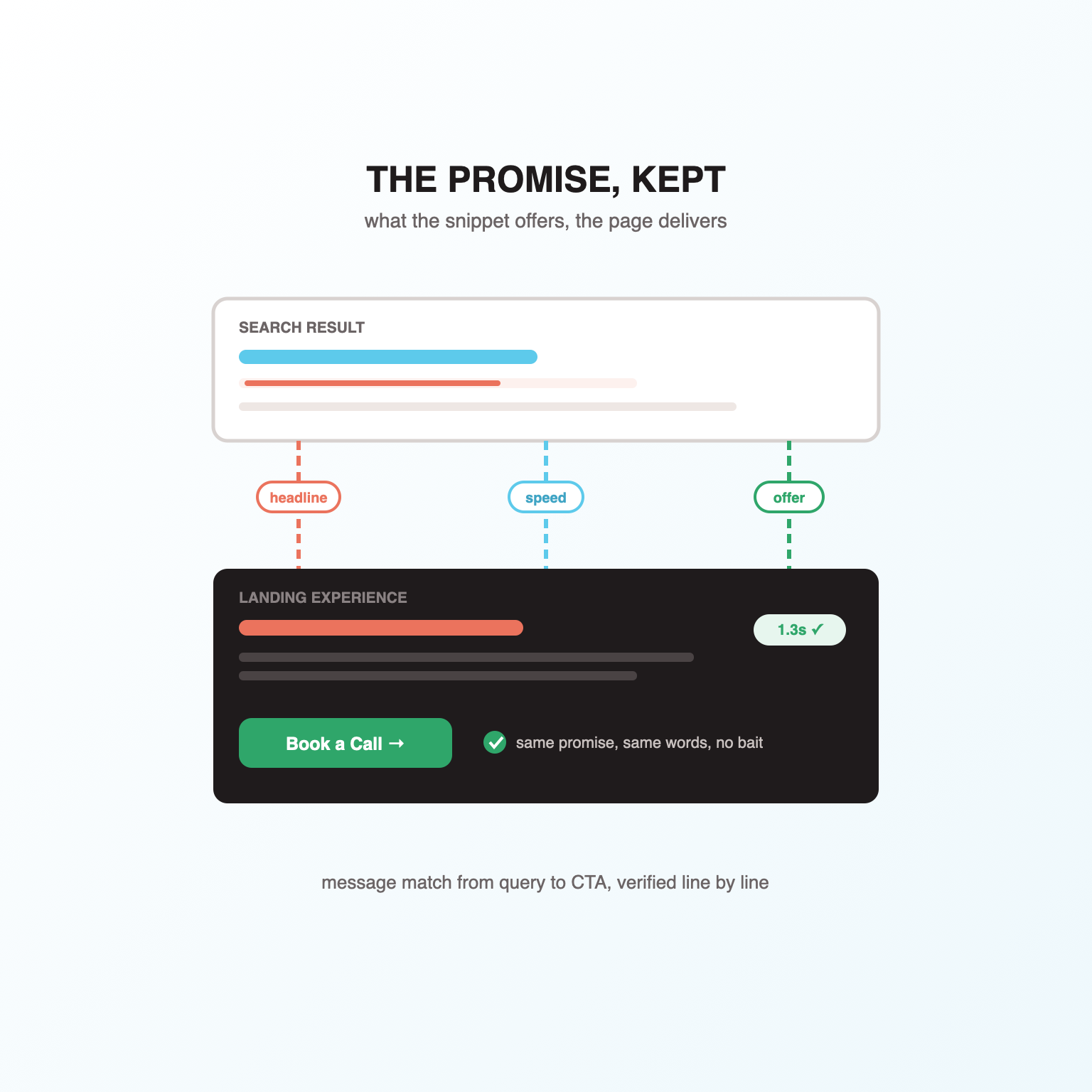
Landing experience and message match. The seconds after the click decide everything, so we design them deliberately: headlines that confirm the visitor landed right, layouts that answer before they ask for anything, proof placed at the moment of scepticism, and navigation that serves the journey instead of the sitemap. Message match runs from query to snippet to page to CTA, one promise, kept the whole way down.
Conversion paths and friction removal. SXO finishes the job the ranking started: forms trimmed to what the motion needs, CTAs that ask at the right moment with the right level of commitment, mobile flows built for thumbs and interruptions, and the diagnostic toolkit of our CRO practice, recordings, funnels, surveys, testing, aimed at organic visitors specifically, because they arrive with different intent than paid traffic and deserve paths designed for it. An organic visitor mid-research needs a lighter ask than a retargeted one ready to buy, and the paths should know the difference.
Unified measurement. One scoreboard for the whole arc: rankings and clicks, engagement and vitals, conversions and revenue per organic session, read together so trade-offs become visible. A change that lifts rankings but taxes conversion gets caught; a page that converts but repels crawlers gets fixed; and reporting speaks in outcomes leadership recognises, because search experience optimization answers to the P&L, not to a position chart.
The Difference
Rankings Make Promises. Experiences Keep Them
A position on a results page is an offer: click here and your question ends well. Sites that break that offer bleed twice, visitors leave, and engines notice they leave. Sites that keep it compound twice, visitors convert, and engines reward the satisfaction. SXO is the discipline of keeping the offer at every step, and it turns the same traffic you already earn into meaningfully more business.
Book a Strategy CallOur Process
How We Run an SXO Engagement
A disciplined sequence, adapted to your competitive landscape. Open each step.
01Journey audit
02Intent and experience mapping
03Performance foundation
04Page experience rebuilds
05Convert and iterate
Why Unified Platforms
Why Teams Choose Us for SXO
The working habits behind every engagement.
The three crafts, genuinely in one room
Most agencies sell SXO as a bundle of departments that meet at the invoice. Our SEO, CRO, and development teams share briefs, reviews, and a scoreboard, the SEO cluster on this site, the CRO practice, and the performance engineering are the same people who would work on yours. The joined-up discipline is the product, not the pitch.
Proof the arc works end to end
A 1.3 second mobile LCP, 37 percent bounce, and 3.2x demo conversion on one engagement, plus the organic programmes measured in tens of millions of visits and the conversion lifts in our CRO results: we can show every stage of the SXO arc working on real clients, and walk you through how each number was earned, including the parts that took two attempts.
Built for AI-era search
The same clarity that satisfies a human visitor is what AI search systems select and cite, which means SXO pages are natively ready for the answer layer. We run GEO and AI search optimization as sister practices, and the experience work feeds them directly: one investment that compounds across classic rankings, AI citations, and conversion at once.
Evidence over aesthetics
Every experience change traces to something observable, a recording, a vitals report, a funnel segment, a test result, and ships with measurement around it. Redesign taste is cheap and frequently wrong; diagnosed friction is specific and fixable. Our recommendations arrive with the evidence attached, so your team can challenge them, and occasionally does, productively.
Rankings protected while experience changes
The fear that keeps teams from touching ranking pages is legitimate, which is why every structural change here passes SEO review before it ships and gets watched after: redirects, headings, internal links, crawl behaviour. We have rebuilt money pages for years without losing their rankings, and the discipline that makes that possible is baked into the process rather than bolted on.
One scoreboard, honest trade-offs
When search and experience report separately, each team optimises its own number and the business absorbs the conflicts. Our unified measurement makes trade-offs explicit and decides them by revenue per organic session, which occasionally means telling you a ranking is not worth defending or a conversion pattern is taxing visibility. That honesty is the entire value of running the arc as one discipline.
Industries
Industries We Work With
Category specific strategy, not one template applied to every business.
Get a Free Journey Scorecard
Send us three queries you rank for and care about, and we will send back a journey scorecard: what the searcher wants, what your page promises, how fast it delivers, where visitors leak, and what one joined-up fix would be worth. It is the fastest way to see your search presence the way SXO sees it, as journeys with outcomes, not positions on a chart, and the scorecard is yours either way. Teams usually recognise the biggest gap the moment they see their own journey laid out end to end; the scorecard just makes it impossible to unsee.
Book a Strategy CallQuestions
Frequently Asked Questions
Straight answers before you ever get on a call.
SXO Basics
What is search experience optimization?
How is SXO different from doing SEO and CRO separately?
Is SXO worth it if our rankings are already strong?
Method
What does intent mapping actually involve?
How much do Core Web Vitals really matter?
Do you redesign pages or work within our existing design system?
Working With Us
Which pages should an SXO programme start with?
What does an SXO engagement look like?
We already have an SEO agency. Can SXO run alongside them?
How long until SXO shows results?
Situations
Is SXO relevant for ecommerce category and product pages?
We are about to redesign our website. Should SXO come before or after?
Does SXO help with AI Overviews and zero-click results?
Can SXO fix a site whose traffic grew but leads flatlined?
Measurement
How do you measure SXO success?
Will experience changes put our existing rankings at risk?
Can you prove the conversion lifts came from SXO and not something else?
Keep the Whole Promise Your Rankings Make
The economics of organic search are tightening from both ends: clicks cost more effort to win as answer engines absorb the easy queries, which makes every visit that still arrives worth more than it was last year. Teams that respond by chasing more traffic are running up a down escalator; teams that respond by converting harder are compounding. Every ranking you hold is a promise to a searcher, and every visit is the moment the promise is kept or broken. Search experience optimization is simply the decision to take responsibility for the whole promise, the query, the click, the seconds after, and the outcome, instead of optimising fragments and hoping they add up. Book a free strategy call, bring three queries you care about, and we will show you the journeys your searchers are actually having, and what keeping the whole promise would be worth.
Book a Strategy Call